2090 Activity-dep dev (11)
 Call Kai
 Learn
Learn Practice Test
 Spaced Repetition
 Match
Match Flashcards
 Knowt Play
1/12

There's no tags or description
Looks like no tags are added yet.
Name | Mastery | Learn | Test | Matching | Spaced | Call with Kai |
|---|
No analytics yet
Send a link to your students to track their progress
13 Terms
Proximity-seeking (emotional refueling) when locomoting
Emotional Refueling
Each movement an infant makes helps train their visual system and allows them to explore their environment with greater independence.
As infants begin moving farther from their caregiver, they also learn the social meaning of distance.
Crawling away can create anxiety, so infants often return to their caregiver for reassurance, a behavior known as “emotional refueling.”
By checking back in, infants regulate their emotions before going out to explore again. This process shows how motor development and social-perceptual development are connected.
Integrating social information with locomotor experience when negotiating risky slopes (experiment) (Tamis-LeMonda & Adolph)
Hypothesis
If infants know they can safely go down a slope (shallow slope), they will go down regardless of whether their mother encourages or discourages them.
If infants know the slope is too steep, they will not attempt it, regardless of the mother’s cues.
If the slope is uncertain (moderately steep), infants will look to their mother’s social cues and follow her encouragement or discouragement.
Method / Procedure
Infants were first tested on slopes without social cues to determine which slopes they could safely descend.
Then infants were tested again on three types of slopes:
Safe (shallow)
Impossible (very steep)
Uncertain (moderate risk)
Mothers either encouraged or discouraged the infant from descending.
Results
Infants always descended shallow slopes and refused extremely steep slopes, regardless of the mother’s message.
On uncertain slopes, infants looked to their mothers and followed their encouragement or discouragement.
Experienced crawlers/walkers used social cues appropriately, while novice movers did not.
Conclusion
Infants integrate their own locomotor experience with social information when making decisions about risk. Locomotor experience helps infants understand social affordances and when to rely on caregiver cues.
Development of the Object Concept (Piaget)
Jean Piaget proposed that object permanence (the object concept) develops during infancy and reflects a child’s ability to understand that objects continue to exist even when they cannot be seen. According to Piaget, infants learn about the world by acting on their environment and detecting patterns or regularities.
Piaget argued that true object permanence emerges around 8 months of age, and its development corresponds with the six sensorimotor substages of infancy.
Six sensorimotor substages of infancy
1. Reflex Schemas (0–1.5 months)
Behavior is dominated by reflexes (e.g., sucking, grasping).
Infants do not search for hidden objects.
2. Primary Circular Reactions (1.5–4 months)
Infants repeat actions involving their own bodies.
If an object disappears, they may orient toward where it vanished, but do not actively search.
3. Secondary Circular Reactions (4–8 months)
Infants repeat actions involving external objects.
They search for partially hidden objects, but stop searching if the object is completely hidden.
4. Coordination of Secondary Circular Reactions (8–12 months)
Beginning of object permanence.
Infants search for completely hidden objects, but only in the original hiding location (this is related to the A-not-B error).
5. Tertiary Circular Reactions (12–18 months)
Infants experiment with new behaviors.
They search for an object if they see it moved, but not if it is moved secretly.
6. Beginnings of Symbolic Representation (18–24 months)
Infants develop mental representations.
They search for objects in multiple locations, even if the movement occurred out of sight.
Key Idea
Piaget believed that searching for a hidden object requires mental representation—a cognitive ability that allows infants to represent objects in their minds even when those objects are absent.
Development of the Object Concept: Thelen
Esther Thelen proposed an alternative explanation to Jean Piaget for how infants develop the object concept (object permanence).
Instead of believing that object permanence suddenly appears when a specific mental representation “switches on,” Thelen argued that knowledge of hidden objects develops gradually through changes in motor abilities, perception, and experience interacting with objects.
Her dynamic systems theory suggests that cognitive abilities emerge from the interaction of multiple systems, including:
Motor development (reaching and movement)
Memory
Attention
Experience interacting with objects
Environmental context
According to Thelen, the ability to search for a hidden object is partly built from movement and motor habits, especially during the first year of life. For example, performance on the A-not-B task is influenced not only by memory but also by the infant’s previous reaching patterns and motor control.
Research supporting Thelen’s theory demonstrated that signs of object knowledge can appear as early as 3 months, much earlier than Piaget’s proposed timeline. These findings challenge Piaget’s claim that object permanence emerges around 8 months and suggest that the development of the object concept is more gradual and distributed across multiple systems rather than appearing suddenly.
Development of Memory
Memory is a key component of cognitive development and undergoes significant change during infancy.
One important phenomenon is infantile amnesia, which refers to the fact that adults cannot remember experiences from the first few years of life (typically before age 3).
Infantile amnesia occurs because the memory system is still developing during infancy, and early memories are not stored or organized in ways that allow them to be retrieved later in adulthood.
During the first year of life, infants’ memory abilities improve significantly. One important change involves the retention interval, which is the length of time information can be remembered.
Younger infants have short retention intervals and forget information quickly.
As infants grow, their retention intervals increase, allowing them to remember experiences for longer periods.
Thus, the development of memory during infancy involves gradual improvements in how information is encoded, stored, and retained, which supports broader cognitive development.
Development of Memory: Mobile Task / Experiment
The mobile task is a classic experiment used to study memory in infants, particularly how long infants can remember an action they previously learned.
The Basic Setup
Researchers place an infant lying on their back in a crib. A ribbon is tied from the infant’s leg to a mobile hanging above them.
When the infant kicks their leg, the ribbon pulls the mobile and makes it move.
Infants quickly learn the relationship: kicking → mobile moves
Because the movement is interesting, infants begin kicking more frequently.
The Testing Phase
In later trials, the ribbon is no longer connected to the mobile. Instead, it is attached to the crib, so kicking does not move the mobile anymore.
The key logic is:
If the infant remembers the earlier experience, they will kick a lot, expecting the mobile to move.
If the infant does not remember, their kicking will return to normal levels
Findings About Infant Memory
Researchers found that infants do remember, but their memory is very fragile early in life.
2-month-olds:
Show memory immediately after learning.
However, they forget within minutes or a very short time, showing very short retention intervals.
3-month-olds:
Can remember the kicking-mobile relationship for up to about a week.
These results show that memory capacity increases rapidly during infancy.
Context-Specific Memory
Another important discovery is that early memories are highly dependent on context.
For example, if an infant learned that kicking moves the mobile when
The mobile has certain objects, or the mobile is a specific color
Then changing those features (new shapes or colors) can cause the infant not to remember to kick.
This means early memory is tied to the exact situation in which it was learned.
Developmental Change
As the memory system matures, memories become
longer lasting (longer retention intervals)
less context dependent
more generalized across situations
Development of Memory: Train Task / Experiment
As infants grow older, the mobile task becomes less effective for studying memory. By around 6 months, infants develop greater motor abilities—they can sit up, grab objects, or interact with the mobile in multiple ways. Because they can solve the problem in many ways, the mobile task is no longer a precise measure of memory.
To study memory in older infants (6–18 months), researchers developed the train task.
The Setup
In this experiment, infants sit in front of a toy train setup. In front of them is a large bar they can press or bang. When the infant hits the bar, it activates the train and makes it move along the track.
A plexiglass barrier is placed in front of the train so the infant cannot grab the train directly. This ensures that the only way to make the train move is by banging the bar.
Logic of the Experiment
The procedure works similarly to the mobile task:
Infants learn that hitting the bar makes the train move.
Later, researchers test whether infants remember this relationship.
If infants remember, they will hit the bar more frequently, expecting the train to move.
Findings: Increasing Retention Intervals
The train task revealed that memory duration increases dramatically across infancy.
Approximate retention intervals:
6 months: remember for about 2 weeks
9 months: remember for about 5.5 weeks
10 months: remember for about 7 weeks
15 months: remember for about 10 weeks
18 months: remember for about 13 weeks
What This Shows
These findings demonstrate that:
Infant memory improves steadily with age
Retention intervals grow longer over time
Cognitive development involves gradual strengthening of memory systems
Challenges to Jean Piaget (competence vs. performance distinction)
Piaget argued that infants’ abilities reflect their true competence, and errors show a lack of knowledge
He distinguished:
Competence = what a child knows
Performance = how a child demonstrates that knowledge
Challenge: Research shows infants’ memory is rapidly developing and not fixed in the first year
Memory is supported by lower-level systems:
perception
attention
motor abilities
encoding & retrieval processes
Bottom-up view: Higher-level cognition (e.g., memory, object permanence) emerges from these basic systems
Therefore:
Infants may fail tasks not because they lack knowledge, but because:
Memory demands are too high
Motor responses are difficult
attention is limited
Key implication:
→ Violates Piaget’s assumption that performance = competence
→ Infants may have greater underlying knowledge than Piaget claimed
Origins of Knowledge: Nativist
New cards
Origins of Knowledge: Nativist
🧠 Core Idea
Nativists believe babies are born with built-in (innate) knowledge
👉 This is called “core knowledge”
👶 What Babies Know (According to Nativists)
Babies already understand basic ideas like:
Number
Objects
Physics
👉 They don’t need to learn these from scratch
🔍 Role of Experience
Experience is:
❗ Less important
👉 Babies don’t need much learning — they already “know” a lot
⚖ Competence vs Performance
Competence = what babies actually know
Performance = what they can show/do
👉 Babies may know more than they can show (because of limits like memory, motor skills, attention)
🧪 How They Study Babies
Use “impossible event” experiments
😲 Impossible Event Paradigm
Babies see:
Something normal (possible)
Something weird/impossible
👉 If babies look longer at the impossible event, it means:
They are surprised
So they must have expected something else
🎯 Key Idea
Looking longer =
➡ “This violates what I expected”
👉 Shows babies had knowledge already
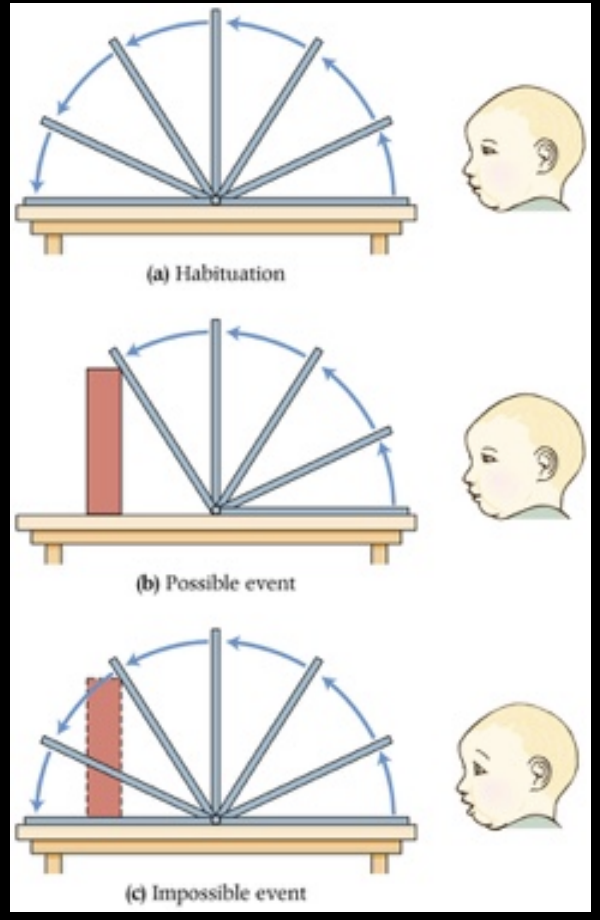
Challenges to Piaget: Baillargeon 2004
NATIVIST IDEA
Violation of Expectancy (VOE) Paradigm
Since infants can’t talk, researchers measure looking time:
Habituation → decreased looking (learning occurred)
Dishabituation → increased looking (something unexpected)
👉 Infants look longer at events that violate their expectations
Renée Baillargeon and “Impossible Events”Method
Infants are habituated to a possible event
Then shown:
A possible event OR
An impossible event (e.g., object passing through a solid barrier)
Habituation test: object placed behind screen, then screen rotates up and into the objec
Finding
Infants look longer at impossible events (object passing through a solid barrier)
Conclusion
Infants have early (possibly innate) knowledge of:
Object permanence
Physical properties (e.g., solidity)
👉 Supports:
Competence ≠ performance
Infants may know more than they can act on
Origins of Knowledge: Constructivists
🧠 Core Idea
Constructivists believe:
👉 Babies build knowledge over time through experience
🌍 How Learning Happens
Babies learn by:
Seeing (perceiving)
Doing (acting on the world)
👉 Learning = interaction with the environment
👶 Role of “Immature” Behavior
Babies aren’t bad at things for no reason
👉 Their mistakes actually:
Help them learn
Create opportunities to improve
👀 Importance of Perception
Perception is:
⭐ VERY important
👉 Babies learn from:
What things look like
What they hear, touch, see
🧬 Biology + Experience
Babies are not blank slates, BUT:
Their biology is designed to learn from experience
👉 Development =
Brain + Experience working together
🎯 Key Idea
Knowledge is:
❌ NOT fully inborn
✅ Built step-by-step through experience
🔥 Simple Example
A baby doesn’t understand number at first
👉 They first learn:
“how much stuff” (perception)
👉 Then later:
actual numbers
Problems with Baillargeon: Cashon and Cohen Study
CONSTRUCTIVIST IDEAS
Cashon and Cohen are basically testing this idea:
👉 Do babies react because they already know what’s possible/impossible,
OR because they just learned something during the experiment?
They say:
If babies truly have innate knowledge, then what they saw during habituation shouldn’t matter.
👉 Meaning:
Even if you show them impossible events over and over, they should STILL recognize:
“That’s impossible”
So here’s the key test:
First, babies are habituated to impossible events (they get used to them)
Then, they are shown a possible event
If babies have innate knowledge, they should think:
“This possible event is normal”
👉 So they should NOT react
BUT instead:
👉 Babies DO react (look longer) at the possible event
💡 What that means (this is the important part)
Babies are NOT thinking:
“This is possible vs. impossible”
They are thinking:
“This is DIFFERENT from what I just saw”
So the “violation” is NOT:
❌ breaking an inborn rule about physics
It IS:
✅ breaking the pattern they just learned during habituation
🎯 What Cashon & Cohen conclude
Baillargeon thought:
👉 Babies have inborn knowledge of physics
But actually:
👉 Babies are just responding to:
what they learned during the experiment
what is familiar vs. new