Paper 3 Section C - Consuming energy resources
 Call Kai
 Learn
Learn Practice Test
 Spaced Repetition
 Match
Match Flashcards
 Knowt Play
1/24

There's no tags or description
Looks like no tags are added yet.
Name | Mastery | Learn | Test | Matching | Spaced | Call with Kai |
|---|
No analytics yet
Send a link to your students to track their progress
25 Terms
Name the three different classifications of energy resources and name the examples of each
Non-renewable
Finite stocks of fossil fuel coal, oil and gas
Renewable
Solar, wind, hydroelectric power
Recyclable
Nuclear, biofuels
Define
Renewable energy resources
Non-renewable energy resources
Recyclable energy resources
Renewable: can be replenished at the same rate (or faster) as the rate of consumption
Also known as flow resources as they are constantly being renewed by natural processes, and the Earth has an endless supply)
Non-renewable: cannot be replenished at the same rate as the rate of consumption, so will run out
Recyclable: energy resources that can be reused or regenerated; this is because they have usable waste products
For example:
Nuclear waste can be reprocessed and reused
The waste products from the production of biofuels can also be used as fuels
Describe the environmental impacts of mining and drilling (non-renewable energy resources)
Open cast coal mines strip away large areas of soil, reck and vegetation to reach materials; this can cause landscape scarring
This can result in the destruction of natural landforms, making areas less attractive and reducing tourism
Abandoned mines can cause soil erosion and water pollution
Carbon emissions
Mining processes can release greenhouse gases
Burning the fossil fuels extracted releases greenhouse gases that can cause climate change
This also releases other pollutants, such as sulfur dioxide which causes acid rain, damaging forests and aquatic wildlife
Removal of forests
Land must be cleared, which may destroy habitats, disrupting ecosystems and reducing biodiversity
Contributes to global warming as fewer trees are available to absorb carbon dioxide
Oil spills - oil can leak during drilling or from tankers transporting the fuels
Oil coats marine animals’ fur, destroying the insulating ability of the fur, leading to hypothermia
Poison marine animals
Destroy ecosystems and habitats such as coral reefs
Non-renewable resource extraction usually has long-lasting and global scale impacts on the environment
Describe the landscape impacts of renewable energy
Hydroelectric power
Building dams floods valleys, submerging farmland, habitats and sometimes indigenous communities
Disrupts river ecosystems by preventing fish migration (eg. may prevent fish from reaching breeding grounds)
Wind turbines
Require large areas of land, visually unappealing
Noise pollution
Spinning blades can kill birds and bats
Solar panels
Take up large areas of land
This can destroy habitats, disrupting ecosystems
Heat reflected from mirrors in solar farms can kill wildlife
Explain the factors affecting access to energy resources
Accessibility
Some countries have large energy resources but cannot access them eg due to permafrost or as energy resources are found in protected areas
Conflict
Can prevent energy sources from being extracted
Development level of a country
Levels of economic development and technology determine whether countries can effectively exploit their energy resources
LIC lack technology to extract and utilise fuels
Geology
Fossil fuels are found only in sedimentary rock
Countries on plate boundaries can use geothermal
Climate
Sunny climates can use solar
Windy areas can use wind turbines
Landscape
Must be on a coast to use tidal
Dams must be built in mountainous/ high altitude areas
What is energy use per capita?
The amount of energy consumed by each person in a country annually
Explain the global patterns of energy use
High income countries use the most energy per capita
High living standards
Widespread car ownership
Presence of energy-intensive industries
Rising levels
Newly emerging economies have rapidly increased energy use in recent decades, due to rapid industrialisation and urbanisation
Low income countries use the least energy per capita
Lack access to electricity
Rely on basic fuels such as wood or dung - traditional fuels are less efficient and so release less energy
(Colder countries require more energy overall as they need to heat homes and buildings)
Describe the causes in variations of global energy use per capita
Levels of economic development
HIC: people can afford more electrical goods and cars, energy needed for electric heating and cooling
NEES: rapid economic growth increases demand for energy to power factories
LIC: fewer industries and lower incomes; many people live in rural areas without electricity grids
Reliance on traditional fuel sources
Traditional fuels are less efficient, so they produce less usable energy and people consume less
Demand from different economic sectors
Primary sector economies: focus on farming and small scale activities that require little energy
Secondary sector economies: manufacturing and industry require large amounts of energy
Post-industrial economies have shifted towards service industries, which require energy, but less than manufacturing economies
(Cold countries require more energy for heating)
True or false: Oil reserves are evenly distributed throughout the world
FALSE: oil reserves are found in only a few countries (mostly in the middle east
Explain why oil production is unevenly distributed
Oil production doesn’t just depend on a country’s oil reserves:
Infrastructure + technology
In order to extract oil, countries need expensive and advanced technology
Political stability
Conflict can damage infrastructure, and may also mean countries invest their money elsewhere (eg. defences)
Domestic demand
High domestic demand means a country may produce more oil to meet their own energy needs
Shrinking reserves
Shrinking reserves reduces oil production because when oil reserves become depleted, there is less oil available to extract
Explain why oil consumption is rapidly growing
Rising per capita GDP
People in wealthier countries have more disposable income, so consume more goods which require energy to produce
More individuals own cars
Rapid industrialisation in emerging economies
Growing population = more resources needed
Growing cities consume energy for construction
Factories require large amounts of energy to produce goods
What does oil supply and oil prices depend on?
Changing international relations
Conflicts
Disrupts oil production, which leads to a decrease in oil supply. Shortages of oil cause prices to increase
Diplomatic relations
Poor diplomatic relations can lead to other countries refusing to trade oil to certain countries, reducing supply in those countries and thus increasing prices
Economic factors
Periods of recession verses boom
Recessions lower the demand for oil because industrial activities and economic growth slows down, causing prices to fall
Economic booms increase oil prices due to increased consumption and demand
Over or under supply
Oil prices depend on supply and demand; if global demand is higher than supply, oil becomes scarce which causes oil prices to rise
Define conventional and unconventional energy resources
Conventional: used for a long time and are easy to extract using well-established methods; simpler and cheaper as the technology needed to extract them is already developed
Unconventional: harder to extract because because the fuel is trapped in difficult geological conditions, and require new or more complex technologies to extract; more expensive and has greater environmental impacts
Describe the economic costs and benefits of developing new conventional oil and gas sources in ecologically-sensitive and isolated areas
Benefits:
Reduces energy imports which costs lost of money
Countries can make money by exporting the energy
Energy companies bring investment and jobs to an area
Costs:
Isolated locations and harsh climates make drilling expensive
Pipelines and roads must be built, which brings large transport and infrastructure costs
Risk of environmental damage, which can impact tourist and fishing industries
Describe the unconventional energy sources
Shale gas
A form of natural gas that is trapped in shale rock underground
It is extracted by fracking: liquid is pumped into the shale rock at high pressure, causing the rock to crack (fracture) releasing that gas which is collected as it comes out of the well
Tar sands
Mixtures of sands that contain bitumen, which can be refined to produce oil
Surface mines collect tar sand and transport it to processing plants which use water and chemicals to separate the bitumen from the sands
Deep water oil
Extracting oil from deeper and harder-to-access depths from the ocean
Describe the environmental costs of developing new unconventional oil and gas sources in ecologically-sensitive and isolated areas
Shale gas
Chemicals used in fracking liquid as well as the shale gas itself can pollute groundwater and drinking water
Land has to be cleared to build drilling pads for fracking, which destroys animal habitats and disrupts ecosystems
Methane can escape during extraction
Can trigger small earthquakes
Tar sands
Open mining requires large amounts of space, so habitats are destroyed; this can cause a reduction in biodiversity as organisms have less space to live and find food
Processing tar sands produces large amounts of liquid waste full of harmful chemicals which can pollute water supplies if not managed properly
Processing bitumen releases large amounts of carbon dioxide
Large amounts of water are needed, leading to a strain on local water resources
General:
Permanent landscape scarring
Greenhouse emissions can escape during extraction
Soil degradation
Air and noise pollution
Describe how the demand for energy can be reduced
Energy conservation
Changing behaviours
Energy efficiency
Appliance performs the same task but wastes less energy, so less overall energy is consumed
Why is energy efficiency and energy conservation important?
It reduces demand for energy which:
Helps finite energy supplies last longer
Reduces carbon emissions
Describe how energy consumption can be reduced in the home and in transport
Through energy conservation and energy efficiency
Home
Insulation
Turning off lights
Using energy efficient appliances (eg. modern boilers)
Solar panels
Transport
Hybrid or electric cars
More efficient engines
Improving public transport
Encouraging walking or cycling
Describe the advantages of using alternatives to fossil fuels
Reducing carbon footprints
Improving energy security
Energy security: reliable, uninterrupted and affordable supply of energy
Renewable sources ensures that energy is still available when the supply of fossil fuels run out
Diversifying the energy mix
This reduces a country’s reliance on a single source of energy, which increases energy security as countries are less affected by shortages of one energy source, reducing the risk of energy deficits
Using renewables will make non-renewables last longer
Give the costs and benefits for using alternatives to fossil fuels:
Biofuels
Wind energy
Solar energy
HEP
Hydrogen fuel
Energy source | Benefits | Costs |
Biofuels |
|
|
Wind energy |
|
|
Solar energy |
|
|
HEP |
|
|
Hydrogen fuel |
|
|
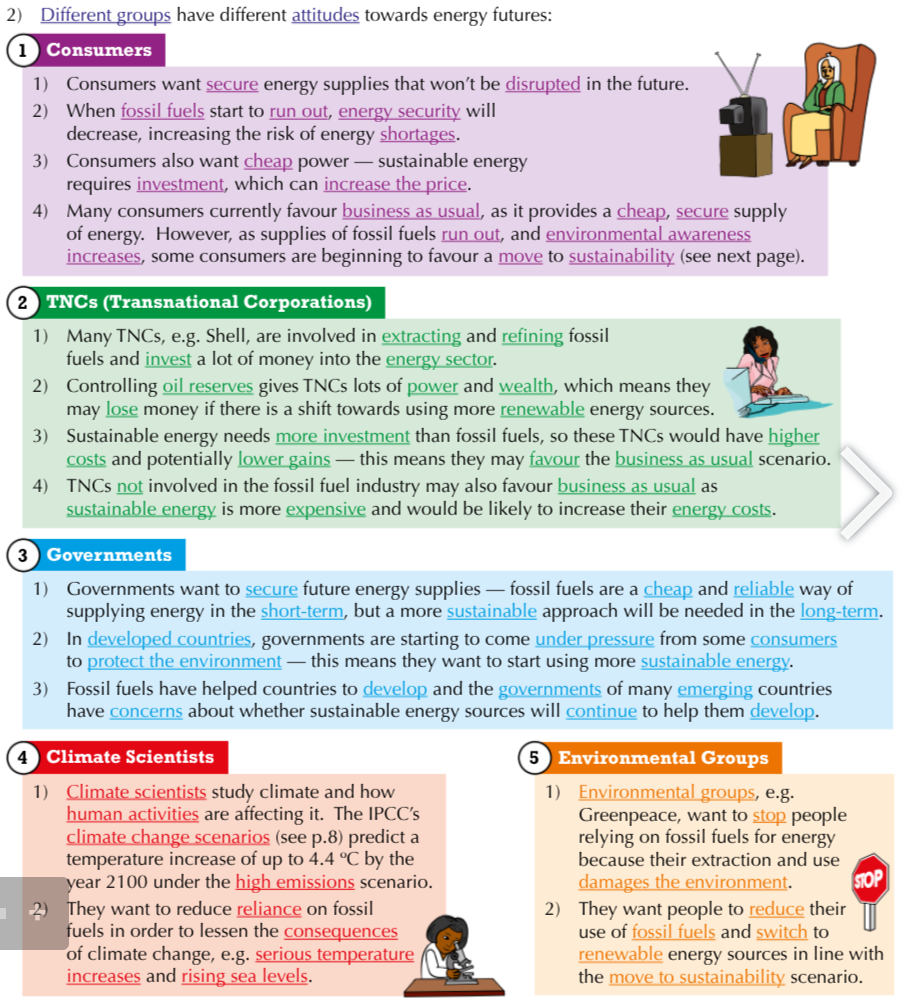
Describe the different attitudes that different groups have towards energy futures
Describe how and why attitudes to energy and environmental issues are changing
Rising affluence
People with more money can afford to make a choice about energy use (eg. buying newer more energy-efficient cars and appliances, solar panels)
Governments in developed countries have more money to invest into public transport and renewable energy
Environmental concerns
Due to increasing living standards, peoples needs for food, shelter and water are being met, meaning that they are no longer main concerns and therefore environmental concerns are becoming increasingly important
Education
People have access to education so they have a better understanding of the consequences of using non-renewable energy
People are educated on how to reduce their carbon footprint, so there is more interest in using cleaner energy sources and reducing overall consumption
Define carbon footprint
Carbon footprint: measure of the amount of greenhouse gases generated by the activities of an individual or organisation or by a product over its lifetime
Define ecological footprint
Ecological footprint: measure of how much land is needed to support an individual’s lifestyle