lectures 9-13: kinetic approaches
 Call Kai
 Learn
Learn Practice Test
 Spaced Repetition
 Match
Match Flashcards
 Knowt Play
1/37

There's no tags or description
Looks like no tags are added yet.
Name | Mastery | Learn | Test | Matching | Spaced | Call with Kai |
|---|
No analytics yet
Send a link to your students to track their progress
38 Terms
what do time scales of biological processes tell us
how fast a molecule moves
why are kinetic methods used
to understand mechanisms and allows you to piece together bits to get the whole speed frame
rate law
the experimental rate of reaction is often found to be proportional to the concentration of reactants raised to some power e.g. rate of reaction = k [A]α [B]β
rate of reaction = k [A]α [B]β what does everything represent
[A]/[B] is the molar concentration of the reactants
k is the rate constant that tells us how fast a reaction is
the exponents are the orders which tell you how much a reactant affects the speed
0 order
changing the concentration has no effect on rate
1st order
doubling the concentration, doubles the rate
2nd order
doubling the concentration, quadruples the rate
how do you find the overall order
the sum of all the orders
when do transitions take place
when (through randomly bouncing around) molecules gain enough energy to pass over an energy barrier
irreversible unimolecular reactions
when a single molecule transforms into a product and cannot return to its original state, following first-order reactions
differential rate law:
d[A]/dt = -k[A], given by concentration over time
when would you use d[A]/dt
for an analytical approach → exact numbers to describe [A], k, t (needs calculus) but only works in simple cases
when would you use -kA
for approximates, can be used with complex cases
what is the integration of the analytical equation
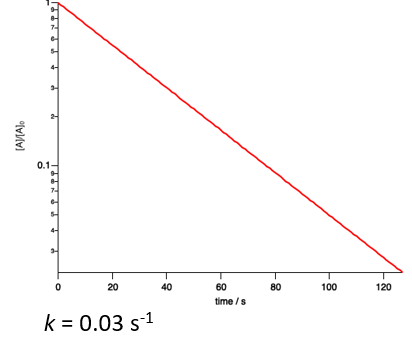
[A]t = A0e-kt gives an exponential function
![<p>[A]<sub>t </sub>= A<sub>0</sub>e<sup>-kt </sup>gives an exponential function</p>](https://assets.knowt.com/user-attachments/86e83f5a-a680-4210-863e-f4faf3434c5b.png)
ln([A]/[A]0) = -kt
the slope of the straight line would be the rate
unimolecular reversible reactions
a process where a single molecule transforms into a product but the product has enough energy to transform back into the reactant
what is the equation for a unimolecular reversible reaction that is at equilibrium
K+1/K-1 = [B]eq/[A]eq = Keq
For example: [A] = 100 µM, [B] = 0, and K = 10. Find [A]eq and [B]eq
[A]eq = proportion of [total] that is A at equilibrium
= [total] 1 / (1 + K) = 100 µM 1/(10 + 1) = 9.1 µM
[B]eq = proportion of [total] that is B at equilibrium
= [total] K / (1 + K) = 100 µM 10/(10 + 1) = 90.9 µM
what is Kobs
When one reactant is present in large excess compared to others, the reaction can be approximated as pseudo-first-order. In this case, kobs is derived from the concentration of the limiting reactant while the excess reactant’s concentration is effectively constant
analytical approach for unimolecular reversible reactions involves the integration of the rate equation to give:
[A] = [A]0(Ae-kobst + B)
Kobs = k+1 + k-1
bimolecular irreversible reactions
2 distinct molecules (or 2 same) collide and react to form a product. the reaction is heavily dependent on the probability of 2 things hitting each other in the right orientation and with enough force (activation energy)
what kind of order reaction is bimolecular irreversible
second-order, d[A]/dt = -k+1[A][B]
analytical approaches to solving biomolecular rate laws part 1: [A]=[B]
since they react in a 1:1 ratio, their concentrations will stay equal throughout the entire reaction, so if you replace [B] with [ A], the equation becomes d[A]/dt = -k+1[A]2
what is the problem with [A]=[B] in analytical approaches to solve bimolecular rate laws
it is difficult to physically measure out exact equal moles of 2 different substances down to the last molecule
analytical approaches to solving bimolecular rate laws part 2: [A]«[B]
if you have 1,000,000 molecules of B but only 10 of A, even after all of A has reacted, you would still have 999,990 of B, so we say [B] is constant → giving a first-order reaction (integrating gives Kobs)
how would pseudo-first order kinetics work in real life
keep one reagent at a low concentration
vary the concentration of the other reagent (always above a 10-fold excess)
record and plot observed rate constants against concentration
bimolecular reversible reactions
where 2 molecules collide to form a product but the product can also break apart/ react to reform the original molecules (realistic binding)
what qualities can we make a quantitative assessment of in bimolecular reversible reactions?
interaction strength
on mutation
structural variation
predict binding under a given set of experiments
bimolecular reversible equation
d[A]/dt = -k+1[A][B] + k-1[C]
kd
[A][B]/[C] = k-1/k+1
lower the Kd, the…
higher the binding affinity
whats the equation to find the fraction of protein bound to ligand
[PL]/[P]T =[L]/[L] + Kd
simple enzymes
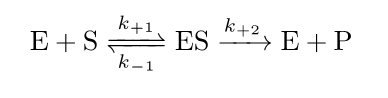
the enzyme-substrate complex can either revert back into the substrate and enzyme or can go forward in the reaction
the pre-equilibrium assumption
k+1 » k + 2, this means that the complex falls apart back into the reactants much faster than it creates product
because of this we can assume the first step in the reaction is at equilibrium, this allows us to determine the Michaelis constant (Km)
Km =
[E][S]/[ES]= k-1/k+1
Kcat
K+2
rate of simple enzymes
(Kcat[E]T[S])/[S]+Km
the Briggs-Haldane approach
if k-1 is not » k+2 → Kcat/Km = k+1 (k+2/k-1+k+2)