Social Psych - Exam 3: Romance/Attraction
 Call Kai
 Learn
Learn Practice Test
 Spaced Repetition
 Match
Match Flashcards
 Knowt Play
1/36

There's no tags or description
Looks like no tags are added yet.
Name | Mastery | Learn | Test | Matching | Spaced | Call with Kai |
|---|
No analytics yet
Send a link to your students to track their progress
37 Terms
How does beauty play a role in social interactions
researchers believe that certain faces are more attractive than others
- high level of agreement
- positive outcomes (better social treatment, job opportunities, and popularity)
- morphed faces (combination of faces that create smooth, average, and symmetrical face)
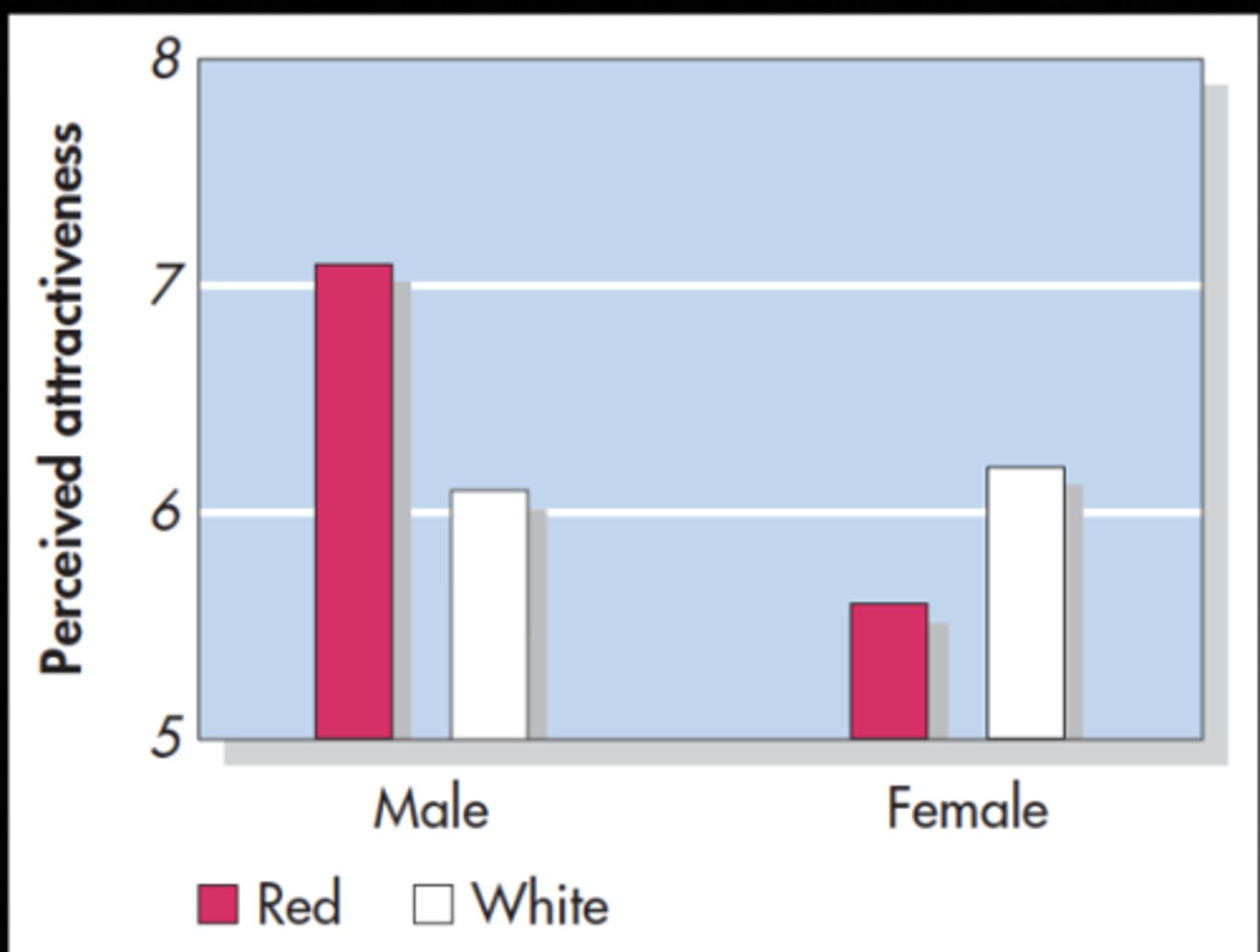
Romantic Red: Elliot & Niesta (2008)
The study found that the color red unconsciously increases attraction; men rated women as more attractive when linked with red (e.g., clothing or background), showing that color subtly influences romantic perception.
"what is beautiful is good" stereotype
attractive people are seen as having better traits and lives. Good-looking individuals often receive more positive treatment but may face attribution problems (others assume success is due to looks) and pressure to maintain their appearance.
Mate Selection David Buss
Females: highly selective due to limited reproductive opportunities
- less likely to pursue short term mating due to higher biological costs (pregnancy, childbirth) and risk
Men: can father an unlimited number of children and are generally less selective
- more likely to pursue short-term mating bc they can have kids with minimal investment
- look for "easy" women
What type of women do men prefer
- physical attractiveness, youth, and fertility as indicators of reproductive ability
- loyalty (they don't want to father someone else's child)
What type of men do women prefer
- resources, stability, ambition, protection, and willingness to invest in offspring
- want someone who is invested
- virgins
Buss (1989) Study:
Men tended to prefer traits like “good looks” and “no previous sexual experience,” while women preferred “good financial prospects” and partners who are “ambitious and industrious.”
Buss: How "capable" changes over time
Capability is tied to resource acquisition.
Capability years ago: hunting skill, strength, leadership, and bravery.
Capability today: intelligence, education, ambition, income, and social influence.
Evolutionary lag
Overemphasize muscularity or risk-taking
conspicuous consumption
Buying and using products because of the "statement" they make about social position
(flaunting wealth)
Men vs. Women seeking expressions of love
Women: seeking love (emotional connection)
Men: sex (young women)
Jealousy in romantic relationships
- Men are more likely to be triggered by sexual infidelity, as it threatens certainty of paternity.
- Women are more likely to be triggered by emotional infidelity, as it signals possible loss of resources and commitment.
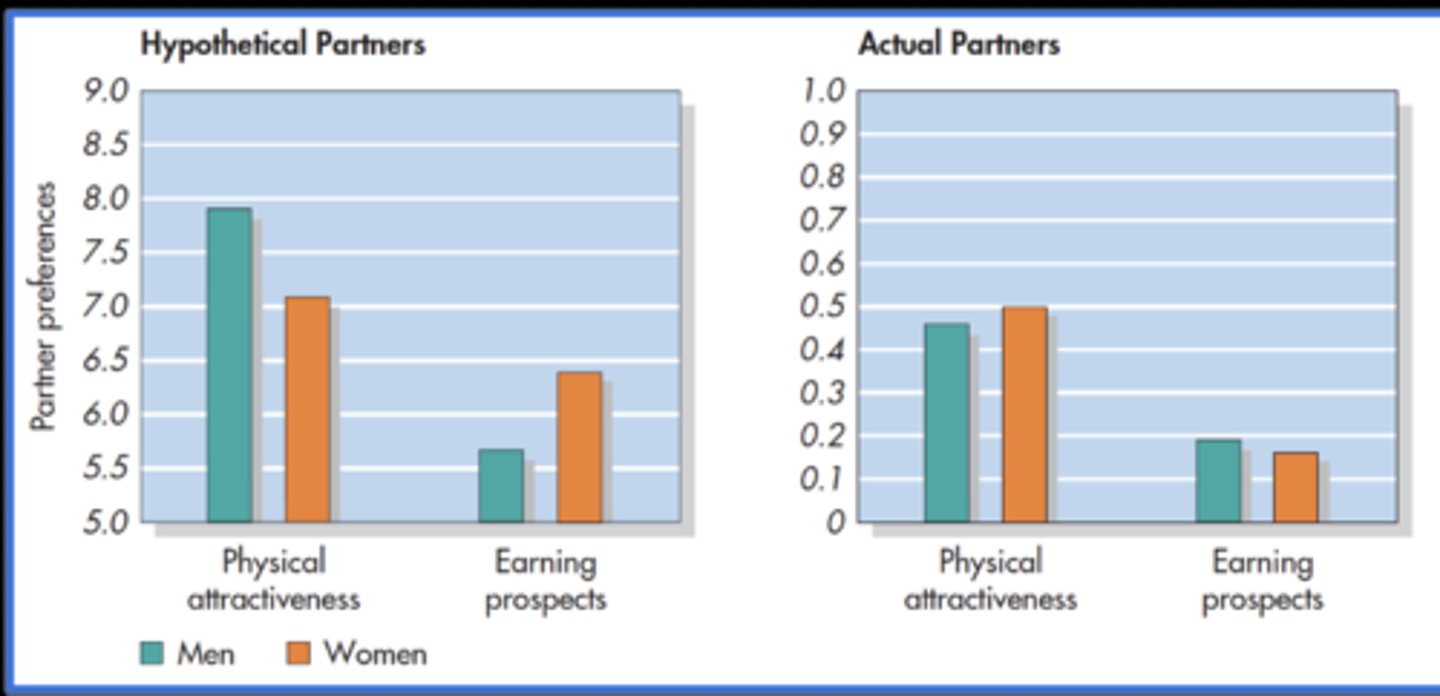
Evolutionary Mate Preferences: In Theory and in Practice (Finkel and Eastwick 2008)
- looked at real-life behavior matches traditional evolutionary predictions about mate pref (men valuing physical attractiveness and women valuing resources)
- found people say they prefer evolutionary traits in speed dating settings they did not align
- looked more to personal connection
Vaughn et al. (2010): Fertility × Mortality Salience
- Exp Condition: When women were high fertility and reminded of mortality (MS), they preferred less masculine (more average) male faces.
- Control: high-fertility women preferred more masculine faces.
- Result: Morality can override typical fertility based attraction
Intimate Relationships
A close relationship between two adults involving emotional attachment, fulfillment of psychological needs, or interdependence.
social exchange theory
the theory that our social behavior is an exchange process, the aim of which is to maximize benefits and minimize costs
- high/low comparison levels (used to judge what they expect or feel they deserve in relationship)
- Self-esteem: higher self esteem = higher comparison
- Alternatives: past exes
equity theory
The theory that people are most satisfied with a relationship when the ratio between benefits and contributions is similar for both partners.

Attachment style
The way a person typically interacts with significant others
Powers et al. (2006)
- Insecurely attached individuals experience more stress in romantic relationships.
- Early attachment with parents often reflects in adult romantic attachment.
Sternberg's triangular theory of love
A theory proposing that love has three basic components—intimacy, passion, and commitment—that can be combined to produce eight subtypes.
passionate love
an aroused state of intense positive absorption in another, usually present at the beginning of a love relationship
- high arousal
- fear of rejection
excitation transfer
The process whereby arousal caused by one stimulus is added to arousal from a second stimulus and the combined arousal is attributed to the second stimulus
White et al 1981 - Arousal without distress
- Physiological arousal = feelings of attraction as long as the arousal is not from distress
- ex. heart racing from going on roller coaster they may see the person next to them as sexually attractive
companionate love
A slow-building, secure, trusting, and stable partnership
Self-disclosure
Self disclosure
Sharing personal thoughts, feelings, and experiences with a partner, which helps build closeness and strengthen companionate love.
Liking (Sternberg triangular theory of love)
Liking intimacy alone
Companionate love (Sternberg triangular theory of love)
intimacy + commitment
*elderly couple who have been together for years not driven by passion
fatuous love (Sternberg triangular theory of love)
passion + commitment
*couple meets and gets married quickly
Romantic love (Sternberg triangular theory of love)
intimacy + passion
*deeply attracted to each other and share strong emotional connection but haven't committed to a long-term relationship
empty love (Sternberg triangular theory of love)
commitment alone
*arranged marriage
infatuation (Sternberg triangular theory of love)
passion alone
*love at first sight
consummate love
intimacy, passion, commitment
*ultimate love
The marital trajectory
73% of American college students surveyed said they would sacrifice most other life goals rather than give up a satisfying relationship.
Divorce rate is about 50%
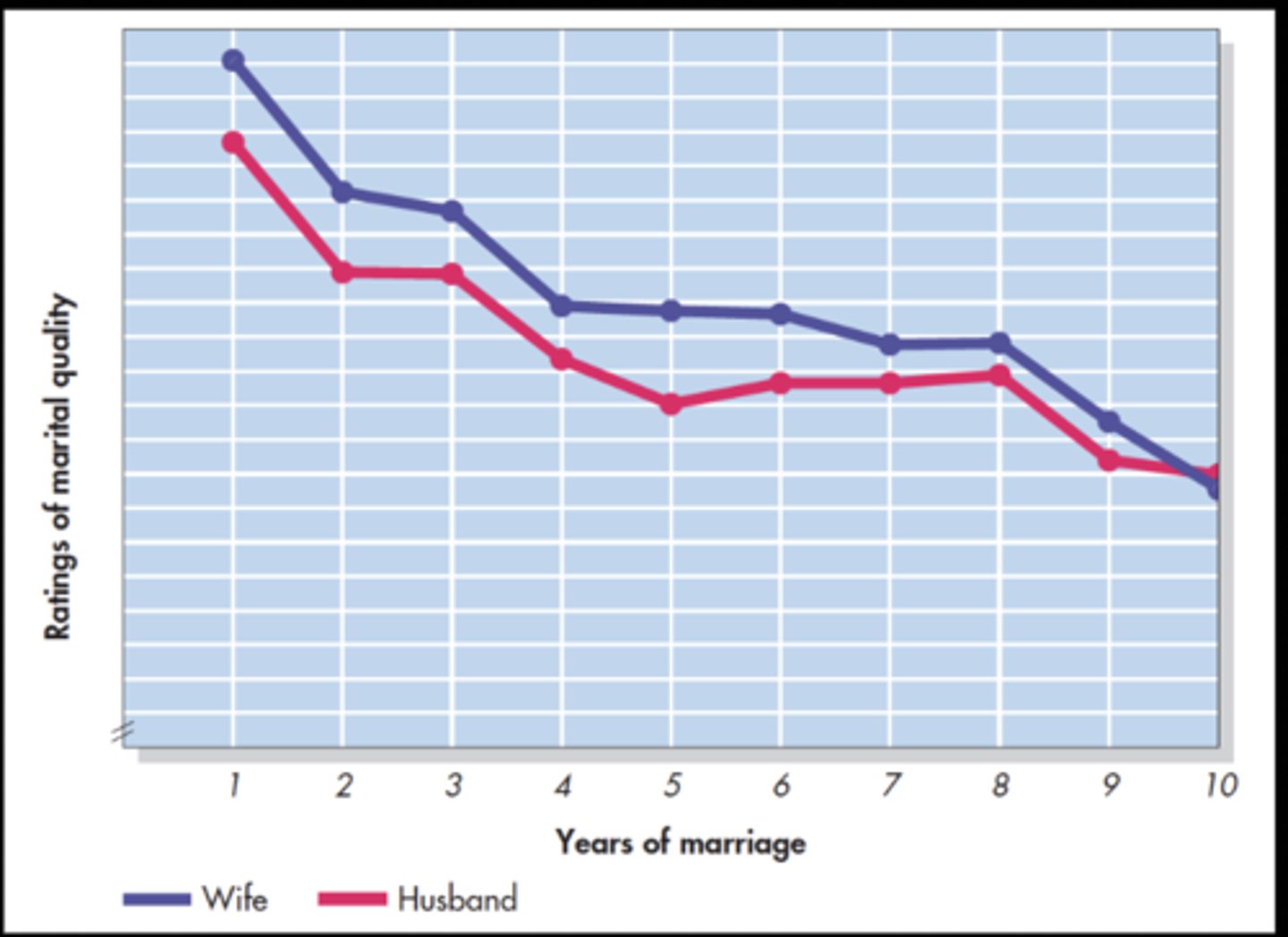
Marital satisfaction over time
goes down each year married
breaking up
People's ability to cope with divorce depends on the nature of the loss
Changes in Life Satisfaction Before and After Divorce
Satisfaction goes down before divorce -> after divorce satisfaction increases
Divorce rate and why
40-50%
- why?:
Marrying very young
Lower education levels/financial stress
High conflict/negative communication patterns
Children of divorce 2x as likely
Children of divorce - 60-67% will divorce
Child of intact marriages - 30% will divorce
Neuroticism/insecure attachment/mental health