Evolution
 Call Kai
 Learn
Learn Practice Test
 Spaced Repetition
 Match
Match Flashcards
 Knowt Play
 Podcast
1/60

There's no tags or description
Looks like no tags are added yet.
Name | Mastery | Learn | Test | Matching | Spaced | Call with Kai |
|---|
No analytics yet
Send a link to your students to track their progress
61 Terms
DNA
Deoxyribonucleic acid
It consists of nucleotides
They are made of: Deoxyribose, a Phosphate and 1 ot 4 nitrogenous bases
The four nitrogenous bases
Adenine
Thymine
Guanine
Cytosine
Gene to protein
The proteins produced by cells determine phenotypes/
The cells make the proteins by reading the DNA sequence and forming together amino acids to make a protein chain.
What happens when changing one base
This is a mutation, which can dramatically alter protein functions
Mutation
The premanent alteration of the nucleotide sequence of the genome
Sources of mutations
Radiation
Chemicals
Viruses
Natural causes:
Errors in DNA replication
When will a mutation pass down to its offspring
When they are present in the germ cells (gametes)
Variation
Physiological, structual, or behavioural difference between individuals within a population
Discontinous variation
Distinct classes or categories
They cannot be measured over a range
Individuals cant have features that are between categories
Continuous variation
No distinct classses or categories
Characteristics can be measured over a range
Harmful mutation
Mutations that cause death or struggle
Neutral mutations
Mutations that have to persist in the gene pool. Don’t fo
Advantageous mutations
Mutations that help survival/ reproduction
Adaption
A characteristic that helps an organism to survive and reproduce in its enviroment. They are inhertiable
Physiological adaption
Biochemical feautre
Structural
Anatomical feature
Behavioural
activity or habit
When do variation become adaptions
The favourable variations are selected through the process of natural selection and thus become adaptions
Selective pressures
External factoes that affect an organisms ability to survive in a given enviroment.
These determine the adaptions
Industrial revolution and its impact on adaptation
Rise of factories prompted mass migration from farms to cities.
Mimicry
Structural adaptionwhere a harmless species resembles a harmful one
It’s an because this a characteristic that allows for an organism to survive and reproduce better in it’s enviroment.
Darwins principle on evolution
All living things are related
Natural processes drive evolution
Evidence of evolution
Comperative anatomy
Embryology & development
Fossil records
DNA/ biochemical comparisons
Biogeography
Observation evidence
Comperative anatomy
The body parts of very differen organisms are similar. Thus showing they are related to a common ancestor
Vestigiality
The rention of structures that have lost some or all of their ancestoral function
Homologous structures
Evolved from a common ancestor
Similar anatomy
Different functionality
Analogous structures
Evolved independently
Anatomically different
Similar functionality
Embryology and development
Embryonic similarties are present in non-similar verterbrate species. The more closely they are related, the more similarities they share
Fossil records
Fossils display incremental changes over time.
Older layers= simpler organisms
Mass extinction show evolutionary recssion and succession
Transitional forms
Organisms that connect distant relatives
Archaeopteryx
Tiktaalik
DNA comperative
More closesly related organisms have more similar DNA
Evolutionary tree
A diagram that shows how species are related and how they branced off from shared ancestors over time
Cousins
The familial relation between two organisms that share a common ancestor
Biogeography
Closely related species are found in areas that are, or were geographically close to eachother.
Distant species with similar features under conditions with similar sleective pressures
Observations evidence
Viruses evolve in order to adapt to their host and thus cause antibiotics to not work because they are already adapted to suruve them
Natural selection
The process where organisms better adapteed to their enviroment tend to survive and produce more offspring. As the generations pass, the stronger/ desirable phenotypes persist.
Fitness
The ability of an organism to pass its genes on to its offspring and then the next generation
Sexual selection
Naturla selection happening though the preference by one sex for certain traits in individuals of the other
Gene pool
The combination of all the genes (including alleles) present in a reproducing population or species.
A larger gene pool is better to withstand unexpected enviromental challenges
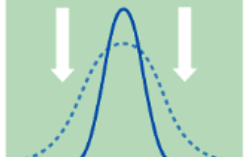
Stabilizing selection
The intermediate variation converys greater fitness than the extermes
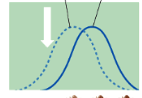
Directional selection
Variations towards one end of the spectrum have higher fitness
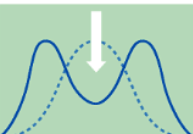
Disruptive slection
Variations at both extermes convey greater fitness
Genetic drift
The change in allele frequency within a population over generations due to random choice
Founder effect
A form of exterme genetic drift where genetic variation is lost when a new populatin is established by a small grouo
Genetic bottleneck
A form of exterme genetic drift in which a single event drastically reduces genetic variation
Gene flow
The transfer of genetic variation from one population to another
Speciation
The formation of one or more distinct species from a prexsisting population
Causes:
When a group become reproductively isolated from other in the population
After time, selective pressures will make each group evolutionarily distinct
Allopatric speciation
when biological populations of the same species become isolated due to geographical changes
Sympatric speciation
Speciation within the same habitat due to behavioural or temporal changes
Abrupt speciation
Where speciation happens in one generation, usually happens in plants.
Possible because plants can remain vaible despite being polyploid
New polyploid plants can no longer breed with parent generation due to incompatible ploidy
Polyploid
An organism with two or more sets of chromosomes
Autopolyploidy
Polyploidy resulting from the fusion of polyploid gamaetes from the species
Allopoluploidy
Polyploidy that happens because of fusion of polyploid gamaetes from close related species/ sub
Descent with modification
Humans evolved through natural selection.This mean that traits helping with survival and reproduction become more common over generation
Sahelanthropus
Lived 7 million years ago in central africa
Potentially earliest human ancestor with bipedalism
Australopithecus
Walked upright 4 million years ago, small brain
Lucy is apart of this
Homo erectus
First to leave Africa, use fire, and make complex tools
Homo neanderthalensis
Came before modern humans in Europe; adapted to the cold, intelligent and interbred with us
Major steps in human evolution
Bipedalism: Allowed to free our hands for tolls use and improving energy efficency
Brain growth: Our brain sized tripled this allowed for complex thinking, language, and culture
Tool use: Simple stones —> adavanced tools that helped for survival and social cooperation
Language: Enabled knowledge sharing, planning, and cultural transmission
Modern humans
Slender builds, high foreheads.
Excelled in symbolic thought, art, and long distance trade
Neanderthals
Stockier, adapted to cold climates
Used tools to bury their dead, but generally had les symbolic expression.