8.2 PRIMARY MOTOR CORTEX M1 /4 Brodman´s Area
 Call Kai
 Learn
Learn Practice Test
 Spaced Repetition
 Match
Match Flashcards
 Knowt Play
1/40

There's no tags or description
Looks like no tags are added yet.
Name | Mastery | Learn | Test | Matching | Spaced | Call with Kai | Chat |
|---|
No analytics yet
Send a link to your students to track their progress
41 Terms
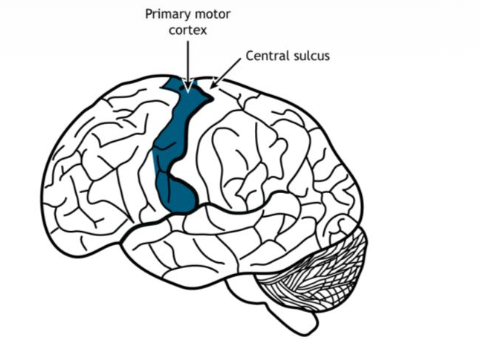
PRIMARY MOTOR CORTEX M1 /4 Brodman´s Area → The primary motor cortex (M1) is organized in a
somatotopic map
Upper motor neurons in M1 can control
multiple lower motor neurons in the spinal cord that innervate different muscles.
activation of an upper motor neuron can
excite or inhibit different neurons at once
primary motor cortex is responsible for
movements patterns
Stimulation of upper motor neurons in monkeys can lead to
complex motions like bringing the hand to the mouth or moving into a defensive position
Motor control modulation
basal ganglia
cerebellum
basal ganglia & cerebellum form
Specific neural loops with the motor areas of the cortex.
They do not directly command movement, but help regulate its timing, precision, selection, & learning.
Basal ganglia
basal ganglia nucleis are composed of
caudate & putamen (which both make up the striatum), as well as the globus pallidus.
Basal ganglia is closely associated with
ventral thalamus
dopaminergic neurons in the substantia nigra
Basal ganglia influence movement by
regulating the activity of upper motor neuron circuits.
Basal ganglia is essential for
The initiation & ending of movement sequences
Adjustment of the force of movement (strength)
Basal ganglia inputs
Striatum
striatum
input zone of the basal ganglia.
Its neurons receive projections from several regions of the cerebral cortex & the substantia nigra.
The primary output of the GABAergic neurons in the striatum is to the
globus pallidus
Basal ganglia projections
outputs
main source of output from the basal ganglia to other parts of the brain is
globus pallidus:
globus pallidus:
Many of its projections reach the motor cortex via a relay in the thalamus
Also projects to the subthalamic nucleus
This way, the loop circuitry of the basal ganglia is complete.
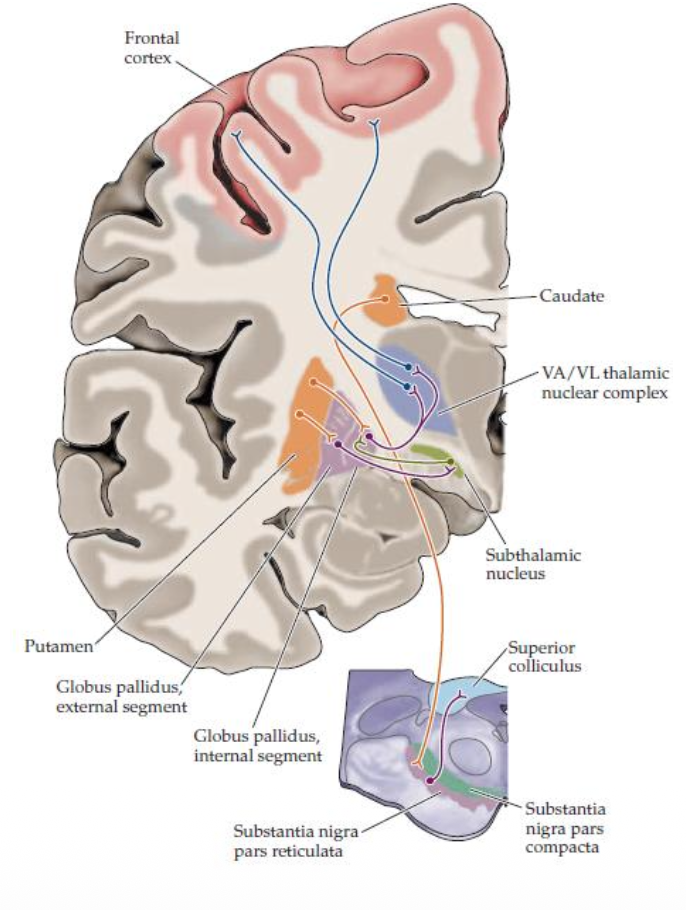
efferent cells of the globus pallidus are
GABAergic & tonically active
main output of the basal ganglia is an
inhibition to the motor cortex, preventing unwanted movement
The basal ganglia behave as a
“movement filter”, preventing the initiation of unwanted motor plans and allowing only desired movements.
BASAL GANGLIA: The gatekeepers of movement
connections between cortex, basal ganglia, & substantia nigra forming two pathways
connections between cortex, basal ganglia, & substantia nigra form two pathways →
DIRECT PATHWAY
INDIRECT PATHWAY
DIRECT PATHWAY:
Facilitates the initiation of a movement
The cerebral cortex sends a signal to the striatum to start movement.
Dopamine from the substantia nigra binds to D1 (excitatory) receptors.
The internal segment of the globus pallidus (Gi) is inhibited.
The inhibition of the globus pallidus frees the
upper motor neurons from the tonic inhibition, facilitating voluntary movement.
If an inhibitory pathways is blocked
it allows excitation
When the striatum neurons become active
they remove the break over the upper motor neurons, & the movement can be initiated.
INDIRECT PATHWAY:
antagonizes (inhibits) the activity of the direct pathway
antagonizes (inhibits) the activity of the direct pathway to →
prevent activation of unwanted movement programs
in indirect pathways the Striatum
Inhibits the external segment of the Globus Pallidus (GPe).
Decreased GPe activity disinhibits the Subthalamic Nucleus (which is normally inhibited).
The STN excites the Globus Pallidus internal (GPi).
Result from indirect pathways
Increased inhibition over the thalamus & the motor cortex, preventing the movement.
Activation of the Indirect Pathway detailed version
When the indirect pathway is activated by the cortex, the striatum neurons project inhibitory signals to the external segment of the globus pallidus (GPe).
This inhibition of the GPe neurons results in disinhibition of the excitatory neurons in the subthalamic nucleus.
The excitatory output from the subthalamic nucleus to the GP internal segment increases inhibition of the thalamus, leading to decreased thalamic output to the cortex.
Motor effect of dopamine
release of dopamine from the substantia nigra pars compacta is associated with the facilitation of movements.
striatum neurons that activate the two pathways have different dopamine receptors
Direct pathway → D1 dopamine receptors (excitatory)
Indirect pathway → rich in D2 dopamine receptors (inhibitory)
the release of dopamine from the substantia nigra stimulates
direct pathway & inhibits the indirect pathway
This is why dopamine depletion increases
difficulty in initiating movement & dopamine excess can cause involuntary movements.
Dopamine and the basal ganglia → pathways
The nigrostriatal pathway
Drug-induced Parkinsonism
Side effect of drugs, such as antipsychotics (D2 inhibitors).
Basal ganglia lesions
Co-activation of both pathways is important for the smooth initiation & execution of new motor actions.
HYPOKINETIC DISORDERS
Difficulty in the expression of movement (more tonic inhibition
Parkinson
HYPERKINETIC DISORDERS
Expression of unwanted movement (less tonic inhibition)
Huntington
Tourette's Syndrome