Biol 213 chapter 14
 Call Kai
 Learn
Learn Practice Test
 Spaced Repetition
 Match
Match Flashcards
 Knowt Play
1/12

There's no tags or description
Looks like no tags are added yet.
Name | Mastery | Learn | Test | Matching | Spaced | Call with Kai |
|---|
No analytics yet
Send a link to your students to track their progress
13 Terms
Why does oxygen become the electron acceptor in oxidative phosphorylation
H+ use up their free energy by end
Every NADH produced=
3 ATP produced
Proton gradients across a membrane are used to
generate ATP in animals, plants, and bacteria
First steps of photosynthesis
Photosystem 2 splits water, gets electron, attaches light energy to electron
Plastoquinone takes it to cytochrome, uses that energy to pump hydrogens across the membrane that bring electron back down to its ground state
Second steps of photosynthesis
plastocytun then carries those electrons to photosystem 1, where it captures light and excites those electrons again
Excited electrons given to ferredoxin who takes them to ferredoxin NADP to be paired with NADP+ reductase to be paired with NADP+ and H+
Happens in stroke and produce NADPH
As that’s happening, the proton meta force that has been generated from cytochrome B6F complex now going back down through ATP synthase to produce ATP in the stroma
3rd step of photosynthesis
both NADPH and ATP are produce in the stroma of this to where they will be then used for next step of photosynthesis which is sugar production step through the carbon cycle
Carbon fixaiton of Calvin cycle (second stage of photosynthesis)
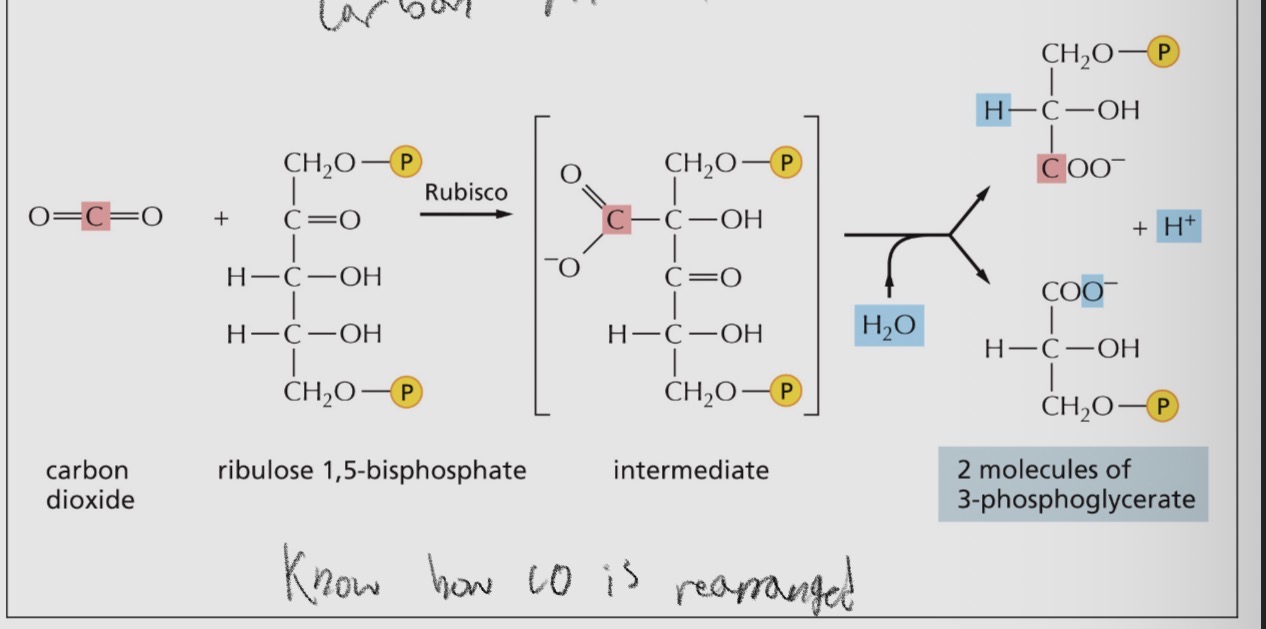
The ATP and NADPH generated from the first stage of photosynthesis is used to synthesize
carbohydrate from CO2 and water (Calvin cycle)
Reactions take place in the chloroplast Stroma and can continue in the dark until
all ATP and NADPH is exhausted (can happen very quickly)
Net product of Calvin cycle
G3P
converted to sucrose in Cytosol
Feeds into glycolysis in the Cytosol
How many cycles are needed to make enough G3P to generate sugars, fats, amino acids
3
Everyone does respiration but not everyone does
Photosynthesis
Goal of photosystems
Charge separation, electron transfer, and in the case of photosystem 2, water splitting versus the ferredoxin complex reductase complex is used for NADPH production for the light dependent reactions