Urea cycle and nitrogen metabolism
 Call Kai
 Learn
Learn Practice Test
 Spaced Repetition
 Match
Match Flashcards
 Knowt Play
1/37

There's no tags or description
Looks like no tags are added yet.
Name | Mastery | Learn | Test | Matching | Spaced | Call with Kai |
|---|
No analytics yet
Send a link to your students to track their progress
38 Terms
which two metabolic cycles link together in land mammals?
kreb’s cycle and urea cycle
which two metabolic cycles don’t link together in birds and terrestrial reptiles?
kreb’s cycle and uric acid cycle
what is the general process of urea and nitrogen metabolism?
intracellular proteins → amino acids → a-ketoacids and NH4+
NH4+ → biosynthesis of AAs or urea/uric cycle
a-keto acids → kreb’s cycle
after deamination of amino acids, what happens to the ammonium formed?
either excreted - fish and amphibians
a-ketoacids enter kreb’s cycle
In fish:
what is N excreted as
where is it synthesised
where is it transported to
via what?
excreted through?
ammonotelic (ammonium)
liver
n/a
n/a
gill
In most land mammals:
what is N excreted as
where is it synthesised
where is it transported to
via what?
excreted through?
ureoteilc (urea)
liver
kidney
blood
bladder → urethra
in birds/reptiles:
what is N excreted as
where is it synthesised
where is it transported to
via what?
excreted through?
uricotelic (uric acid)
liver
kidney
blood
cloaca
Compare the energy cost to excrete N in fish, land mammals, birds and reptiles
least amount of energy in fish, excrete as NH4+/NH3
most in reptiles as uric acid
in terms of water needed for N excretion, compare between fish, most land animals and birds/reptiles
birds/reptiles take the least, secreting as uric acid
fish require the most, secreting as ammonium
what are 2 pathways that cause excess N in the body?
digestion/breakdown of diet proteins
breakdown of skeletal muscle proteins
why must amino acids be deaminated?
they can’t be stored in the body or excreted in their normal form.
what is the process of deamination?
amino acids → a-keto acids and NH4+
what enzymes are involved in deamination?
transaminase
glutamate dehydrogenase
what is transaminase involved in?
a-amino acid → a-keto acid
simultaneously a-ketoglutarate → glutamate
what is glutamate dehydrogenase involved in?
glutamate → a-ketoglutarate
simultaneously NAD + H2O → NADH + NH4+
how can we remove excess ammonia if we don’t have amino acids present?
a-ketoglutarate → glutamate → glutamine
each step requires NH4+
what is the carbonated skeleton of an amino acid?
the a-ketoacid
what is the fate of the carbonated cytoskeleton of an aa?
go down 20 different pathways, converge on 7 metabolic intermediates that feed Kreb’s cycle
which essential amino acids are glucogenic amino acids (8)
methionine
arginine
histidine
threonine
isoleucine
phenylalanine
tryptophan
valine
what is a glucogenic aa?
they enter into the Kreb’s cycle components/form pyruvate → glucose synthesis
what are the 5 essential ketogenic aas?
leucine
lysine
isoleucine
phenylalanine
tryptophan
what are ketogenic aas?
form acetyl-CoA/acetoacetate
formation of lipids
what is an essential aminoacid?
the organism can’t synthesise the carbon skeleton themselves, must be obtained via the diet
5 enzymes involved in ammonium catabolism
carbamoyl synthetase
ornithine transcarbamolyase
none - only ATP
arginosuccinase
arginase
what is hte energy expenditure for ammonium breakdown?
2ATP/N
where in the cell do the two parts of urea metabolism take place?
mitochondria
ctyosol
where do some of the products of the nitric cycle go?
TCA/citric/Kreb’s cycle
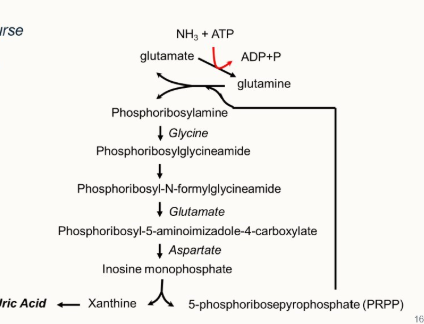
how does uric acid formation in birds differ from urea formation
uric acid is produced
requires more energy - 3.75ATP/N atom
what is the IN of nitrogen balance?
total intake of organic nitrogen
what is the EX of nitrogen balance
total excretion of organic nitrogen
if IN = EX what does this mean for nitrogen balance?
nitrogen IN and EX is balanced
if IN > EX, what does this mean?
positive nitrogen balance = growth/repair
if IN < EX, what does this mean?
negative nitrogen balance e.g. fasting/starvation/constant/protein turnover
what is the cahill cycle
the production of urea from skeletal muscle breakdown → amino acid → energy production in the liver
what is the Cori cycle?
anaerobic glycolysis and the relationship with skeletal muscle/blood/liver
outline the urea cycle
ornithine → citrulline (with energy from amino acids) → arginino-succinate (uses aspartate) → arginine (with loss of fumarate) → ornithine - this is where urea is lost with the addition of water
fumarate is produced in the urea cycle, what does this go on to do?
uses water → malate → oxaloacetate → aspartate (which is used again in the urea cycle).
why is it key to understand that urea cycle and uric acid are cycles?
products produced are recycled and used up again in the same cycle - consider the impact if the cycle goes wrong and the further consequences this’ll have.