Bio 160 Chapter 4
 Call Kai
 Learn
Learn Practice Test
 Spaced Repetition
 Match
Match Flashcards
 Knowt Play
1/88

There's no tags or description
Looks like no tags are added yet.
Name | Mastery | Learn | Test | Matching | Spaced | Call with Kai |
|---|
No analytics yet
Send a link to your students to track their progress
89 Terms
is the simplest structural unit of a living
organism
cell
What are the 3 components of cell theory?
1. Cells are the fundamental units of life
2. All living organisms are composed of cells
3. All cells come from preexisting cells.
Which statement is one of the tenets of cell theory?
a. All cells take in energy and matter from the
environment.
b. Cells are separated from their environment by a cell
membrane.
c. All cells come from preexisting cells.
d. All cells contain mitochondria.
e. Cells sustain the living state through chemical
transformations.
c
A general function of all cellular membranes is to
a. regulate which materials can enter or leave the cell.
b. support the cell and determine its shape.
c. produce energy for the cell.
d. produce proteins for the cell.
e. move the cell.
a
The cytosol and _______ are two components of the
cytoplasm in a prokaryotic cell.
a. Golgi apparatus
b. chloroplasts
c. mitochondria
d. ribosomes
e. smooth ER
D
What is the fluid mosaic model of cell membranes?
Lipids and proteins move laterally though the membrane.
Phospholipids form
bilayers
Phospholipids form bilayers with the charged,
hydrophilic “heads” of the phospholipid bilayer are on the ___ of the membrane
outside
The nonpolar hydrophobic fatty acid “tails” of the phospholipid bilayer are on the ___of the membrane
inside.
The hydrophobic interior prevents
molecules and ions through the membrane.
A general function of all cellular membranes is to
a. regulate which materials can enter or leave the cell.
b. support the cell and determine its shape.
c. produce energy for the cell.
d. produce proteins for the cell.
e. move the cell.
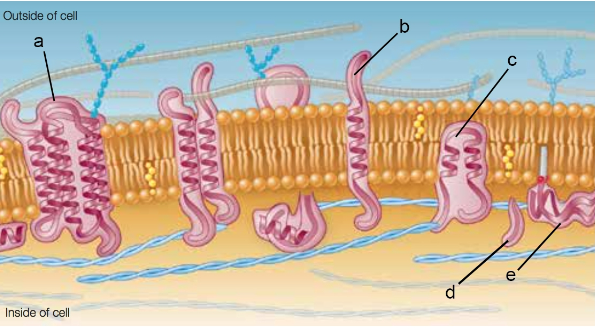
A section of the cell membrane is shown below. Which
letter(s) in the figure represent transmembrane proteins?
a. a and b
b. b and c
c. c and e
d. b, only
e. d and e
Membrane fluidity is influenced by:
• Lipid composition—short, unsaturated chains
increase fluidity; cholesterol alters interactions
among fatty acid side chains
• Temperature—fluidity decreases in cold
conditions; some organisms alter lipid
composition in cold environments
Membranes differ in lipid composition by
phospholipids vary in terms of fatty acid chain
length, degree of saturation, and polar groups.
at least partly
embedded in phospholipid bilayer. Hydrophobic
regions interact with membrane interior;
hydrophilic regions interact with the aqueous
environment.
integral membrane proteins
covalently
attached to fatty acids or other lipid groups
Anchored membrane proteins
no hydrophobic
groups; not embedded in the bilayer—polar or
charged regions interact with exposed parts of
integral membrane proteins or with charged
heads of phospholipids.
Peripheral membrane proteins
extend through the
bilayer; they may have domains with different
functions on the inner and outer sides of the
membrane
Transmembrane proteins
carbohydrate attached to a lipid
Glycolipid
oligosaccharide attached to a
protein
Glycoprotein
many carbohydrates attached
to a protein
Proteoglycan
Which compounds in a biological membrane form a barrier
to the movement of hydrophilic materials across the
membrane?
a. Integral membrane proteins
b. Carbohydrates
c. Lipids
d. Amino acids
e. Peripheral membrane proteins
biological membranes
allow some substances, but not others, to pass
Selective permeability
does not require energy;
substances diffuse down a concentration
gradient
Passive transport
requires energy and the
assistance of specialized membrane proteins.
Active transport
random movement of particles toward a state of equilibrium; a net movement from regions of higher concentration to regions of lower concentration
Diffusion
Diffusion in water is slow; speed depends on:
• Diameter of molecules
• Temperature
• Concentration gradient
• Area and distance
Simple diffusion
net movement of water from a region
of lower solute concentration to a region of
higher solute concentration
osmosis
pressure that must be applied to a solution to prevent flow of water
across a membrane by osmosis:
= CRT
osmotic pressure
solute particles per liter of water
(solute concentration)
Osmotic pressure can be quantified by
osmolarity
relative concentration of solutes on either
side of a membrane; determines direction and extent of net water movement
tonicity
solutions have equal solute
concentrations are…
isotonic
solution has a lower solute concentration is…
hypotonic
solution has a higher solute
concentration is…
hypertonic
Which statement regarding the red blood cells in the figure
is true?
a. Osmosis occurs when a cell goes from condition B to C
but not from condition B to A.
b. The concentration of solutes inside cell C is higher than
in the solution surrounding the cell.
c. Diffusion of solutes out of the cell is causing the events
shown in the transition from condition B to A.
A molecule is present at two different concentrations on
either side of a membrane. The molecule will have the
greatest diffusion rate if the concentration is _______ mM
on one side and _______ mM on the other.
a. 20; 30
b. 50; 60
c. 30; 30
d. 15; 50
is the internal pressure against the cell wall—as it builds up, it prevents more water from entering
Turgor pressure
passive transport of solutes down their concentration gradient with the help of integral transmembrane proteins
Facilitated diffusion
form channels across the
membrane
channel proteins
bind to a solute to speed up diffusion
Carrier proteins
channel proteins that allow specific ions to pass through; water can “hitchhike” along with some ions
Ion channels
Ligand-gated—the stimulus is
a ligand, a chemical signal
Voltage-gated—the stimulus is
a change in electrical charge difference across the membrane
glucose is quickly broken down in the cell, so there is always a strong concentration gradient that favors glucose
uptake
glucose transporters
A cell shrinks if the solution surrounding it is _____________ to its contents and will expand if the solution surrounding it is _____________ to its contents.
hypertonic; hypotonic
In facilitated diffusion, the diffusion rate of a specific
molecule across a membrane does not continue to
increase as the molecule’s concentration difference across
the membrane increases beyond a certain point. Why?
a. Facilitated diffusion requires the use of ATP.
b. As the concentration difference increases, molecules
interfere with one another.
c. The diffusion constant depends on the concentration
difference.
d. The carrier proteins become saturated.
In reference to membranes, the characteristic of allowing certain substances to pass through while other substances are excluded.
selective permeability
Diffusion across a membrane; may or may not require an integral membrane protein.
passive transport
he energy-dependent transport of a substance across a biological membrane against a concentration gradient—that is, from a region of low concentration (of that substance) to one of high concentration
active transport
the process of random movement of particles toward a state of equilibrium.
diffusion
the change in solute concentration with distance in a given direction. The greater the concentration gradient, the more rapidly a substance diffuses.
concentration gradient
A transport protein in plant and animal cell membranes through which water passes by osmosis
(channels for movement of water)
aquaporins
Movement of water across a selectively permeable membrane, from a hypotonic solution to a hypertonic solution.
osmosis
The property of aqueous solutions that determines the direction of osmotic water movement when water can move from one solution to another. When water moves by osmosis between two solutions, it always moves from the lower to the higher osmotic pressure. Each individual dissolved entity (regardless of chemical nature) contributes approximately equally to the osmotic pressure of a solution.
osmotic pressure
uses chemical-bond energy released during the hydrolysis of ATP or another chemical reaction, or light energy, to transport a solute against its concentration gradient.
primary active transport
An integral membrane protein (anti-porter) that carries out primary active transport of ions; it uses energy from ATP to pump sodium ions out of a cell and potassium ions into the cell.
sodium-potassium (Na+ -K+) pump
A form of active transport that does not use as an energy source; rather, transport is coupled to ion diffusion down a concentration gradient established by primary active transport. Also called coupled transport or co-transport.
secondary active transport
Within the cytoplasm, a membrane-enclosed compartment that is associated with other organelles; the Golgi apparatus is one example
It is used to transport large molecules or particles out of the cells
vesicles
Transport of large molecules or particles out of the cells
exocytosis
A process by which liquids or solid particles are taken up by a cell through invagination of the cell membrane
endocytosis
a specialized cell engulfs a large
particle or another cell, forming a food vesicle
(phagosome). This usually fuses with a
lysosome, where the contents are digested.
phagocytosis
vesicles are smaller and bring in
fluids and dissolved substances.
pinocytosis
brings specific large molecules into a cell via specific receptors.
receptor-mediated enocytosis
The ___ of a cell determines its metabolic
activity and thus the cell’s need for resources and
rate of waste production per unit of time.
volume
The ___ of a cell determines rate at which
substances can enter or leave the cell.
surface area
a meshwork of protein
filaments:
• Supports and maintains cell shape
• Maintains position of organelles and other particles within the cell.
• Moves organelles and other particles within the cell
• Interacts with extracellular structures to anchor cell in place.
cytoskeleton
actin polymers: actin monomers attach to the “plus end” and detach at the “minus end” of the filament.
these help maintain cell shape and cause
localized shape changes in a cell:
• Cytoplasmic streaming
• Division of an animal cell into two daughter cells following mitosis.
• Formation of pseudopodia that enable some cells, such as Amoeba, to move
microfilaments
the filaments can shorten (more detachment) or lengthen (more assembly), allowing for quick assembly or breakdown of the cytoskeleton.
dynamic instability
In muscle cells, interaction of___ and the motor protein myosin, are responsible for cell contractions.
actin filaments
At least 50 different kinds in six molecular
classes
• Tough, ropelike protein assemblages; more permanent than other filaments; no dynamic instability
• Anchor cell structures in place
• Resist tension, maintain rigidity
intermediate filaments
are long, hollow, unbranched cylinders about 25 nm in diameter. Microtubules are polymers of the protein tubulin.
microtubules
A protein that polymerizes to form microtubules
tubulin
A long, whiplike appendage that propels cells. Prokaryotic flagella differ sharply from those found in eukaryotes
Some cells have projections from their cell membrane termed
flagella
A hairlike organelle used for locomotion or signaling. Generally shorter than a flagellum.
cilia
Plants, archaea, bacteria, fungi, and some protists build cell walls of
cellulose, chitin, or proteins
provide structural support, and protection from physical damage and pathogens.
Cell walls
A material of heterogeneous composition surrounding cells and performing many functions, including adhesion of cells.
Animal cells have an _____ of collagen and gel-like proteoglycans. It has many
functions:
• Hold cells together in tissues.
• Contribute to physical properties of cartilage, skin, bone
• Help filter materials passing between different tissues, e.g., in the kidney
• Help orient cell movements during embryonic development and tissue repair.
extracellular matrix
a fibrous protein found extensively in bone and connective tissue
collagen
The extracellular matrix of animal cells
a. is composed of cellulose.
b. contains lysosomes.
c. limits the cell volume by remaining rigid.
d. helps orient cell movements during embryonic
development
Proteins such as integrins connect the ____
They span the cell membrane; reversible binding sites connect to microfilaments or intermediate filaments on the interior of the cell, and to collagen in the extracellular matrix.
Cell membrane to the extracellular matrix.
A community of microorganisms embedded in a polysaccharide matrix, forming a highly resistant coating on almost any moist surface
biofilm
Specialized structures associated with the cell membrane that join cells in multicellular organisms. Some contribute to cell adhesion, others to intercellular communication
cell junctions
prevent substances from moving through spaces between cells. For example, the epithelium of the urinary bladder contains tight junctions to prevent urine from leaking into the adjacent abdomen
tight junctions
hold adjacent cells together with stable protein connections. This provides mechanical stability for tissues such as skin that are under stress due to movement. Desmosomes do, however, permit some materials to move around in the extracellular matrix between cells.
desmosomes
are channels that run between membrane pores in adjacent cells and allow substances such as ions, small molecules, and electric signals to pass between cells. In the heart, for example, gap junctions allow the rapid spread of electric current mediated by ions so the heart muscle cells can beat in unison.
Gap junctions
A cytoplasmic strand connecting two adjacent plant cells.
are similar to gap junctions between animal cells, but they allow passage of larger substances.
allow water, ions, small molecules, hormones, and even some RNA and protein molecules to move between connected cells
plasmodesmata
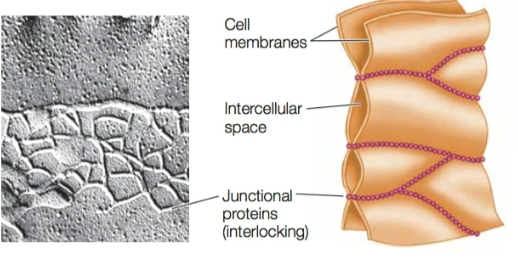
What is a function of the cell junction shown in the figure?
a. Exchange of a lot of material between adjacent cells
b. Conducting electrical activity, as in the heart
c. Preventing substances in a lumen from leaking into the
spaces between the epithelial cells lining the lumen
Lack a nucleus and membrane-enclosed internal compartments.
Protein structures separate certain substances from others in the cell.
Tiny encapsulin nanocompartments enclose a single protein, such as peroxidase, that breaks down toxic substances.
Some cell functions occur in cell regions, likely separated by the cytoskeleton.
prokaryotes