7. step- along calculations and ray tracing
 Call Kai
 Learn
Learn Practice Test
 Spaced Repetition
 Match
Match Flashcards
 Knowt Play
1/24

There's no tags or description
Looks like no tags are added yet.
Name | Mastery | Learn | Test | Matching | Spaced | Call with Kai |
|---|
No analytics yet
Send a link to your students to track their progress
25 Terms
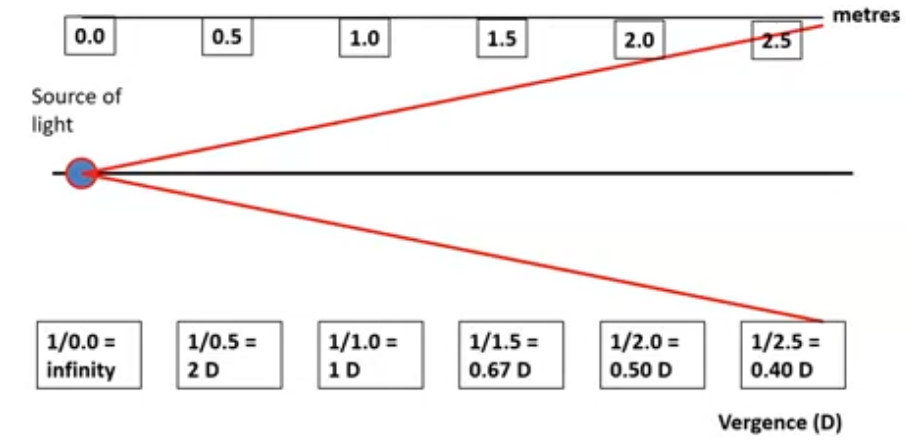
vergence
given in dioptres and calculated by dividing the refractive index of the medium in which the pensic s travelling by the distance to or from the focal point
light travelling left to right through air
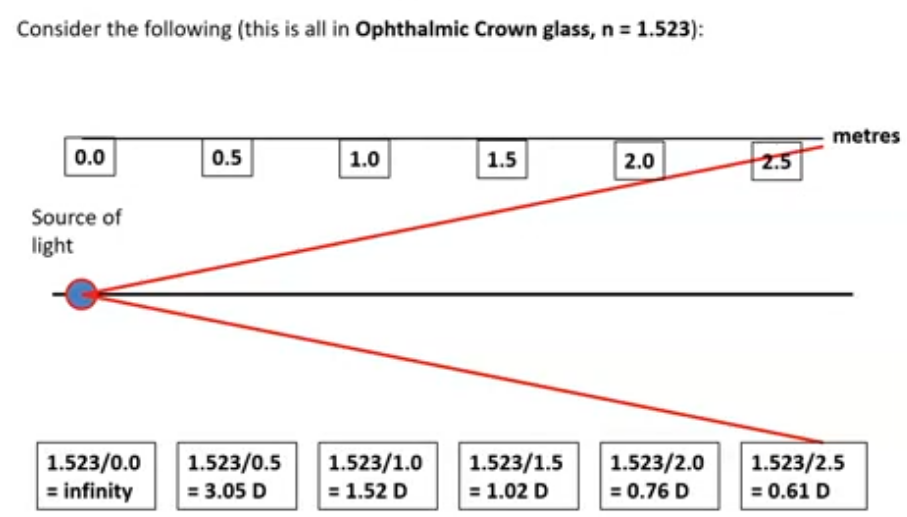
rays passing through a medium other than air
no longer a reciporcal
refractive distance of material/ distance
at 1.0 metre, have more dioptres, and reduces as moves further from source
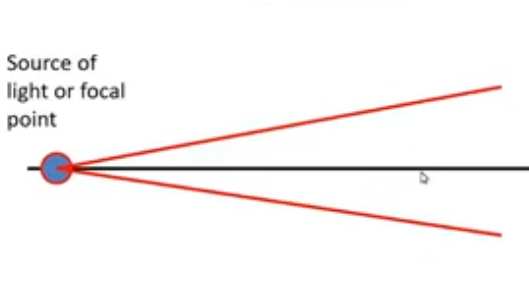
what do diverging rays look like
light travels left to right
light diverging away from a source of light or focal point has negative vergence
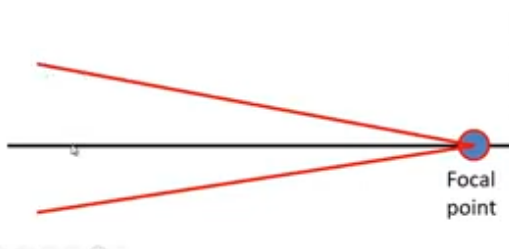
what do converging rays look like
light travels from left to right
light converges towards a focal point has positive vergence
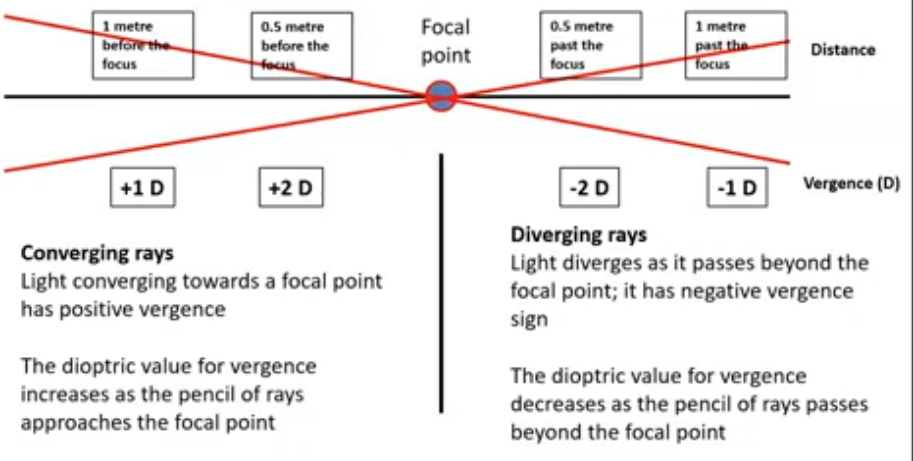
converging & diverging in air
positive dioptric powers of increasig numbers until reaches focal point where it is infinity
past the point- light diverges, dioptres are negative
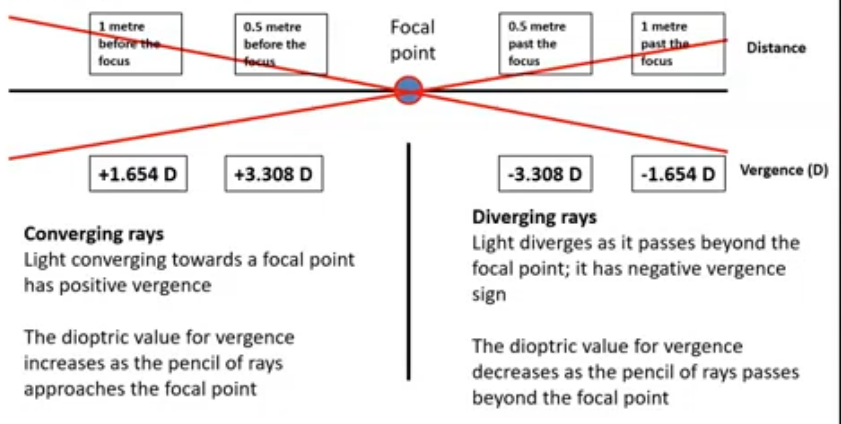
converging and diverging through opthalmic flint glass with a refractive index of 1.654
higher refractive index than air
value/ distance gives dioptric value
moving left to right, more dioptres until go through infinity
then goes to minus
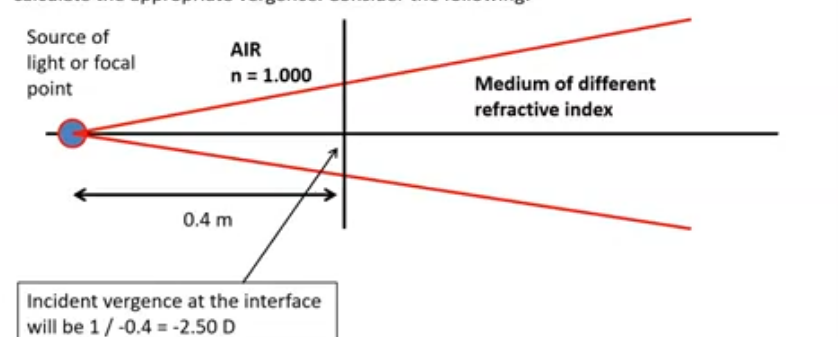
calculating vergence at a transition between 2 media of different refarctive index
interface: boundary between 1 medium and the other
light source in air 40cm away from interface
light passes through air and vergence when hits the surface = 1/-0.4 = -2.50D
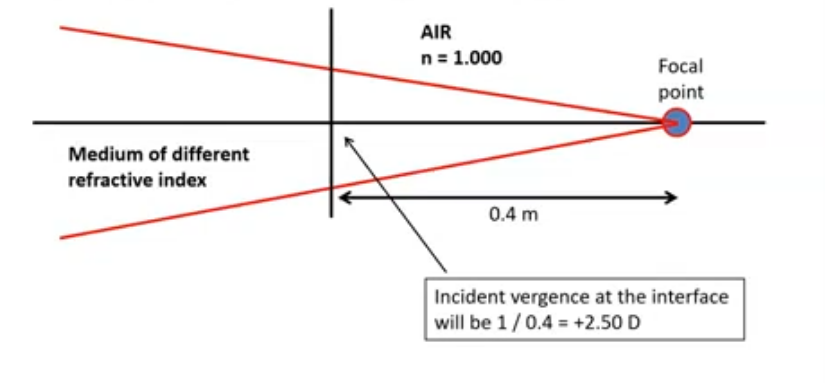
eg of light converging towards focal point but meeting an interface before focal point is reached
calculating vergence when interface has dioptric power
can work out radius of curvature: ( n’-n)/F
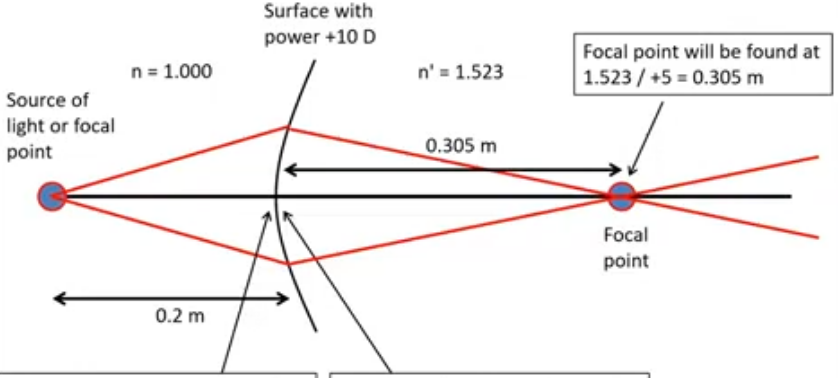
incident vergence AT interface will be 1/-0.2 = -5.00D
vergence of light AFTER surface: -5.00 + 10D = +5D
add the surface power to the incident vergence at the interface
because refractive index is not in air anymore its 1.523
so focal point is formed at : 1.523 /+5 = 0.305m
what happens if something else gets in the way of light before it reaches focal point
light hits front surface of lens- diverges
converges as hits spectacle lens so positive
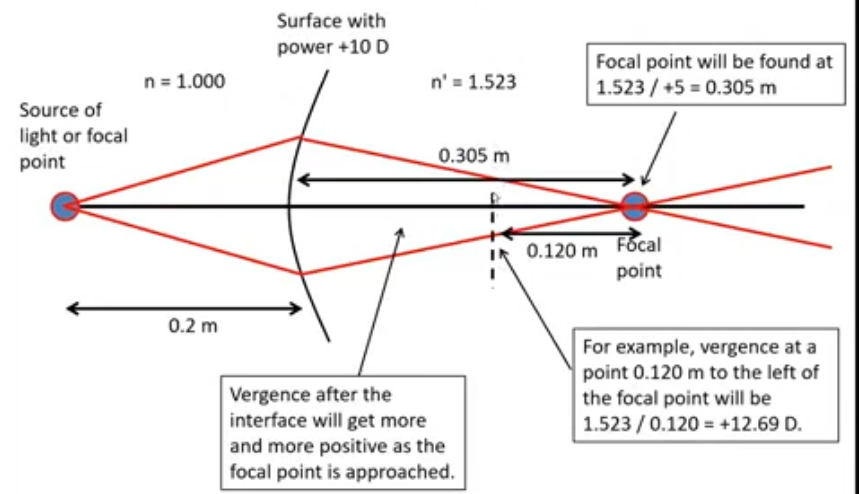
before focus, it hits the back surface of the lens
need to work out vergeance at this point
at the dashed point: light converging, wavefront has plus power , represents where the rear surface of the lens is
1.523/ 0.120 = +12.69D
if the interface was behind the focal point
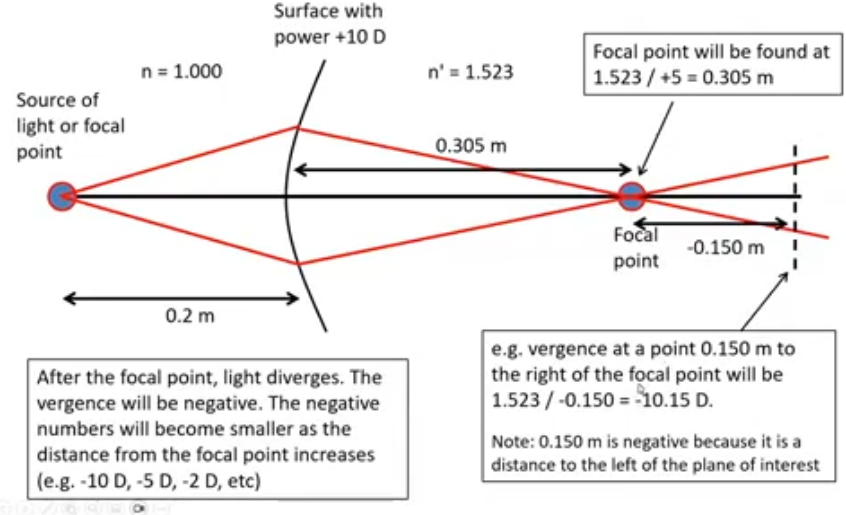
dashed line is behind focal point
light at that point is diverging- negative power
1.523/-0.150 = -10.15D
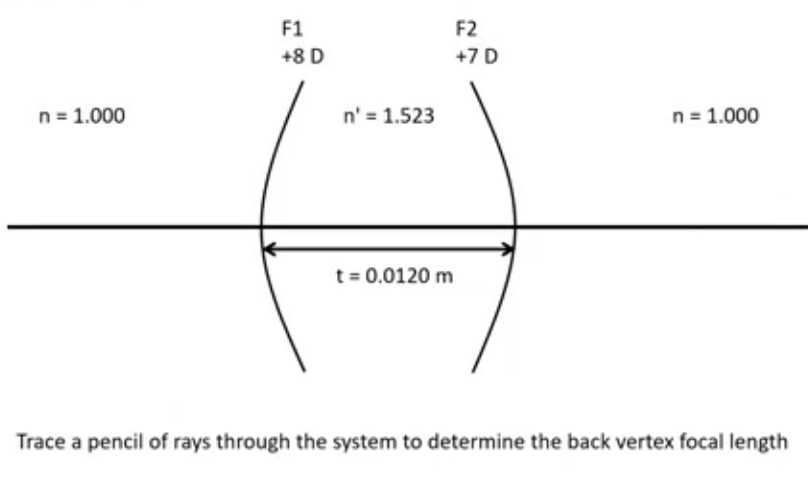
thick lens in air - ray trace to determine back vertex focal length 1
input numbers into BVP equation
or ray trace and check using formula
flat form lens- biconvex lens
light travelling from a source at infinity so has 0D when hits front surface
need to determine vergence of light immediately after front surface
to do this, 0D + 8 = 8D
light converges to F2, so dioptric power goes up
imagine the light after converging carries on throughout - dashed lines , to work out how far it needs to travel to hit focal point
1.523/+8 = 0.1904m :rays would form a focus at this distance if the lens was really thick ( this is 16 lens thicknesses ), but it is not its 0.012
to work f2 vergence, subtract thickness of lens from the back focal length of F1 - 1.523/8 = 0.1904m
so F2 incident vergence - 1.523 / (0.1904-0.012) = +8.537 D #
this shows the vergence as it just hits F2
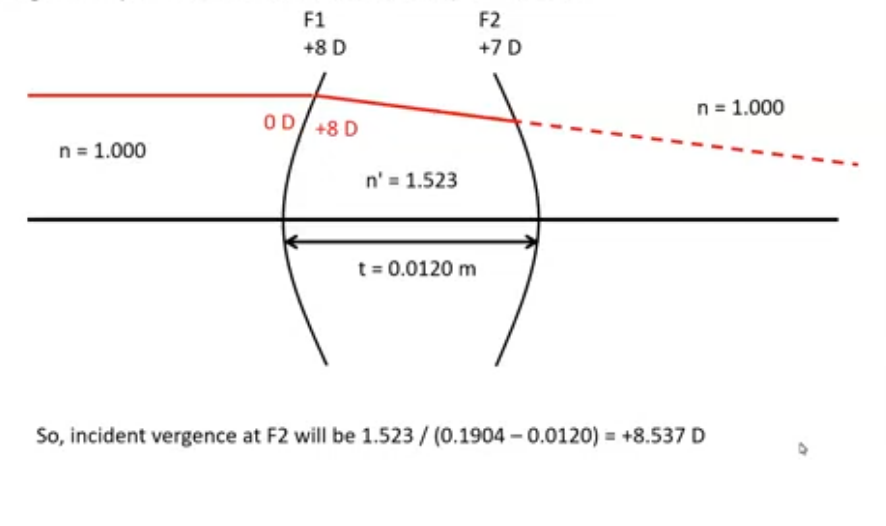
how to work out vergence immediatly after it hits the second surface 2
all you need to do is add the surface power of F2 to the vergence AT the lens
so at the lens it was +8.537D
surface power of F2 = 7D
= 8.537 +7 = 15.537D
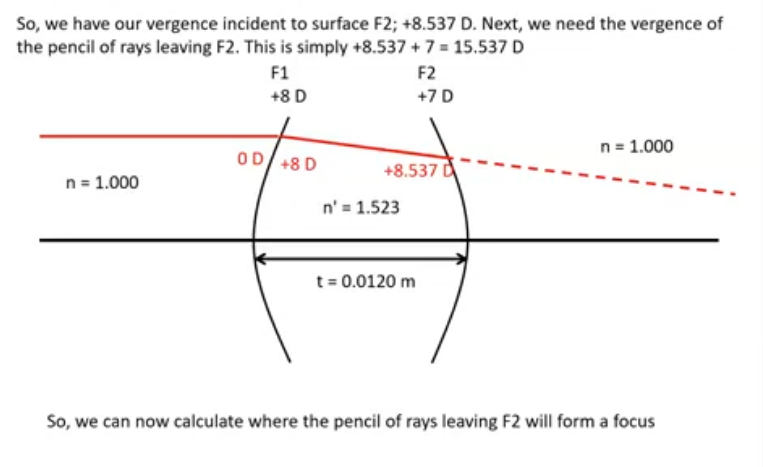
Can now work out where light will form a focus
back in AIR
1/15.537 = 0.644m from the rear surface is where we form a focus BVP = +15.537 can check its rouphly right by thin lens equation = F1+F2 = +7+8 = 15
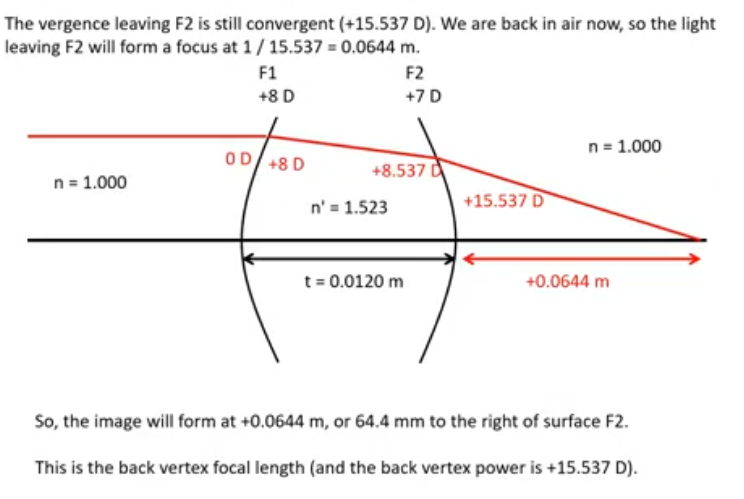
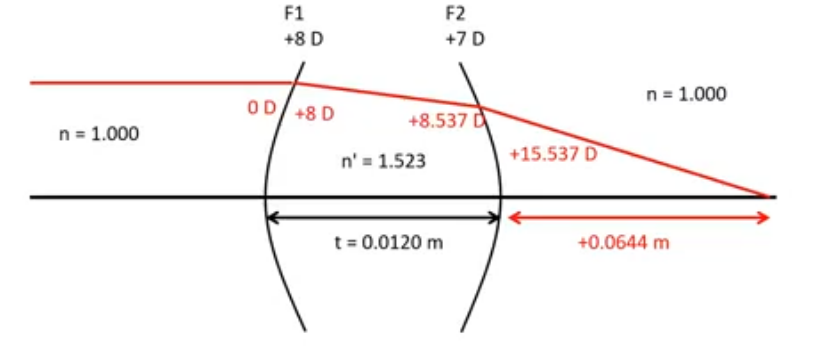
Can use the BVP formula
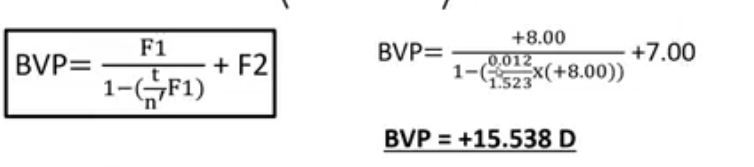
consider the form of this lens : ray trace through to work out BVP 1
meniscus form
thin lens equation would indicate power of the lens would be -5 D
light hitting F1 at infinity is 0D
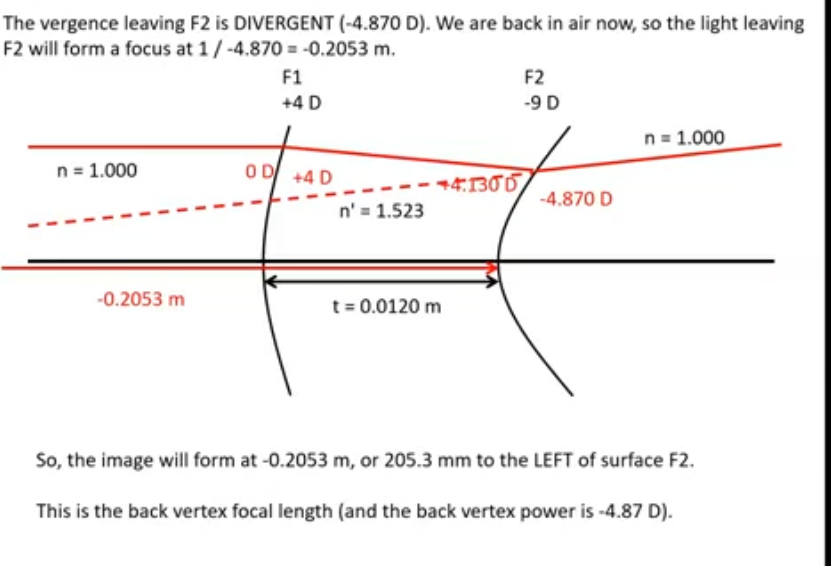
vergence leaving F1 would be 0+4 = +4D
As F2 is only 0.012m away from F1, the rays will be intercepted by F2 before it reaches focus
the rays are convergent so vergence at F2 will have greater positive power
F1= 1.523 / 4 = 0.3808m ; back focal length of F1
vergence at F2 calculated by subtracting thickness of lens from back focal length of F1
1.523 /( 0.3808-0.012) = +4.130D
vergence leaving F2 diverging so negative number , add on -9 to the vergence at F2
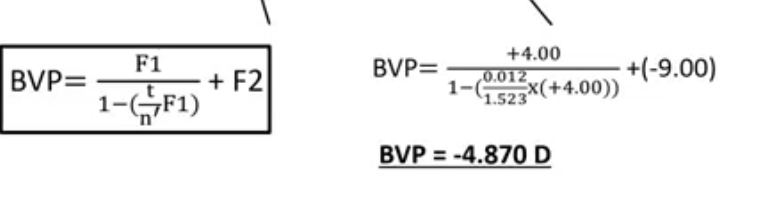
+4.13-9 = -4.870 D after the rear surface
as its a minus lens, trace rays back to the focal point
1/ -4.870 = -0.205m to the left of surface F2
can check using the BVP formula 2
ray tracing through a focimeter
used to show why a low power lens can make the image of the target in a focimeter really blurred
this is because focimeter contains an astronomical telescope- from this we get vergence amplification
this means if you got a small error in vergence of light incoming telescope, when it passes through telescope, the error is made bigger so the blurr is made more prominent
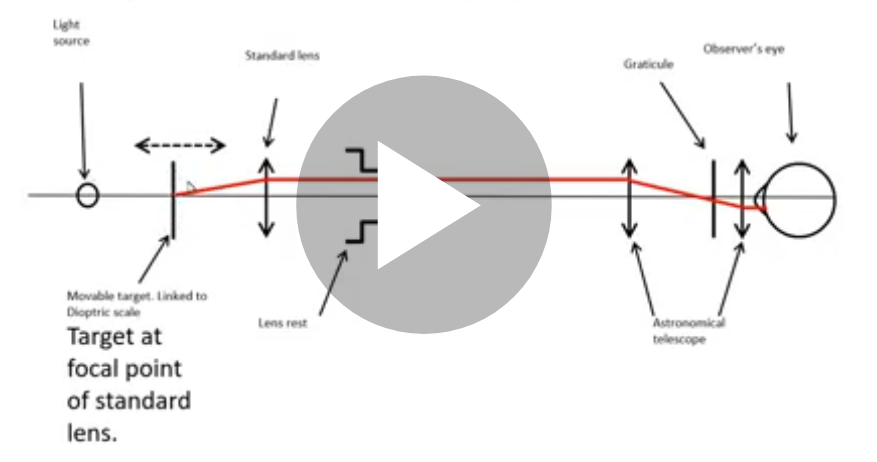
standrad lens distance from lens rest is the focal length of standard lens
target at the focal point of standard lens so 0 vergence light goes into telescope
converges, then diverges once gone through the focal point
rendered paralell when enters eye
what is the astronomical telescope
it has 2 positive lenses that are separated by the sum of their focal lengths and that the lens closest to the eye is the highest power (hsortest focal length) of the 2 lenses
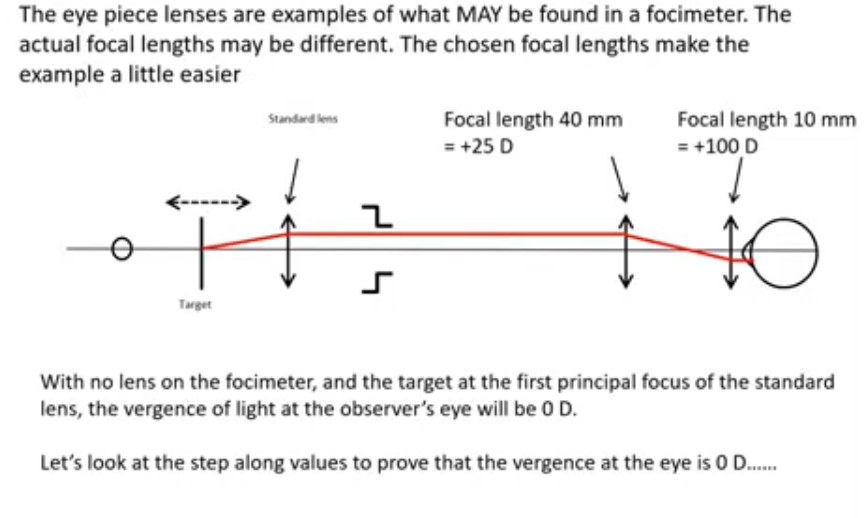
vergence of light as it moves through objective lens
objective lens +25 D and eyepiece lens +100D
target 40mm 1/-0.04 = -25D
as standrad lens is +25D vergence here is +25-25 = 0D
as it hits objective lens it converges at the +25D objective lens and forms a focus 0.04m from the objective lens
light now diverges from this point, but at 1cm from this point it hits the eyepiece lens
vergence at eyepiece - 1/-0.01 = -100D
as focal length of eyepeice lens is +100 D
vergence immediatly after the eyepiece les is -100 +100 = 0D
the observer will see a clear image of the target
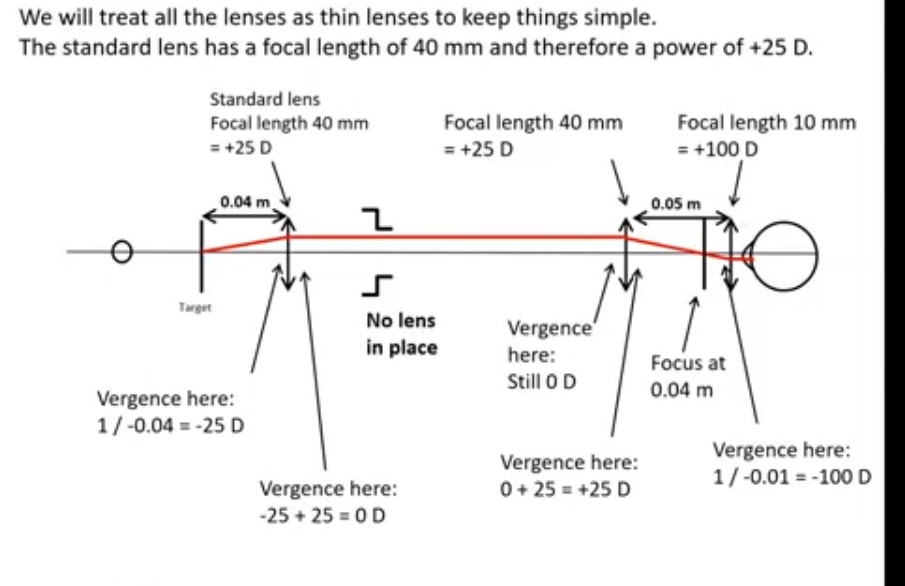
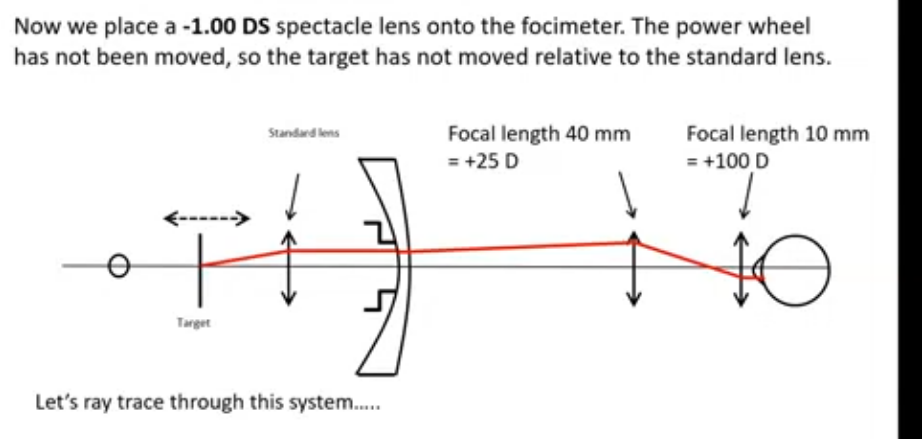
ray tracing through focimeter when a lens is put in place 1 eg
target hasnt moved
vergence from target to stabdard lens is 1/-0.04 = -25 D
vergence after standard lens is 0 as standard lens was +25D
as it hits the -1.00DS lens vergence is now 0+-1= -1D so diverges
0.05 m distance between objective lens and -1.00DS lens
vergence immediatly after the lens is -1.00DS , that is then going to pass 0.05m until it hits front surface of astronomical telescope
to work out vergence of light just before it hits the front surface of astronomical telescope:
1/-1 = -1 m
-1 -0.05 = -1.05 m
1/ -1.05m = -0.95 D
vergence after hitting objective lens: -0.95 +25 = +24.05 D
forms a focus at: 1/24.05 = 0.0416m
as distance between the plus lenses are 0.05 m apart, distance from focus to +100D lens = 0.05 - 0.0416 = 0.0084m
so vergence at the eyepiece lens is 1/-0.0084 = -119 D
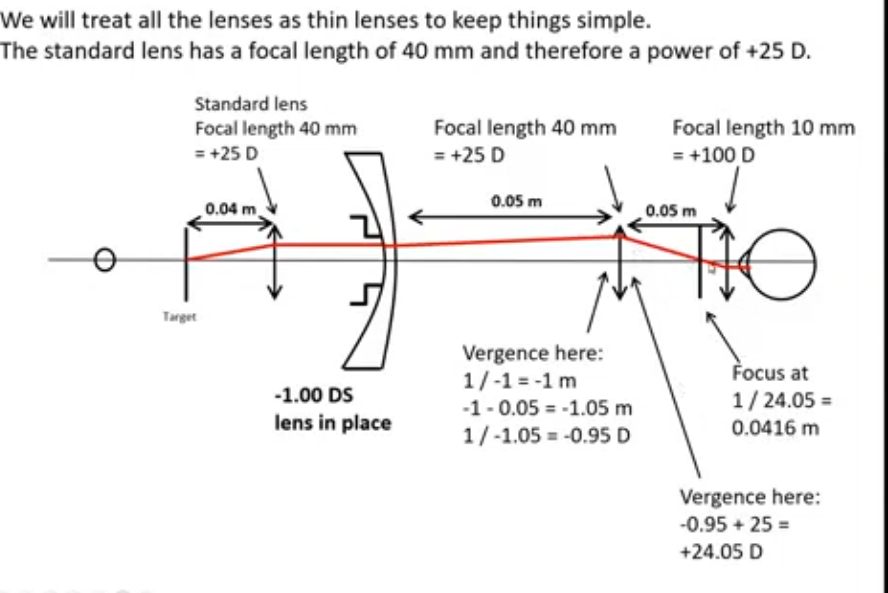
what is vergence after the 100D lens 2
so vergence at the eyepiece was - 119 D
after lens = -119 +100 = -19 D
assuming a distance of 10mm between the 100D lens and the eye( 10 mm gap between your cornea and the lens , the vergence at the eye will be: 1/-19 = -0.0526 m
-0.0526 -0.01 = -0.0626m
1/-0.0626 = -15.97D
observer will see a very blurred image of the target
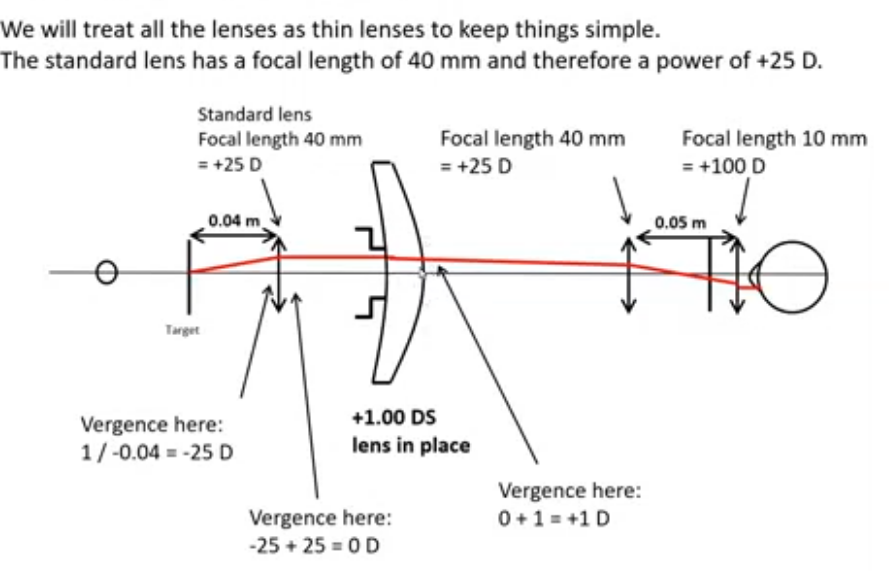
eg when plus 1.00 lens placed on focimeter
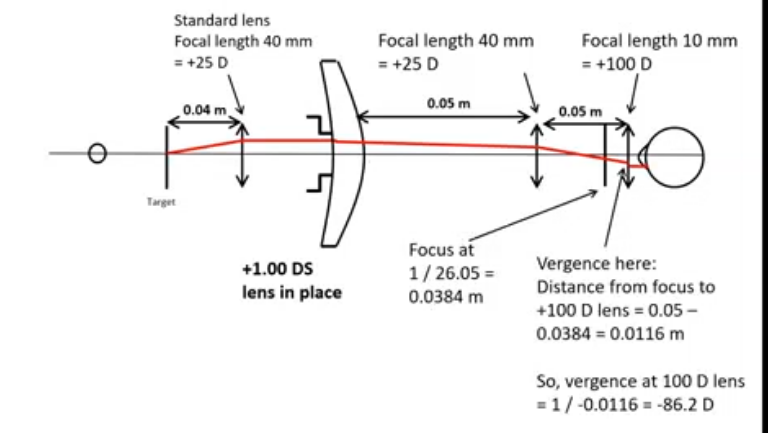
light converges from the lens until pbjective lens with a distance of 0.05m apart
vergence before hitting the objective lens
1/1 = 1m
1-0.05 = 0.95m
1/0.95 = +1.05 D
vergence after hitting objective lens = 0.95+25 = 26.05
forms a focus at 1/26.05 = 0.0384m
vergence at eyepiece lens: distance from focus to +100 D len = 0.05 -0.0384 = 0.0116m
so vergence at 100 D lens 1/- 0.0116 = -86.2 D
vergence after 100 D lens : -86.2 +100 = +13.79 D
1/13,79 = +0.0725 m
0.0725 -0.01 ( countering in distance between cornea and lens) = 0.0625
1/0.0625
+16D
will see bluured image
an object of sie 20mm is placed 10cm to the left of a +20.00DS lens. What is the size of the image?
object size :