BIO 300 Lecture10.IntroToCardio Review

0.0(0)
Studied by 0 people
call kaiCall Kai
learnLearn
examPractice Test
spaced repetitionSpaced Repetition
heart puzzleMatch
flashcardsFlashcards
GameKnowt Play
Card Sorting

1/69

flashcard set

Earn XP

Description and Tags

BIO 300 Pathophysiology

Last updated 4:35 PM on 4/17/26
Name
Mastery
Learn
Test
Matching
Spaced
Call with Kai

No analytics yet

Send a link to your students to track their progress

70 Terms

1
New cards

Heart Location:

rests on the diaphragm

thoracic cavity

mediastinum
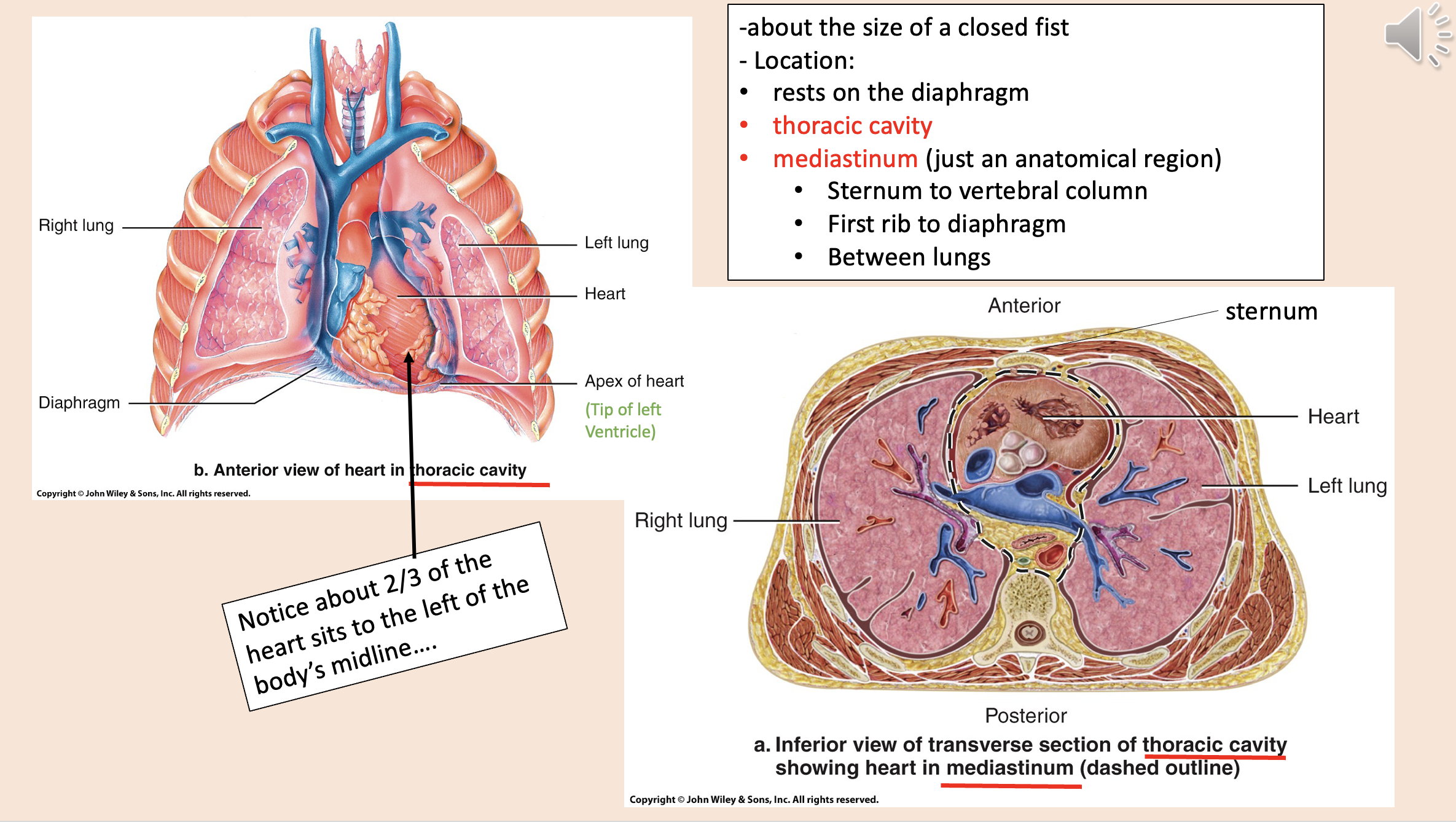
<p>rests on the diaphragm</p><p><span style="color: rgb(255, 0, 0);">thoracic cavity</span></p><p><span style="color: rgb(255, 0, 0);">mediastinum</span></p>
2
New cards

Sternum to vertebral column.

First rib to diaphragm.

Between lungs.

mediastinum
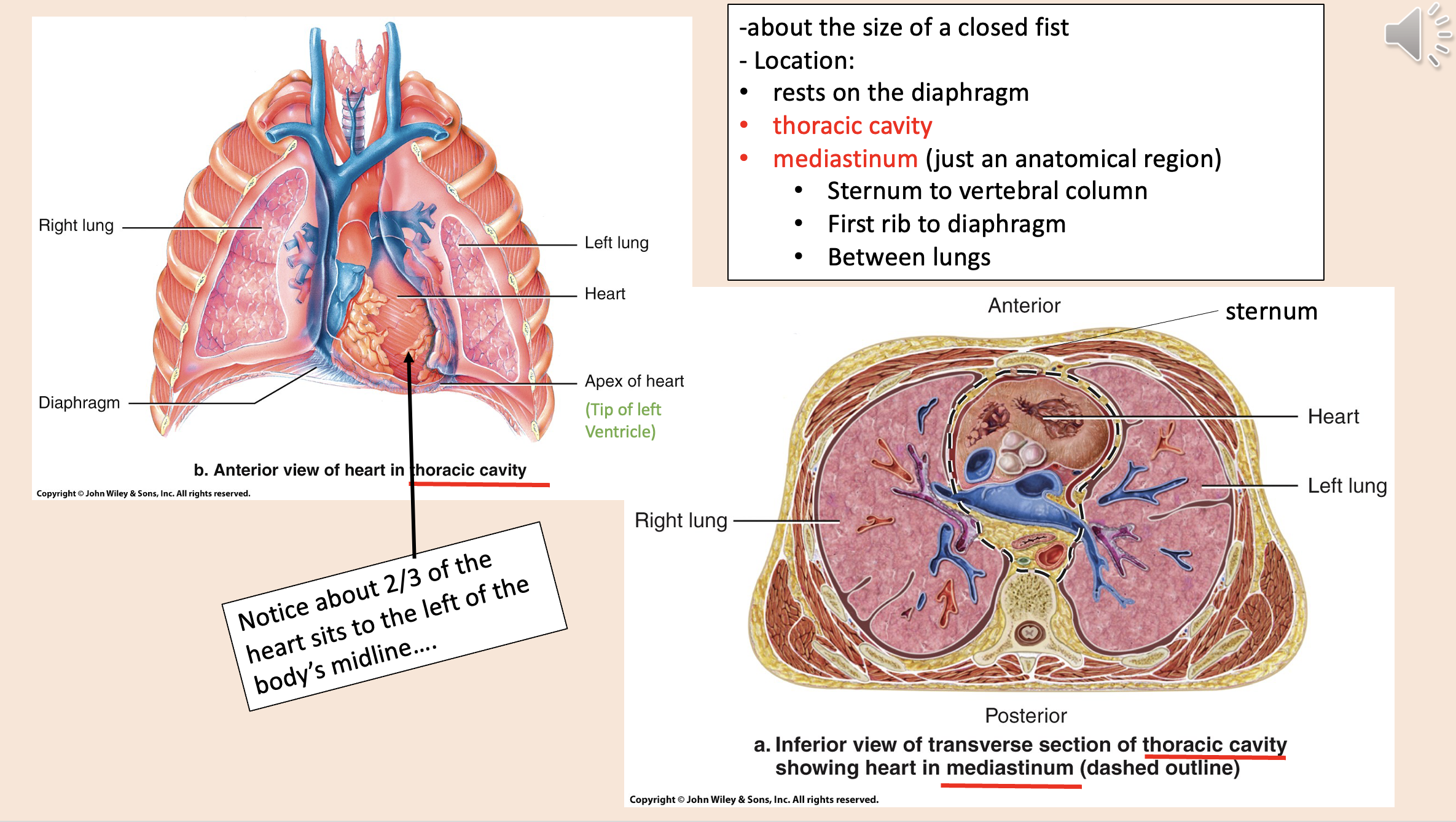
<p><span style="color: rgb(255, 0, 0);">mediastinum</span></p>
3
New cards

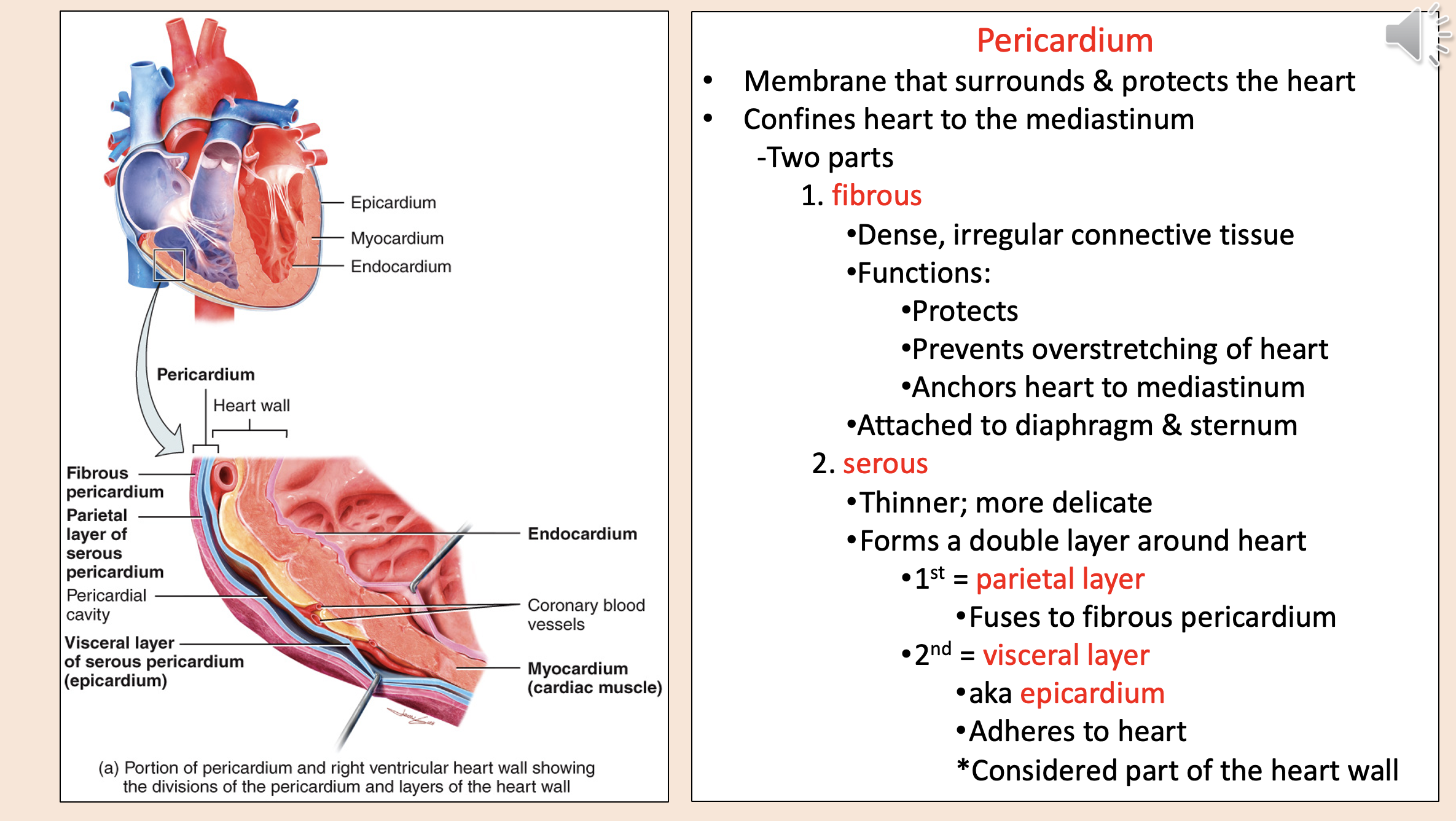
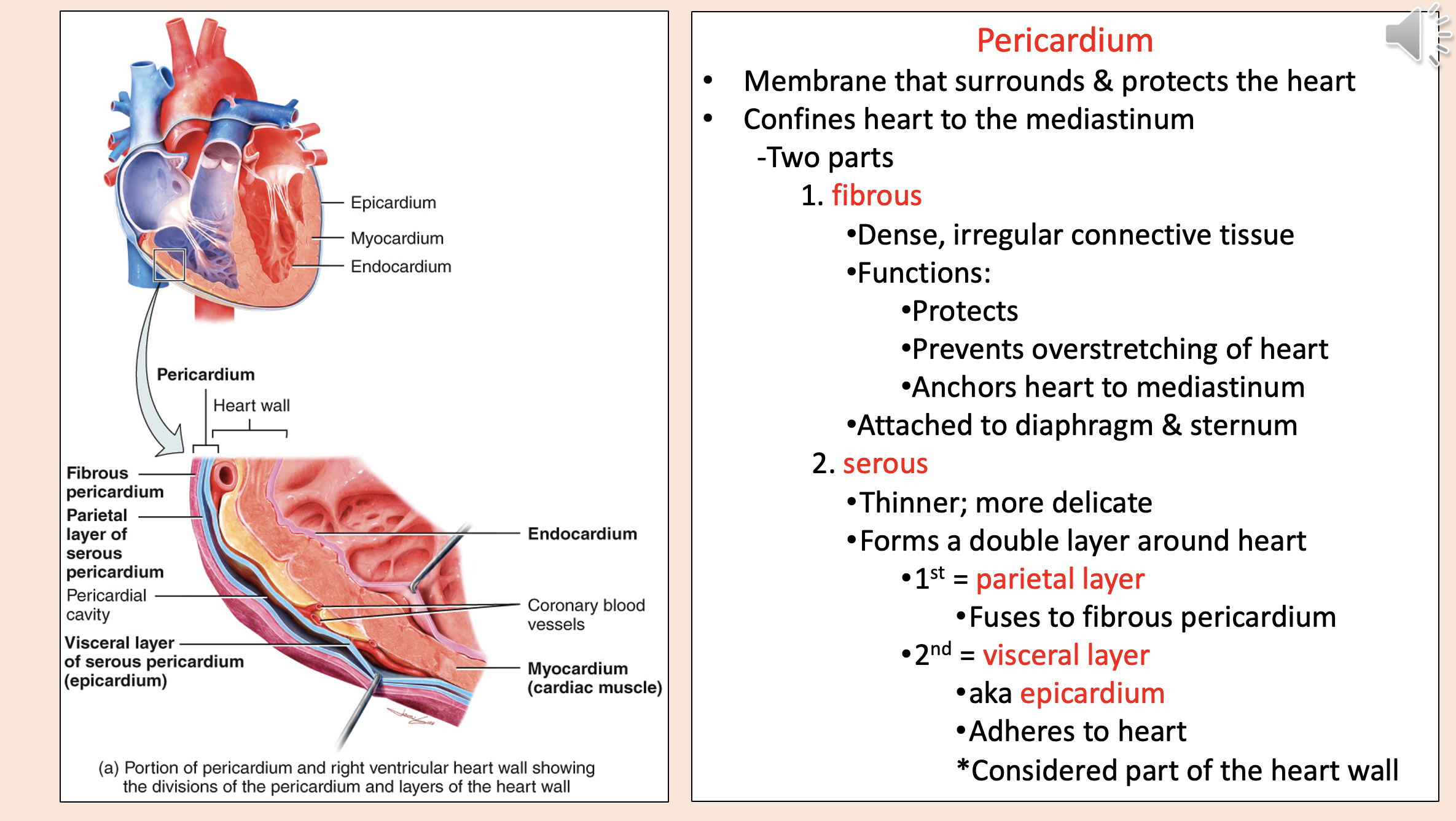
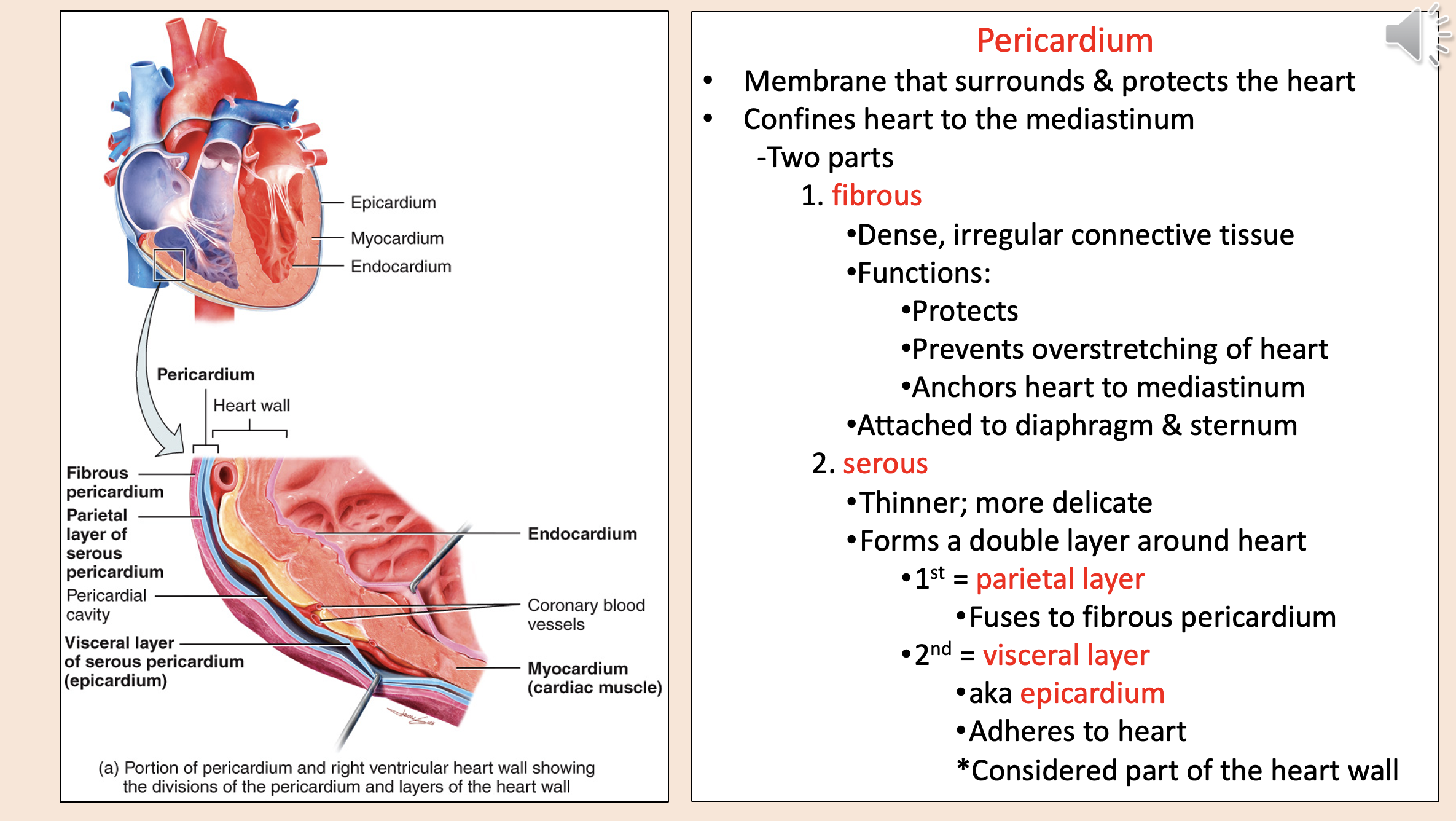
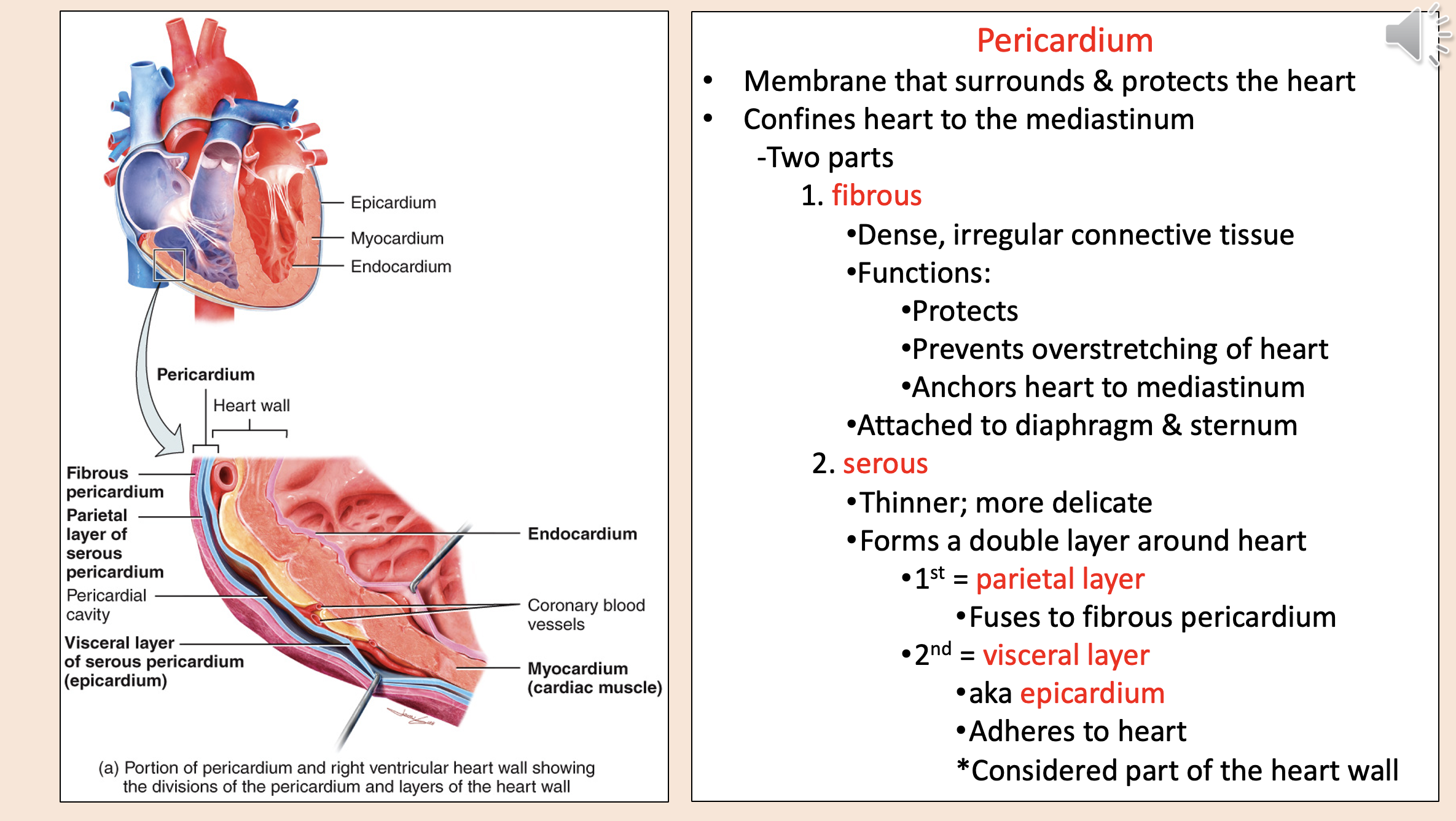
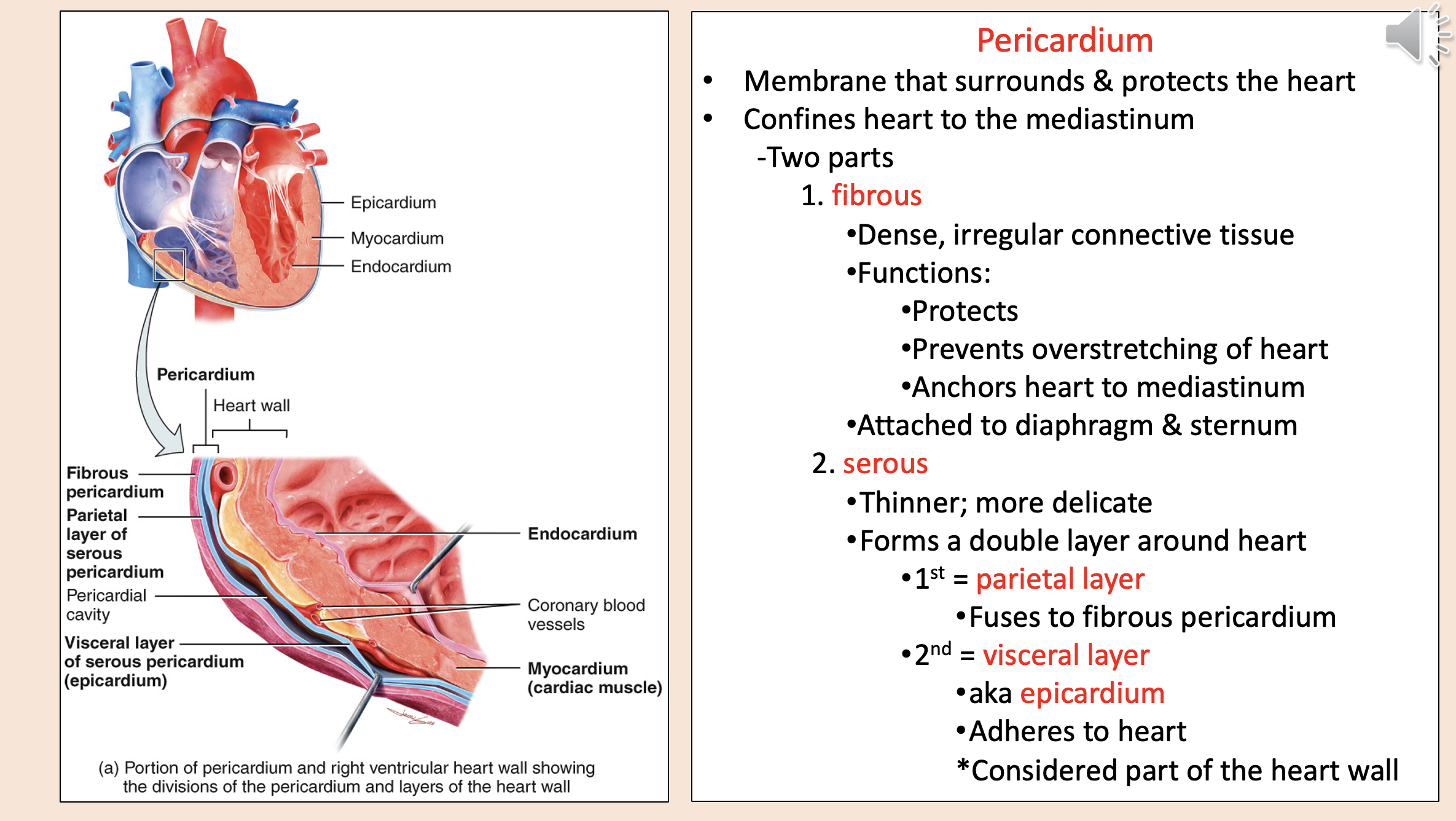
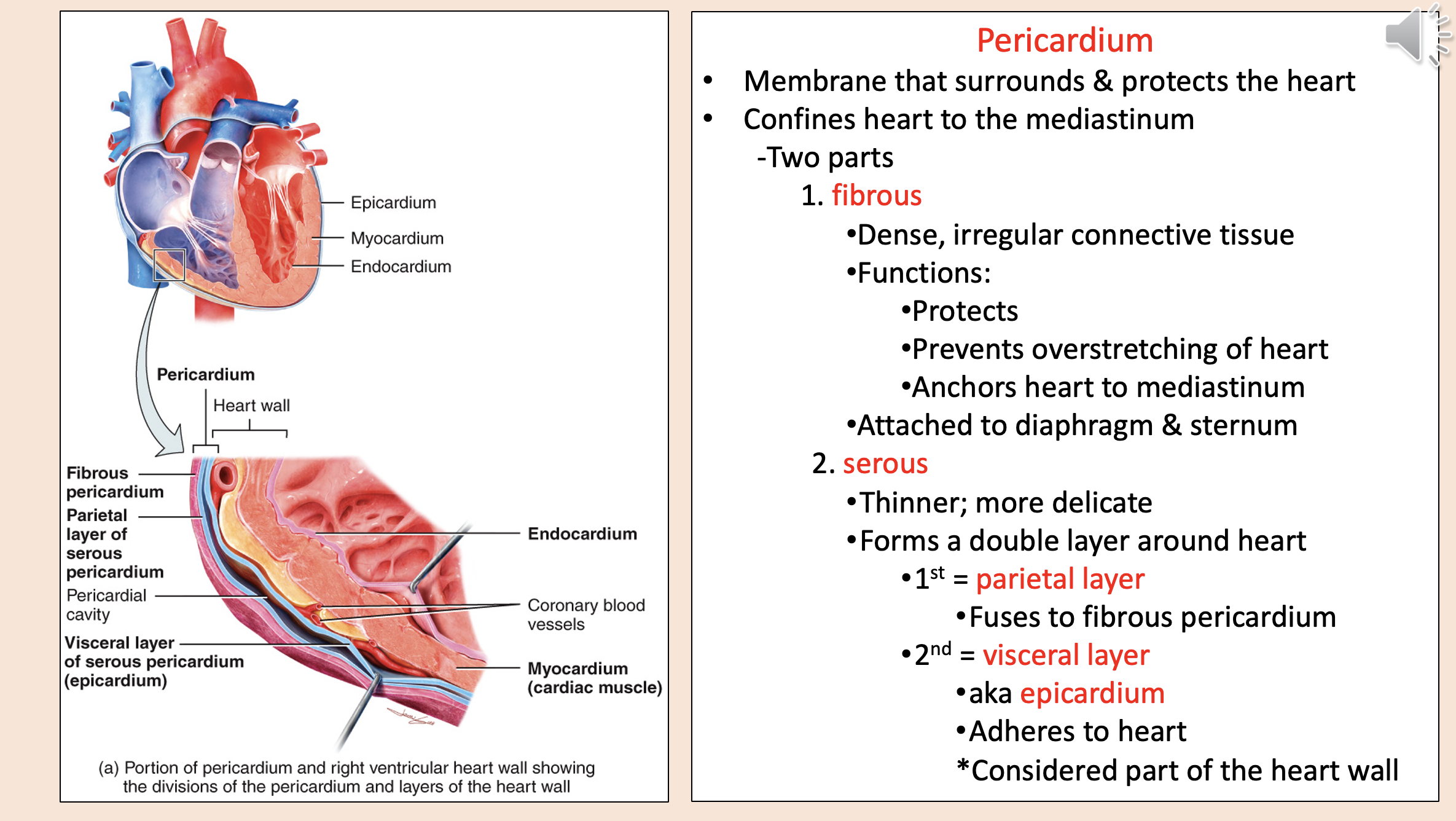
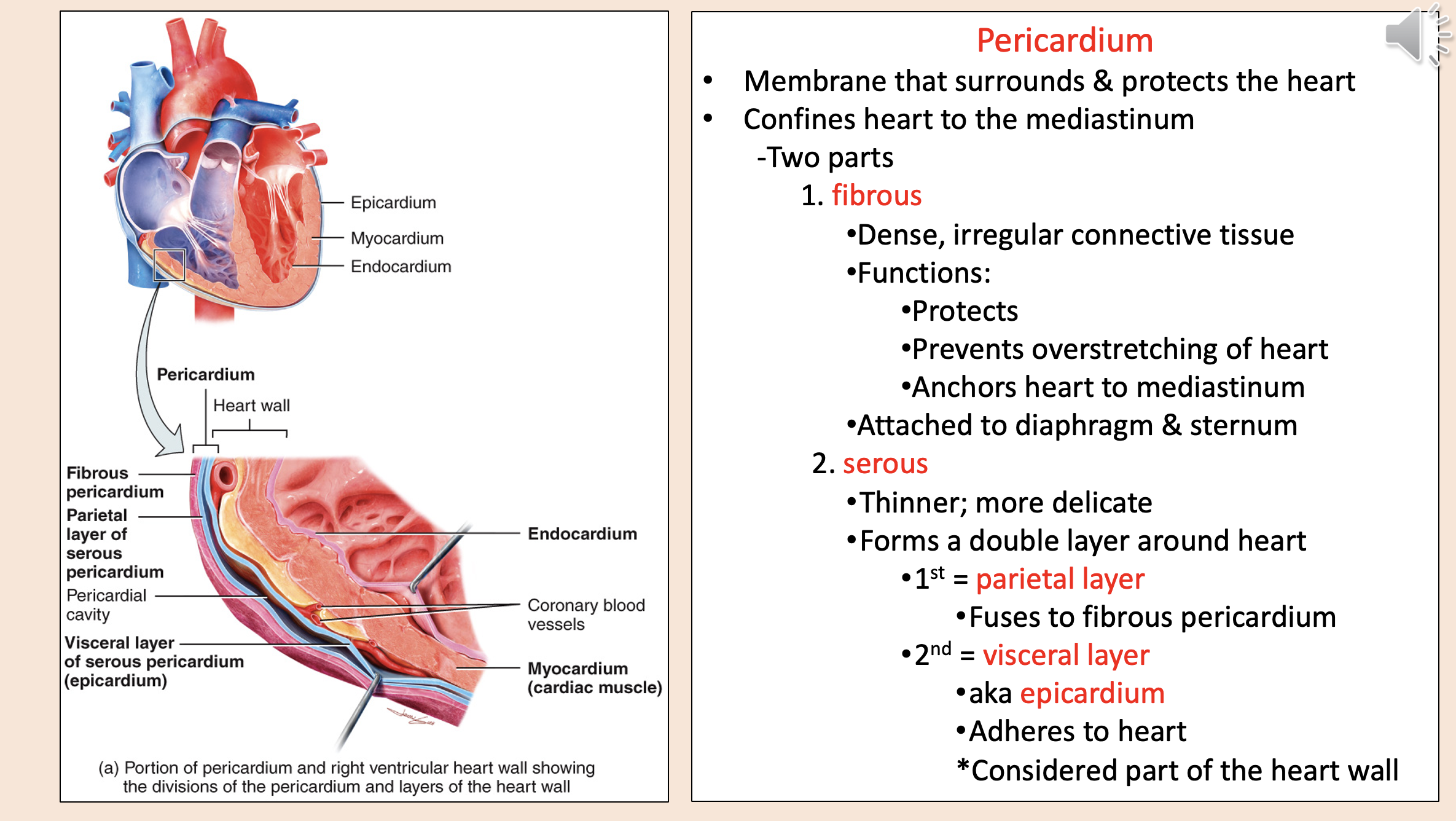
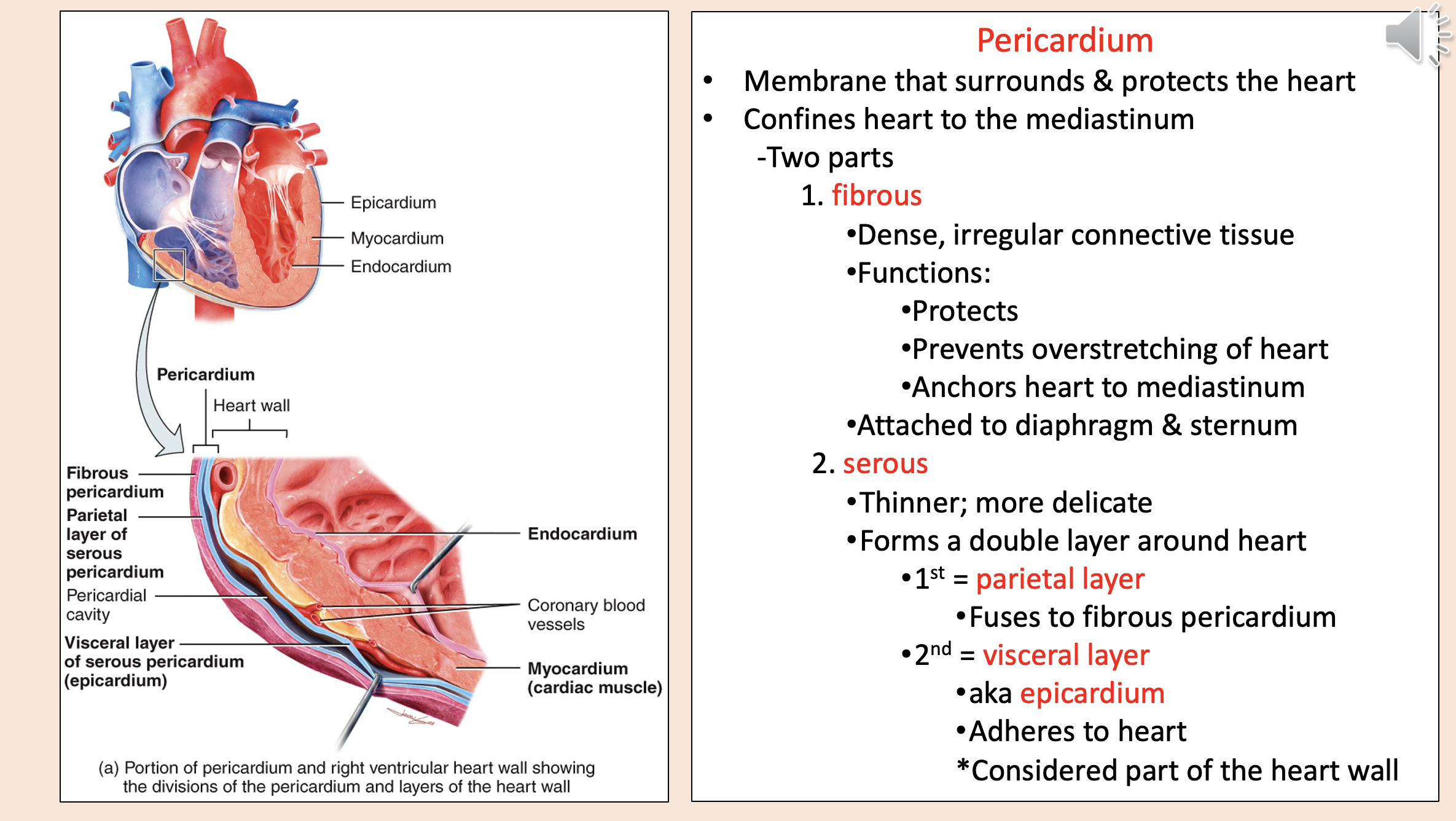
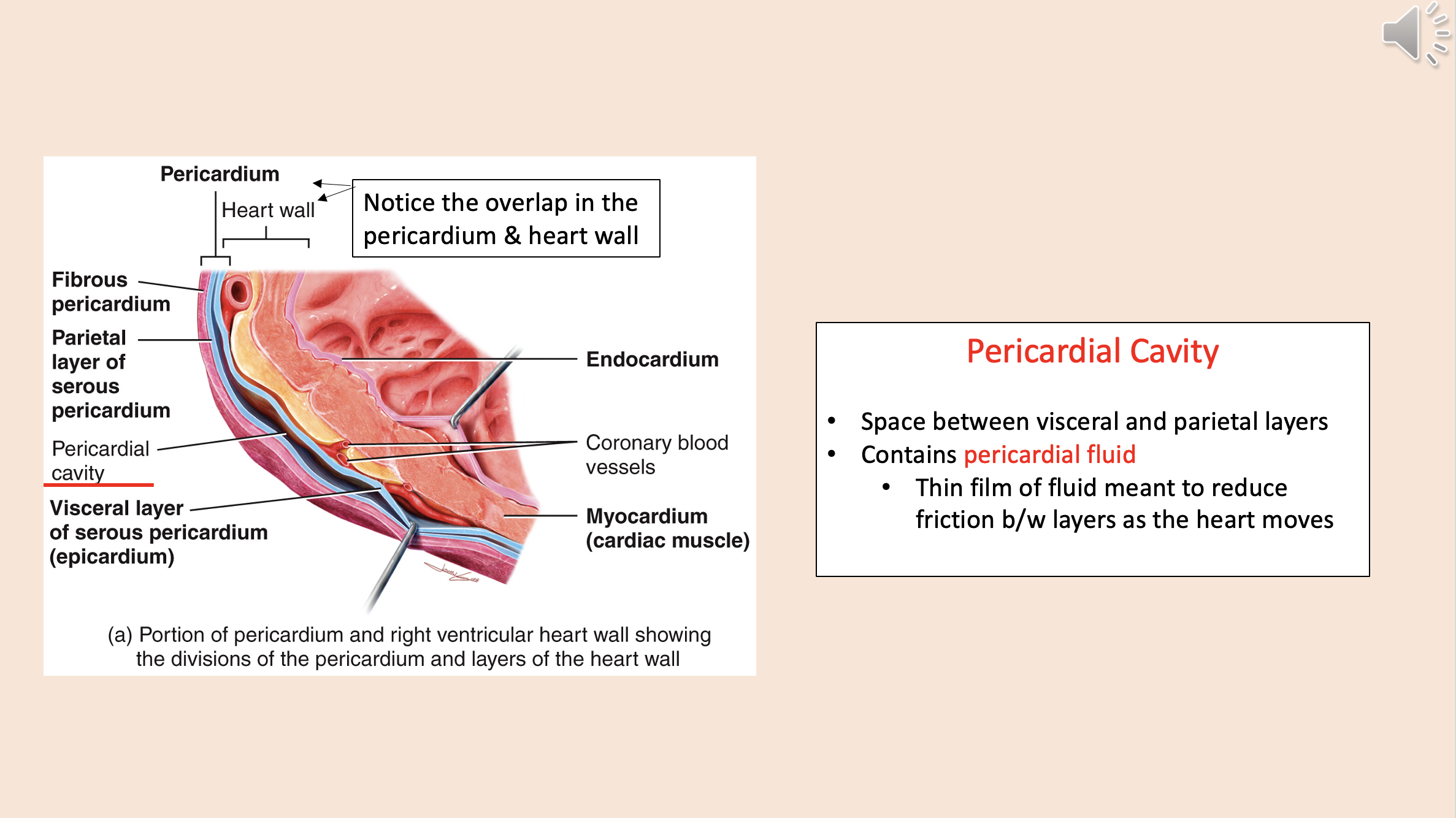
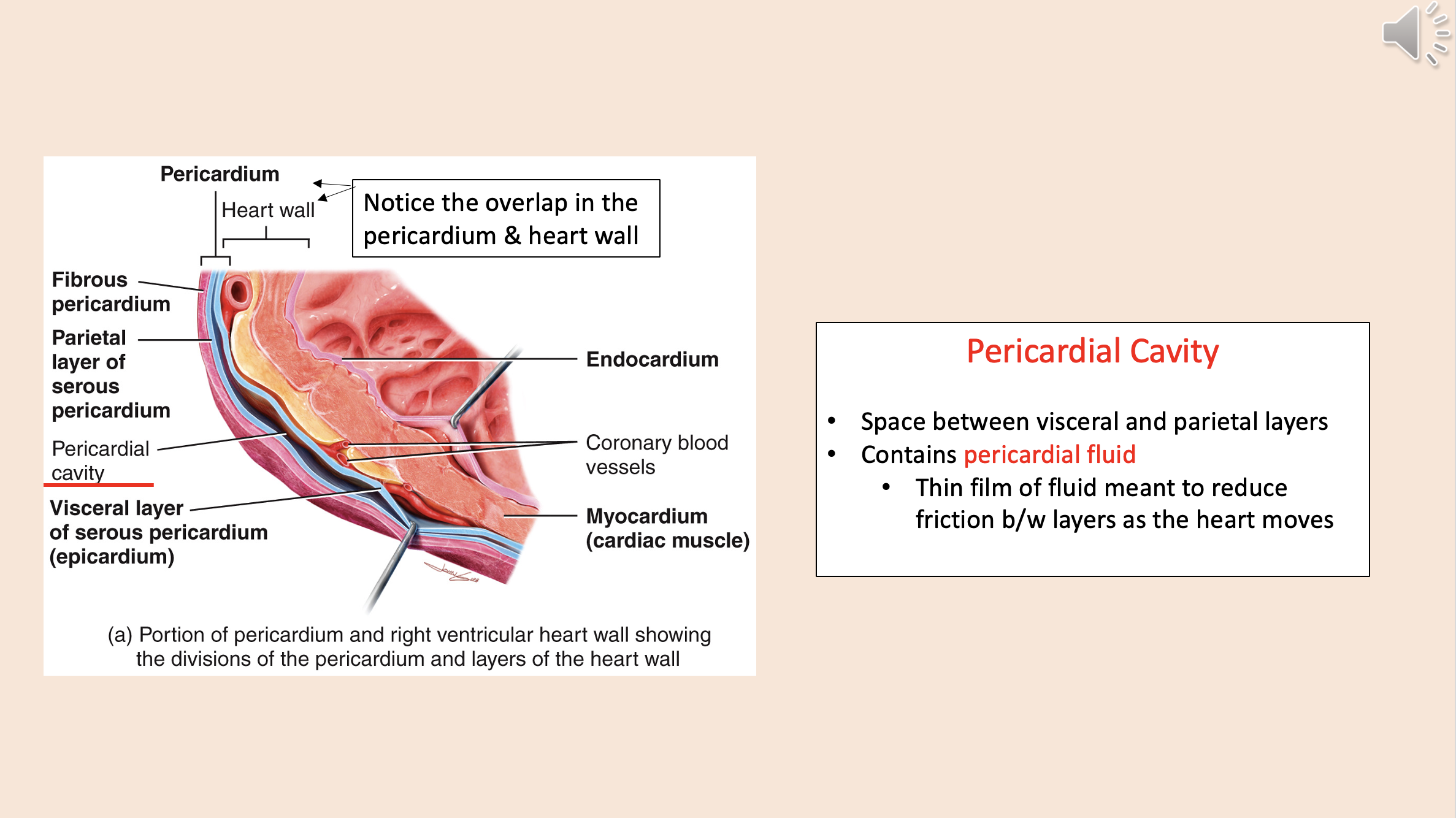
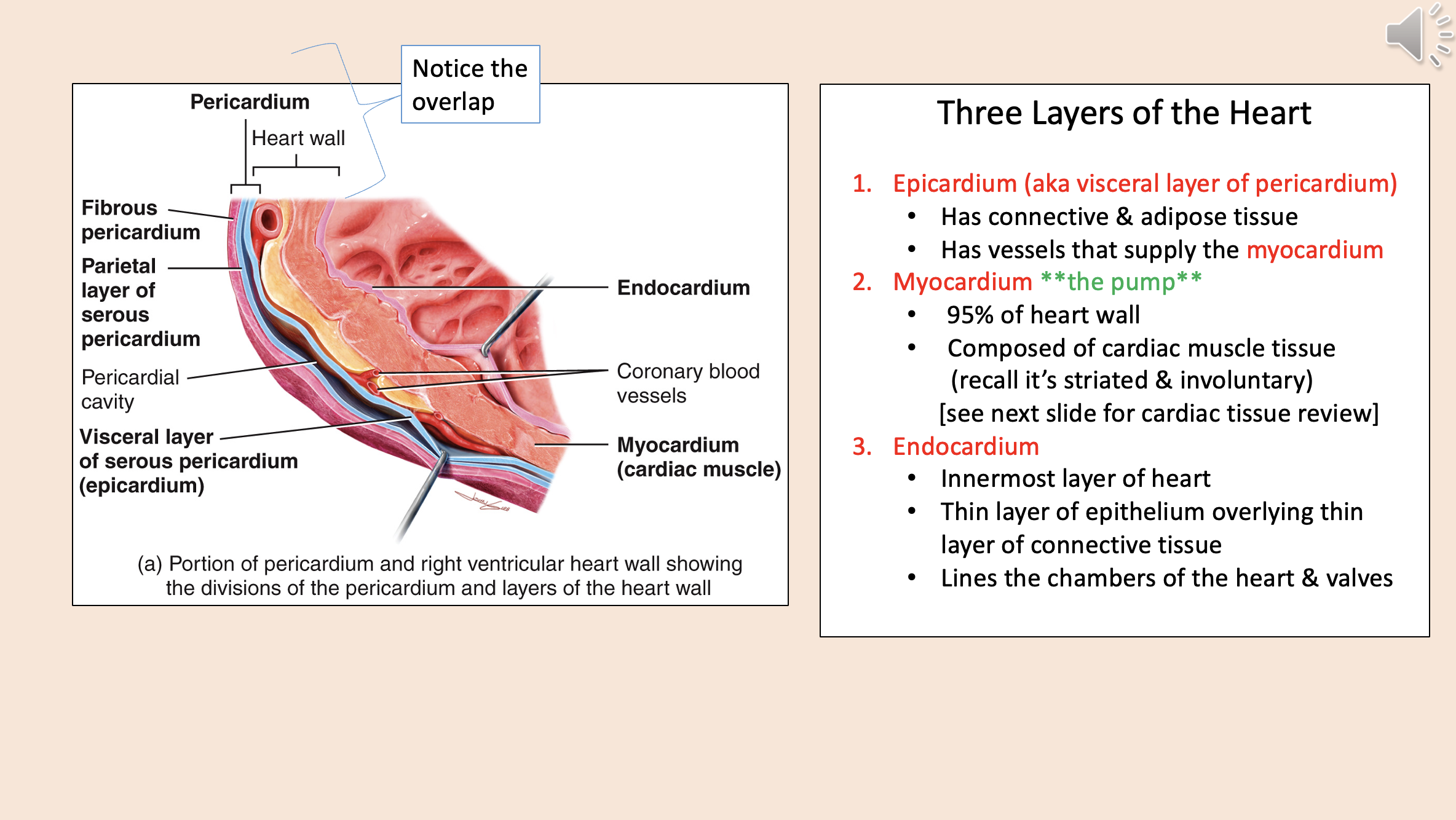
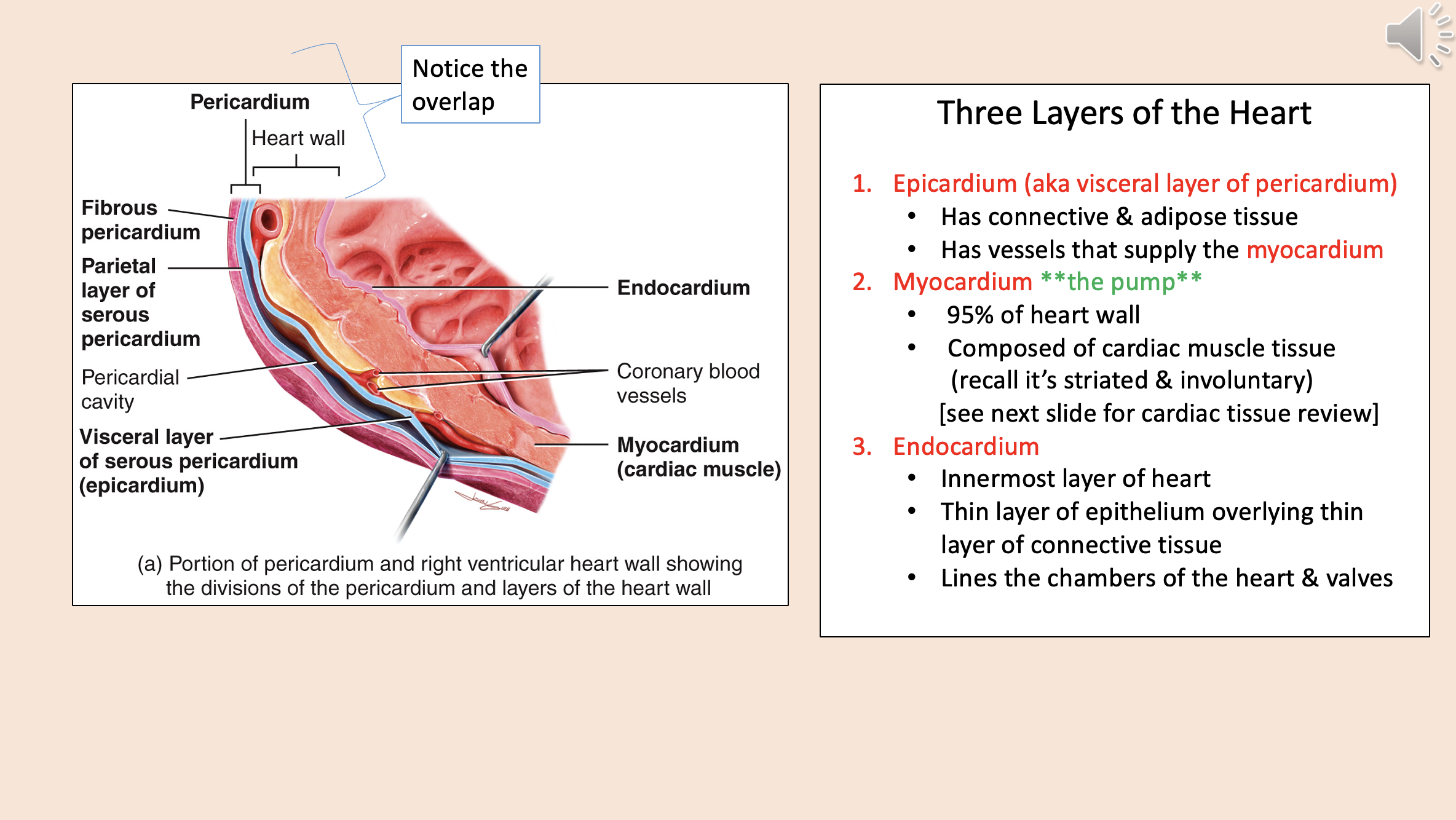
Structural layers of the heart and its protective covering from outermost to innermost

endocardium

myocardium

coronary blood vessels

visceral layer of serous pericardium epicardium

pericardial cavity

parietal layer of serous pericardium

fibrous pericardium
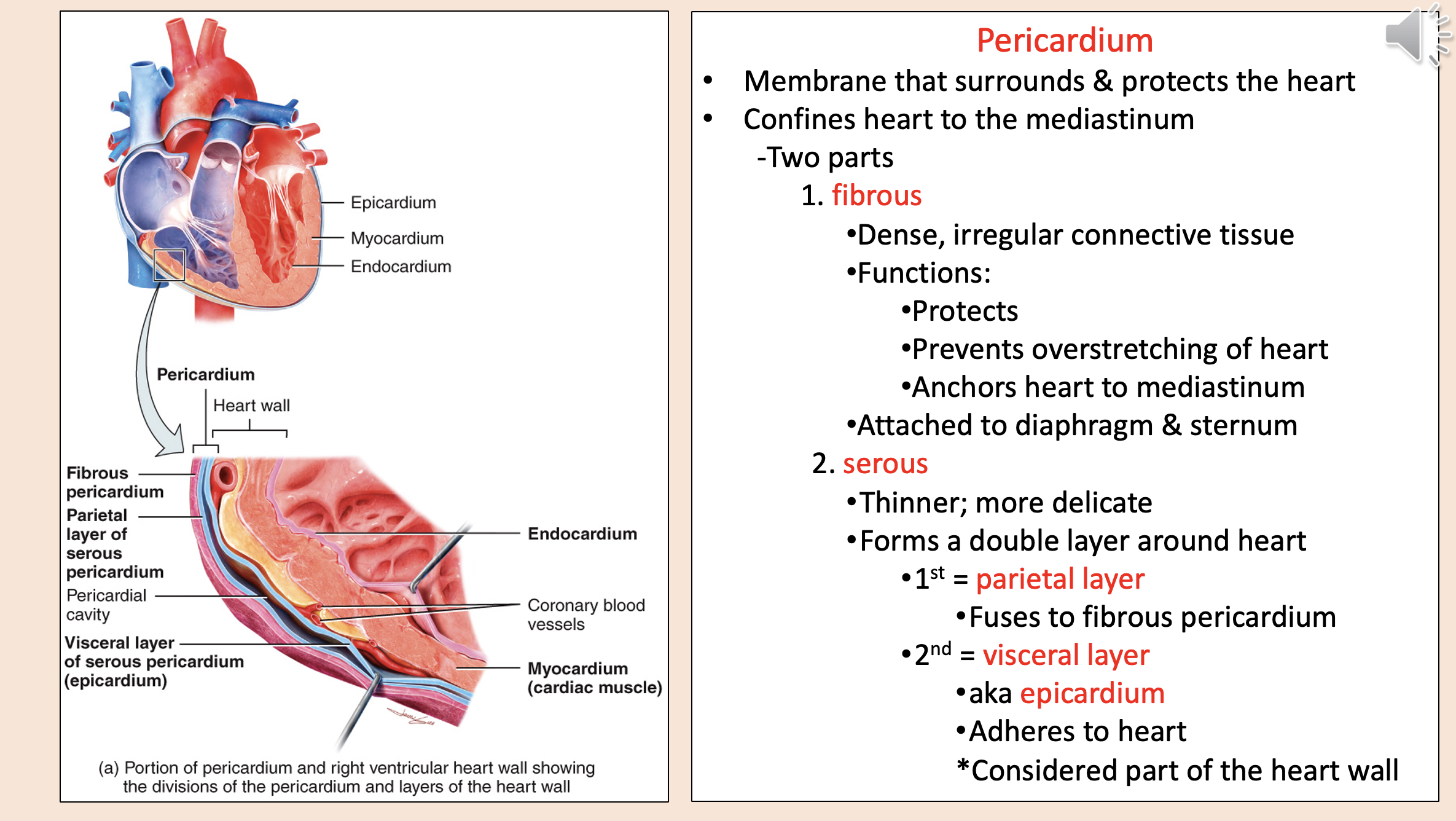
<p>endocardium</p><p>myocardium</p><p>coronary blood vessels</p><p>visceral layer of serous pericardium epicardium</p><p>pericardial cavity</p><p>parietal layer of serous pericardium</p><p>fibrous pericardium</p>
4
New cards

Membrane that surrounds & protects the heart.

Confines heart to the mediastinum.

pericardium
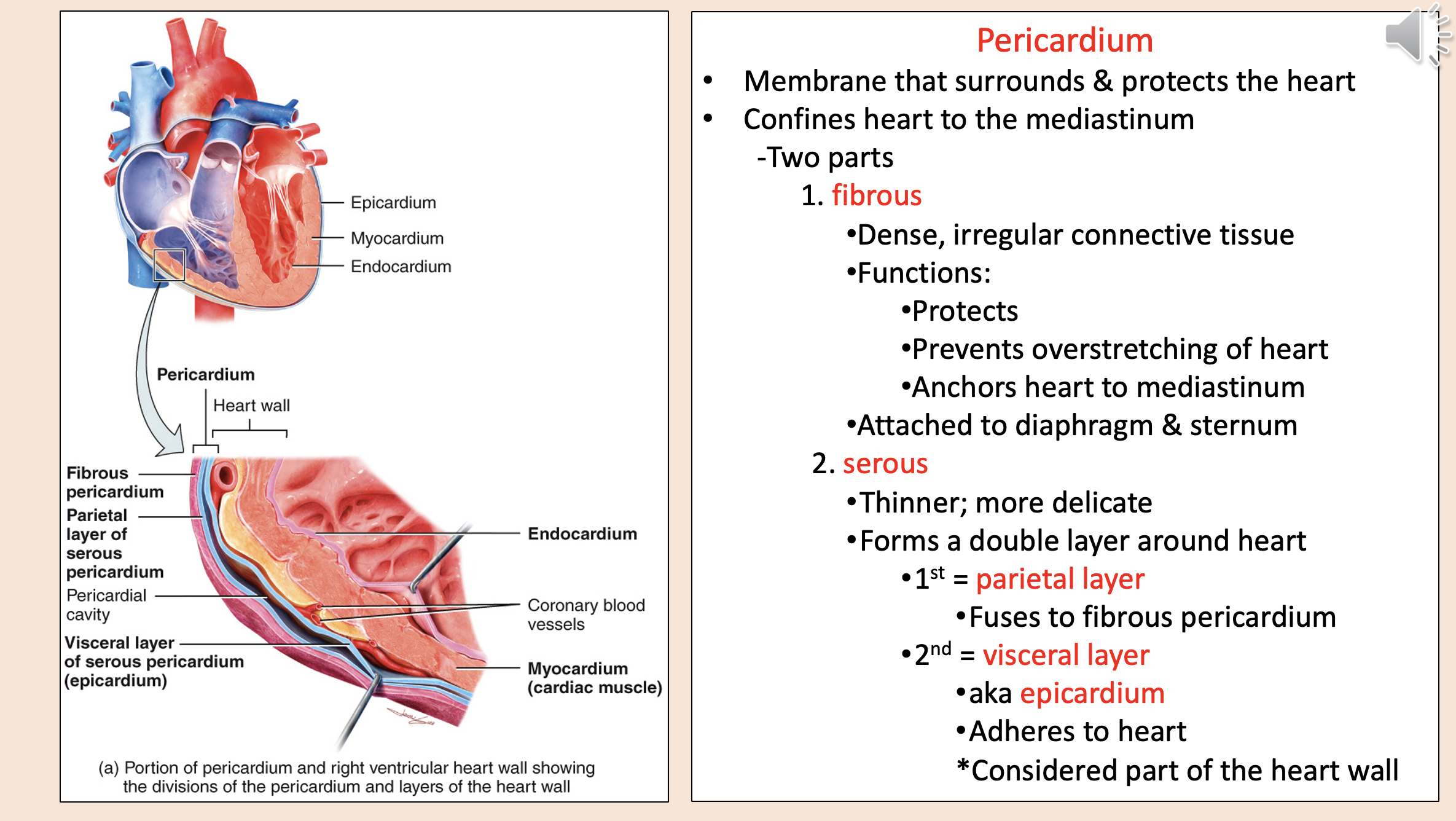
<p><span style="color: rgb(255, 0, 0);">pericardium</span></p>
5
New cards

Two parts of pericardium

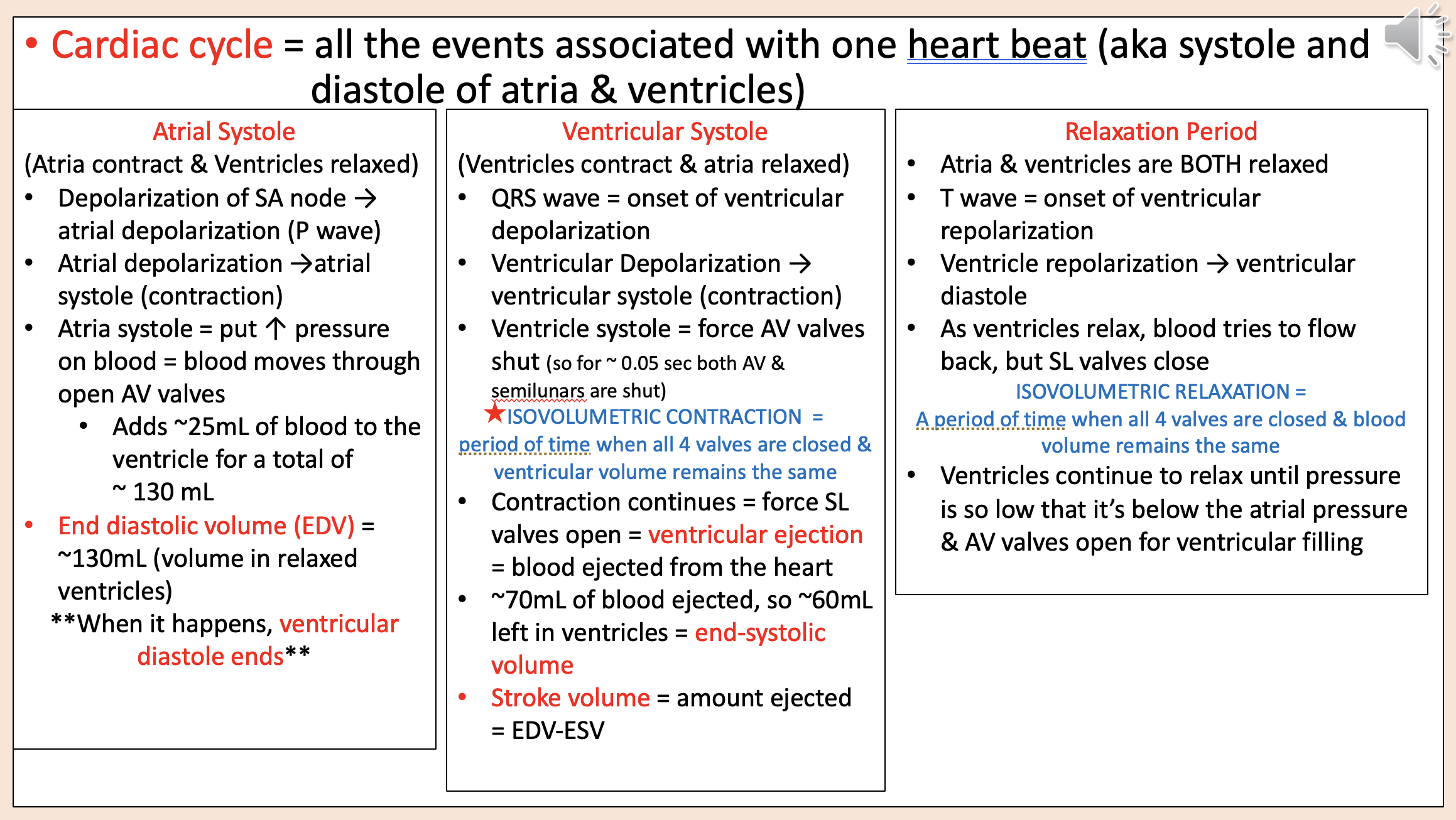
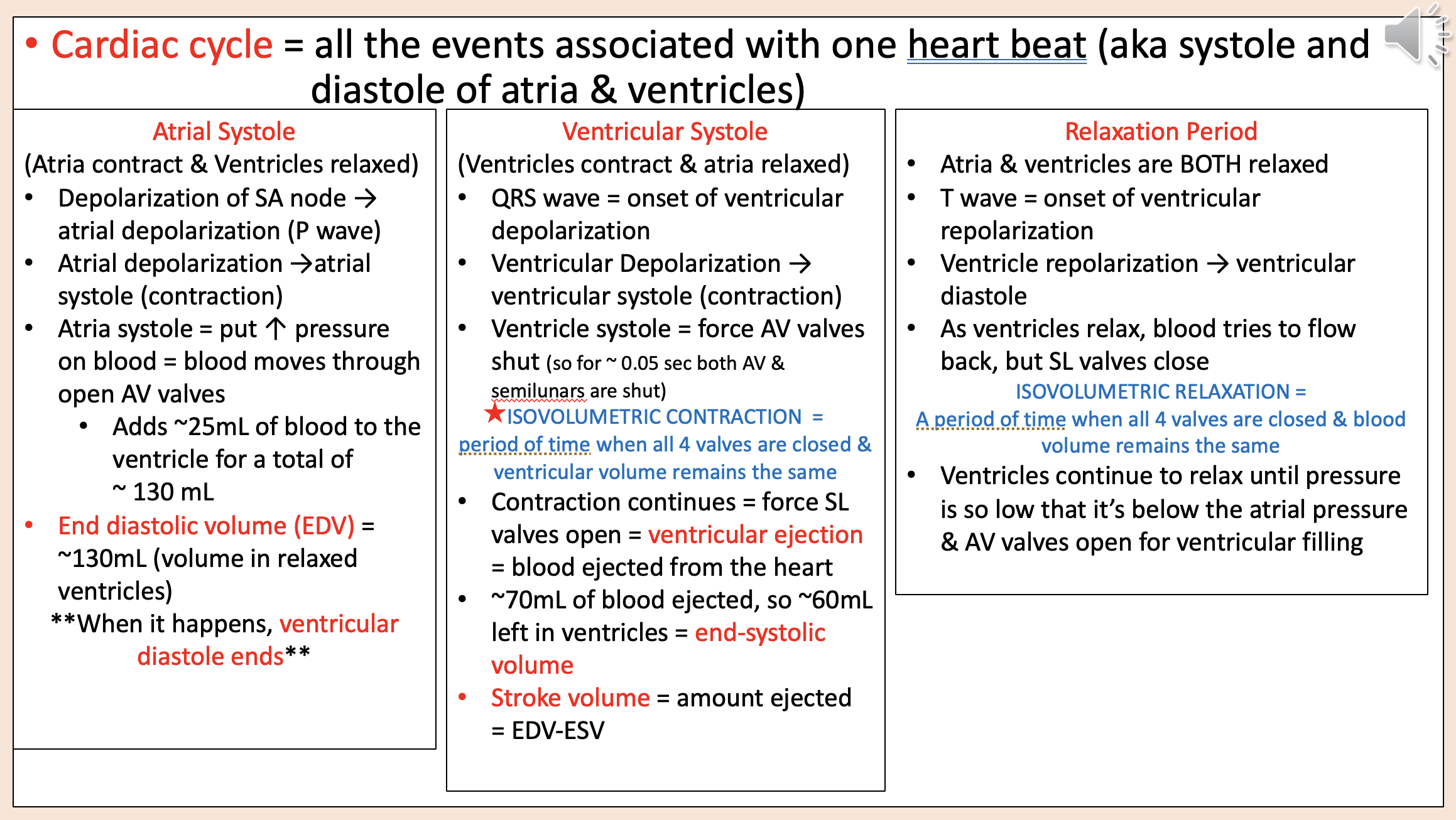
fibrous

serous
<p><span style="color: rgb(255, 0, 0);">fibrous</span></p><p><span style="color: rgb(255, 0, 0);">serous</span></p>
6
New cards

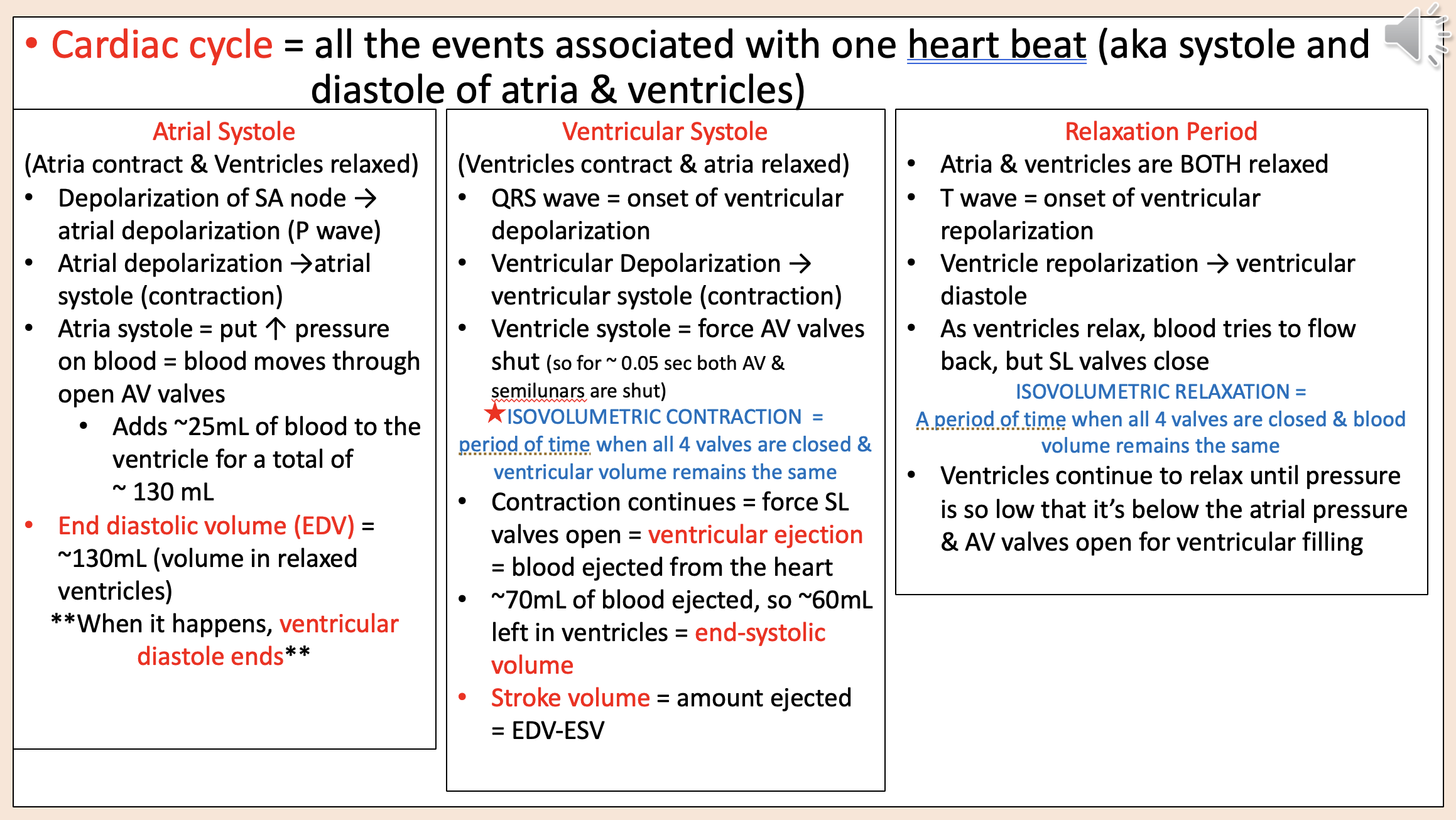
Dense, irregular connective tissue.

Partially fused to tendon of diaphragm.

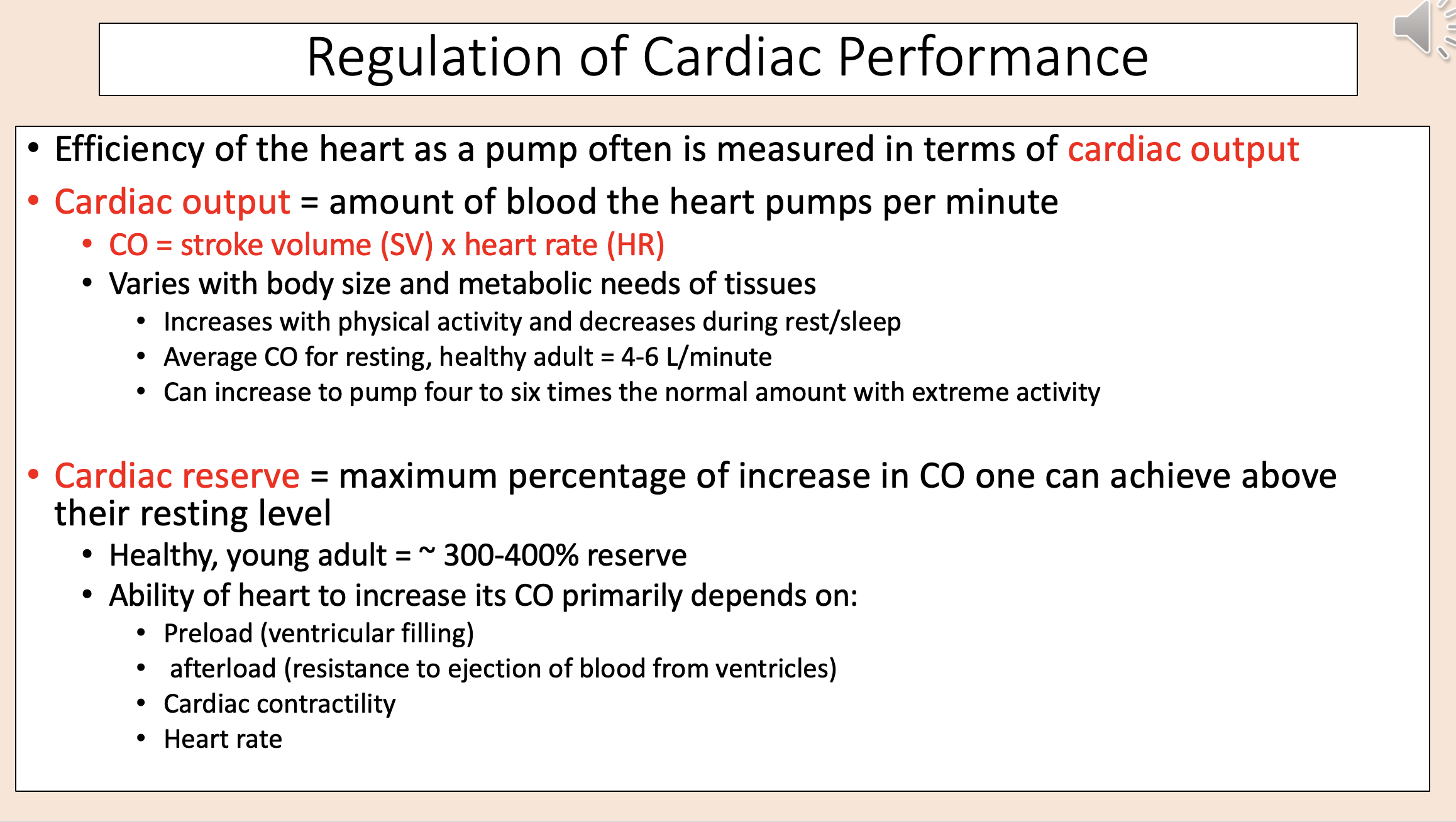
fibrous
<p><span style="color: rgb(255, 0, 0);">fibrous</span></p>
7
New cards

Fibrous Functions:

protects

prevents overstretching of heart

anchors heart to mediastinum
<p>protects</p><p>prevents overstretching of heart</p><p>anchors heart to mediastinum</p>
8
New cards

Thinner; more delicate.

Forms a double layer around heart.

serous
<p><span style="color: rgb(255, 0, 0);">serous</span></p>
9
New cards

Serous Forms a double layer around heart:

parietal layer

visceral layer
<p><span style="color: rgb(255, 0, 0);">parietal layer</span></p><p><span style="color: rgb(255, 0, 0);">visceral layer</span></p>
10
New cards

Fuses to fibrous pericardium

parietal layer
<p><span style="color: rgb(255, 0, 0);">parietal layer</span></p>
11
New cards

aka epicardium

visceral layer

<p><span style="color: rgb(255, 0, 0);">visceral layer</span></p>
12
New cards

Adheres to heart.

Considered part of the heart wall.

visceral layer
<p><span style="color: rgb(255, 0, 0);">visceral layer</span></p>
13
New cards

Space between visceral and parietal layers.

Contains pericardial fluid.

pericardial cavity
<p><span style="color: rgb(255, 0, 0);">pericardial cavity</span></p>
14
New cards

Thin film of fluid meant to reduce friction between layers as the heart moves

pericardial fluid
<p><span style="color: rgb(255, 0, 0);">pericardial fluid</span></p>
15
New cards

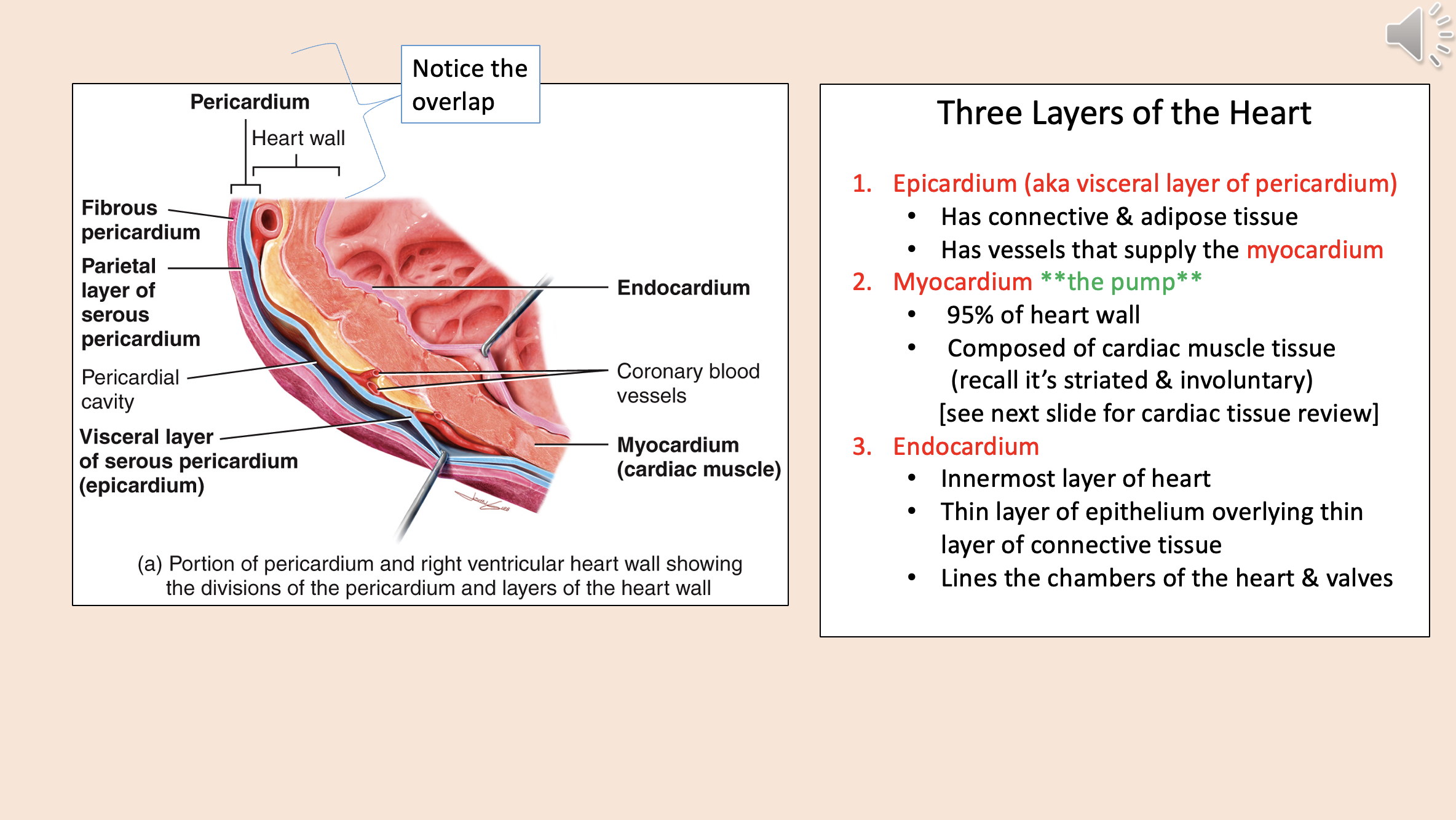
Three Layers of the Heart

epicardium

myocardium

endocardium
<p><span style="color: rgb(255, 0, 0);">epicardium</span></p><p><span style="color: rgb(255, 0, 0);">myocardium</span></p><p><span style="color: rgb(255, 0, 0);">endocardium</span></p>
16
New cards

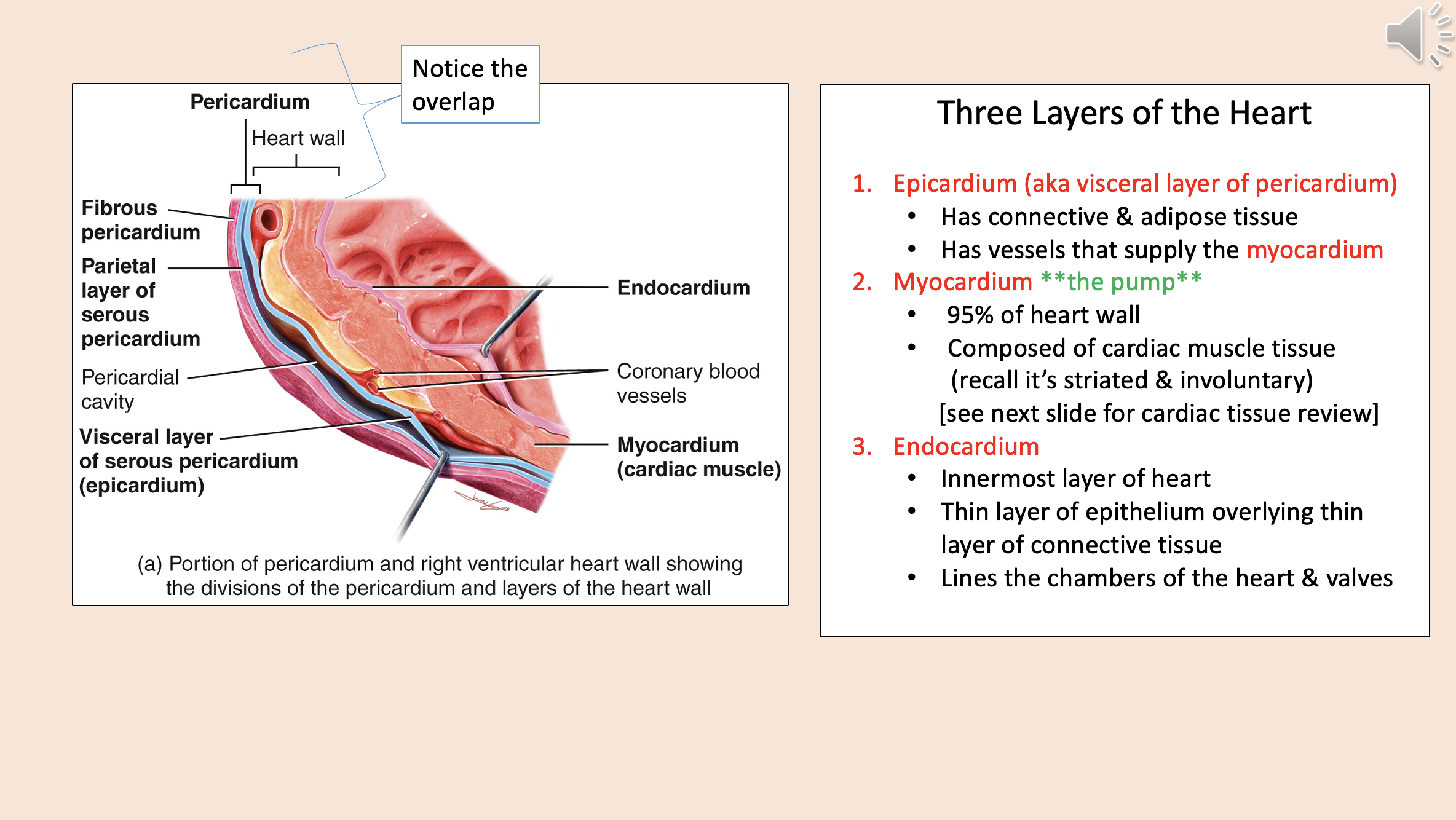
aka visceral layer of pericardium

epicardium
<p><span style="color: rgb(255, 0, 0);">epicardium</span></p>
17
New cards

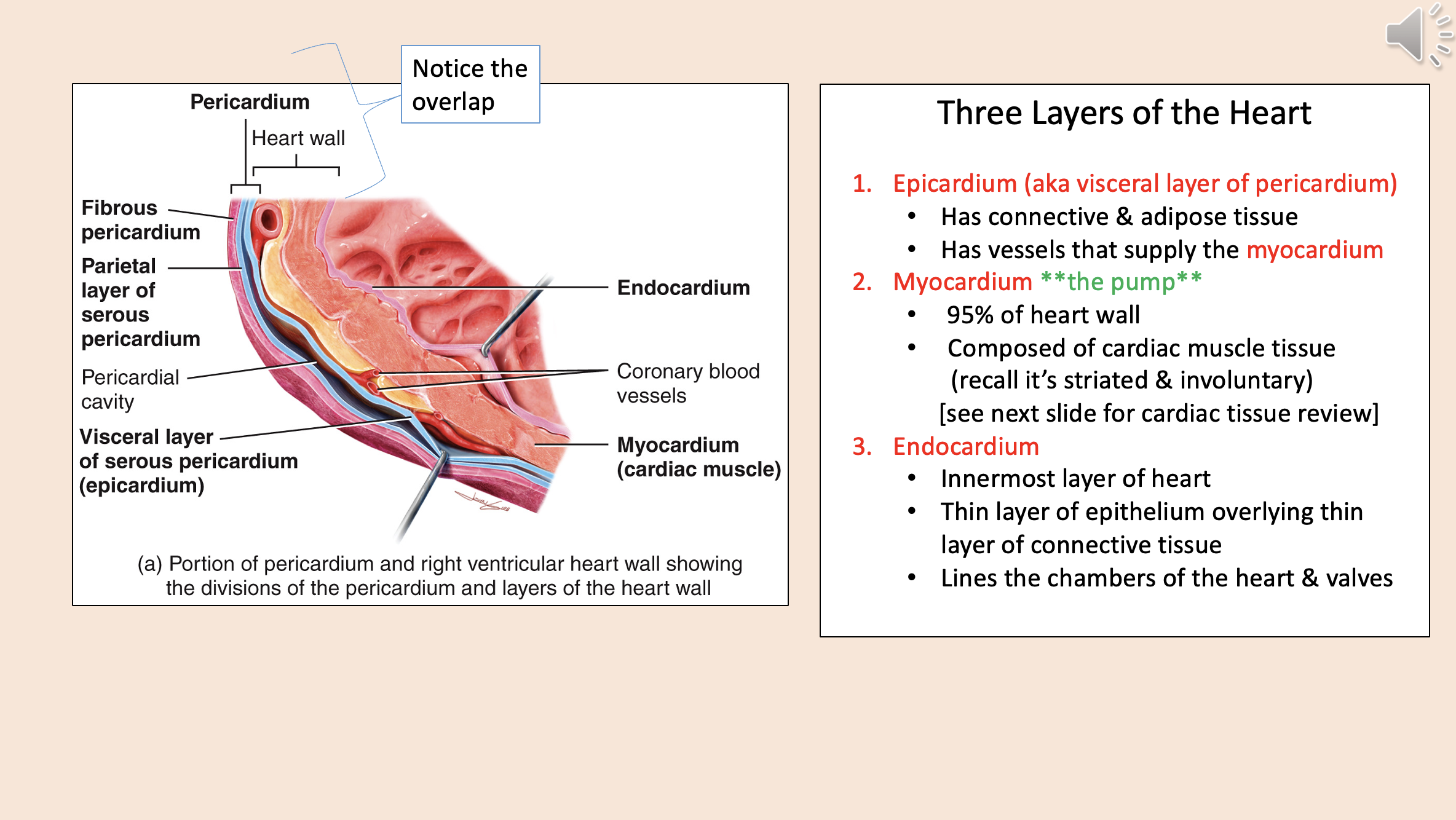
Has connective & adipose tissue.

Has vessels that supply the myocardium.

epicardium
<p><span style="color: rgb(255, 0, 0);">epicardium</span></p>
18
New cards

The pump.

95% of heart wall.

Composed of cardiac muscle tissue (recall it’s striated & involuntary).

myocardium
<p><span style="color: rgb(255, 0, 0);">myocardium </span></p>
19
New cards

Innermost layer of heart.

Thin layer of epithelium overlying thin layer of connective tissue.

Lines the chambers of the heart & valves.

endocardium
<p><span style="color: rgb(255, 0, 0);">endocardium</span></p>
20
New cards

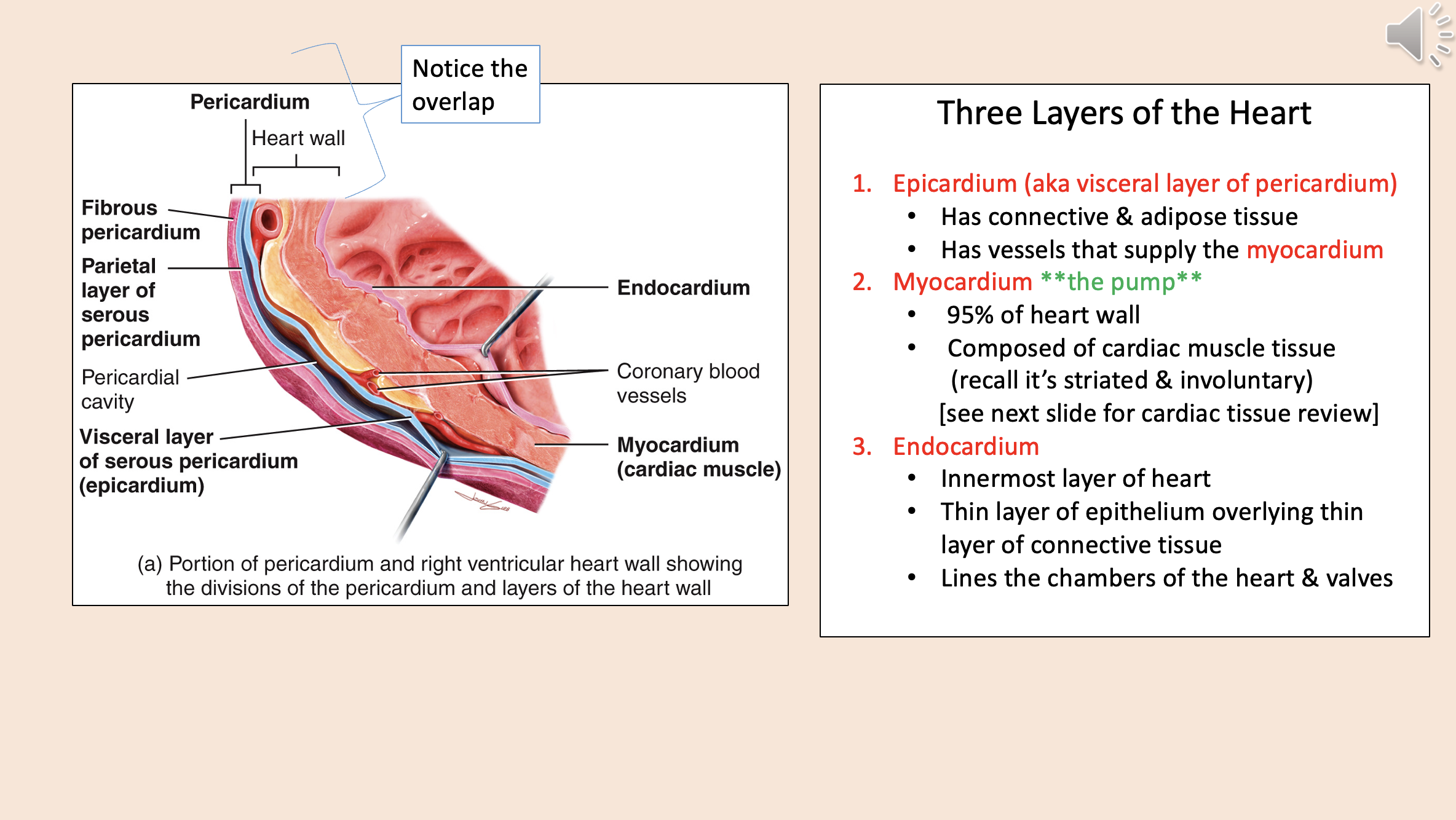
Divisions of the pericardium and layers of the heart wall

endocardium

myocardium

coronary blood vessels

visceral layer of serous pericardium epicardium

pericardial cavity

parietal layer of serous pericardium

fibrous pericardium
<p>endocardium</p><p>myocardium</p><p>coronary blood vessels</p><p>visceral layer of serous pericardium epicardium</p><p>pericardial cavity</p><p>parietal layer of serous pericardium</p><p>fibrous pericardium</p>
21
New cards

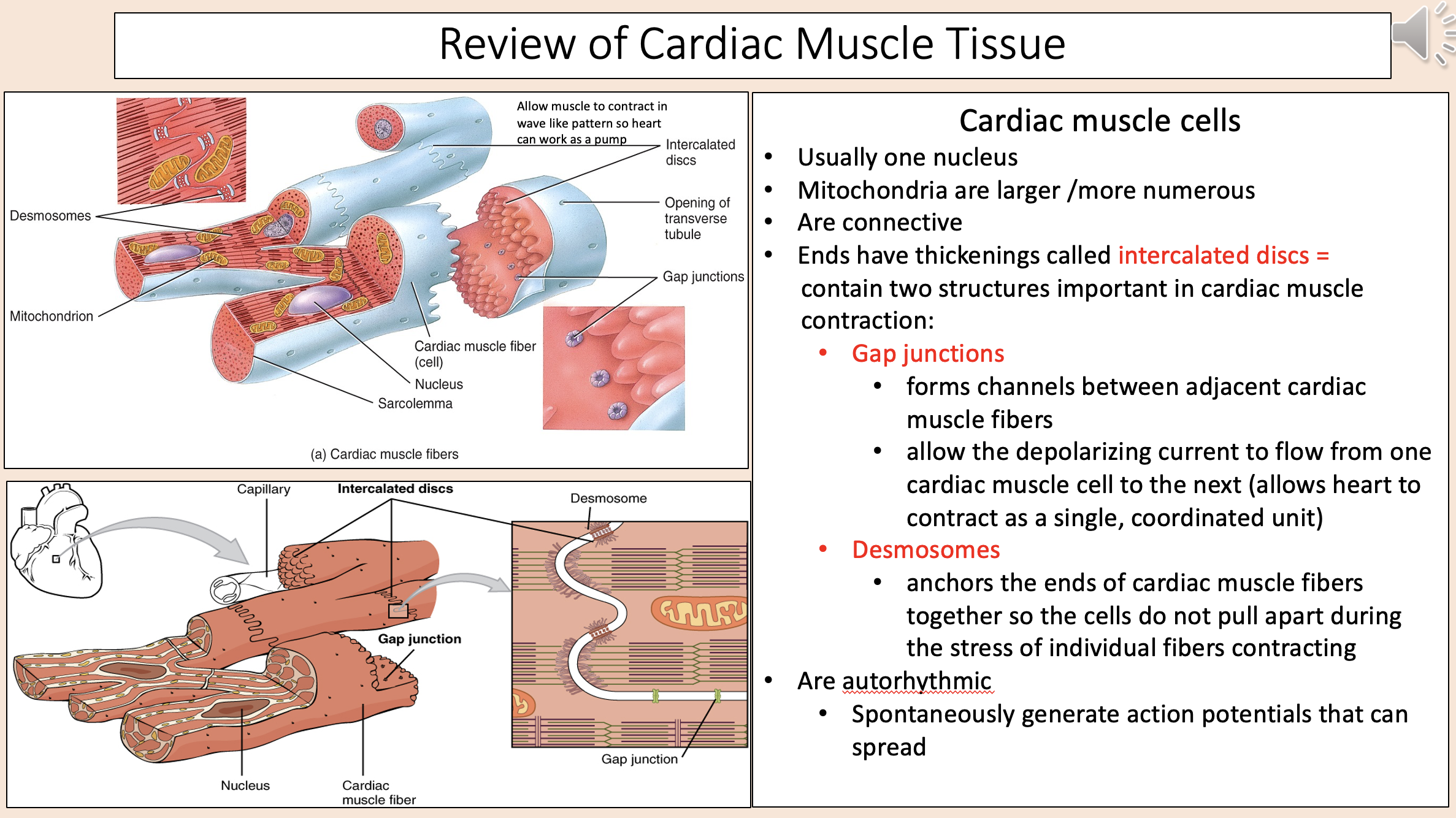
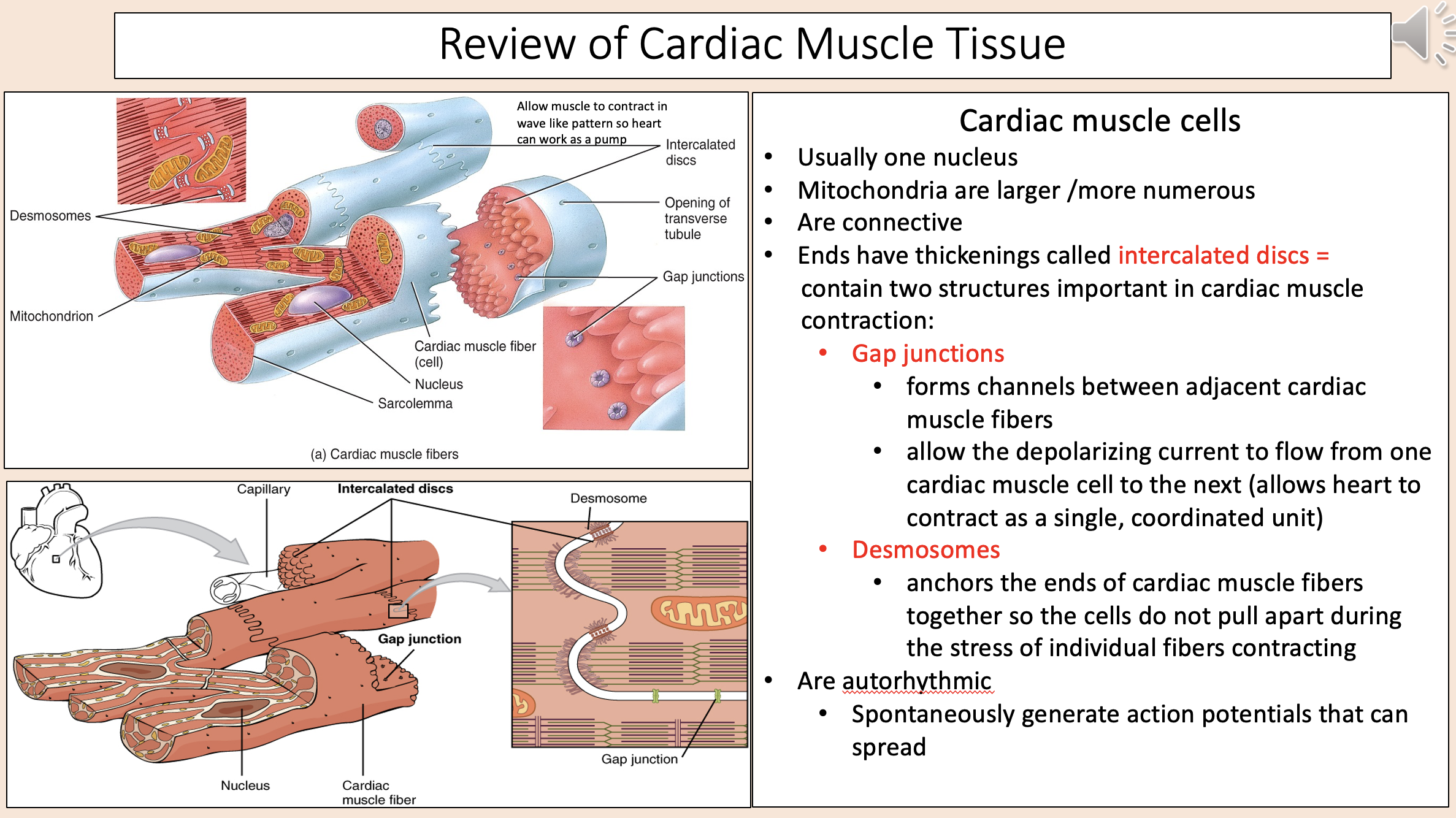
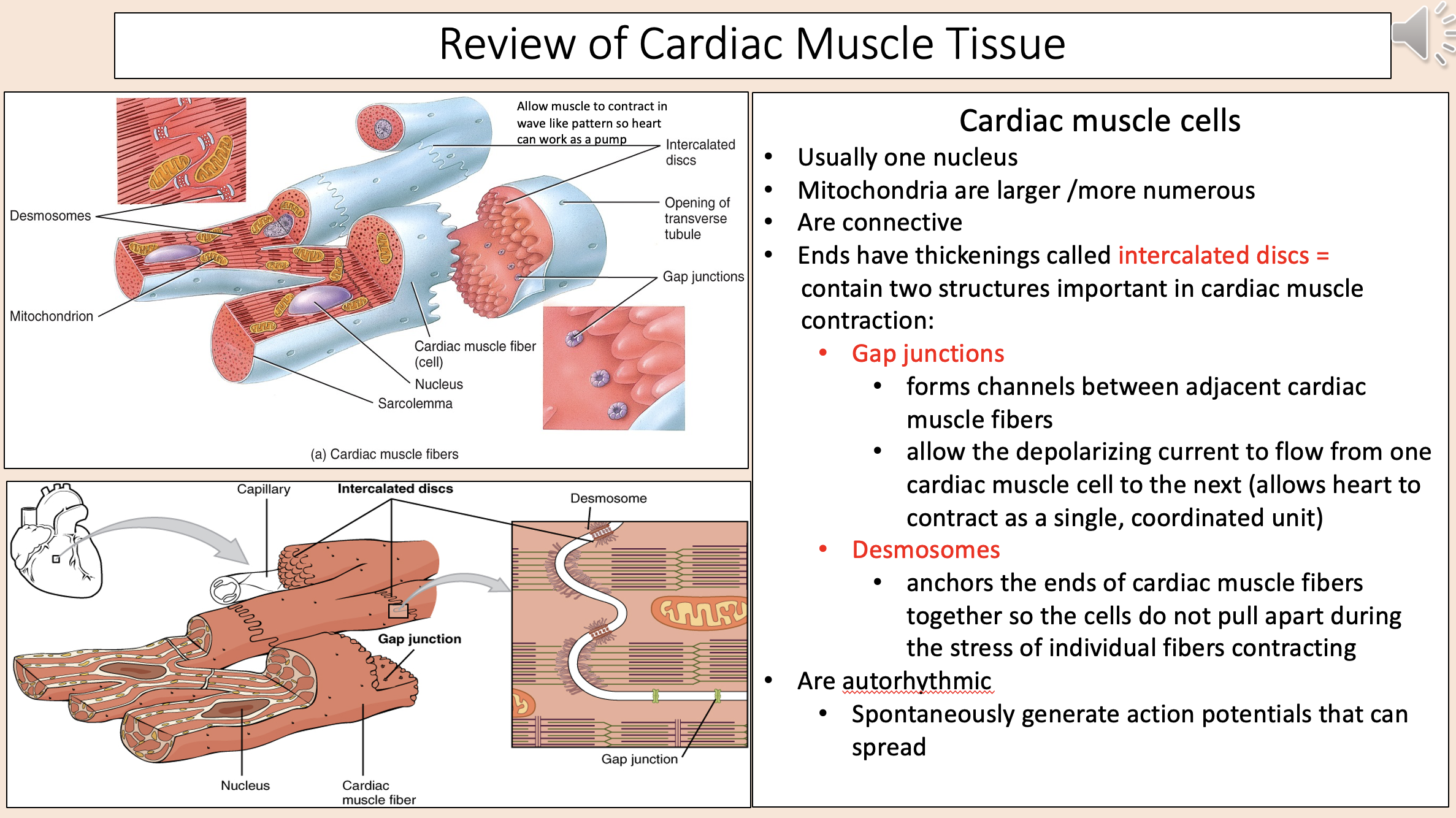
Usually one nucleus.

Mitochondria are larger /more numerous.

Are connective.

cardiac muscle cells
<p>cardiac muscle cells</p>
22
New cards

Ends have thickenings.

Contain two structures important in cardiac muscle contraction.

intercalated discs
<p><span style="color: rgb(255, 0, 0);">intercalated discs</span></p>
23
New cards

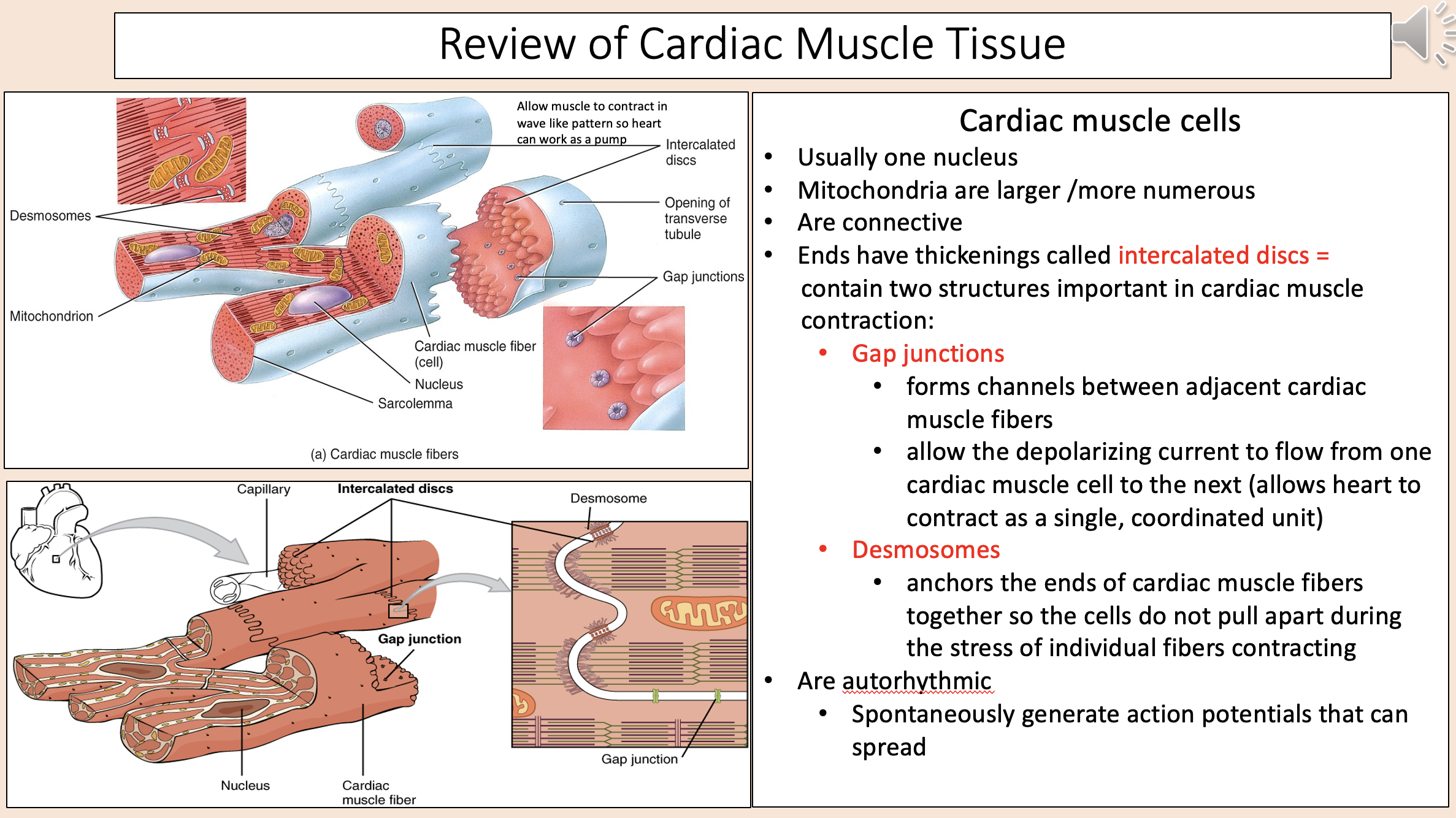
Intercalated discs two structures:

gap junctions

desmosomes
<p><span style="color: rgb(255, 0, 0);">gap junctions</span></p><p><span style="color: rgb(255, 0, 0);">desmosomes</span></p>
24
New cards

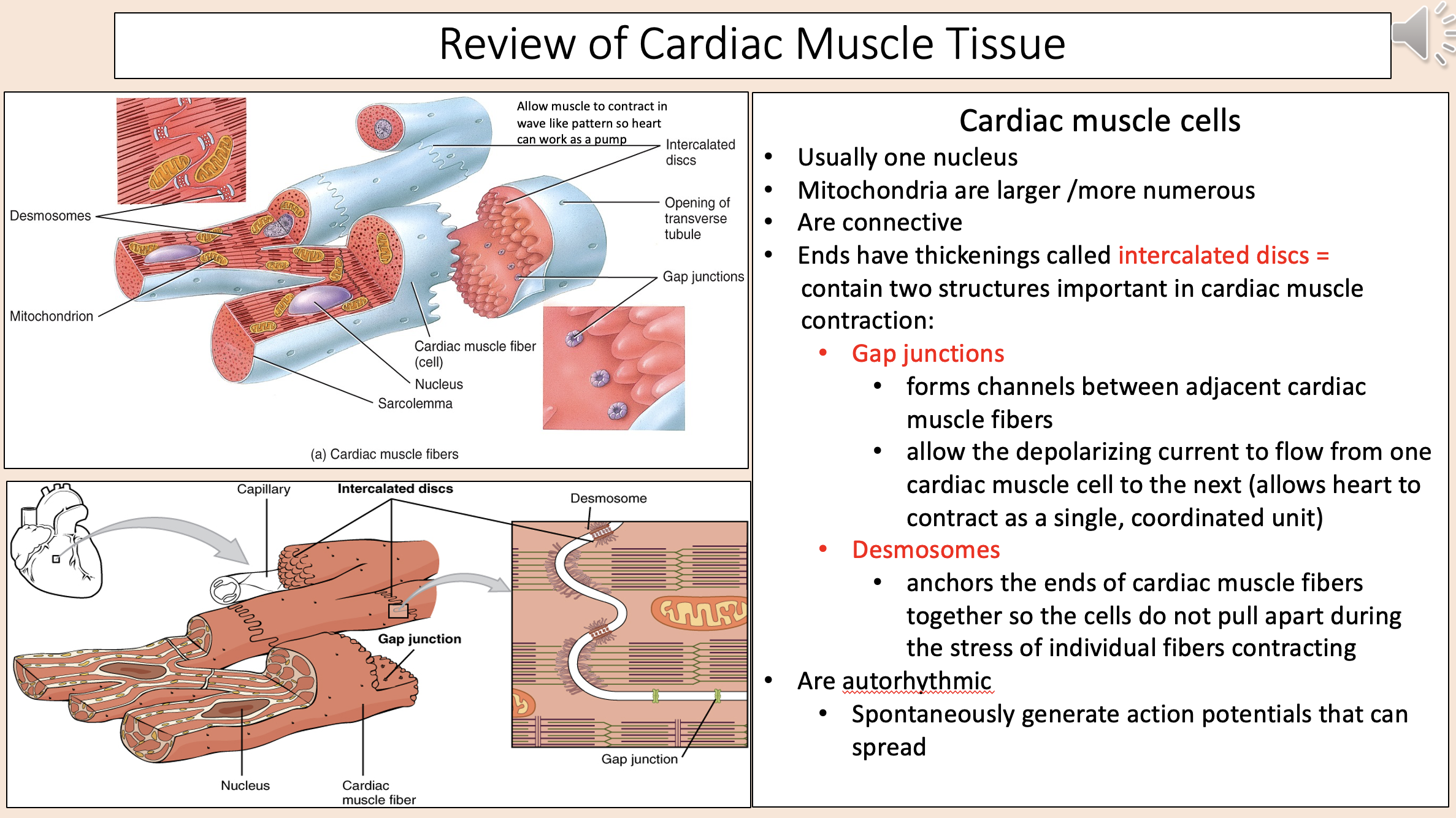
Forms channels between adjacent cardiac muscle fibers.

Allow the depolarizing current to flow from one cardiac muscle cell to the next (allows heart to contract as a single, coordinated unit).

gap junctions
<p><span style="color: rgb(255, 0, 0);">gap junctions</span></p>
25
New cards

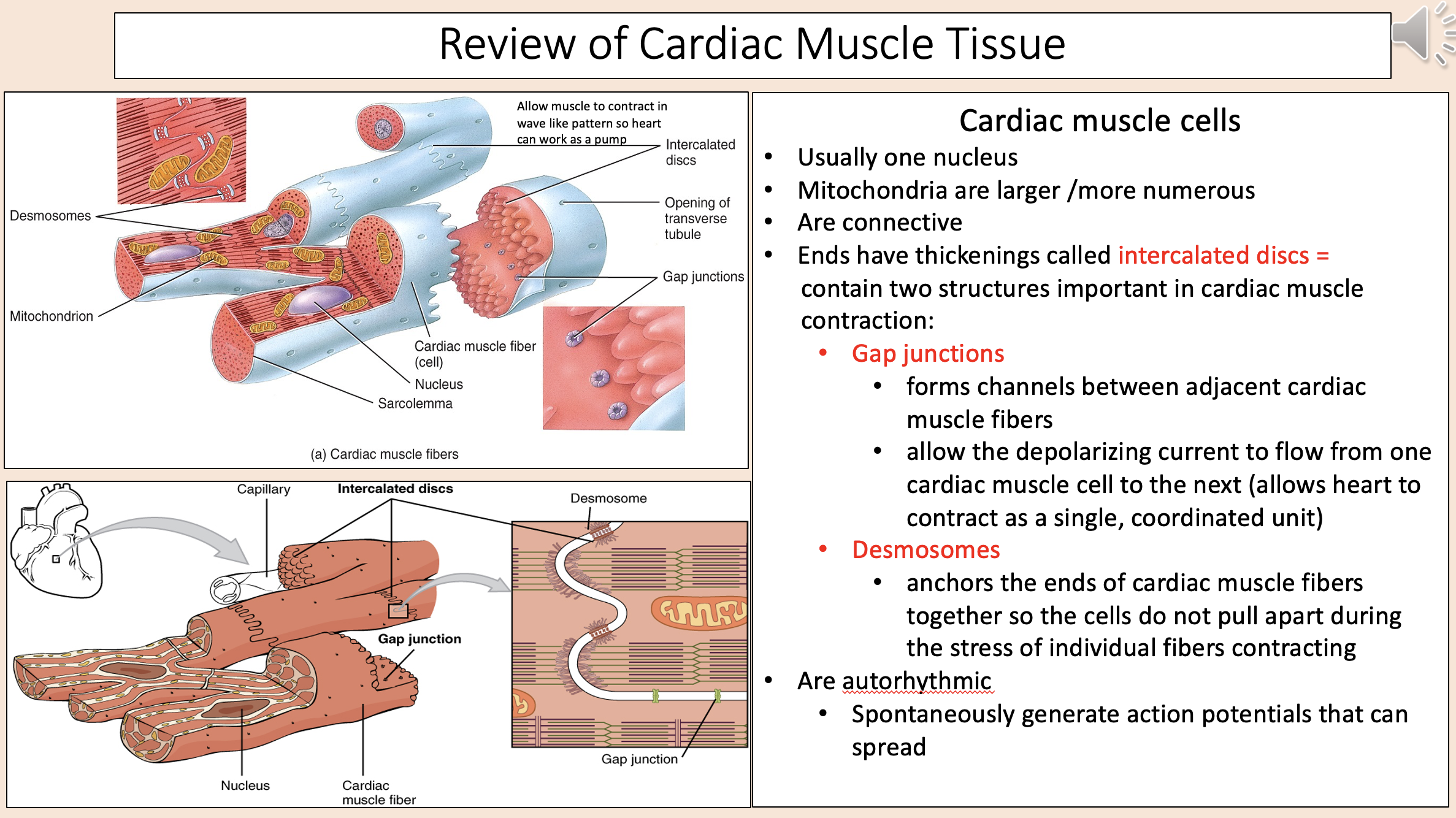
Anchors the ends of cardiac muscle fibers together so the cells do not pull apart during the stress of individual fibers contracting

desmosomes
<p><span style="color: rgb(255, 0, 0);">desmosomes</span></p>
26
New cards

Spontaneously generate action potentials that can spread

autorhythmic
<p><span>autorhythmic</span></p>
27
New cards

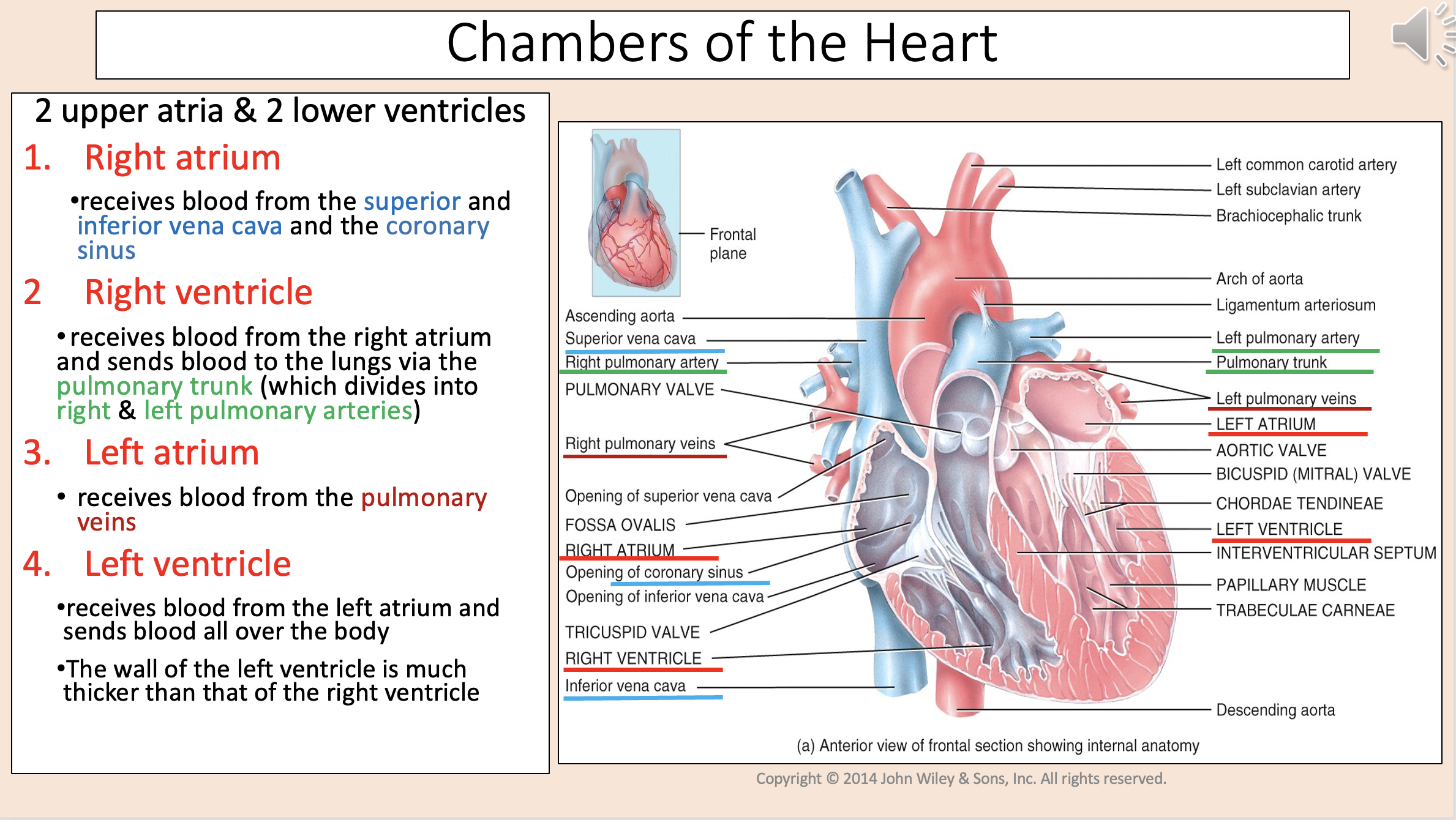
2 upper atria & 2 lower ventricles

right atrium

right ventricle

left atrium

left ventricle
<p><span style="color: rgb(255, 0, 0);">right atrium</span></p><p><span style="color: rgb(255, 0, 0);">right ventricle</span></p><p><span style="color: rgb(255, 0, 0);">left atrium</span></p><p><span style="color: rgb(255, 0, 0);">left ventricle</span></p>
28
New cards

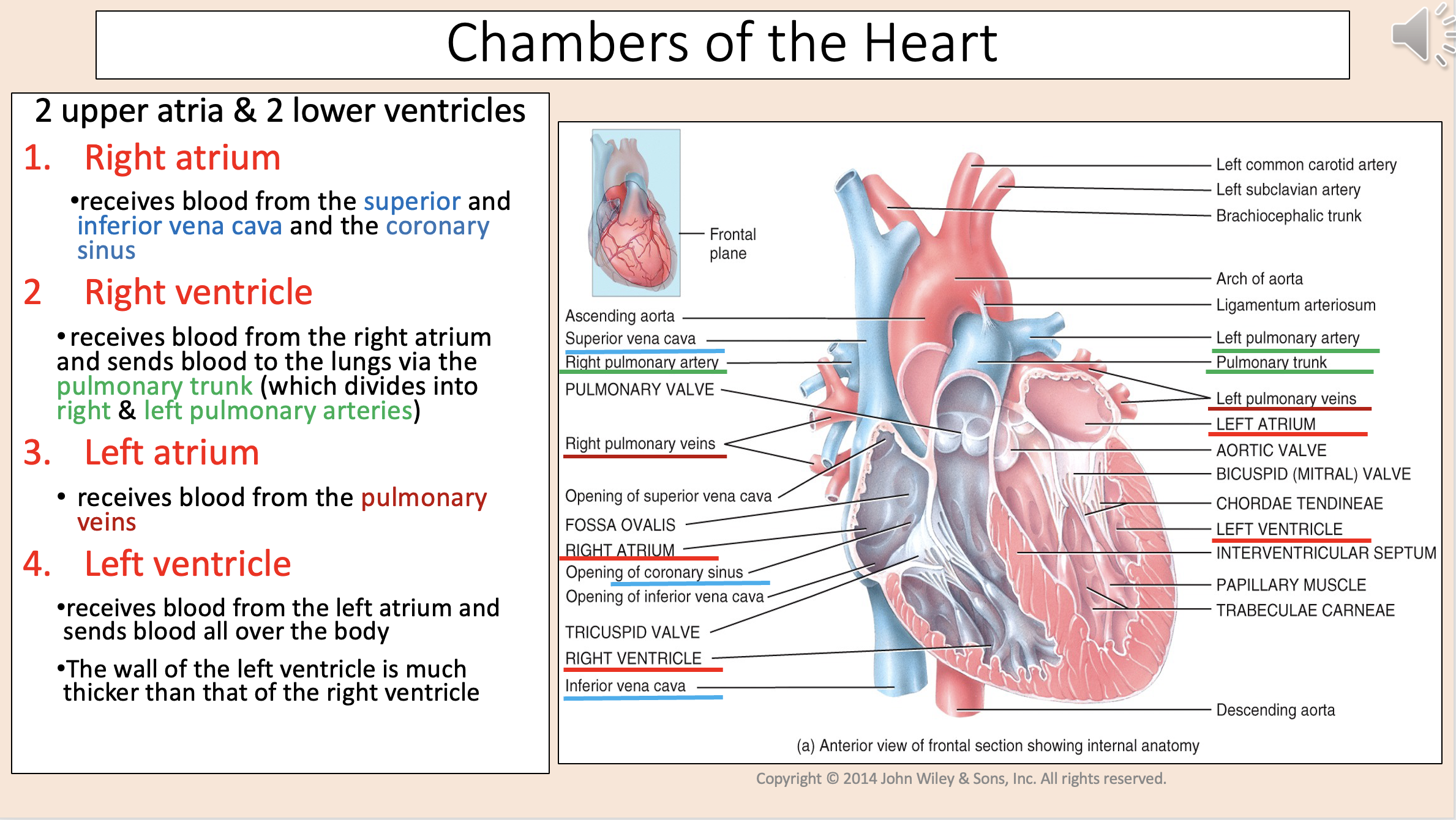
Receives blood from the superior and inferior vena cava and the coronary sinus

right atrium
<p><span style="color: rgb(255, 0, 0);">right atrium</span></p>
29
New cards

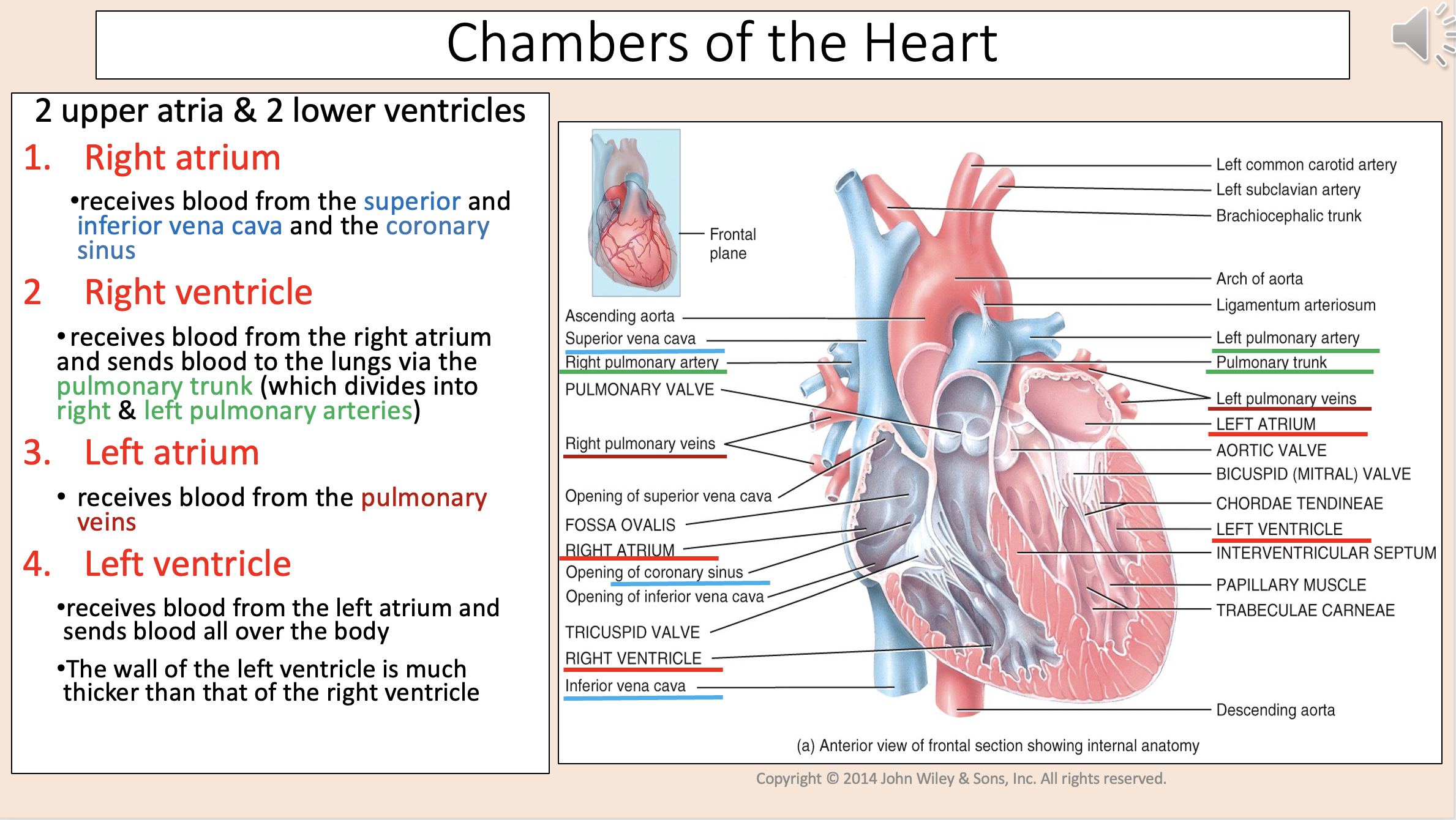
Receives blood from the right atrium and sends blood to the lungs via the pulmonary trunk (which divides into right & left pulmonary arteries)

right ventricle
<p><span style="color: rgb(255, 0, 0);">right ventricle</span></p>
30
New cards

Receives blood from the pulmonary veins

left atrium
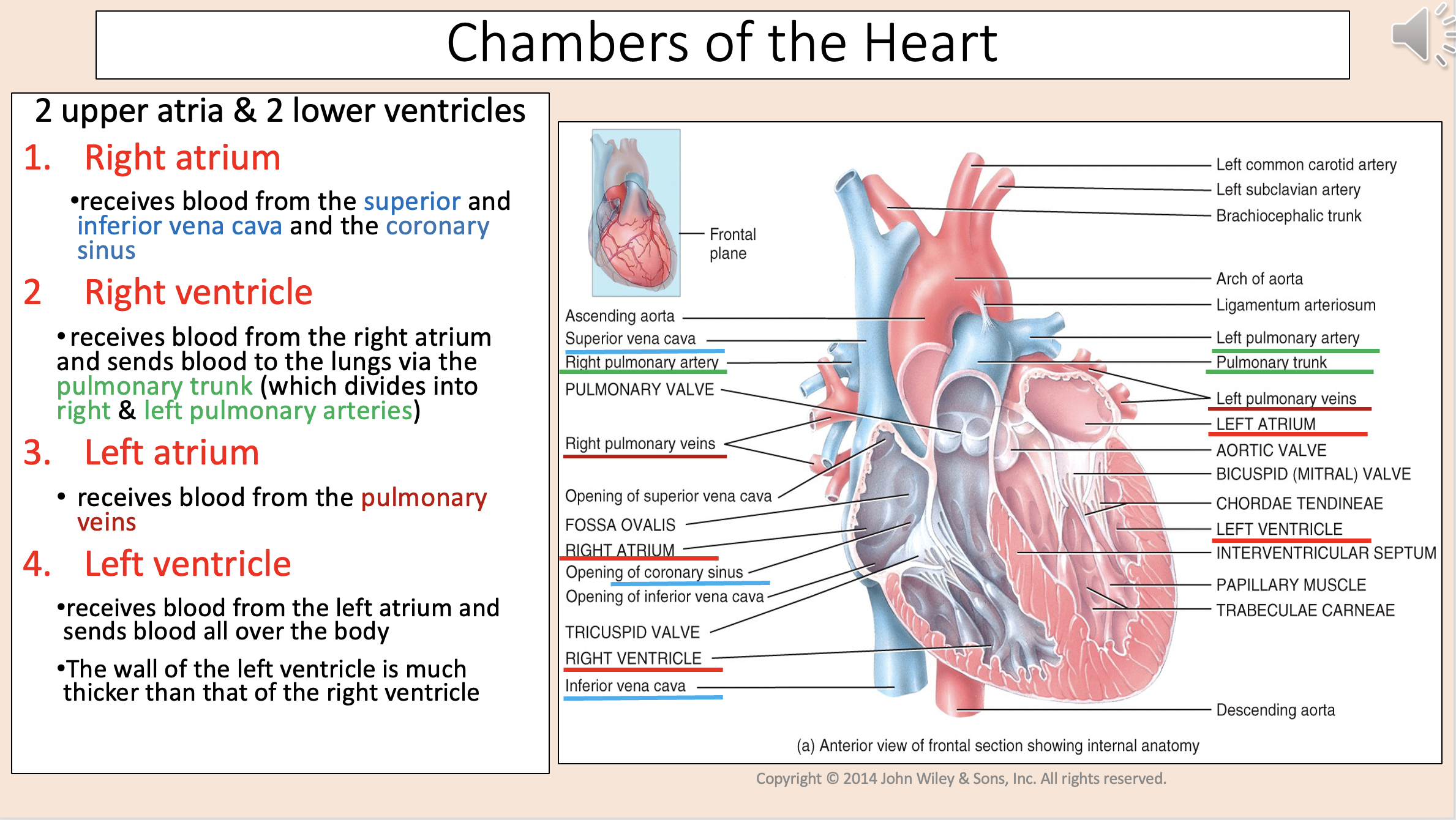
<p><span style="color: rgb(255, 0, 0);">left atrium</span></p>
31
New cards

Receives blood from the left atrium and sends blood all over the body.

The wall of the left ventricle is much thicker than that of the right ventricle.

left ventricle
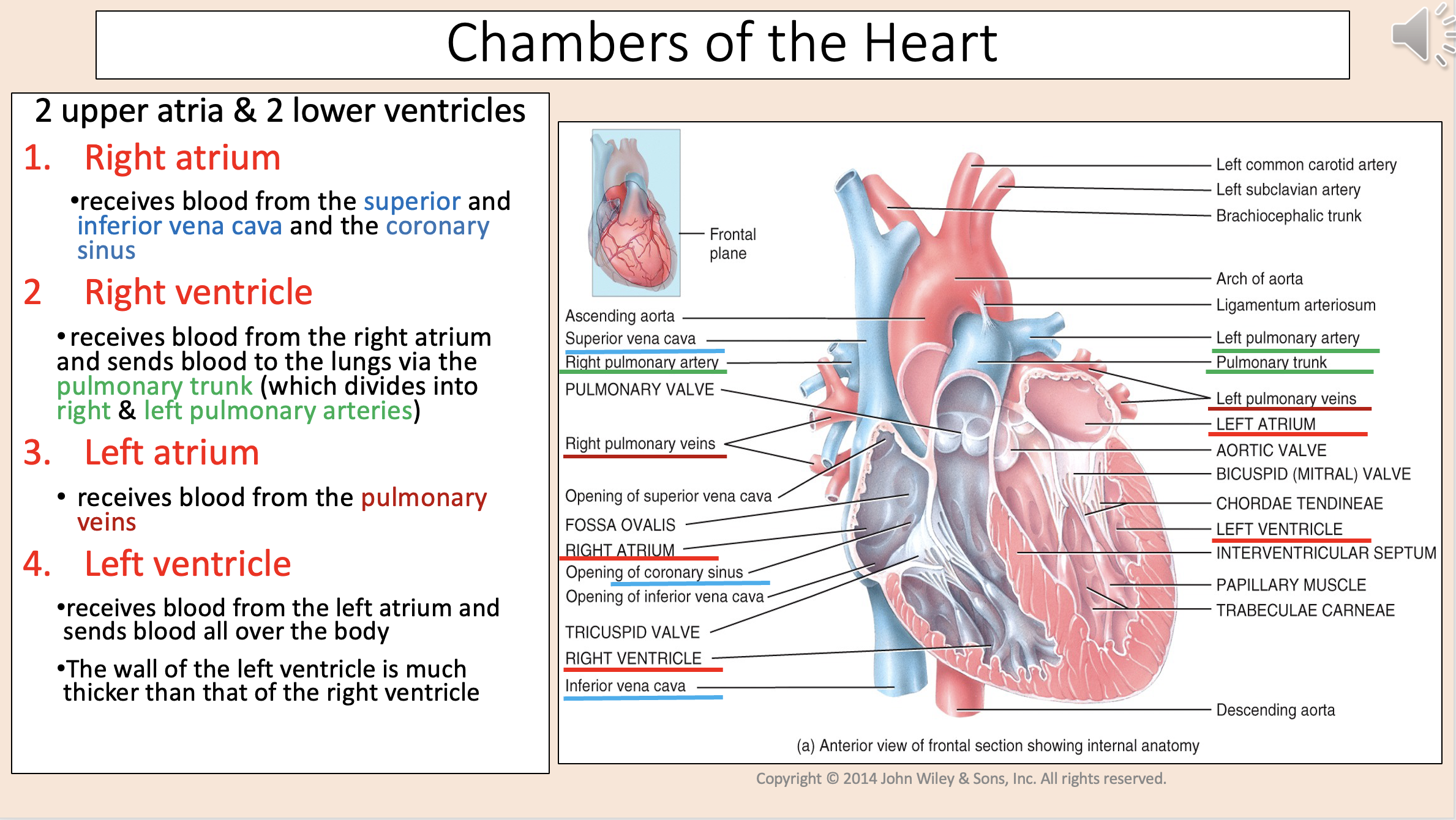
<p><span style="color: rgb(255, 0, 0);">left ventricle</span></p>
32
New cards

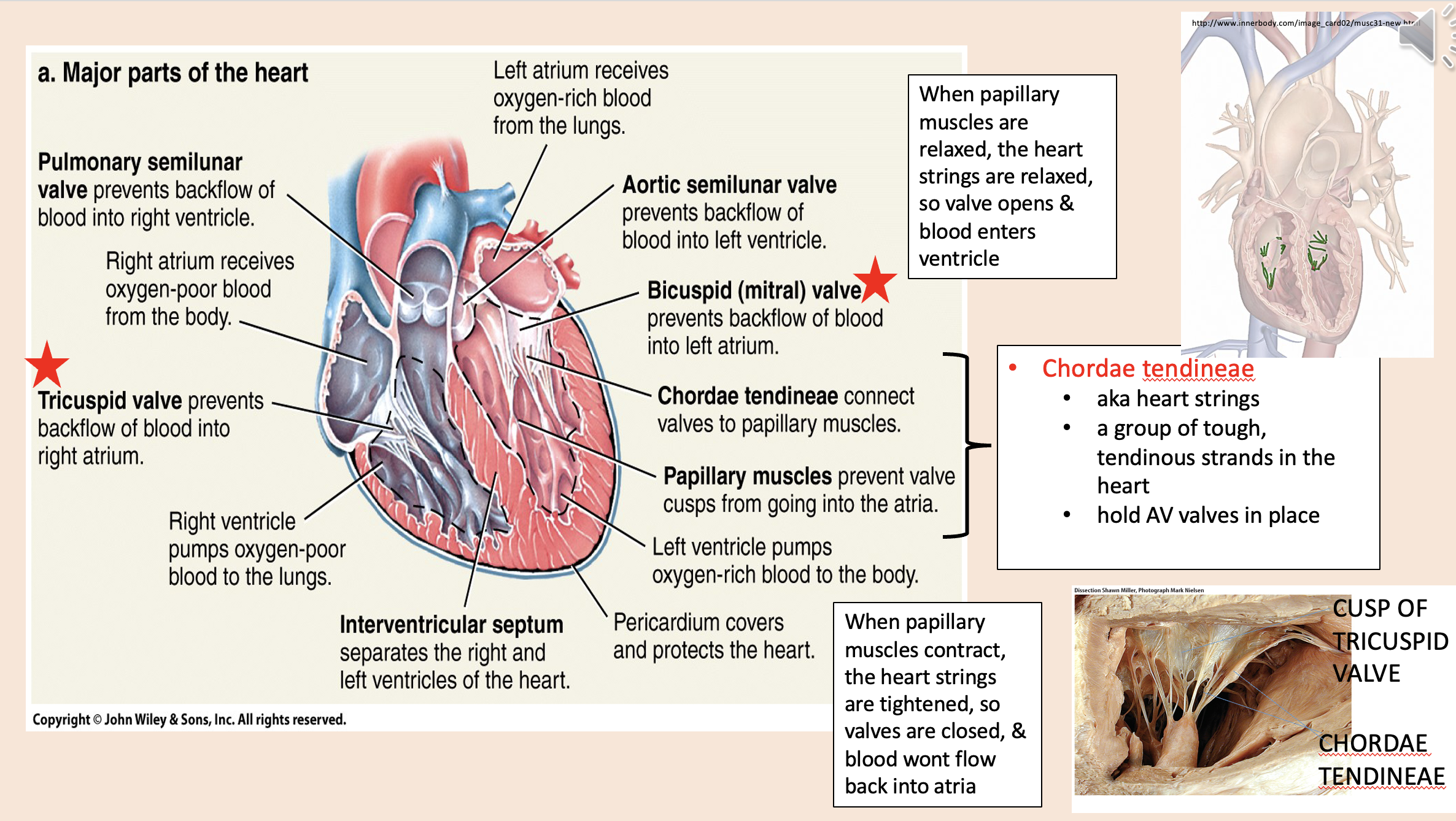
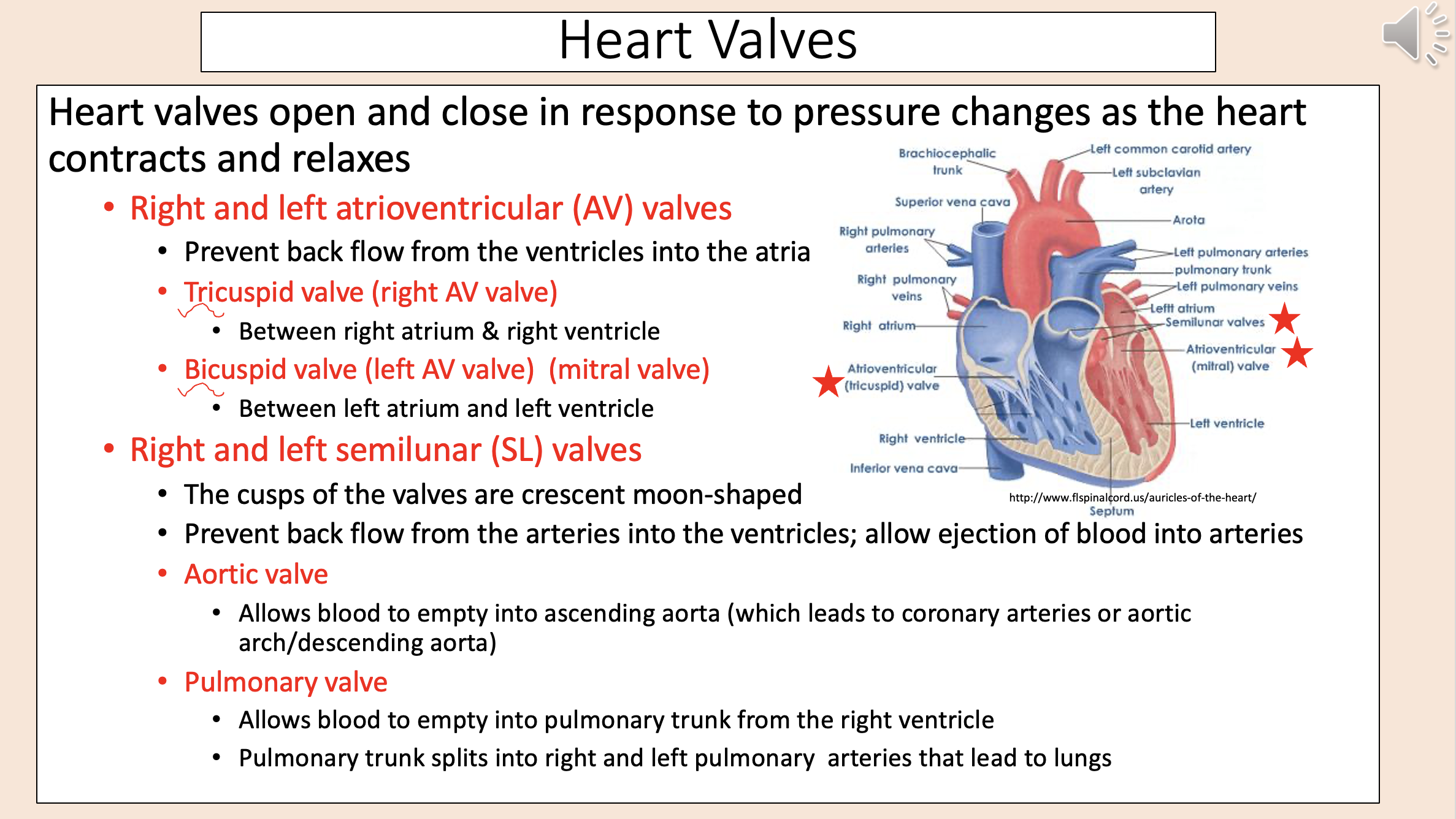
Heart Valves

right and left atrioventricular valves

right and left semilunar valves
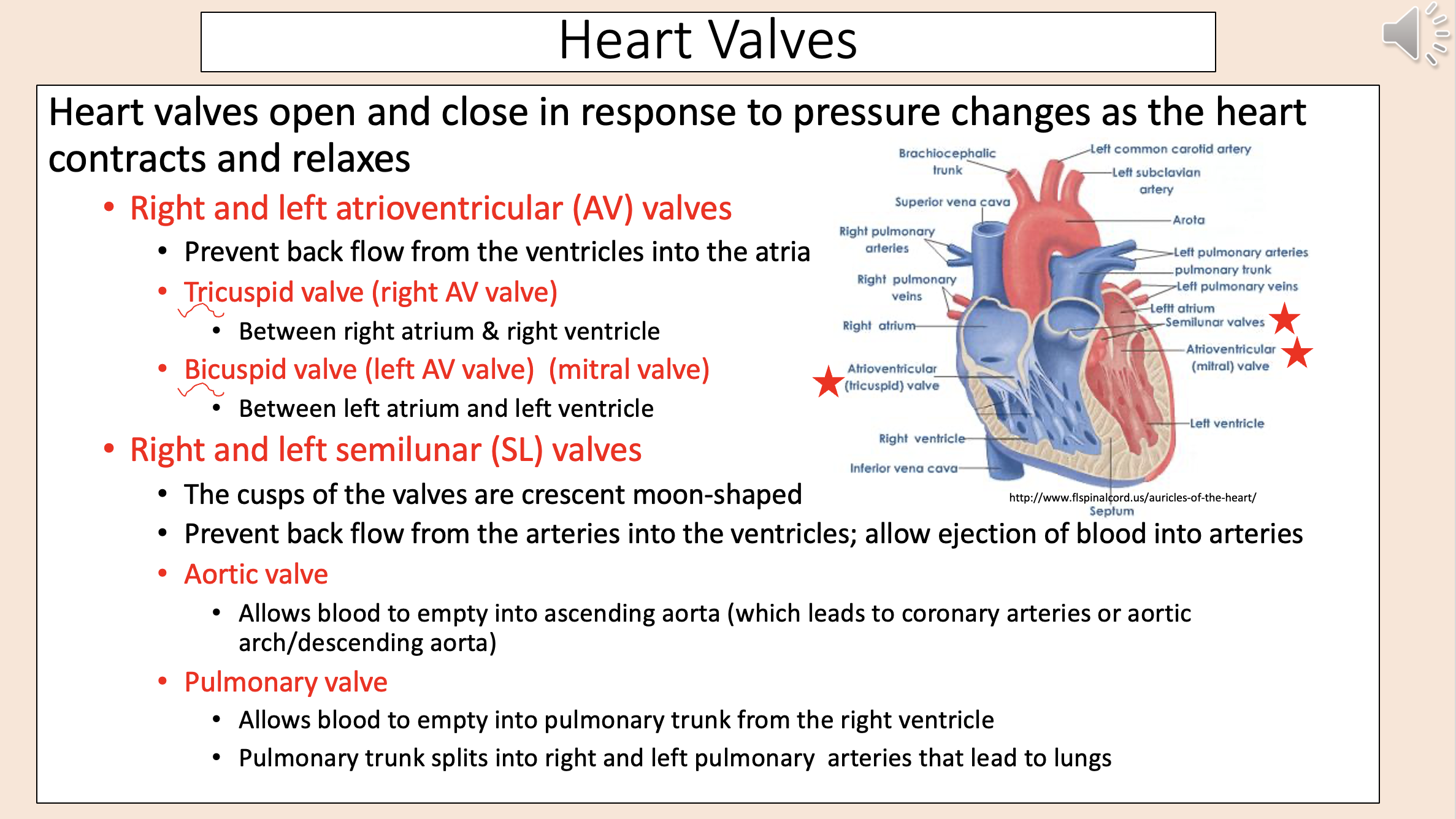
<p><span style="color: rgb(255, 0, 0);">right and left atrioventricular valves</span></p><p><span style="color: rgb(255, 0, 0);">right and left semilunar valves</span></p>
33
New cards

Prevent back flow from the ventricles into the atria

right and left atrioventricular (AV) valves
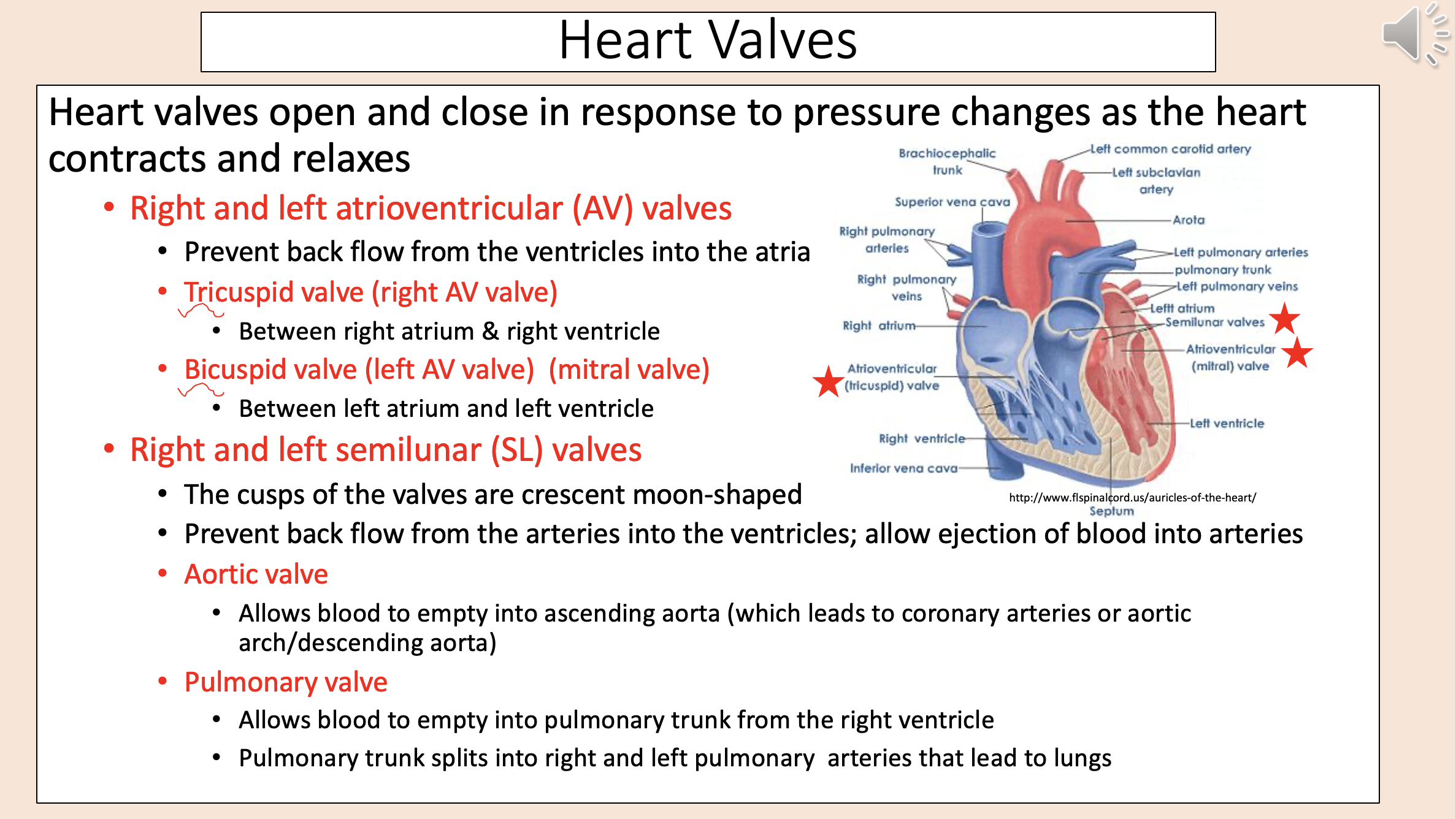
<p><span style="color: rgb(255, 0, 0);">right and left atrioventricular (AV) valves</span></p>
34
New cards

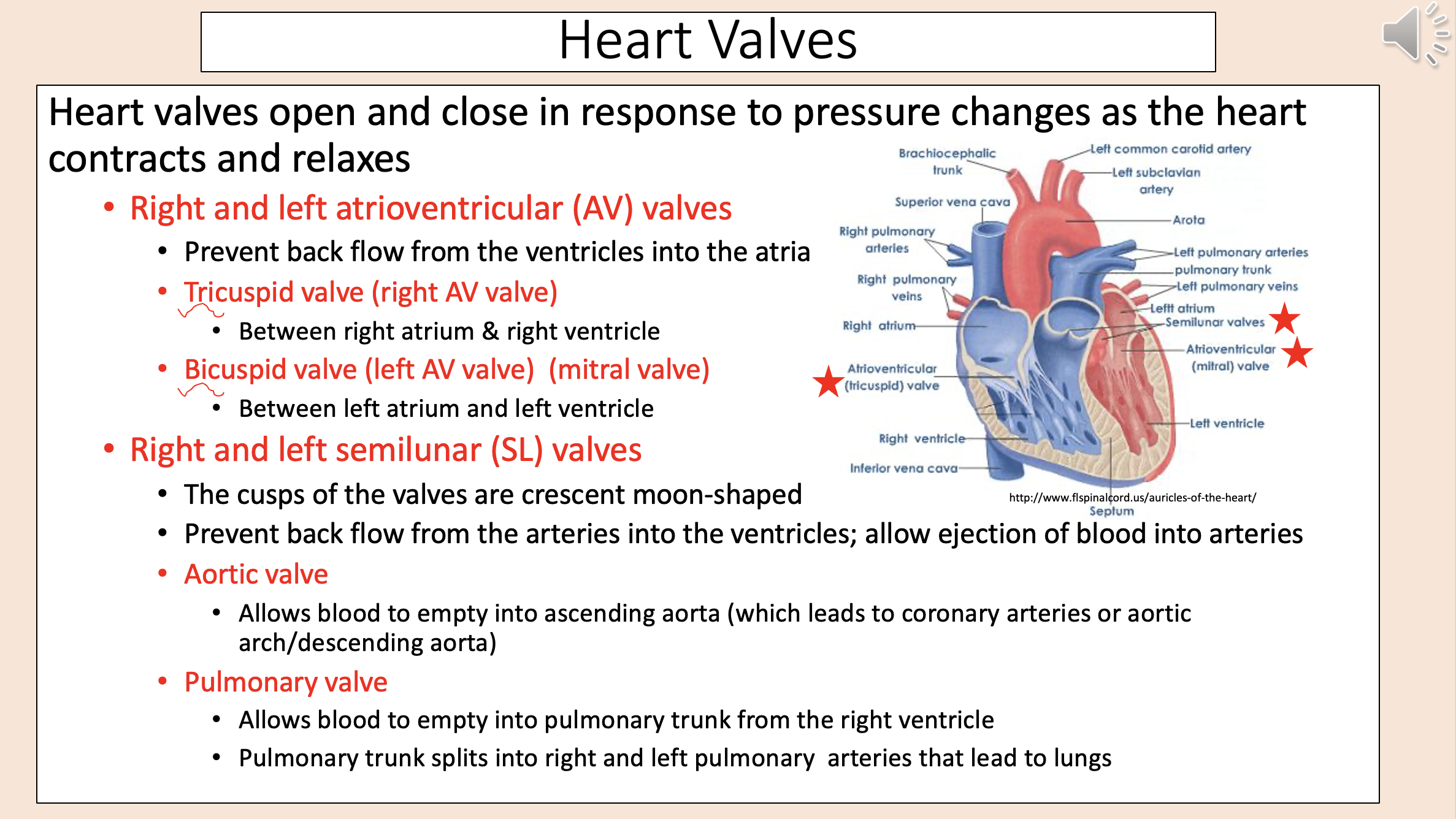
Right AV valve.

Between right atrium & right ventricle.

tricuspid valve
<p><span style="color: rgb(255, 0, 0);">tricuspid valve</span></p>
35
New cards

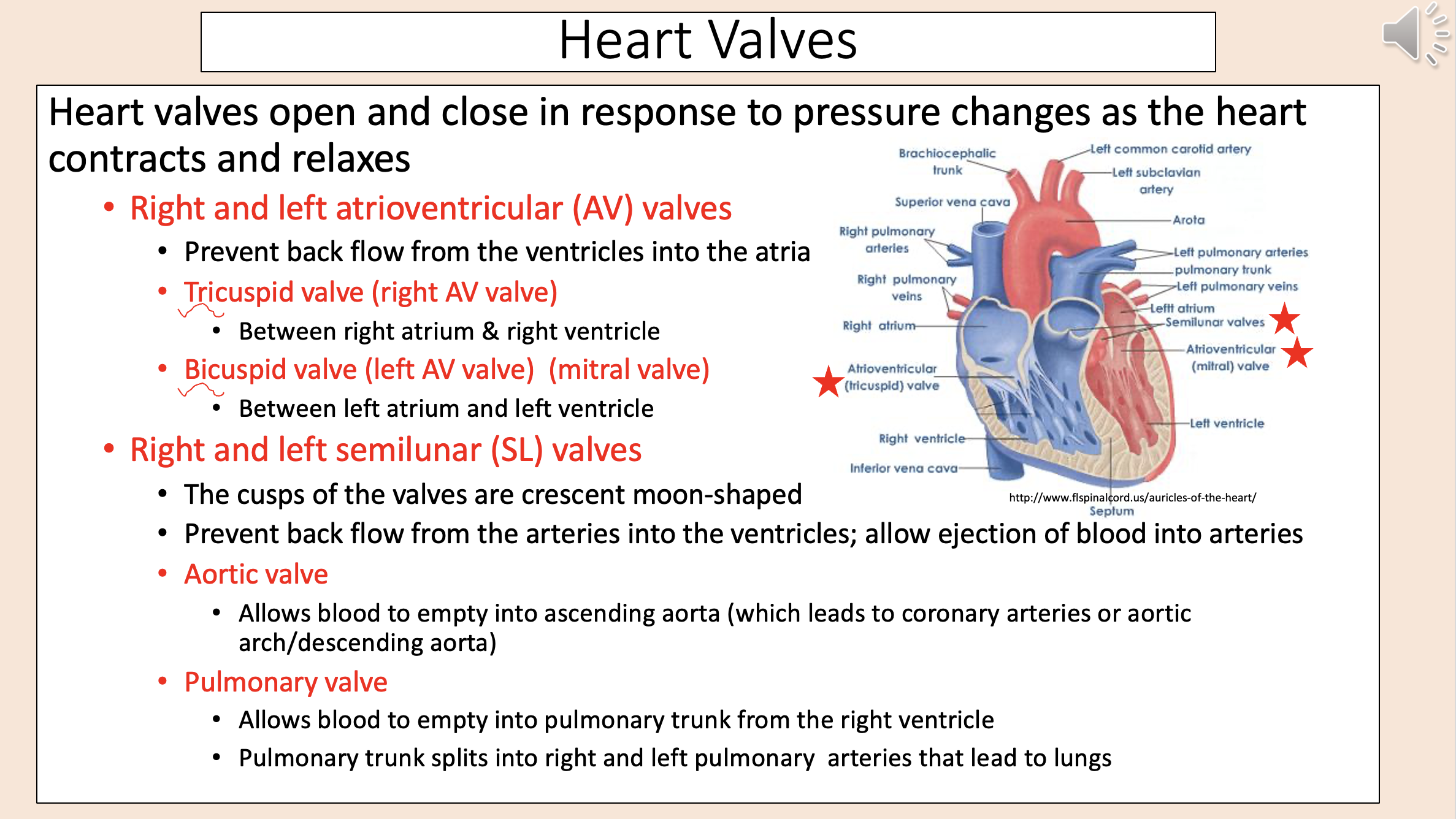
Left AV valve.

Between left atrium and left ventricle.

bicuspid valve

mitral valve
<p><span style="color: rgb(255, 0, 0);">bicuspid valve</span></p><p><span style="color: rgb(255, 0, 0);">mitral valve</span></p>
36
New cards

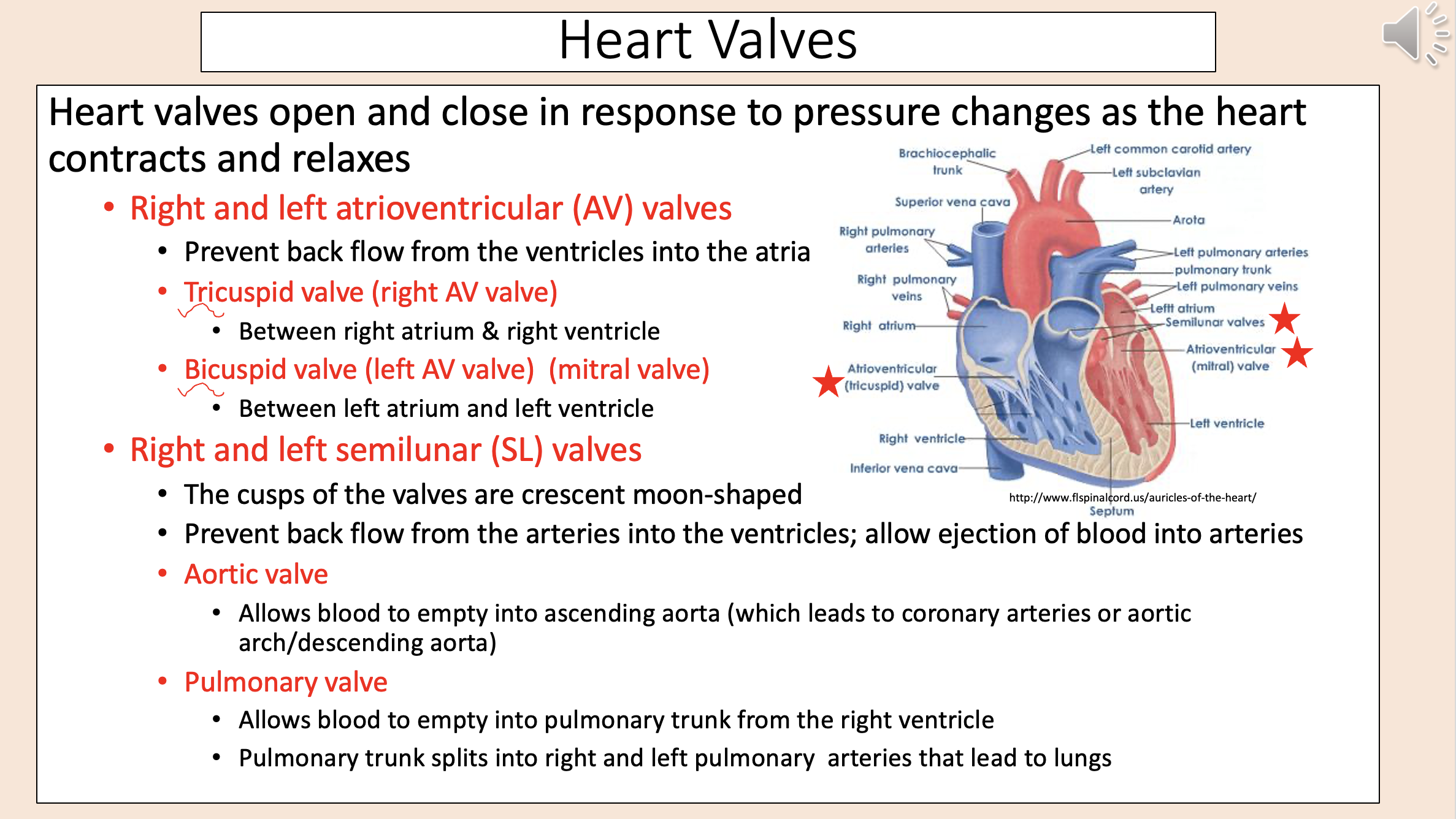
The cusps of the valves are crescent moon-shaped.

Prevent back flow from the arteries into the ventricles; allow ejection of blood into arteries.

right and left semilunar (SL) valve
<p><span style="color: rgb(255, 0, 0);">right and left semilunar (SL) valve</span></p>
37
New cards

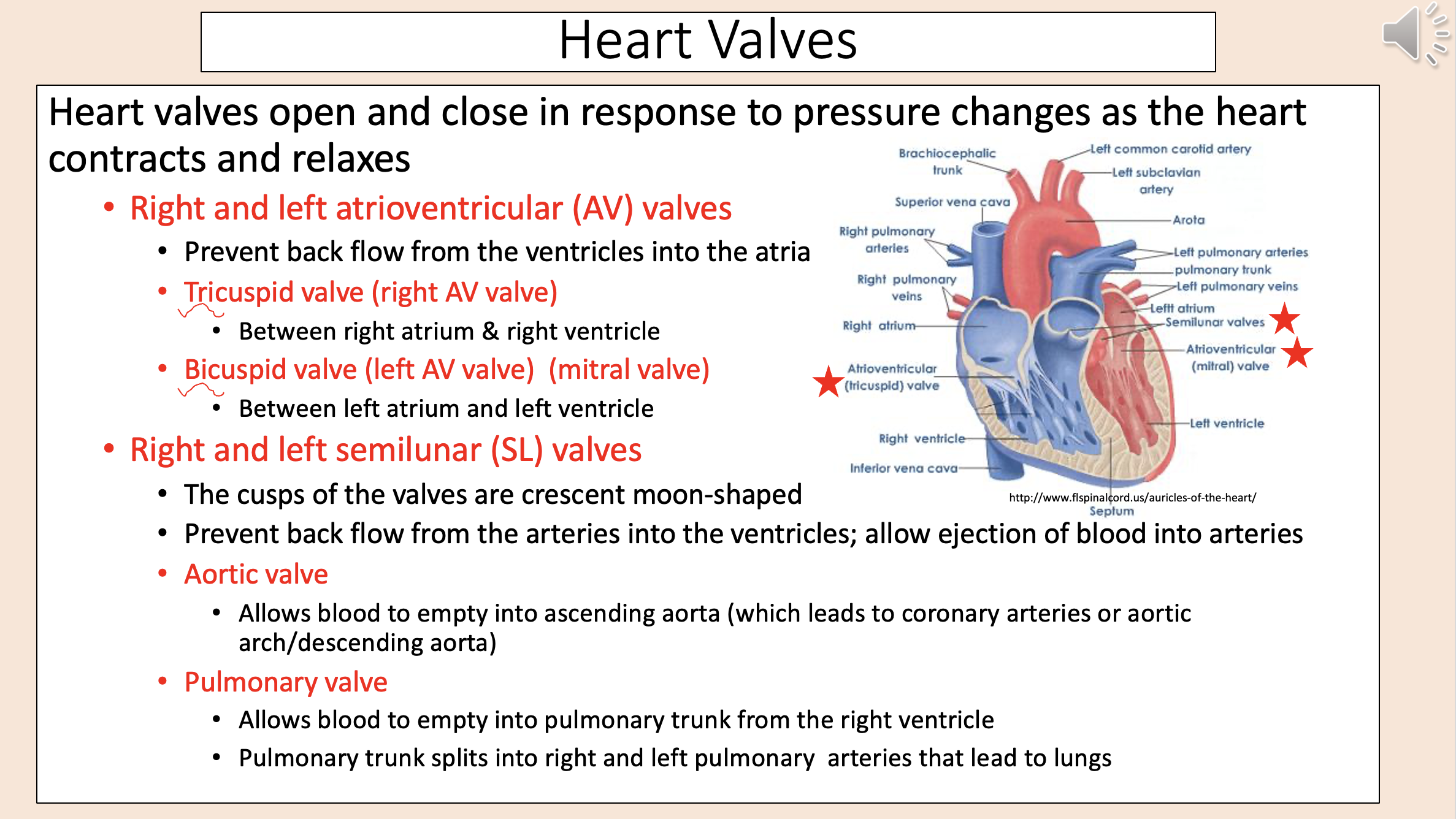
Left semilunar (SL) valve.

Allows blood to empty into ascending aorta (which leads to coronary arteries or aortic arch/descending aorta)

aortic valve
<p><span style="color: rgb(255, 0, 0);">aortic valve</span></p>
38
New cards

Right semilunar (SL) valve.

Allows blood to empty into pulmonary trunk from the right ventricle.

Pulmonary trunk splits into right and left pulmonary arteries that lead to lungs.

pulmonary valve
<p><span style="color: rgb(255, 0, 0);">pulmonary valve</span></p>
39
New cards

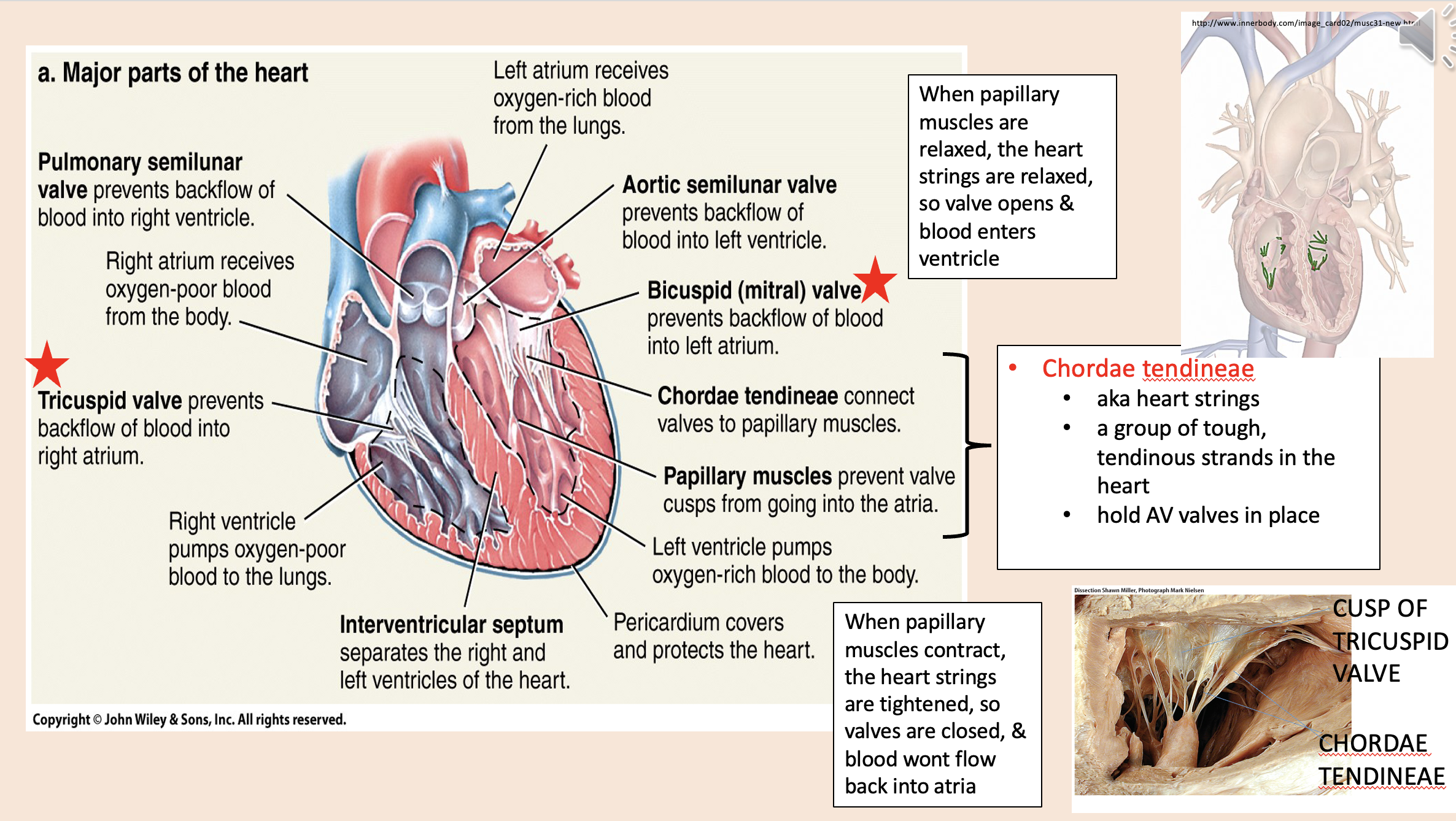
aka heart strings

chordae tendineae

<p><span style="color: rgb(255, 0, 0);">chordae tendineae</span></p>
40
New cards

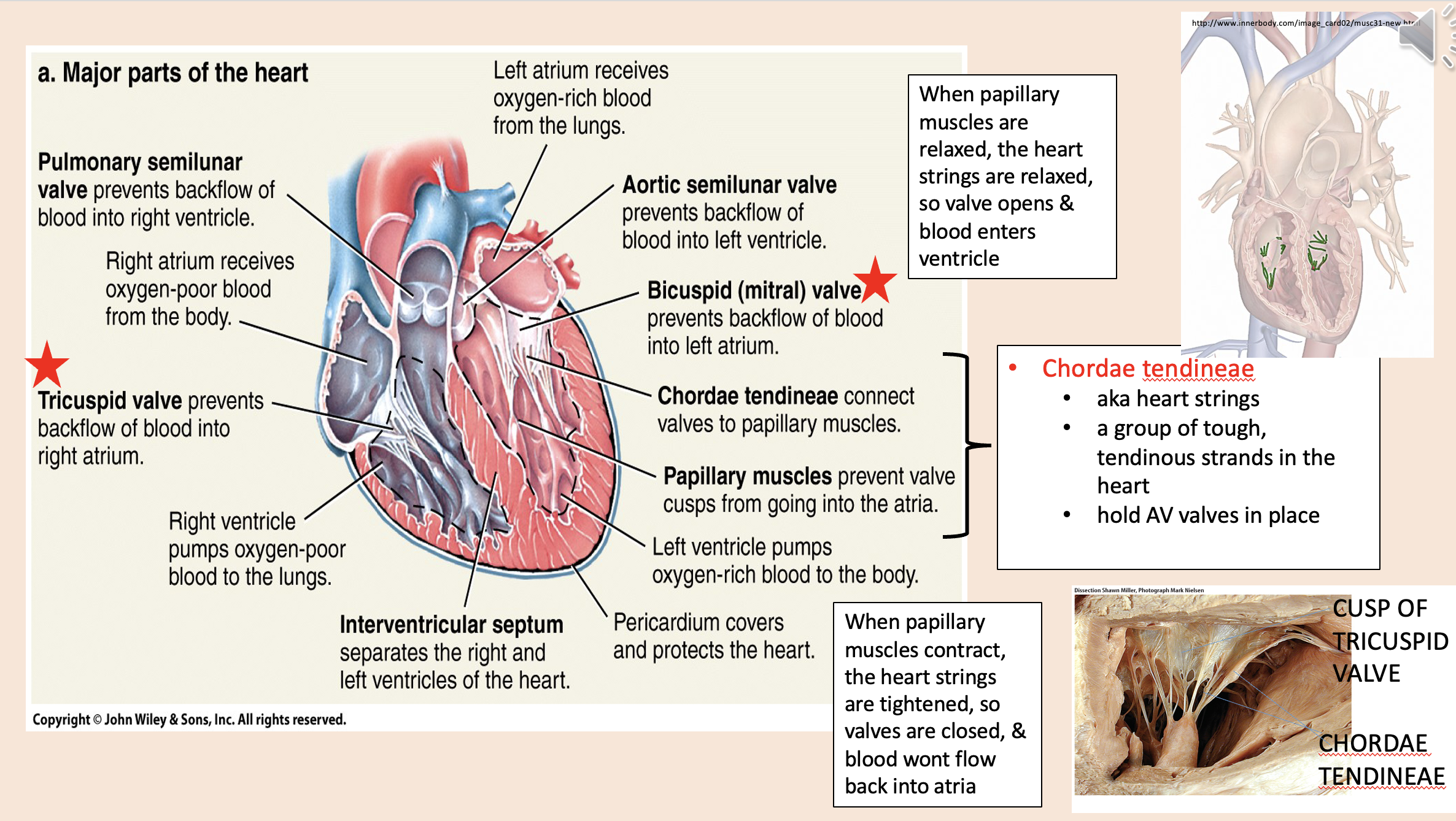
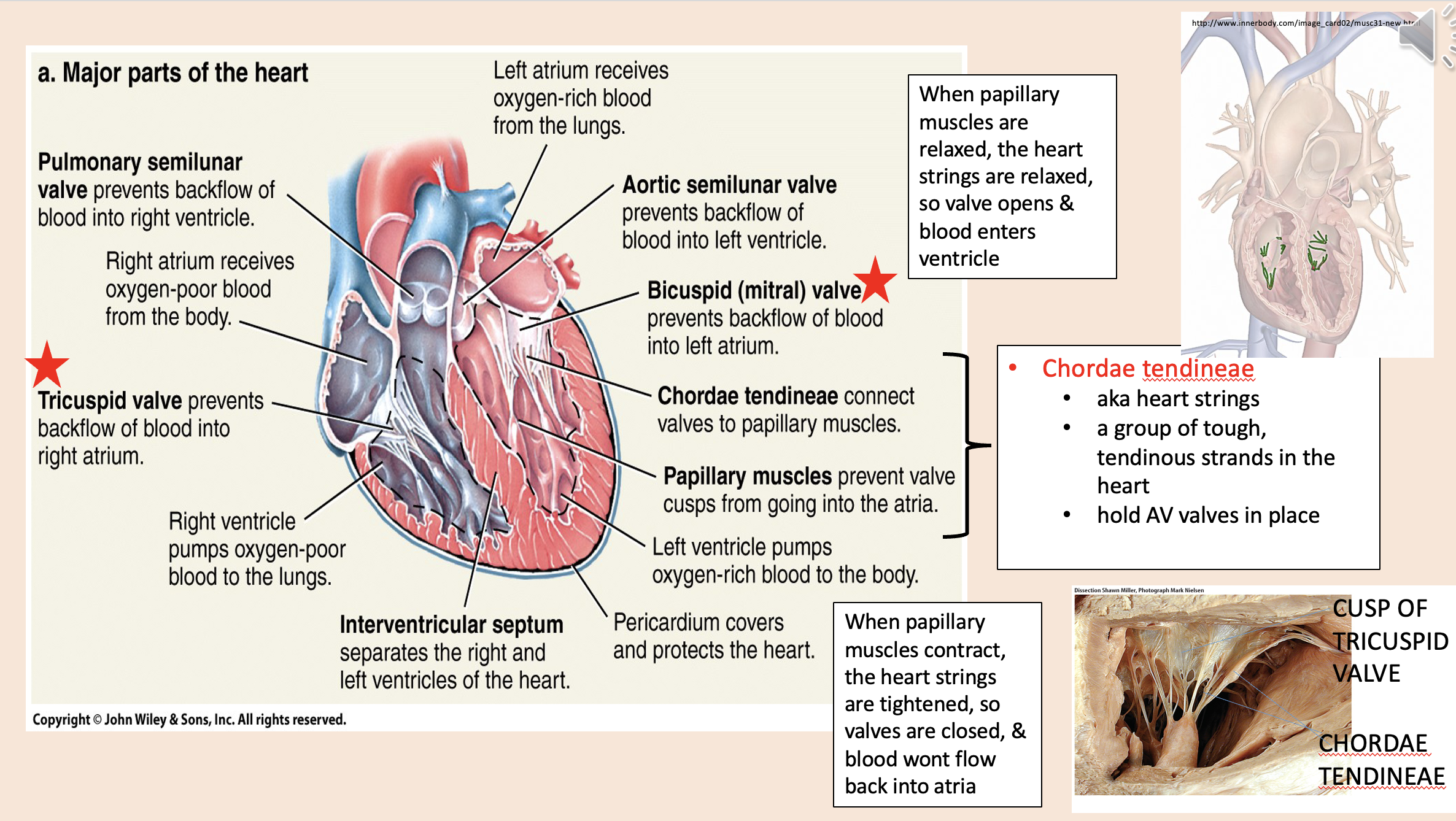
A group of tough, tendinous strands in the heart.

Hold AV valves in place.

chordae tendineae
<p><span style="color: rgb(255, 0, 0);">chordae tendineae </span></p>
41
New cards

When papillary muscles are relaxed, the heart strings are relaxed, so

valve opens

blood enters ventricle
<p>valve opens</p><p>blood enters ventricle</p>
42
New cards

When papillary muscles contract, the heart strings are tightened, so

valves are closed

blood wont flow back into atria
<p>valves are closed</p><p>blood wont flow back into atria</p>
43
New cards

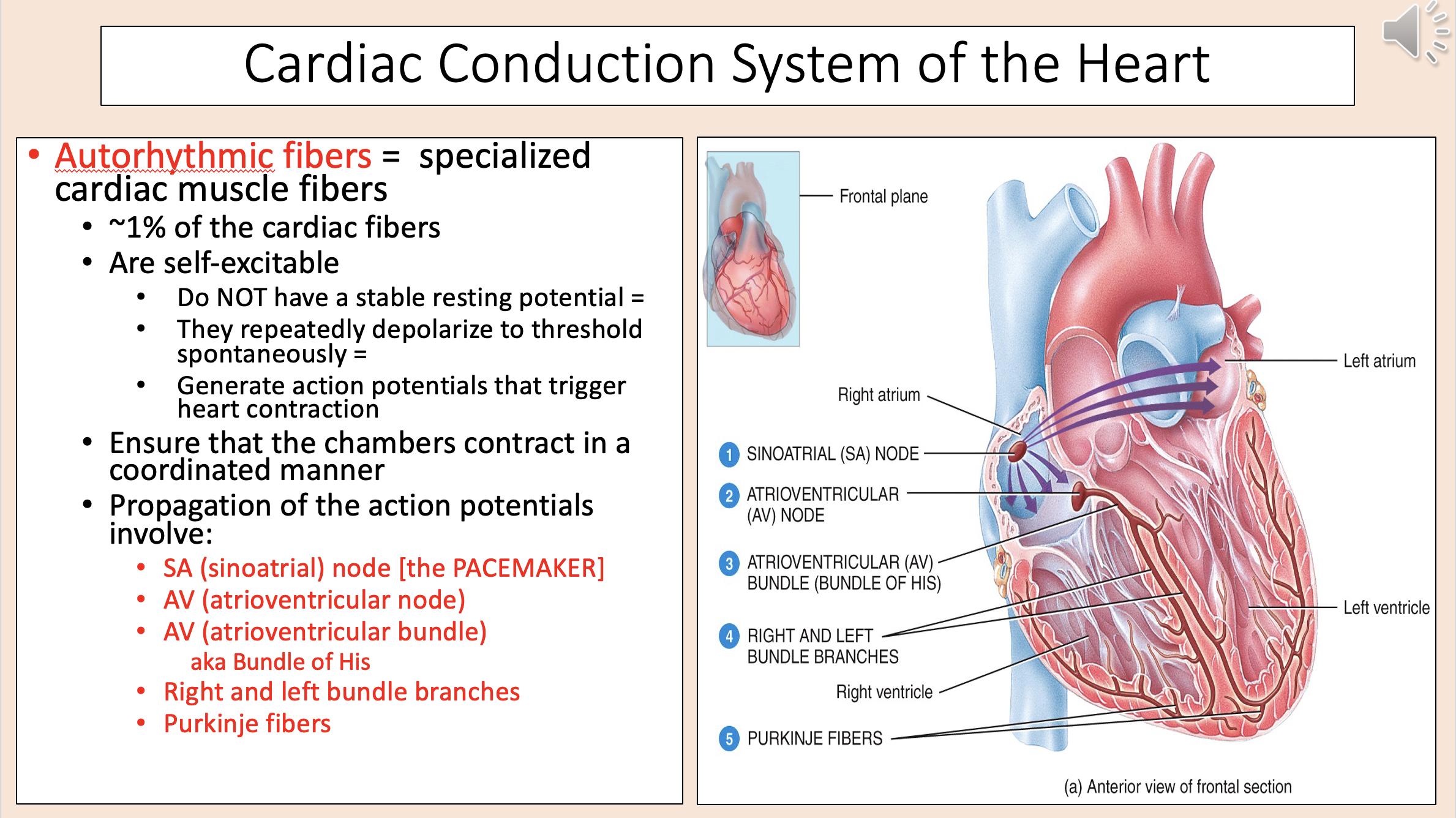
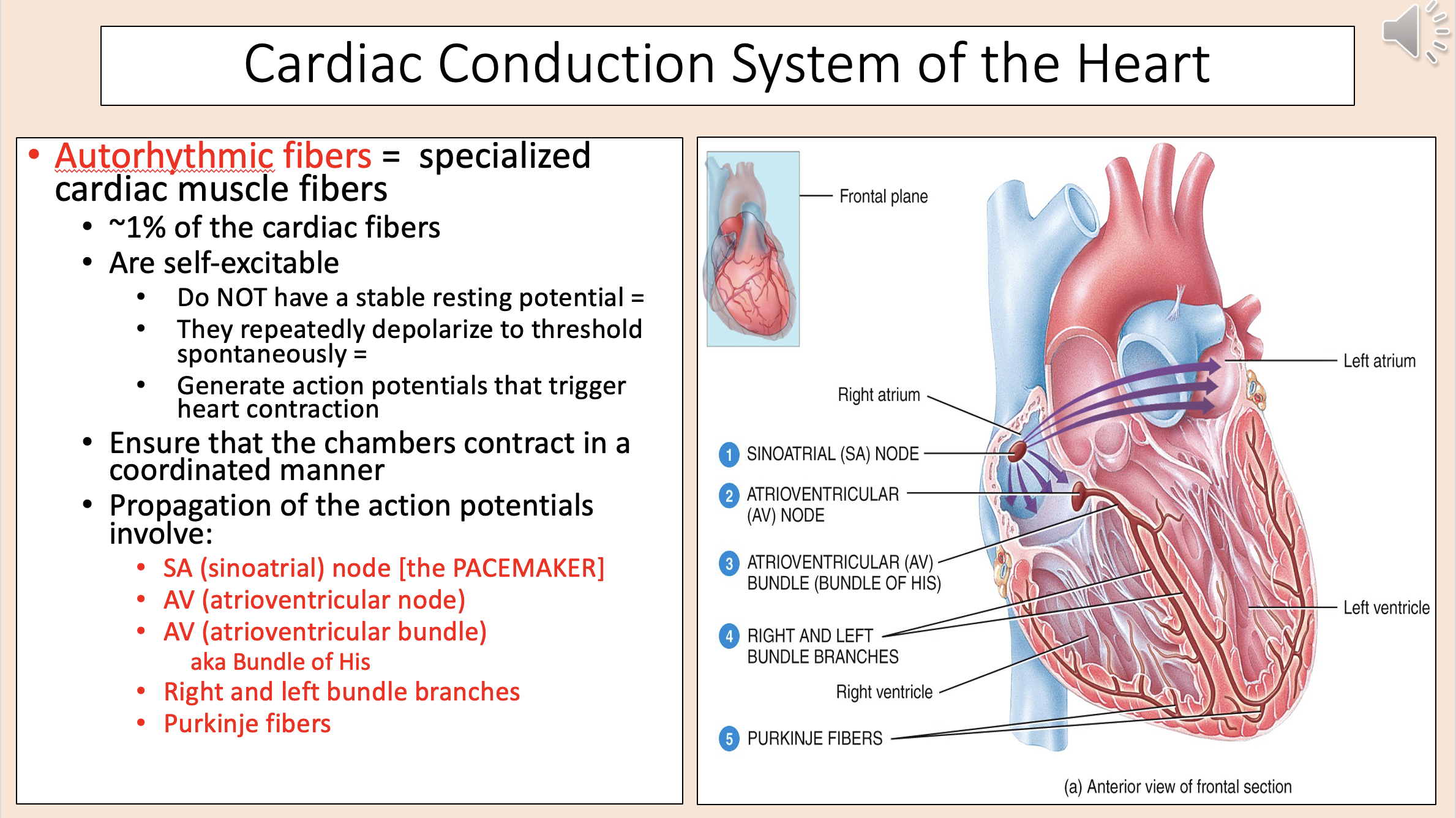
Specialized cardiac muscle fibers.

~1% of the cardiac fibers.

Are self-excitable.

Generate action potentials that trigger heart contraction.

Ensure that the chambers contract in a coordinated manner.

autorhythmic fibers
<p><span style="color: rgb(255, 0, 0);">autorhythmic fibers</span></p>
44
New cards

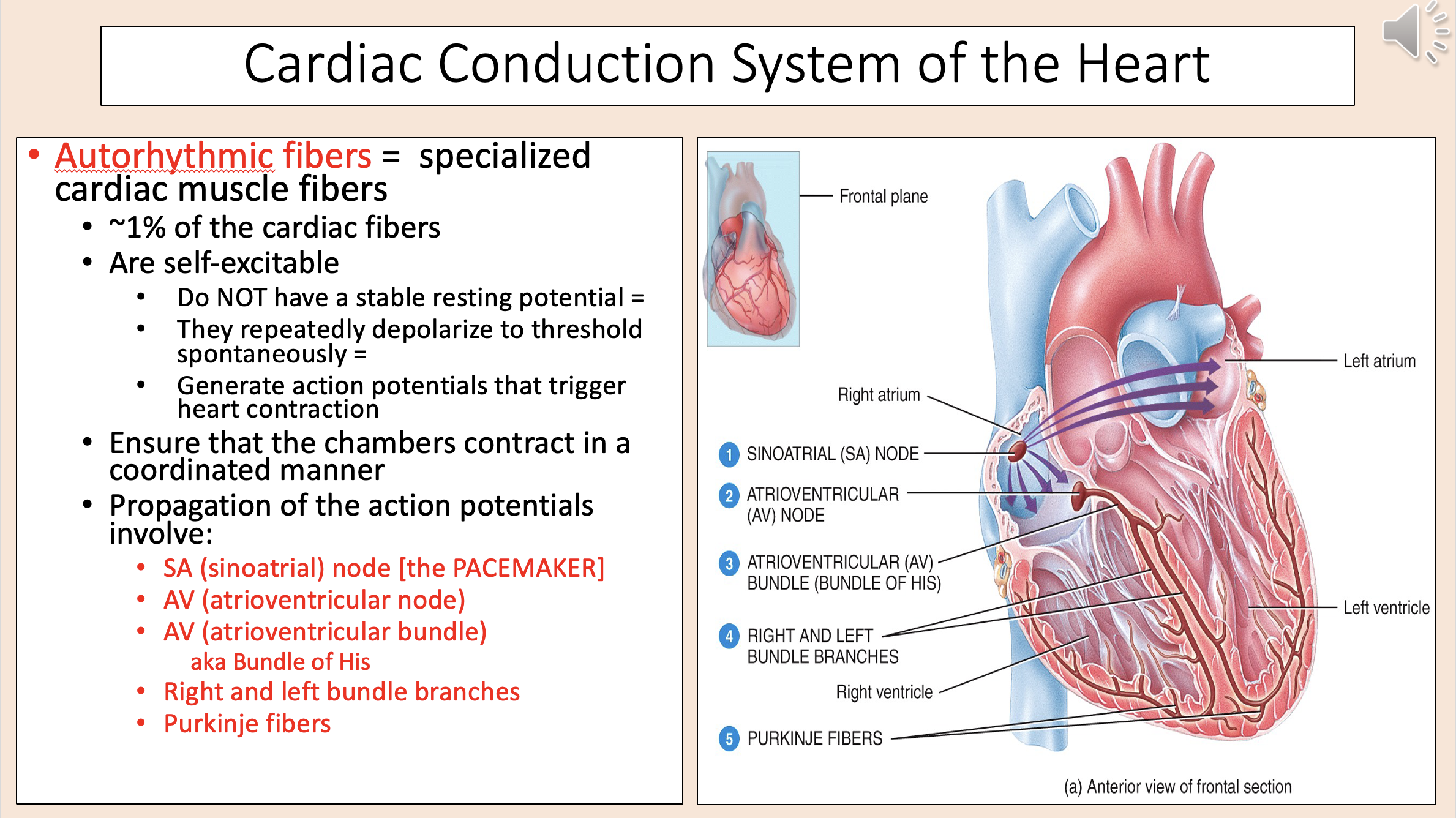
Propagation of action potentials involve:

SA (sinoatrial)

AV (atrioventricular node)

AV (atrioventricular bundle)

right bundle branches

left bundle branches

purkinje fibers
<p><span style="color: rgb(255, 0, 0);">SA (sinoatrial)</span></p><p><span style="color: rgb(255, 0, 0);">AV (atrioventricular node)</span></p><p><span style="color: rgb(255, 0, 0);">AV (atrioventricular bundle)</span></p><p><span style="color: rgb(255, 0, 0);">right bundle branches</span></p><p><span style="color: rgb(255, 0, 0);">left bundle branches</span></p><p><span style="color: rgb(255, 0, 0);">purkinje fibers</span></p>
45
New cards

The pacemaker

sinoatrial (SA)

<p><span style="color: rgb(255, 0, 0);">sinoatrial (SA)</span></p>
46
New cards

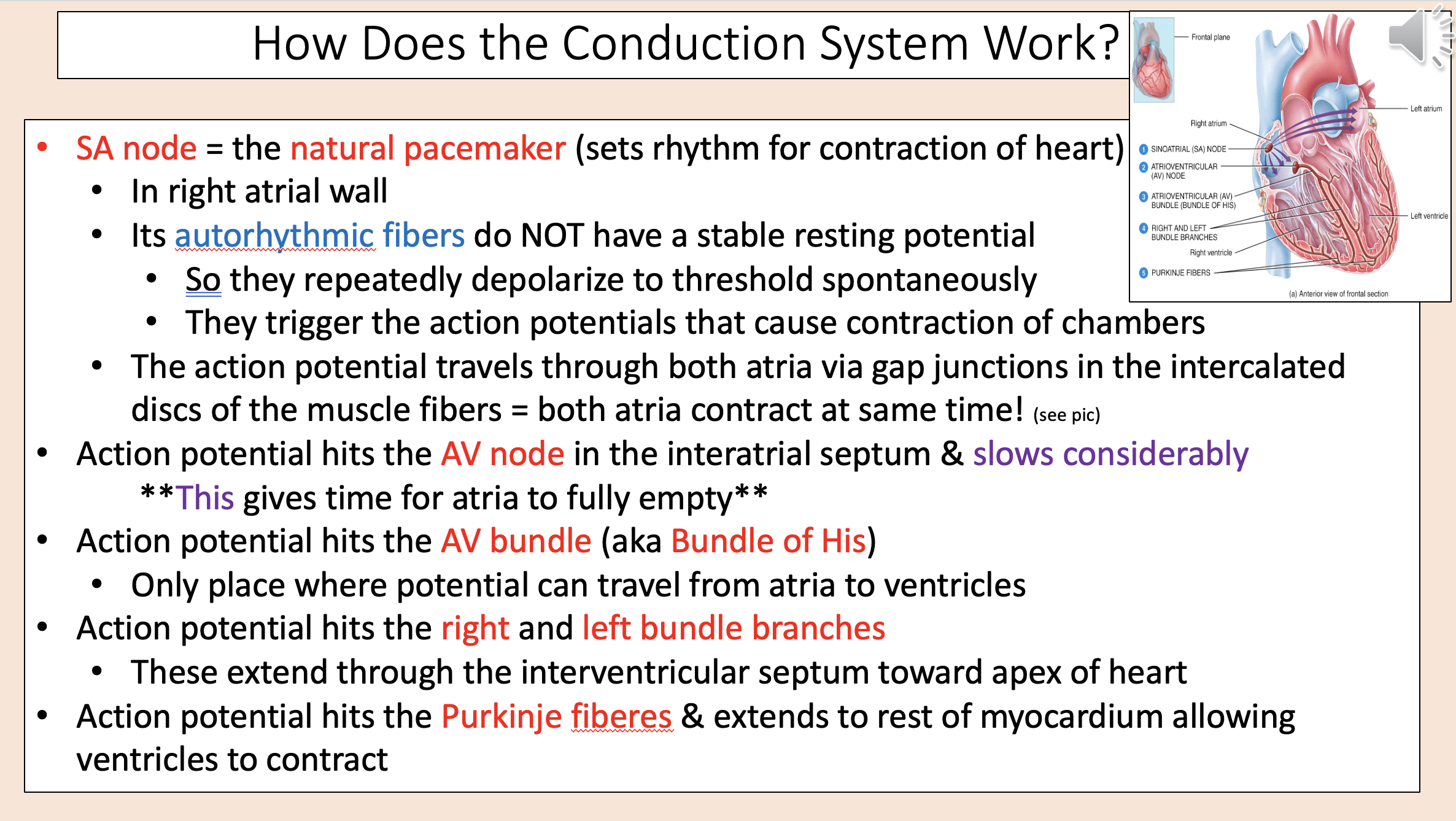
aka Bundle of His

atrioventricular bundle (AV)
<p><span style="color: rgb(255, 0, 0);">atrioventricular bundle (AV)</span></p>
47
New cards

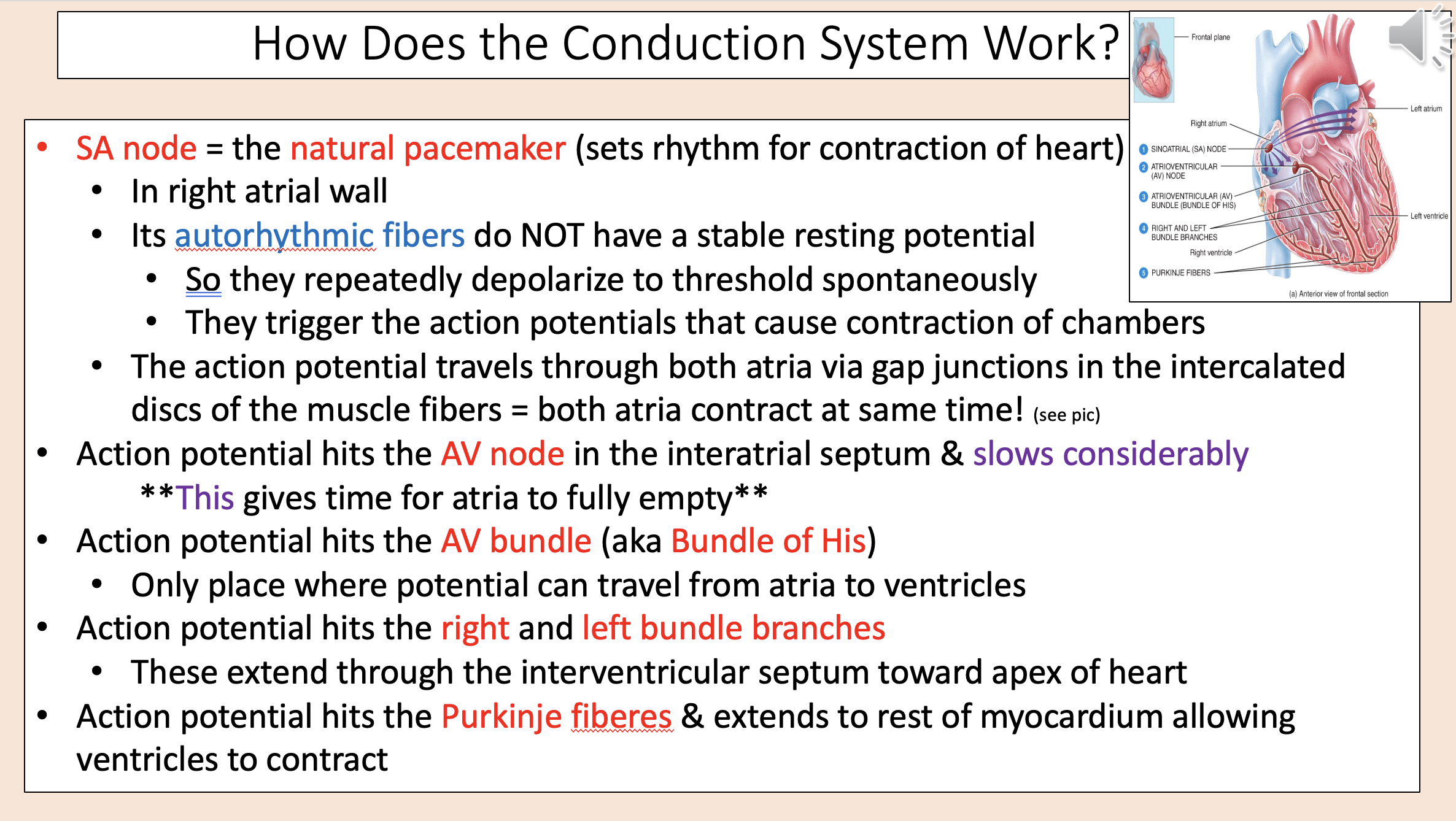
The natural pacemaker (sets rhythm for contraction of heart).

In right atrial wall.

SA node
<p><span style="color: rgb(255, 0, 0);">SA node</span></p>
48
New cards

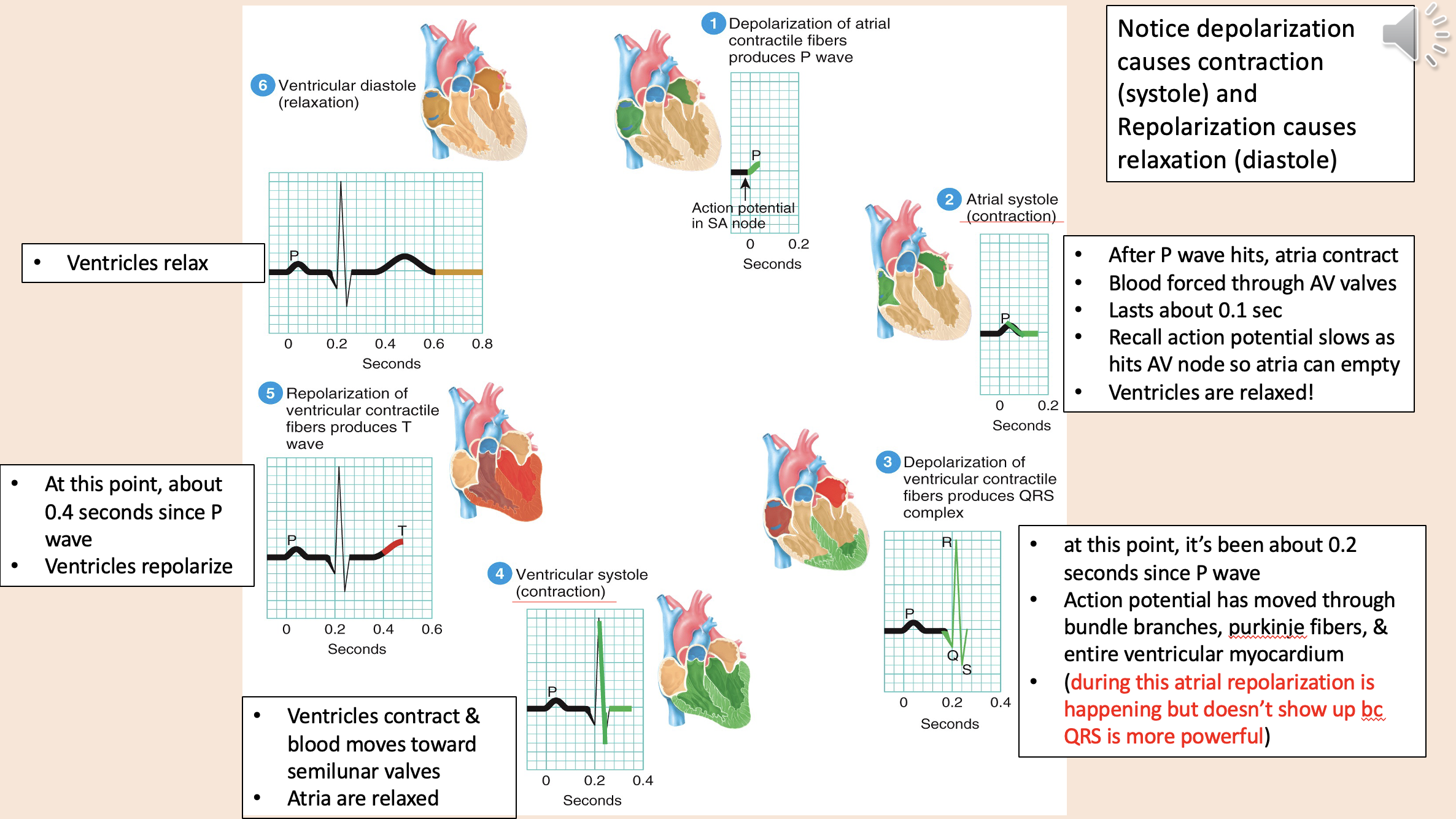
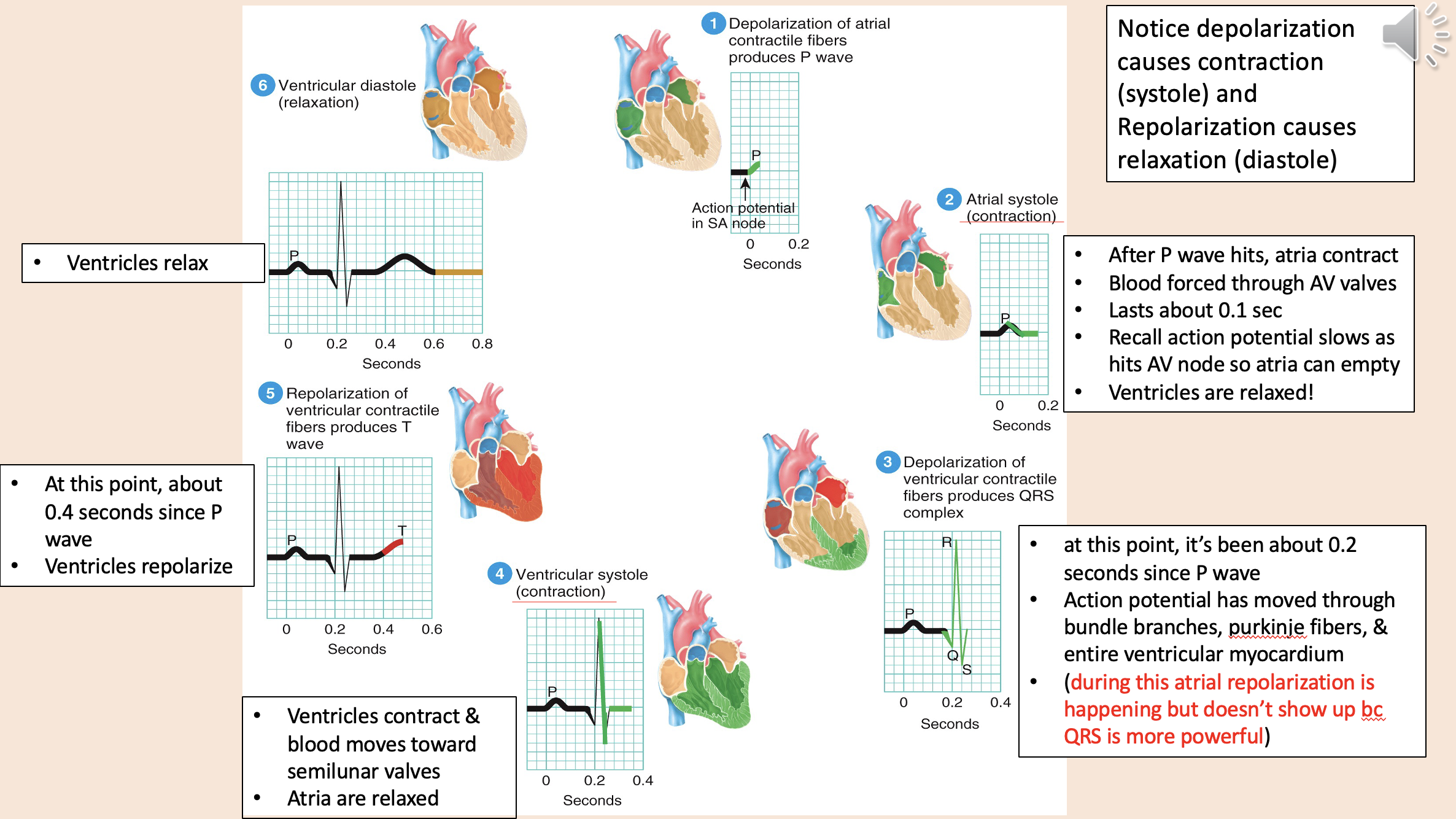
Depolarization causes contraction

systole
<p>systole</p>
49
New cards

Repolarization causes relaxation

diastole
<p><span>diastole</span></p>
50
New cards

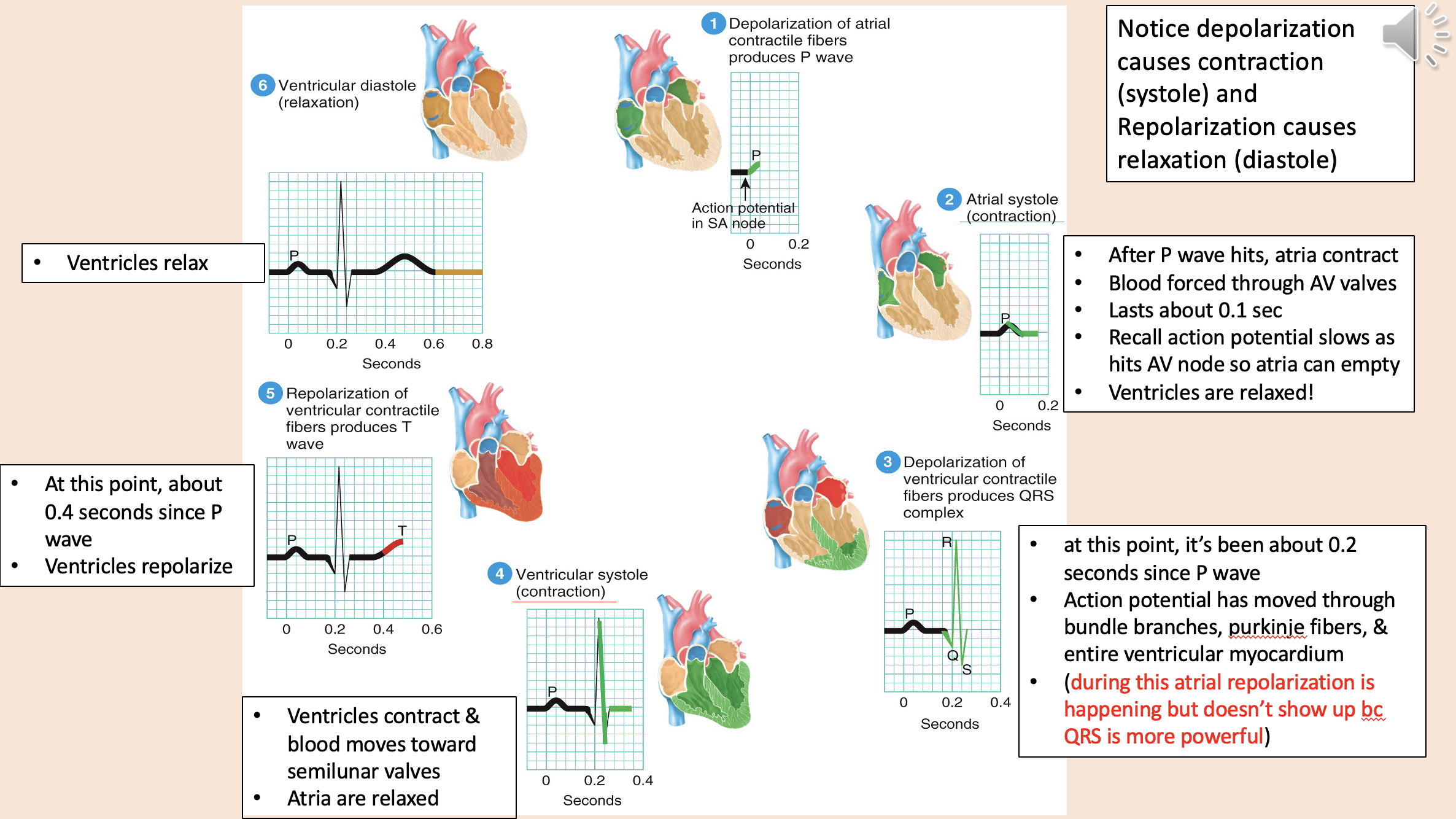
Action potential

depolarization of atria

atrial systole

depolarization of ventricular

ventricular systole

depolarization of ventricular

ventricular diastole
<p>depolarization of atria</p><p>atrial systole</p><p>depolarization of ventricular</p><p>ventricular systole </p><p>depolarization of ventricular </p><p>ventricular diastole </p>
51
New cards

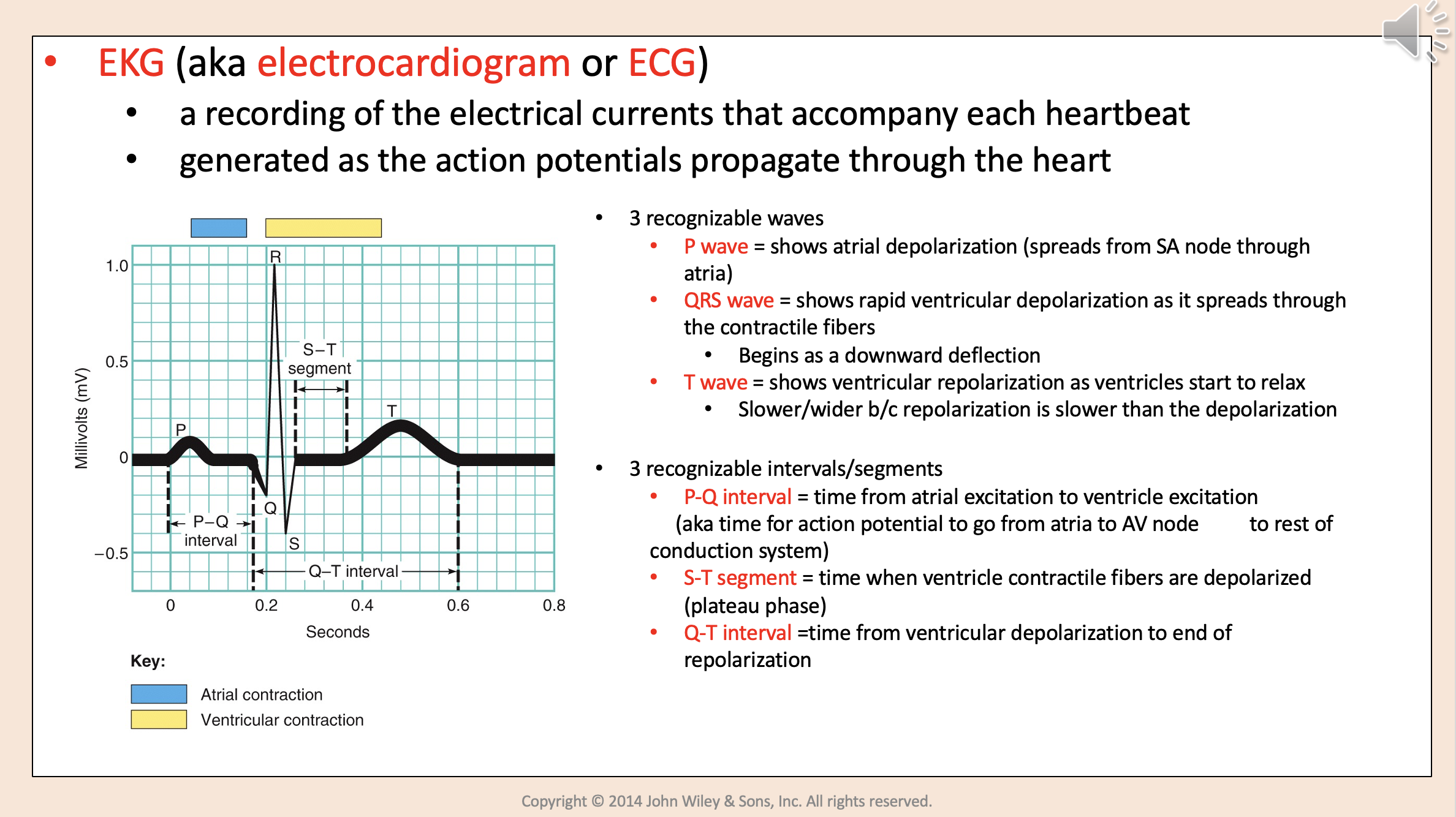
aka electrocardiogram or ECG

EKG

<p><span style="color: rgb(255, 0, 0);">EKG</span></p>
52
New cards

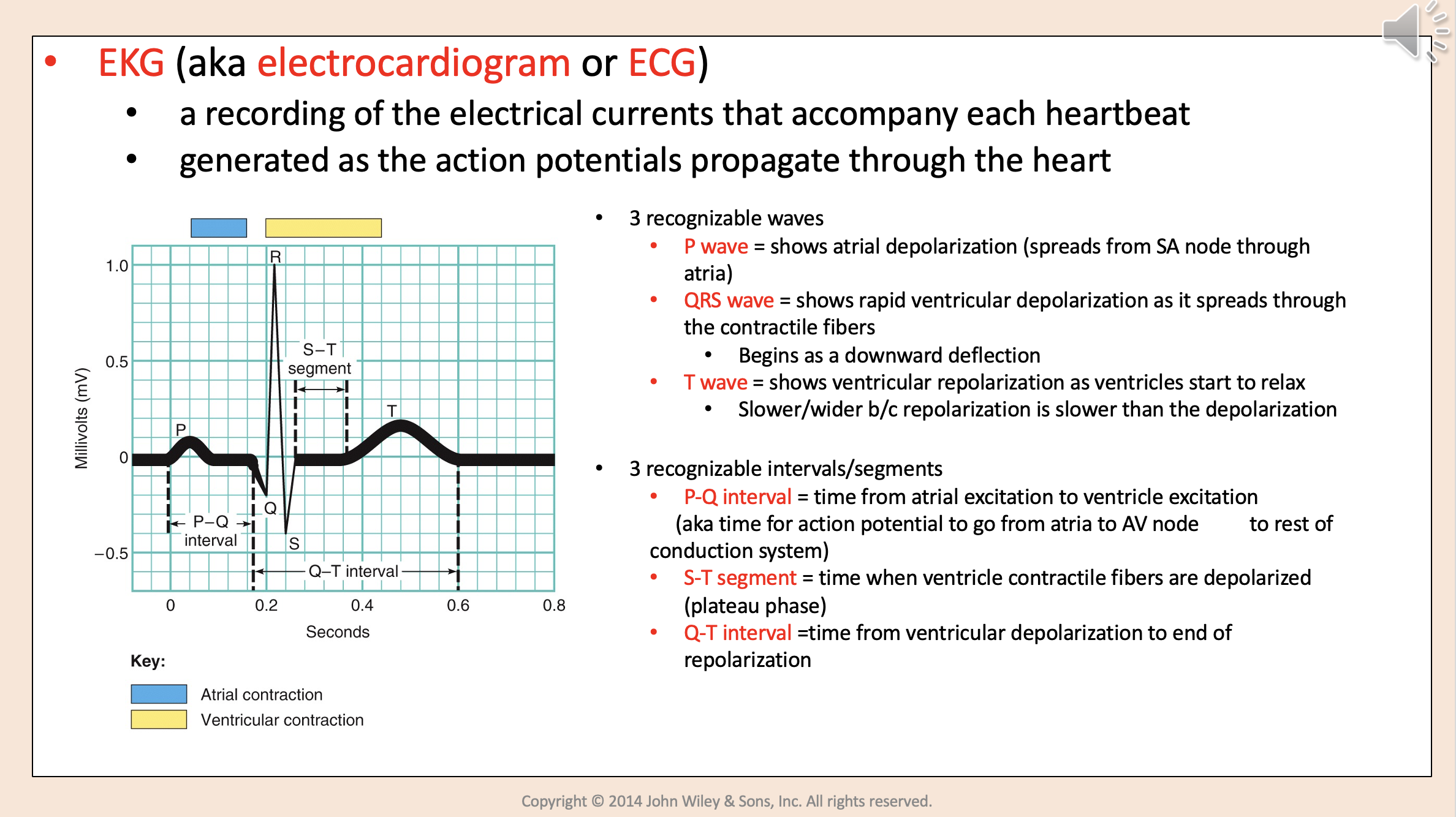
A recording of the electrical currents that accompany each heart beat.

Generated as the action potentials propagate through the heart.

EKG
<p><span style="color: rgb(255, 0, 0);">EKG</span></p>
53
New cards

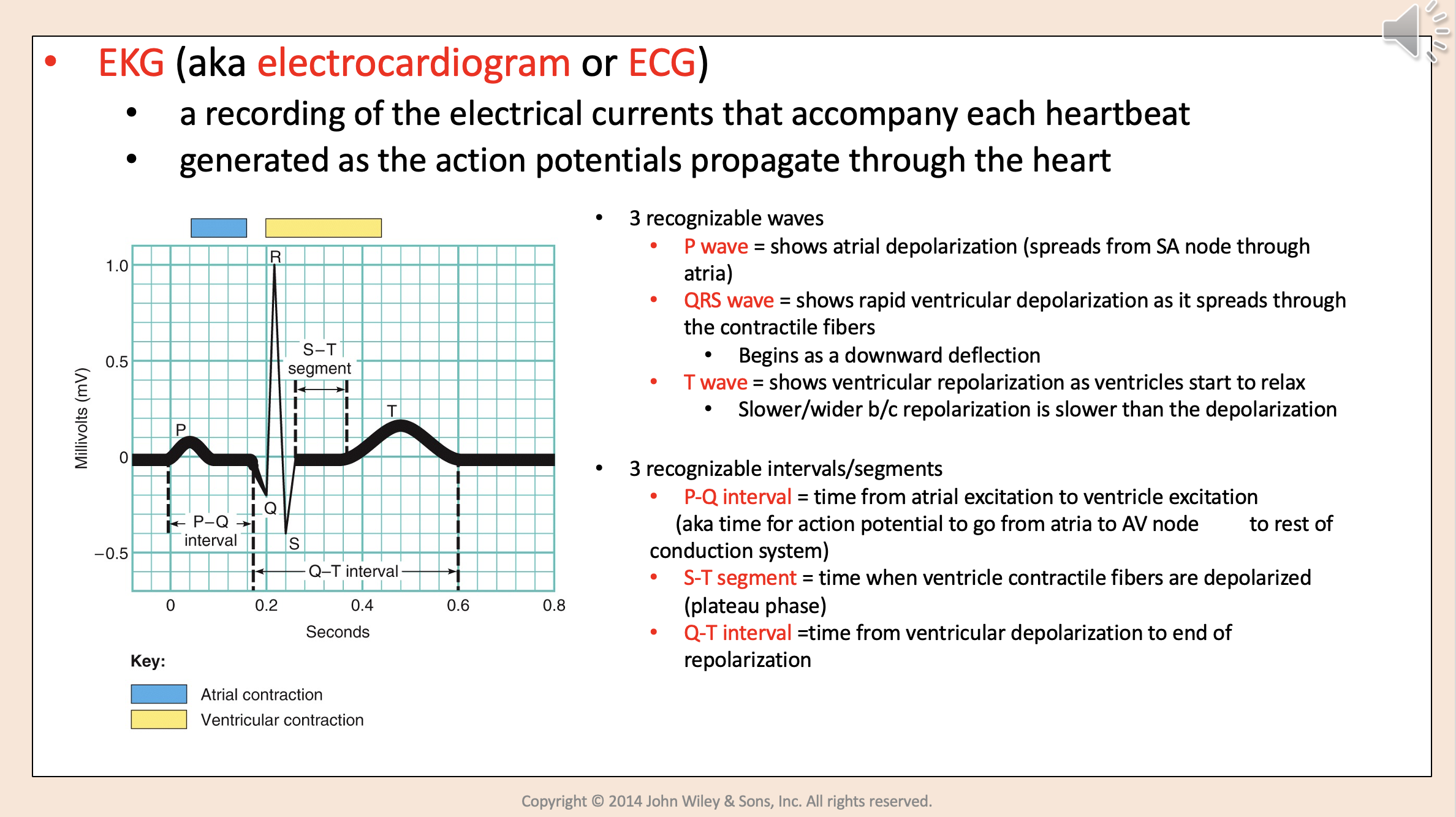
3 recognizable waves:

P wave

QRS wave

T wave
<p><span style="color: rgb(255, 0, 0);">P wave</span></p><p><span style="color: rgb(255, 0, 0);">QRS wave</span></p><p><span style="color: rgb(255, 0, 0);">T wave</span></p>
54
New cards

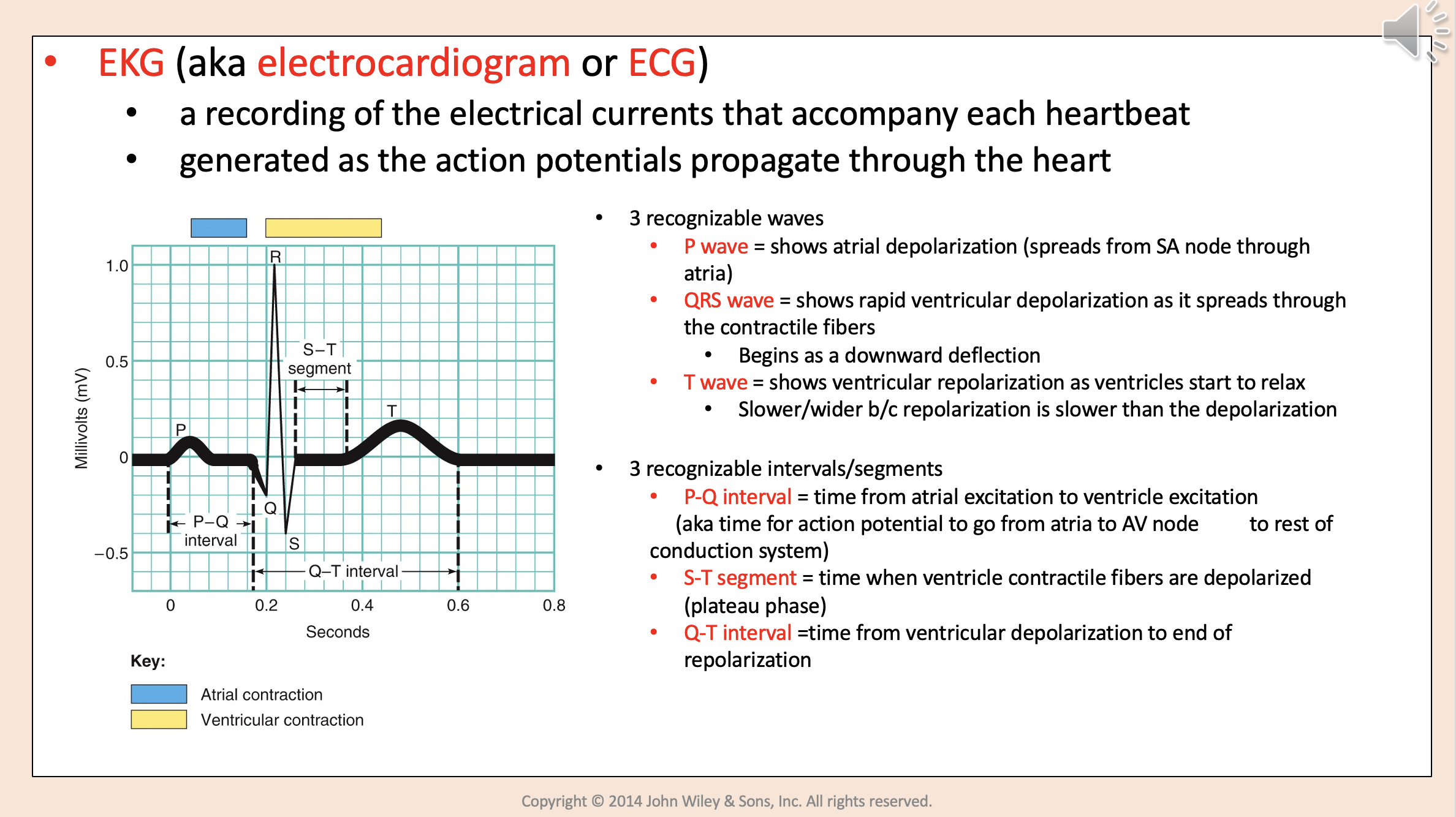
Shows atrial depolarization (spreads from SA node through atria)

P wave
<p><span style="color: rgb(255, 0, 0);">P wave</span></p>
55
New cards

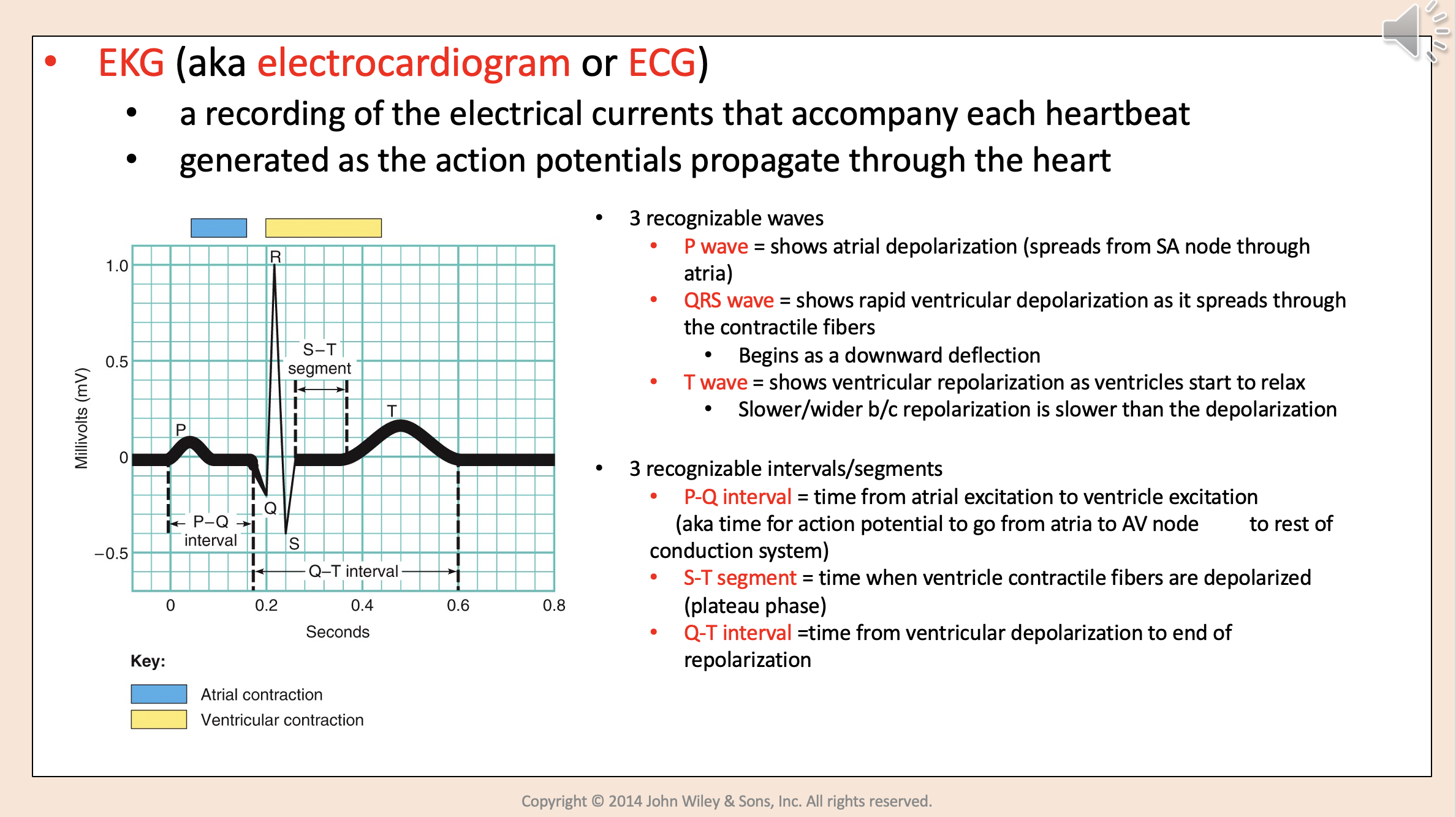
Shows rapid ventricular depolarization as it spreads through the contractile fibers.

Begins as a downward deflection.

QRS wave
<p><span style="color: rgb(255, 0, 0);">QRS wave</span></p>
56
New cards

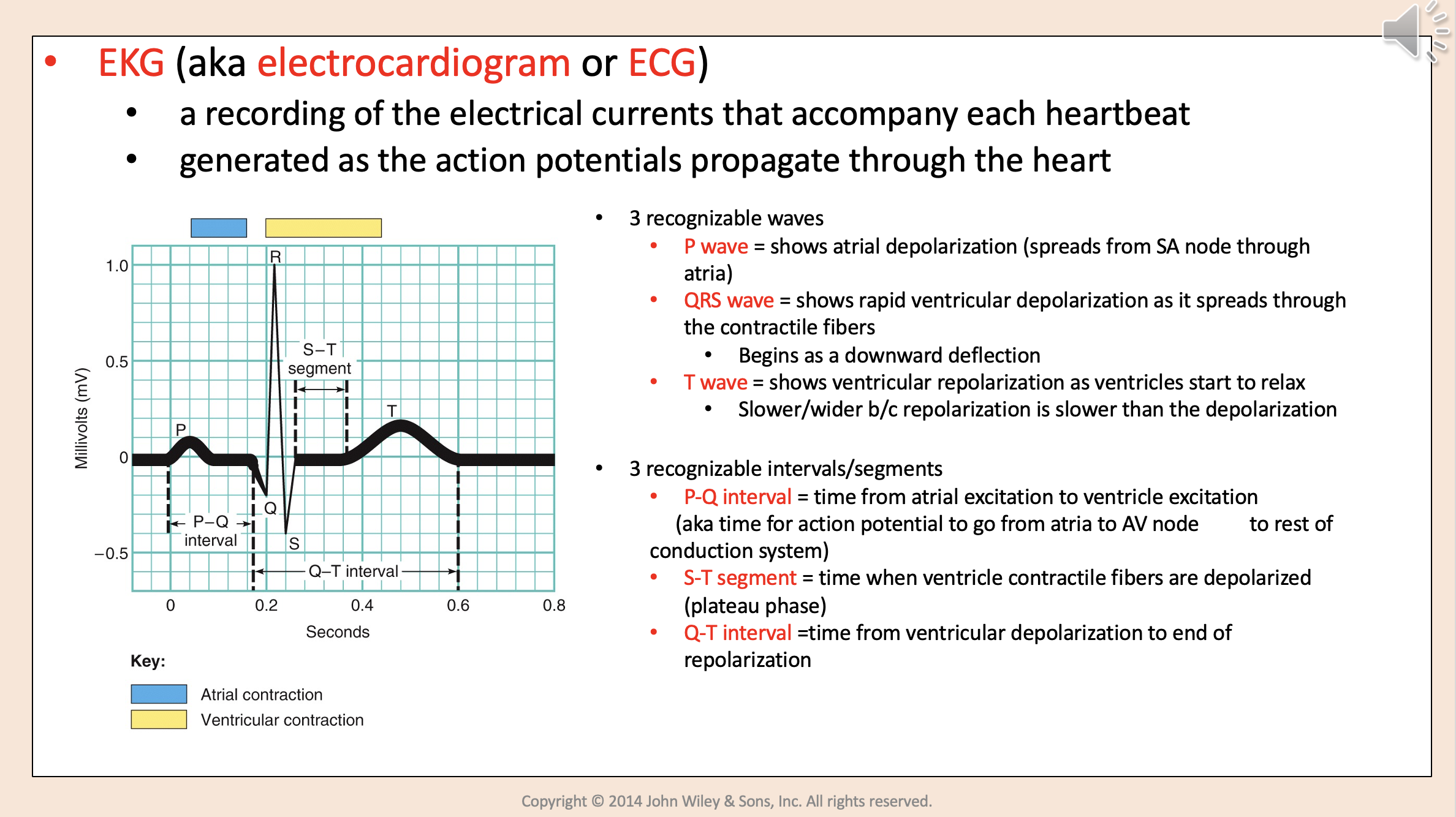
Shows ventricular repolarization as ventricles start to relax.

Slower/wider b/c repolarization is slower than the depolarization.

T wave
<p><span style="color: rgb(255, 0, 0);">T wave</span></p>
57
New cards

3 recognizable intervals/segments:

P-Q interval.

S-T segment.

Q-T interval.
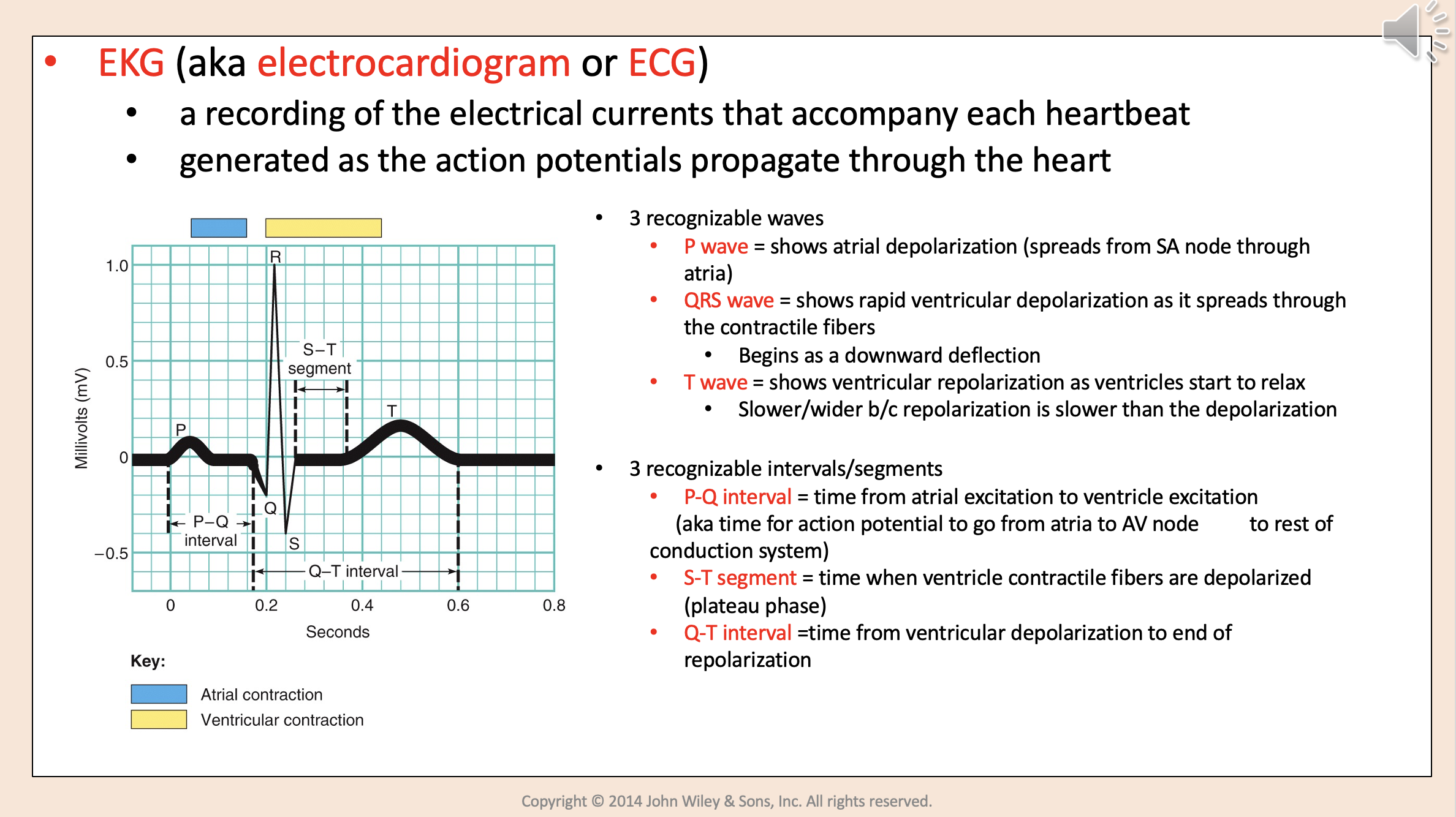
<p><span style="color: rgb(255, 0, 0);">P-Q interval.</span></p><p><span style="color: rgb(255, 0, 0);">S-T segment.</span></p><p><span style="color: rgb(255, 0, 0);">Q-T interval.</span></p>
58
New cards

Time from atrial excitation to ventricle excitation.

aka time for action potential to go from atria to AV node to rest of conduction system.

P-Q interval
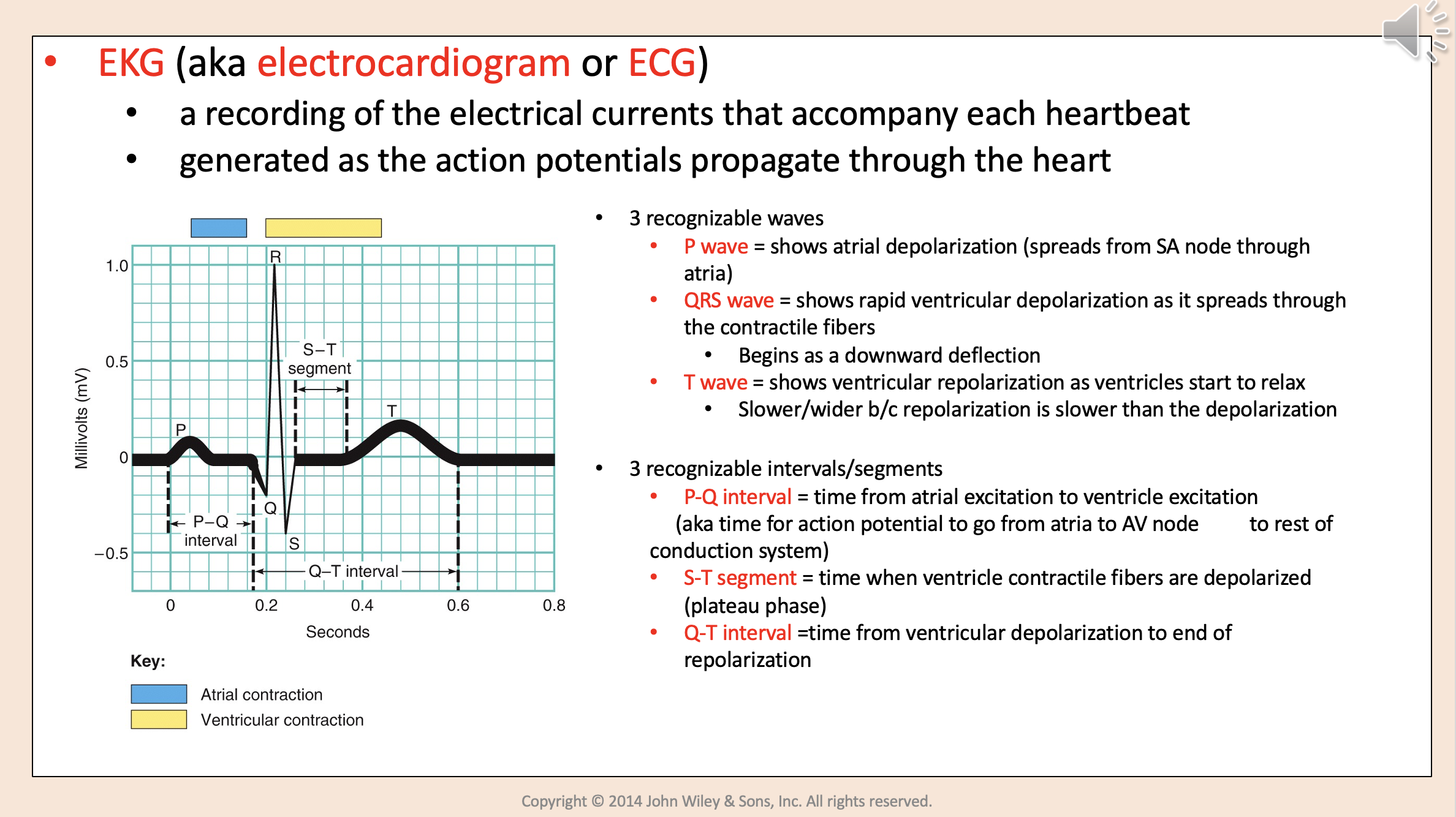
<p><span style="color: rgb(255, 0, 0);">P-Q interval </span></p>
59
New cards

Time when ventricle contractile fibers are depolarized (plateau phase)

S-T segment
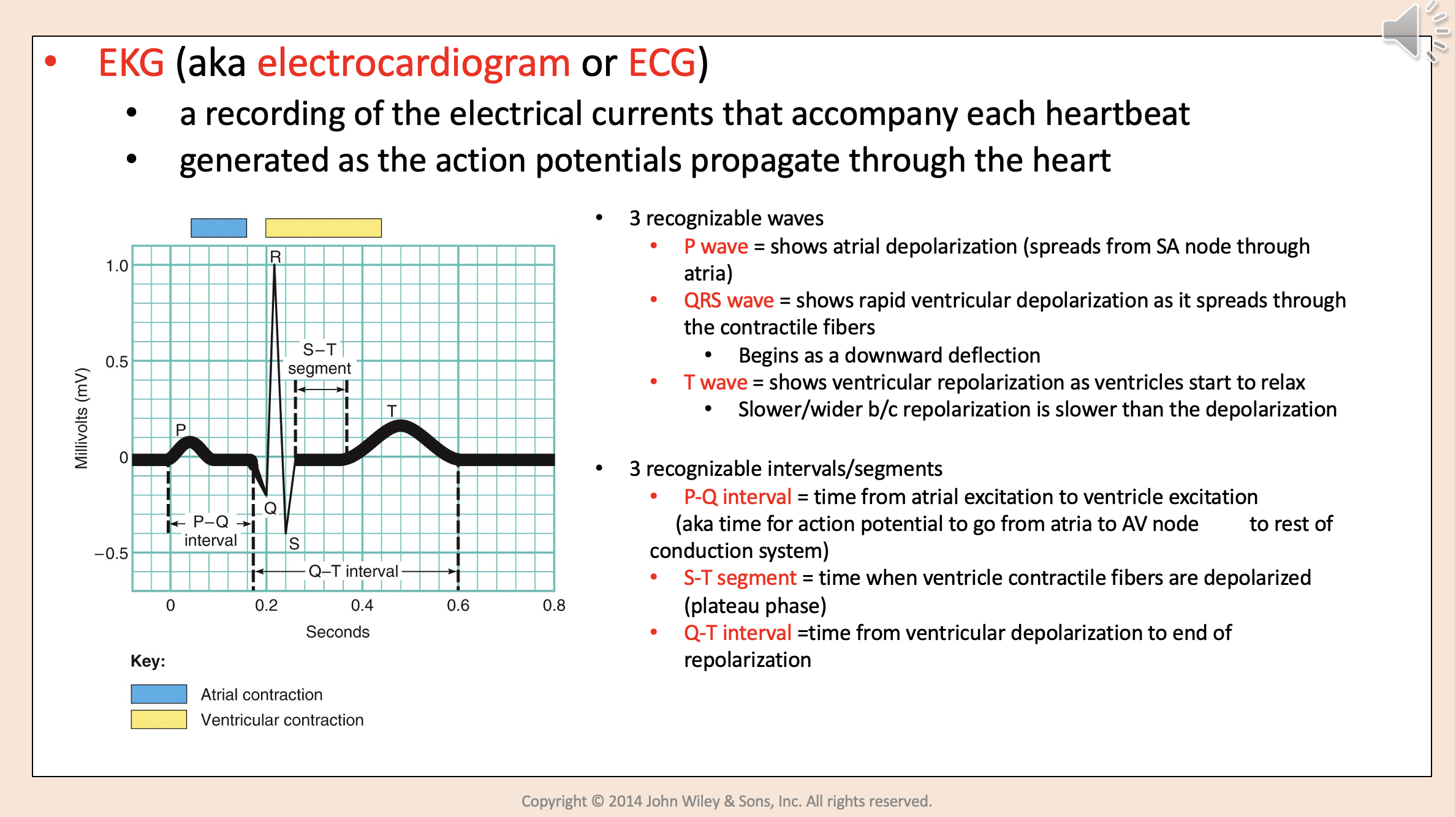
<p><span style="color: rgb(255, 0, 0);">S-T segment </span></p>
60
New cards

Time from ventricular depolarization to end of repolarization

Q-T interval
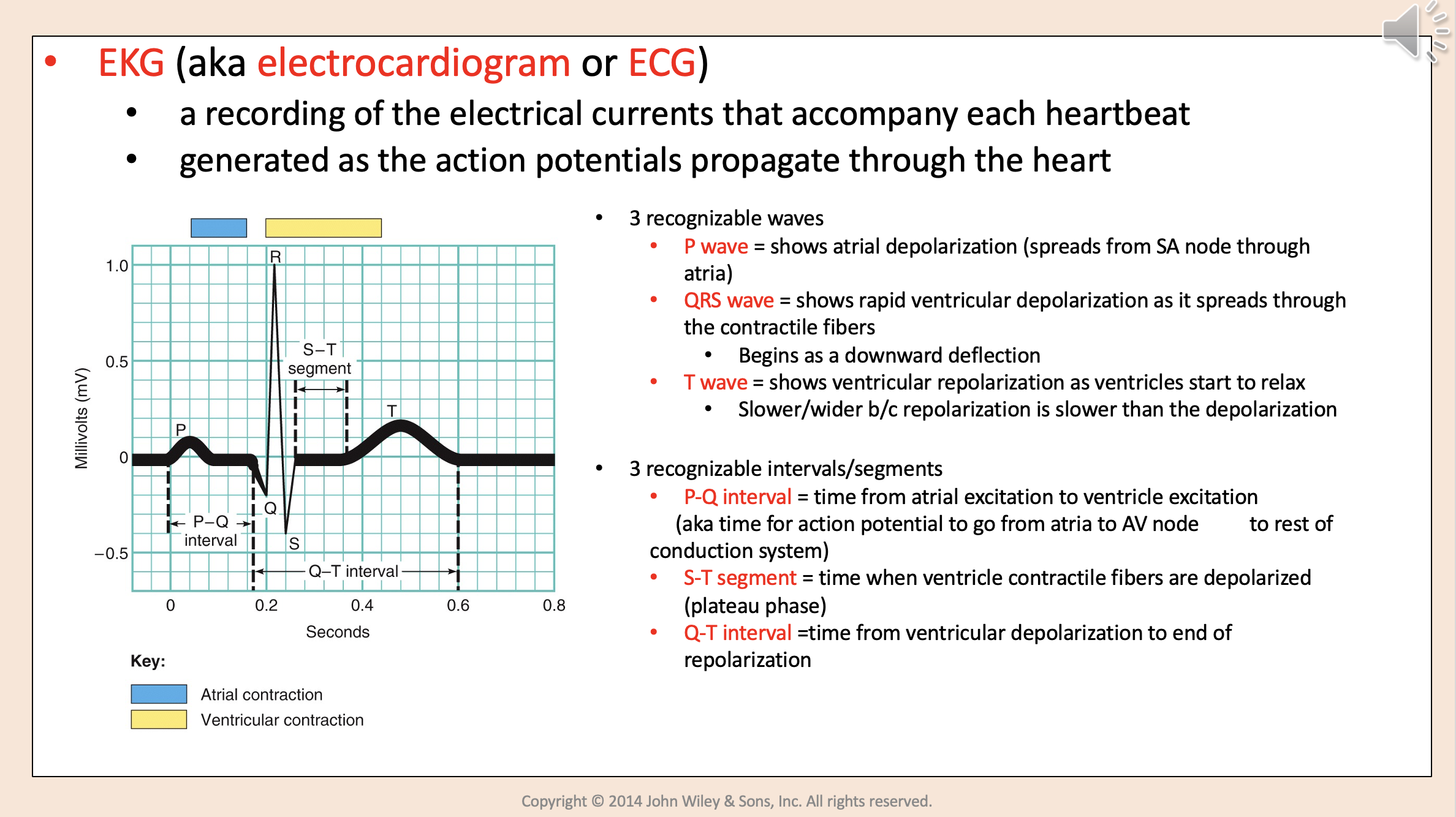
<p><span style="color: rgb(255, 0, 0);">Q-T interval </span></p>
61
New cards

All the events associated with one heart beat (aka systole and diastole of atria & ventricles)

cardiac cycle
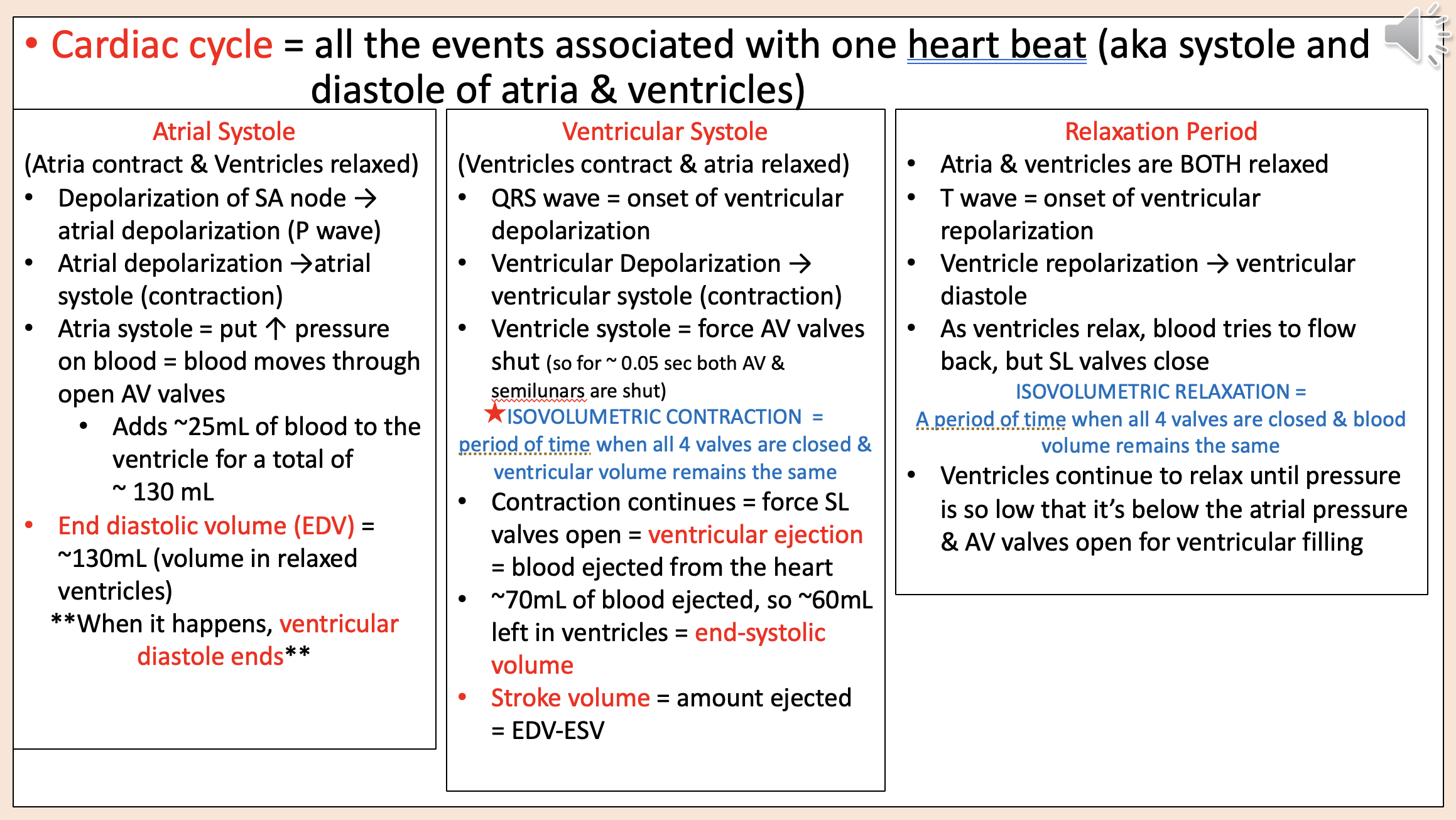
<p><span style="color: rgb(255, 0, 0);">cardiac cycle</span></p>
62
New cards

Atria contract & Ventricles relaxed

atrial Systole
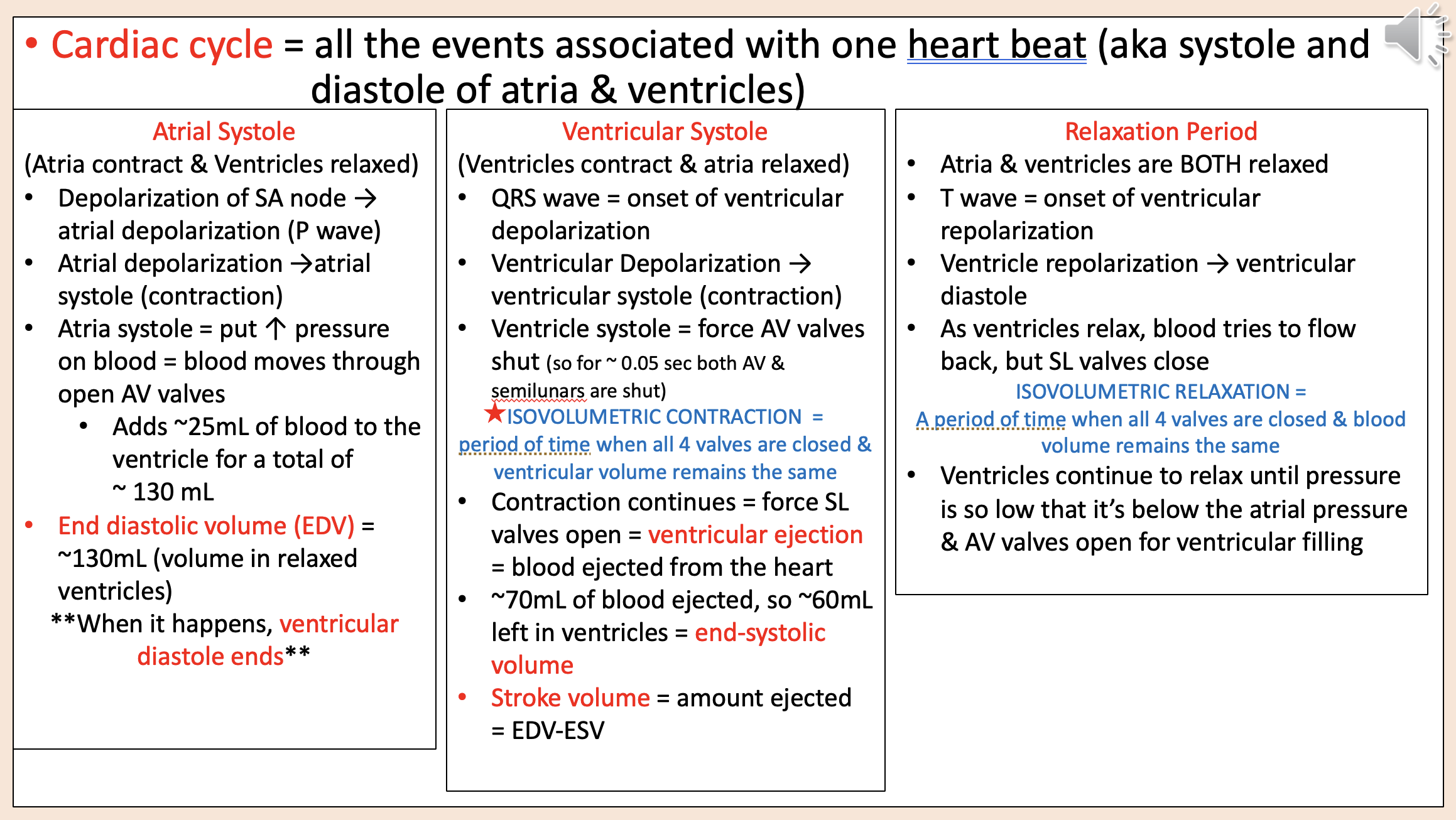
<p><span style="color: rgb(255, 0, 0);">atrial Systole</span></p>
63
New cards

Ventricles contract & atria relaxed

ventricular systole
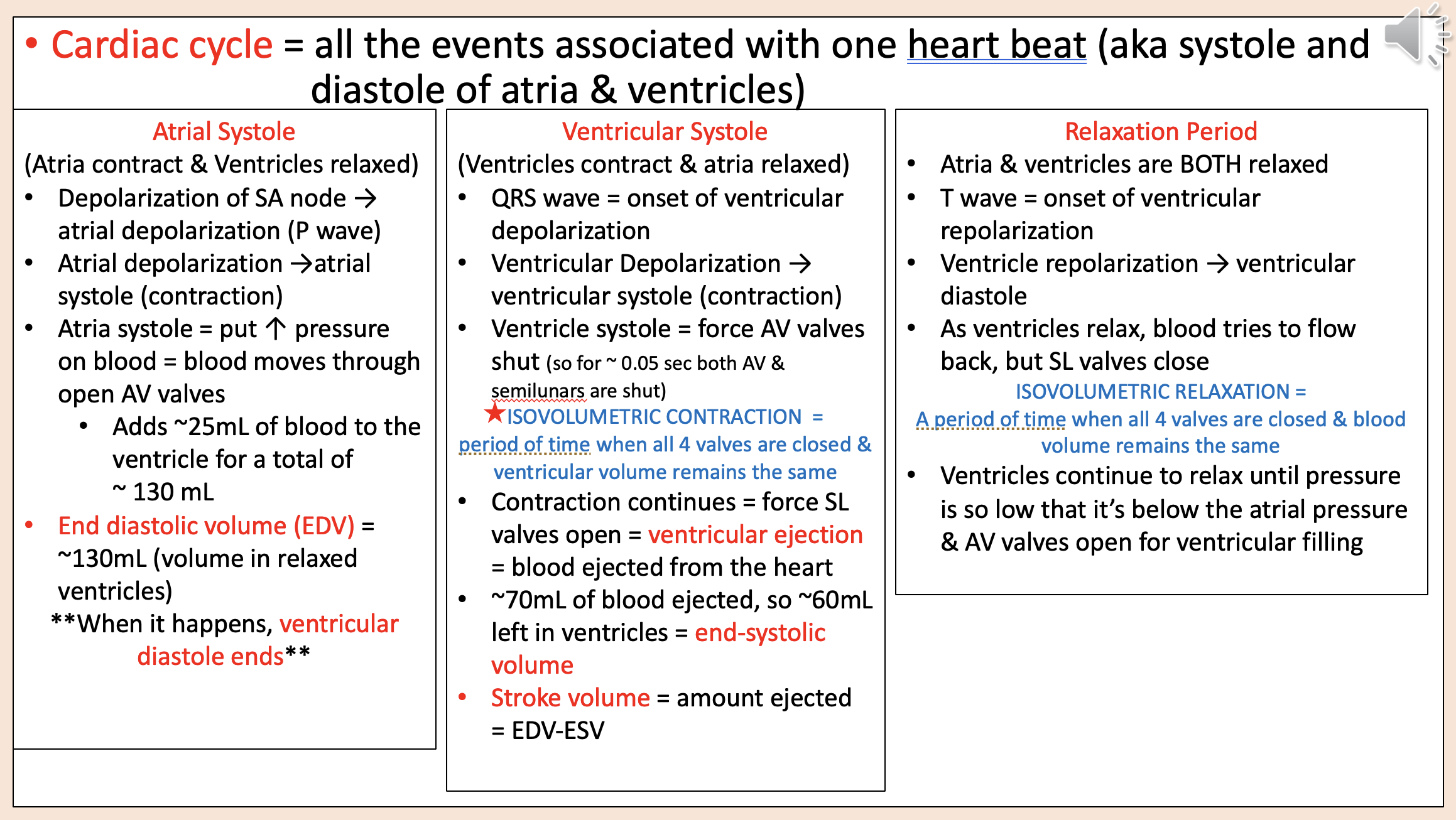
<p><span style="color: rgb(255, 0, 0);">ventricular systole</span></p>
64
New cards

Period of time when all 4 valves are closed & ventricular volume remains the same

isovolumetric contraction
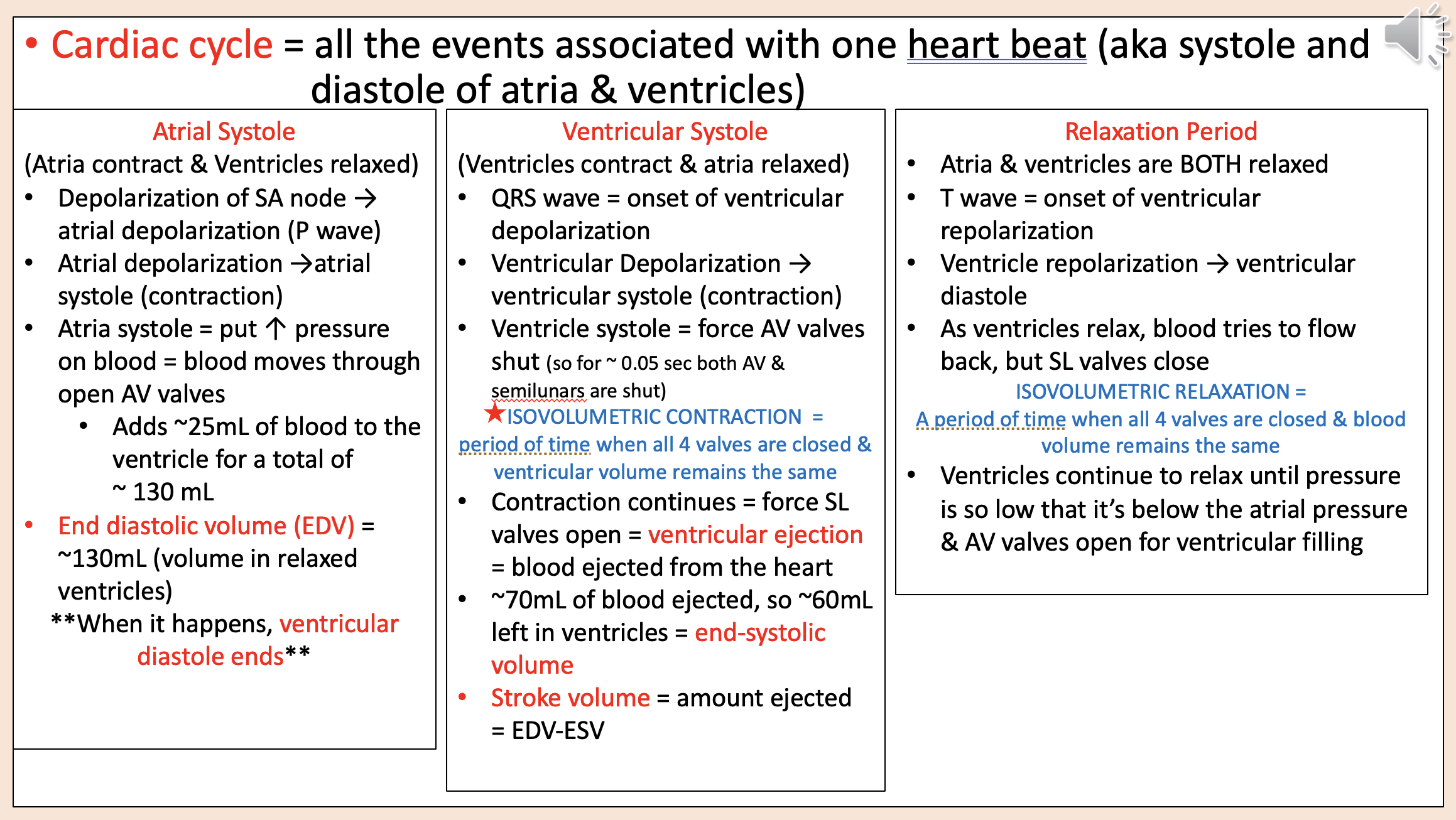
<p><span style="color: rgb(0, 112, 192);">isovolumetric contraction</span></p>
65
New cards

amount ejected = EDV-ESV

stroke volume
<p><span style="color: rgb(255, 0, 0);">stroke volume</span></p>
66
New cards

Atria & ventricles are BOTH relaxed

relaxation period
<p><span style="color: rgb(255, 0, 0);">relaxation period</span></p>
67
New cards

A period of time when all 4 valves are closed & blood volume remains the same

isovolumetric relaxation
<p><span style="color: rgb(0, 112, 192);">isovolumetric relaxation</span></p>
68
New cards

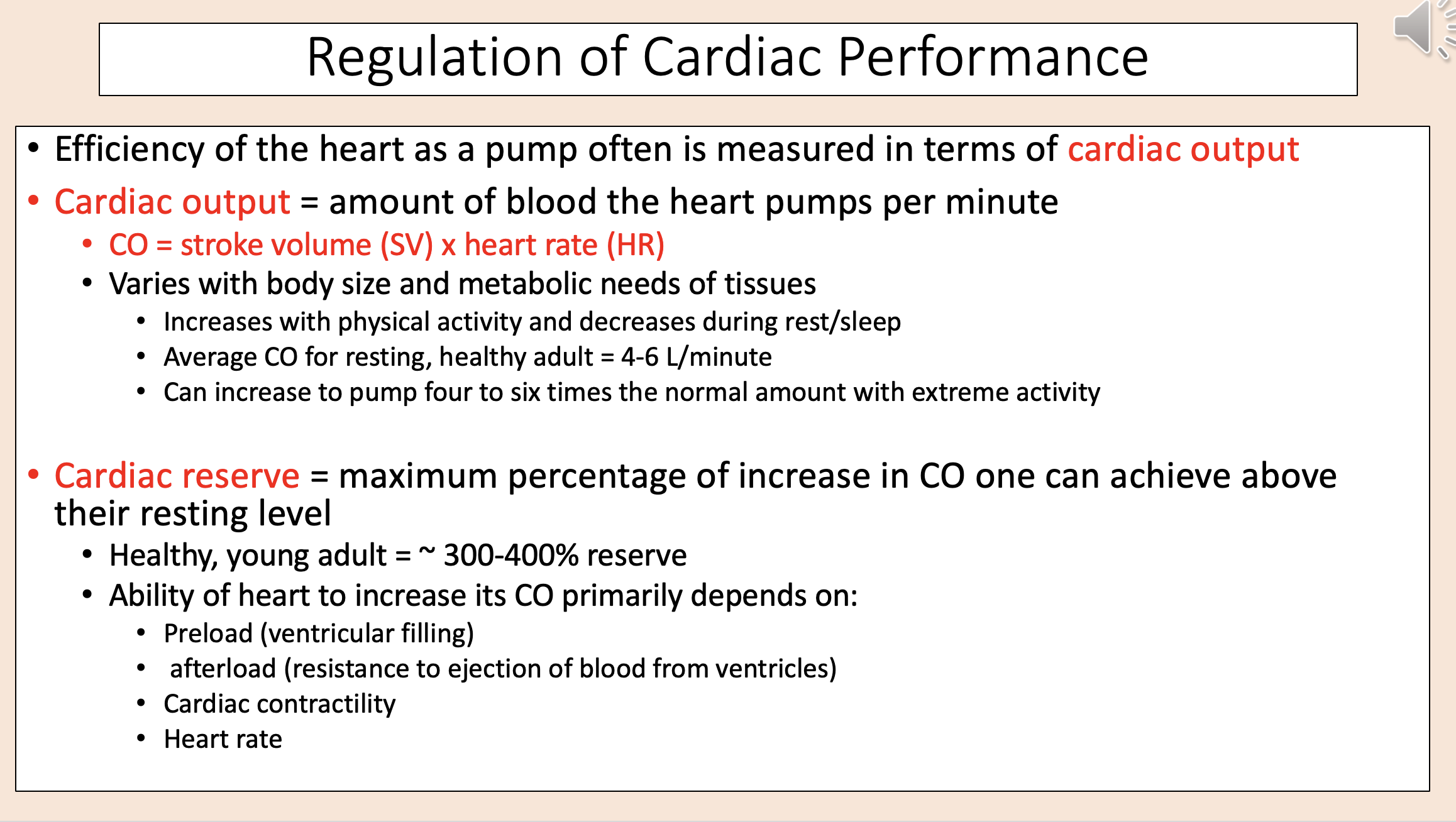
Amount of blood the heart pumps per minute

cardiac output
<p><span style="color: rgb(255, 0, 0);">cardiac output</span></p>
69
New cards

stroke volume (SV) x heart rate (HR)

CO
<p><span style="color: rgb(255, 0, 0);">CO </span></p>
70
New cards

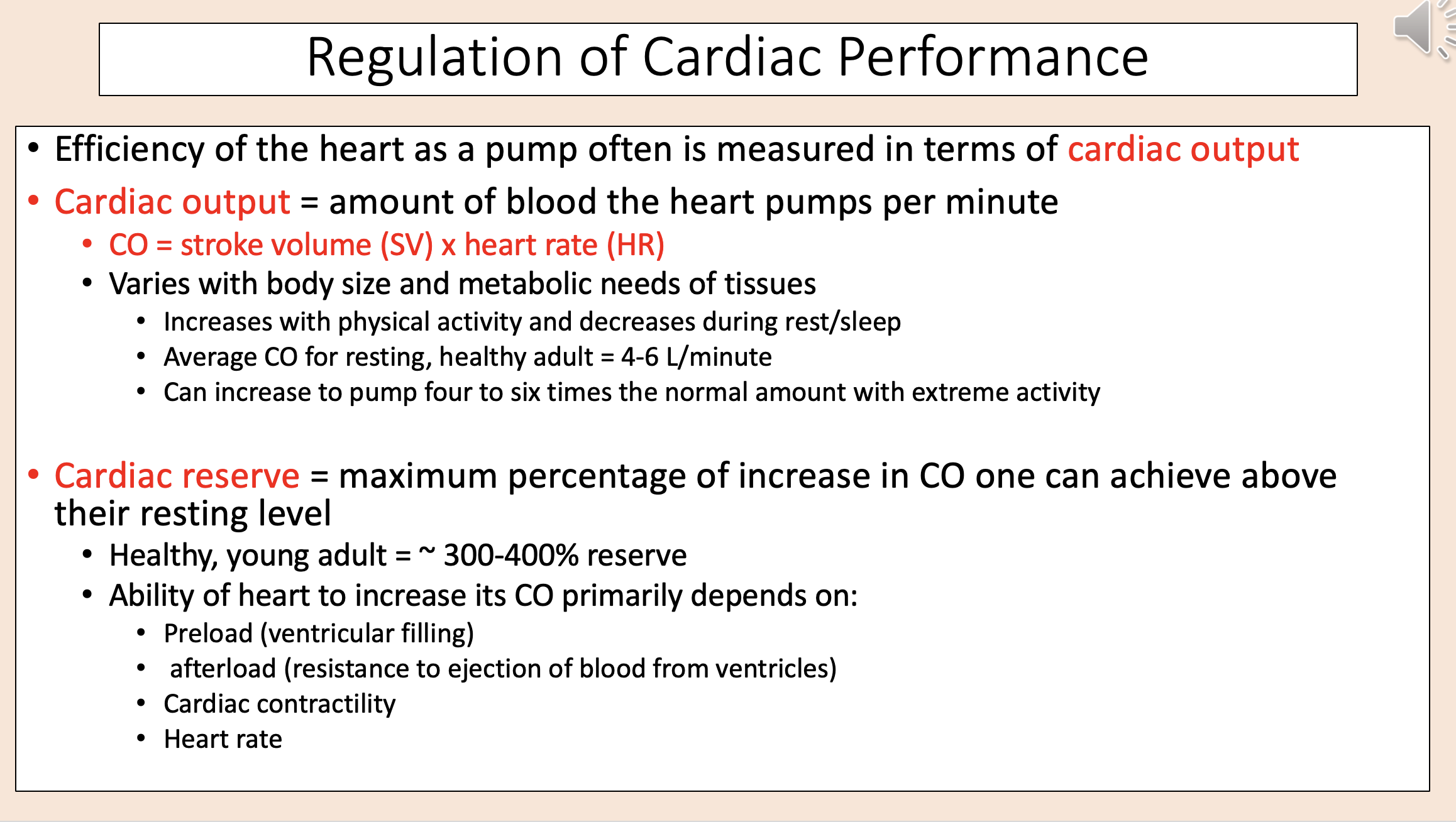
Maximum percentage of increase in CO one can achieve above their resting level

cardiac reserve
<p><span style="color: rgb(255, 0, 0);">cardiac reserve</span></p>