Tutorial: Artificial Intelligence & Language Processing
 Call Kai
 Learn
Learn Practice Test
 Spaced Repetition
 Match
Match Flashcards
 Knowt Play
1/12

There's no tags or description
Looks like no tags are added yet.
Name | Mastery | Learn | Test | Matching | Spaced | Call with Kai |
|---|
No analytics yet
Send a link to your students to track their progress
13 Terms
What are 3 language processing challenges?
words never sound the same: different speakers, accents, fast speakers, “lazy'“ speakers, etc
words are rarely produced without any background noise
words are rarely produced fullyy
What are some of the ways/cues our minds use to split speech into words and recognise those words?
segmentation cues
pauses
stress patterns
syllable length (longer when part of longer word)
phonotactics (allowable sound combination)
What are some of the ways/cues our minds use to split speech into words and recognise those words?
flexibility
adapt to segmentation cues depending on speaker
adapt to the words a speaker tends to use
What are some of the ways/cues our minds use to split speech into words and recognise those words?
context
fill in noisy speech signal
word/sentence context
situation
visual cues
What are some of the ways/cues our minds use to split speech into words and recognise those words?
parallel processing
activate multiple word candidates and modify as the word unfolds
What is automatic speech recognition (ASR) as a system that uses AI to process human language?
in some cases, it is enough for these systems to just transcribe what we say into text commands
dictation/transcription
closed captioning
call centres
What is Natural Language Processing (NLP) as a system that uses AI to process human language?
the system needs to not just recognise words but also interpret and respond to our language
figure out what we’re trying to say and then perform some process/task etc upon that message
What does NLP do?
processes spoken (or written) language to get at its “meaning”
transform the message into something the machine can “understand”
make decisions based on the message
How are NLP systems created?
historically expert knowledge used to create model of sounds → words
now, systems are trained to learn relationships between speech/text and the desired response/output
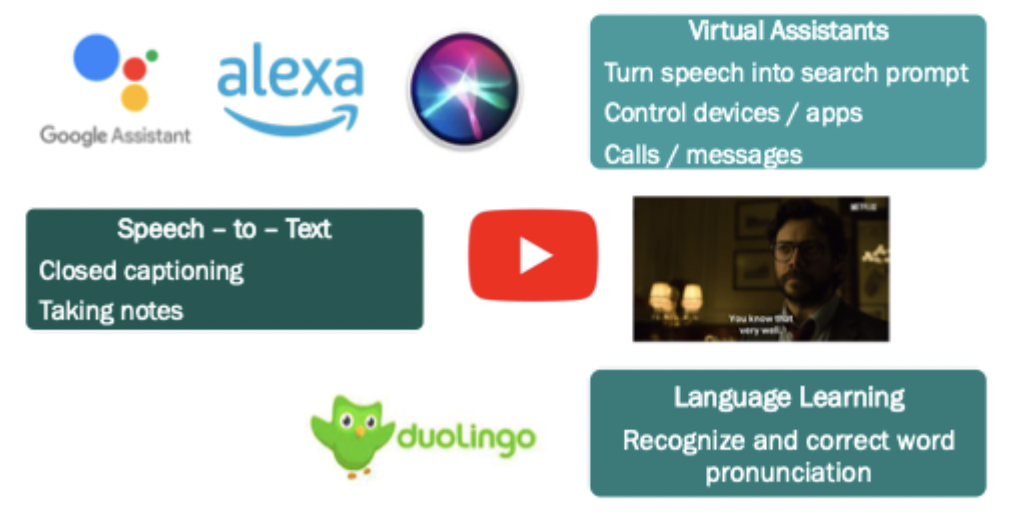
Examples of ASR and NLP in daily life SS
What does AI struggle with (that humans manage)?
less familiar with different accents
worse at filling in noisy speech
less familiar with individual people
non-literal speech e.g. slang?
What cues/information might AI not use?
language context
physical/visual cues
shared references/knowledge
diversity of real everyday language
What should future AI take into account?
non-literal speech (e.g. sarcasm)
different types of words (e.g. slang words) that are perhaps not part of the “standard training”
use context better to differentiate between different meanings of ambiguous word
more diverse input to respond better to different speakers
input from different languages, including switches between languages
non-linguistic cues