L14 - Glycolysis
 Call Kai
 Learn
Learn Practice Test
 Spaced Repetition
 Match
Match Flashcards
 Knowt Play
1/61

There's no tags or description
Looks like no tags are added yet.
Name | Mastery | Learn | Test | Matching | Spaced | Call with Kai |
|---|
No analytics yet
Send a link to your students to track their progress
62 Terms
how are carbohydrates digested
enzymes digest starch into polysaccharides and additional digestion occurs at the microvilli of intestinal epithelial cells - monosaccharides are then generates and transported to epithelial cells where glucose transporters facilitate the transport of glucose form cells into blood
what happens to blood glucose levels after a meal
glucose and insulin levels increase, but decreases glucagon
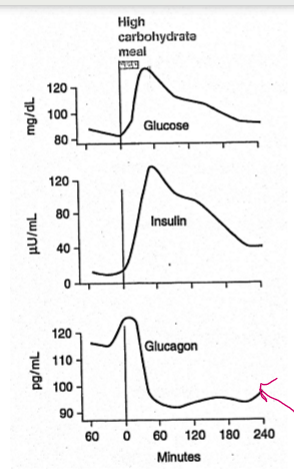
what happens to blood glucose levels during fasting
lowers insulin and glucose but raises glucagon levels
where are insulin and glucagon secreted from
the pancreas synthesizes and secretes them
what is insulin
the primary anabolic (energy storing) hormone that promotes fuel synthesis and storage (glycogen storage glucose uptake, and lipid synthesis) - also increases during feeding, resulting in high blood glucose
what is glucagon
the primary catabolic hormone that promotes fuel utilization and stimulates glycogen breakdown - also increases during fasting resulting in a low blood glucose
where does glucagon, the hormone, travel
from pancreas via catabolism, and goes to the liver to stimulate glycogen breakdown
where does insulin travel
from pancreas to tissue cells to stimulate glucose uptake from food and the liver to stimulate glycogen formation via anabolism
what type of transport is glucose across a membrane
facilitated transport via glucose transporters (GLUTs)- moves the sugar down a concentration gradient bidirectionally across the plasma membrane, so no ATP required for passive diffusion (GLUT1)
when would glucose need to be exported
if the cell produces glucose internally or if blood sugar homeostasis needs to be maintained - dictated by concentration gradient
what happens with GLUT4 when insulin binds to receptors
GLUT4 is normally stored on intracellular vessels, but when insulin binds, GLUT4 translocates to the membrane where it allows for glucose to move against the concentration gradient and enter the cell and rapid induction of glycolysis prevents an export of glucose by adding a P group onto it so they can’t simply diffuse out
what does insulin promote besides just glucose uptake
glucose storage as glycogen in the liver and muscle, amino acid uptake and protein synthesis in muscle, and stimulates fatty acid synthesis in the liver and adipose tissue which inhibits lipolysis
what pathways does glucagon promote
glyconeogenesis and lipolysis
what is glycogenesis
synthesizing glycogen from glucose for energy storage
what is glyconeogenesis
the synthesis of glucose in liver
what is lipolysis
the breakdown/catabolism of triglycerides in adipose tissue
what are the major goal of glycolysis
oxidizes glucose to harvest electrons and to generate smaller carbon molecules and ATP (6C molecule into a two 3C molecules)
what is the starting and end product of glycolysis
starts with one molecule of glucose and ends with two pyruvate (pyruvic acid) molecules, a total of four ATP molecules, and two molecules of NADH
where does glycolysis occur
in the cytoplasm of a cell
what is the overall reaction of glycolysis
glucose + 2 NAD+ + 2 ADP + 2P = 2 pyruvate + 2NADH + 2 ATP
what is the investment phase of glycolysis
composed of 5 initial enzymatic reactions - invests ATP at 2 reactions (Good-Guys and Favor-Fatbutts)
what is the entire glycolysis process mnemonic for products and reactants
Good Guys Favor Fatbutt But Prefer Pretty Pink Pussies
what is the mnemonic for all the enzymes used for glycolysis
Hungry Peter Pan And The Growling Pink Panther Eat Pizza
what types of reaction is the first step of the investment phase of glycolysis from Glucose to Glucose-6-Phosphate
phosphoryl transfer - steals P from ATP and puts it onto glucose
what are the steps of glycolysis that are irreversible
steps 1,3 and 10 - Hexokinase, PFK1, and Pyruvate Kinase
what is common about the three irreversible reaction steps that require energy
each reaction is at or near equilibrium, but these irreversible ones have a large negative value of delta G (highly exergonic)
what type of reaction is Glucose-6-phosphate to Fructose-6-phosphate
isomerization
what type of reaction is fructose-6-phosphate to fructose-1,6-bisphophate
phosphoryl transfer
what type of reaction is fructose-1,6-bisphospphate to glyceraldehyde-3-phosphate
aldol cleavage
what is the enzyme between dihydroxyacetone phosphate and glyceraldehyde-3-phosphate
triose phosphate isomerase
what provides energy for the first irreversible reaction in the investment phase of glucose to glucose-6-phosphate
the hydrolysis of one of the high-energy bonds of ATP - reaction is overall highly exergonic (downhill and without needed help) and so is essentially irreversible in the cell, but not necessarily fast
why is it important to phosphorylate glucose
glucose enters the cell via facilitated diffusion on the glucose transporter GLUT, and by converting glucose to glucose-6-phosphate, it blocks re-export as the transporter does not bind to the phosphorylated form, and it’s too large to exit the membrane alone - lowers the free glucose concentration in the cell and drives glucose movement into the cell
why is the isomerization second step of the investment stage important
converts glucose-6-phosphate into fructose-6-phosphate (a 6 into a 5 membered ring) which serves to make the C1 available for a second phosphorylation that will occur in the next step
how is the reaction between F6P and F-1,6-B during the investment phase achieved (step 3)
ATP is used as a phosphate group donor and the source of energy for driving this reaction - the PFK enzyme reaction is also highly exergonic and is the second irreversible step of glycolysis
what is the rate-limiting step of glycolysis
the PFK reaction (step 3) and is the most highly regulated step in the pathways - so it’s the slowest and determines the overall rate of glucose breakdown
how is PFK regulated in Glycolysis
via allosteric regulation which occurs when an effector molecule binds to a site distinct from the active site to alter the rate of the reaction - increases or decreases the reaction rate depending if AMP or ATP is used
what is the effect of using AMP in PFK regulation
positively increases the rate of the reaction
what happens when ATP is used in PFK regulation
there is a negative decrease in the reaction rate - when ATP builds up to sufficient levels, the activity of glycolysis slows down to not overproduce
what activates PFK
AMP and ADP (signals low energy), and Fructose-2,6-bisphosphate (allosteric activator that increases affinity for P)
what inhibits PFK
high levels of ATP, citrate, phosphoenolpyruvate (PEP), and low pH
how does aldolase interact with fructose-1,6-bisphosphate
forms a schiff base with the substrate during the enzymatic reaction which creates stability and a C=N (imine) - this creates glyceraldehyde-3-phosphate and DHAP
what happens to DHAP after Fructose-1,6-bisphosphate uses a schiff base
it is very important in lipid synthesis and DHAP needs to be isomerized using triose phosphate isomerase so that glyceradldehyde-3-phosphate is the only thing that proceed onto the payoff stage
what step initiates the payoff phase of glycolysis
step 6 when glyceraldehyde-3-phosphate is oxidized by the coenzyme nicotinamide adenine dinucleotide (NAD) along with GAPDH, which is reduced to NADH - the molecule is phosphorylated by the addition of a free phosphate group
what is GAPDH
the enzyme that converts glyceraldehyde-3-phosphate into 1,3-bisphophoglycerate in the 6th step - it has an S-H group that firms a covalent bond with G-3-P which creates a high energy bond allowing the phosphorylated product to be formed
why is GAPDH important
these enzymes remove a hydrogen and electrons are carried on H atoms, so it’s removing an electron from Glyceraldehyde-3-phosphate - identify by looking for electrons moving in a redox reaction
what enzyme converts 1,3-bisphosphoglycerate to 3-phosphoglycerate
phosphoglycerate kinase (PGK) - use high energy bond of phosphoanahydride to drive the formation of ATP where a phosphate group is transfered from the substrate to make ATP - reaction occurs twice for every molecule of glucose, so the 2 ATPs that were invested at the beginning of glycolysis have been regained
why is it called substrate-level phosphorylation
step 7 and 10 - a high-energy phosphate group is transferred directly from a phosphorylated metabolic intermediate (the substrate) to the ADP to form ATP which doesn’t require an electron transport chain like oxidation phosphorylation does - produces less ATP tho
what does phosphoglycerate-mutase do to 3-phosphoglycerate
isomerizes the substrate and then enolase dehydrates it which generates the high-energy intermediate PEP
what does the final step of glycolysis do
the enzyme pyruvate kinase transfers a phosphate from PEP to ADP to form pyruvate and ATP - highly exergonic and irreversible
what conditions does glycolysis occur in
anaerobic conditions - formation of ATP does not require oxygen which is critical for short-term energy generation of ATP under conditions of intense exercise or hypoxia in humans and in organisms that grow in anaerobic conditions
what is the net energy yield of glycolysis from 1 molecule of glucose
2 ATPs from substrate-level phosphorylation, 2 NADH that can potentially yield 6 ATPs from oxidation phosphorylation
what is the reason for the large negative values in the free energy changes of glycolysis
three of the ten reactions of glycolysis (1,3 and 10) release energy - these three are far from equilibrium and serve as control points while the other seven reactions function near equilibrium
what is the fate or pyruvate dependent on
cell type, environment (anerobic vs aerobic), and need for molecular building blocks - can be converted to acetyl-CoA (when oxygen present), oxaloacetate, lactate (without O2), or ethanol + CO2 (without O2)
what is fermentation
when pyruvate undergoes anaerobic glycolysis and is in yeast - pyruvate decarboxylase is not in mammals and the major goal is to regenerate NAD+ so it can accept more H and keep running glycolysis
how does anaerobic glycolysis generate lactate in eukaryotic cells
reaction allows the muscle to function anaerobically for a minute or two because int he absence of oxygen, NADH needs to be reoxidized to NAD+ - either converted back to pyruvate or exported from the cell
what is the main goal of pyruvate oxidation
to start the citric acid cycle (TCA) - requires a molecule that is highly oxidized - to do this, the pyruvate dehydrogenase complex can perform oxidative decarboxylation which acetyl-CoA is the product
how is pyruvate dehydrogenase complex at the start of TCA regulated
Regulated by reversible phosphorylation - to get from glycolysis to TCA, you need to convert pyruvate to acetyl-CoA, and to do that, pyruvate dehydrogenase complex needs to be activated by pyruvate dehydrogenase phosphatase (regulated by dephosphorylation) - 3 total enzymes working here
why is acetyl coenzyme A important
an acetyl group linked to coenzyme A can be readily transferred to another molecule because formation of the new linkage is powered by the favorable free energy change of breaking the thioester bond
where does glycolysis occur
in the cytosol
how many molecules does aldolase create
two G3P molecules because DHAP is converted to the second G3P molecule
what is the net yield of glycolysis
4 (out) - 2 (in) = 2 ATP, 2 NADH, and 2 Pyruvate
what does cAMP regulate in glycolysis
PKA - in the liver and inhibits glycolysis and switches to gluconeogenesis instead during fasting - phosphorylates PFK-2/FBPase-2 and pyruvate kinase