C30 CIA DISCOUNT
 Call Kai
 Learn
Learn Practice Test
 Spaced Repetition
 Match
Match Flashcards
 Knowt Play
1/31

There's no tags or description
Looks like no tags are added yet.
Name | Mastery | Learn | Test | Matching | Spaced | Call with Kai |
|---|
No analytics yet
Send a link to your students to track their progress
32 Terms
Discount Rate
Rate used to discount estimate of future CFs
Consistent w/ timing, liquidity, currency of insurance contract CFs
Can be a single rate → spot rate
Or curve of rates varying by duration → yield curve
Fulfilment Cash Flows (FCF)
PV of ests of future CFs + RA for non-financial risk
Liquidity/Illiquidity Premium
Adjustments to liquid risk-free yield curve
Reflects diff in liquidity characteristics between financial instruments underlying risk-free rates & insurance contracts
Liquidity prem → insurer invests in gov bonds
Low risk & easily converted to cash
Liquidity prem = 0
Liquidity prem → insurer invests in biotech startups
High risk & difficult to convert to cash
Liquidity prem high
Reference Portfolio
Portfolio of assets used to derive discount rates based on current market rates
Adj to remove risk char NOT in insurance contracts
Factors that may differ between reference portfolio vs insurance contracts
Liquidity
Currency
Timing
Investment risk
Credit risk
Market risk
How to address diff in timing risk?
Assess consistency of timing of payments between reference portfolio vs insurance contracts
How to assess currency risk?
Select reference portfolio made up of investments in same currency as insurance contracts
Estimating FCFs → Grouping wrt Reinsurance
Estimate net
Net = Gross - Ceded
= (Direct + Assumed) - Ceded
Estimate gross & ceded separately
Gross = Direct + Assumed
Ceded
Net vs Gross/Ceded of Reinsurance → Considerations
DV-Re
Data availability
If sparse, hard to directly estimate PV of ceded CFs
CF Volatility
Diff segments of business may use diff groupings depending on volatility of CFs
Reinsurance Held
Consider type & consistency of reinsurance held
Segmenting data for payment patterns → Considerations
Business segments used for analyzing undiscounted liabilities
Payout period
Existence of predetermined payment schedule
Discount Rates → Characteristics
Reflect TVM, liquidity, & char of CFs of insurance contracts
Consistent w/ market prices for financial instruments w/ similar CF characteristics as insurance contracts
Exclude factors that don’t affect CFs in insurance contracts
Discount Rate → Bottom-up Method
Liquid, risk-free yield curve
Adj to reflect diff in liquidity char between financial instruments underlying risk-free rate vs insurance contracts
Discount Rate = Risk-free Rate + Liquidity Prem
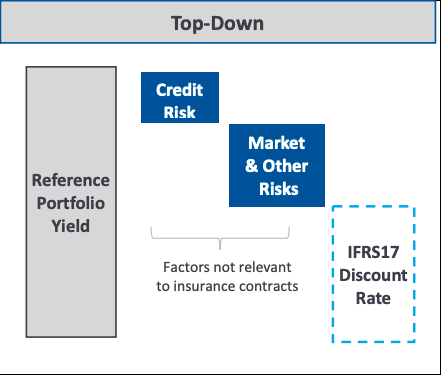
Discount Rate → Top-down Method
Yield to maturity of reference portfolio
Remove factors not relevant to insurance contracts
Ex: credit & market risk
Discount Rate = Ref Portfolio Rate - Credit/Market Risks & Other Adj
Advantage/Disadvantage of Top-down Method
Advantage: doesn’t need liquidity prem
Disadvantage: complexity of deriving & adjusting reference portfolio rate
*Opposite for bottom-up
Ex of Credit Risk
Default risk
Downgrade risk
What is considered risk-free?
Gov bonds
Liquidity Prem → Combined Approach
Top-down Discount Rate = Ref Portfolio Rate - Credit Risk - Market Risk
Market risk = 0 if only bonds
Ind Asset Liquidity Prem (ALP) = Top-down Discount Rate - Risk-free Rate
Liquidity Prem = r x ALP + c
Contract Features that affect Liquidity
Exit Costs
Ex: surrender penalties
Higher = less liquid
Inherent Value
Ex: payments the contract holder expects to receive
Low inherent value = more liquid
Exit Value
Large portion of inherent value paid @ exit = more liquid
Less liquid = _____ liquidity prem
Higher
Types of Insurance Contract Liabilities
Liability for Incurred Claims (LIC)
Liability for Remaining Coverage (LRC)
More liquid → no claims occurred yet so easier to cancel
Basis for Varying Liquidity → LRC vs LIC
LRC: ability to cancel before expiry & receive value w/o significant exit costs
LIC: ability to obtain exit value in advance of “normal” payment dates
Direct → ability of policyholder
Reinsurance → ability of purchaser of reinsurance
Reference Curve
standardized yield curve used for comparisons in the unobservable period (30+ years)
Locked-in Yield Curve
Determined at initial recognition of group of contracts OR @ date of incurred claims
Used when:
PAA approach w/ significant financing component
Where are insurance expenses reported in the Income Statement?
Insurance service expense
Insurance finance expense
Insurance Finance Expense
Change in carrying amt of group of insurance contracts from effect & changes in:
TVM
Financial Risk
Unwinding of Discounts
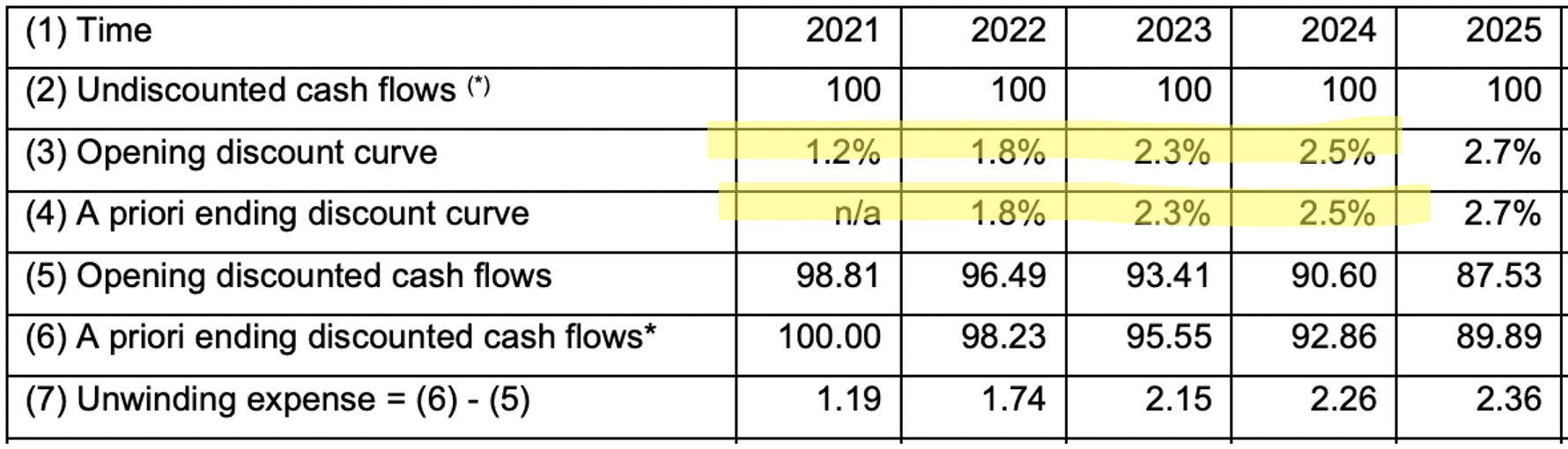
Diff between discounting CFs to beginning vs end of period
Unwinding = Ending CF - Opening CF
Unwinding of Discounts → 3 Methods
Constant Yield Curve
Uses same discount curve @ beginning & end of period
Unwinding using Spot Rates
Ending discount curve = beginning discount curve shifted by 1 period
Expectation Hypothesis
Term structure of interest rates is solely determined by market expectations of future interest rate changes
Unwinding → What’s the Ending discount curve for first year?
0%
Ending disc CF = Undisc CF
Why can’t insurer use own assets as Reference Portfolio?
Diff in Liquidity between Insurer’s Assets vs Insurance Contract Liabilities:
Insurers usually invest in liquid assets
LIC is illiquid due to inability to obtain exit value before normal payment dates
Benefits of using single Liquidity Curve for both LIC & LRC
Fewer curves to manage → could reduce # of curves by half
Operationally simpler bc less calculations