intelligence
 Call Kai
 Learn
Learn Practice Test
 Spaced Repetition
 Match
Match Flashcards
 Knowt Play
1/117

There's no tags or description
Looks like no tags are added yet.
Name | Mastery | Learn | Test | Matching | Spaced | Call with Kai |
|---|
No analytics yet
Send a link to your students to track their progress
118 Terms
intelligence
a multifaceted capacity that manifests itself in different ways
across the life span. In general, intelligence includes the abilities to:
→ acquire and apply knowledge
→ reason logically
→ plan effectively
→ infer perceptively
→ make sound judgments and solve problems
→ grasp and visualize concepts pay attention
→ be intuitive
→ find the right words and thoughts with facility
→ cope with, adjust to, and make the most of new situations
test reliability and validity
A test's validity, or how well it measures what it is supposed to measure, is influenced by its reliability. If a test is less reliable, it may also be less valid.
The reliability of a test usually decreases when the number of test items is reduced.
Therefore, reducing the number of items in a test may decrease its reliability and its validity.
Wechsler-Bellevue 1 drawbacks
The standardization sample was limited in its scope and diversity.
Certain subtests showed poor inter-item reliability.
Some subtests contained items that were too easy and did not provide enough differentiation between examinees.
Scoring criteria for some items were ambiguous and subjective, potentially leading to inconsistent scoring.
Adaptive Testing
implemented in SB5; testing individually tailored to the test taker.
might entail beginning a subtest with a question in the middle range of difficulty.
If the test taker responds correctly to the item, an item of greater difficulty is posed next.
If the test taker responds incorrectly to the item, an item of lesser difficulty is posed.
Profile analysis methods
used with cognitive ability tests to identify significant differences between scores.
Normative data and statistical calculations are used to support these findings.
checklists and note-taking.
During individually administered tests, examiners can observe examinee's extra-test behavior through
These observations may include physical appearance, mood, activity level, medications, and related variables.
The SB5 uses the following cutoff boundaries and corresponding nominal categories:
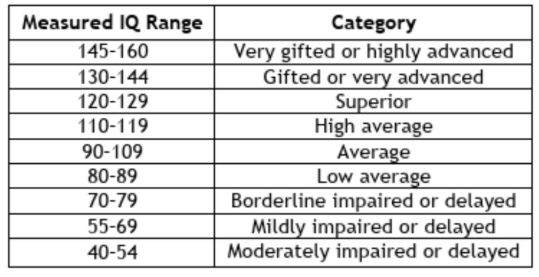
Floor
it refers to the lowest possible score that an individual or group can achieve on the test. Individuals who score at or near the floor should be administered the next lower level of the test for a more accurate estimate of their ability.
Ceiling
it refers to the point in the test where all items beyond that point will no longer be answered correctly (too difficult), resulting in the examiner stopping the test administration.
Basal Level
a term used in Binet testing to describe the point on the test, associated with a given level of functioning or skill, for which the examiner is confident that all items prior to that item would be answered correctly.
Two Routing Tests in SB5
Can referred to by either their activity names (i.e., Object Series/Matrices and Vocabulary) or their factor-related names (i.e., Nonverbal Fluid Reasoning & Verbal Knowledge). These exact subsets are also used to obtain Abbreviated Battery IQ score.
STANFORD-BINET: FIFTH EDITION (SB5):
All composite scores have p = 100 and σ = 15.
The test was based from CHC theory of intellectual abilities. The SB5 measures five CHC factors by different types of tasks and subtests at different levels
The five CHC factor names (with abbreviations) alongside their SB5 equivalents are presented below:
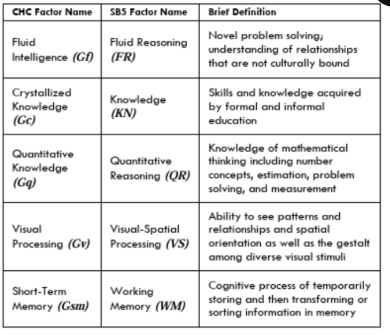
Age Scale
different items were grouped by age.
Test Composite
test score or index derived from the combination of, and/or a mathematical transformation of, one or more subtest scores.
deviation iq
reflects a comparison of the performance of the individual with the performance of others of the same age in the standardization sample
Test performance is converted into a standard score with a μ= 100 and a σ = 16 or 15.
Measuring Intelligence
testing an individual's performance on various tasks and tests based on their developmental level.
This process also provides a standardized situation to observe how the examinee approaches the tasks, regardless of their level of development
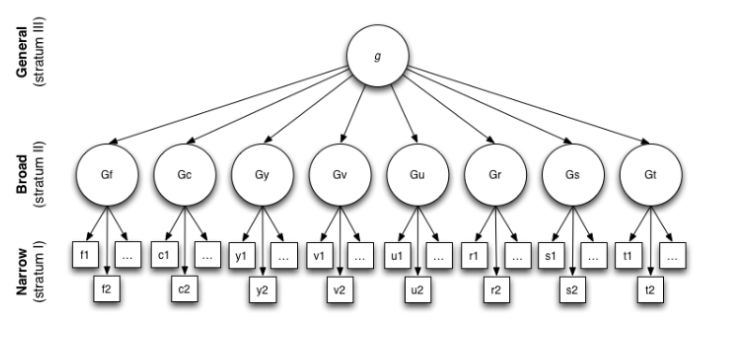
Stratum III
the top stratum or level in Carroll's model is g, or general intelligence.
Stratum II
it is composed of eight abilities and processes: fluid intelligence (Gf), crystallized intelligence (Gc), general memory and learning (Y), broad visual perception (V), broad auditory perception (U), broad retrieval capacity (R), broad cognitive speediness (S), and processing/decision speed (T).
Stratum
these are the factors below each of the abilities in the second stratum.
These are many "level factors" and/or "speed factors"- each different, depending on the second-level stratum to which they are linked.
Operations Dimension
these are the general processes: cognition, memory recording, memory retention, divergent production, convergent production, and evaluation.
Content Dimension
broad area of information where operations dimension is applied: figural, symbolic, semantic, and behavioral.
Product Dimension
this is the result of the application of operations dimension to content dimension: units, classes, relations, systems, transformations, implications.
Many multiple-factor
models of intelligence have been proposed in attempt to be even more specific about identifying and describing factors other than g in intelligence.
FACTOR ANALYTIC THEORY OF INTELLIGENCE
the focus is squarely on identifying the ability or groups of abilities deemed to constitute intelligence.
Theorists have used factor analysis to study correlations between tests measuring varied abilities presumed to reflect the underlying attribute of intelligence.
culture-free intelligence test
if cultural factors can be controlled then differences between cultural groups will be lessened
the effect of culture can be controlled through the elimination of verbal items and exclusive reliance on nonverbal, performance items
General Ability Index (GAI)
composite of two composites
calculated using Verbal Comprehension and Perceptual Reasoning indexes
Cognitive Proficiency Index (CPI)
made by combining Working Memory and Processing Speed.
used to find problems with working memory or processing speed.
SB 1937 Revision
first revision, started revising in 1926 by Lewis Turman and Maud Merrill
included the development of two equivalent forms → L for Lewis and M for Maud
new types of tasks for use with preschool-level and adult-level testtakers
manual contained many examples to aid the examiner in scoring
technical advancement in validity and especially reliability
criticism → lack of representation of minority groups during the test’s development
employed the ratio IQ based on the concept of mental age
SB 1960 REVISION
second revision, consisted of only a single form (L-M)
included the items considered to be the best from the two forms of the 1937 test with no new items added
use of deviation IQ in place of the ratio IQ tables
comparison of the performance of the individual with the performance of others of the same age in the standardization sample
test performance is converted into a standard score with a mean of 100 and standard deviation of 16
SB 1972 Revision
third revision, quality of standardization sample was criticized
manual was vague about the number of minority individuals in the standardization sample
overrepresented the West, as well as large urban communities
Stanford-Binet: Fourth Edition (SB:FE)
previously, different items were grouped by age and the test was referred to as an age scale
this has a point scale
manual contained an explicit exposition of the theoretical model of intelligence that guided the revision, based on Cattell-Horn model
test composite (formerly deviation IQ score) can be obtained
test score or index derived from the combination of, and/or mathematical transformation of, one or more subtest scores
reverse
examinee scores 0 on the first two items from the start point
discontinue
after a certain number of item failures after reversing
ratio IQ
age level at which an individual appears to be functioning intellectually as indicated by level of items responded to correctly

Interactionism
idea that heredity and environment are presumed to interact and influence the development of intelligence
Carroll
g is third-stratum factor, subsuming the broad, second-stratum abilities
Cattell-Horn
g has no place in the model
Francis Galton
Believed that intelligence is caused by the ability to discriminate between small differences in sensations (sensory acuity)
“The more perceptive the senses are of difference, the larger is the field upon which our judgment and intelligence can act”
The first person to publish on the heritability of intelligence
He viewed intelligence as a number of distinct processes or abilities that could be assessed only by separate tests
Alfred Binet
Called for more complex measurements of intellectual ability
Argued that when solving a problem, the abilities involved are interconnected and work together to produce the solution
Therefore, they cannot be separated
He discussed intelligence’s components in terms of reasoning, judgment, memory, and abstraction
he was tasked of developing a test to screen for children with developmental disabilities in the Paris schools.
He collaborated with Theodore Simon and created the first formal test of intelligence in 1905, the Binet-Simon Intelligence Scale.
General Mental Ability
total product of the various separate and distinct elements of intelligence
overall capacity to think, learn, reason, and solve problems across different situations.
“How well your brain works in general, not just in one specific skill.”
David Wechsler
Added that there are non-intellective factors that must be taken into account when assessing intelligence
Defined intelligence as the aggregate or global capacity of the individual to act purposefully, to think rationally and to deal effectively with his environment
It is composed of elements or abilities which, though not entirely independent, are qualitatively differentiable
Jean Piaget
Proposed that intelligence is a kind of evolving biological adaptation to the outside world
described four stages of cognitive development through which, he theorized, all of us pass during our lifetimes.
As cognitive skills are gained, adaptation increases
Mental trial and error replaces physical trial and error
He believed that the process of cognitive development occurs neither solely through maturation nor solely through learning
As a consequence of interaction with the environment, psychological structures become reorganized
Factor-Analytic Theories
focus is squarely on identifying the ability or groups of abilities deemed to constitute intelligence
Factor Analysis
statistical techniques designed to determine the existence of underlying relationships between sets of variables
Assumption is that things that co-occur tend to have a common cause
Can help researchers decide how best to summarize large amounts of information about people by using just a few scores
Charles Spearman
Pioneered new techniques to measure intercorrelations between tests
Developed the two-factor theory of intelligence
found that measures of intelligence (through factor analysis) tended to correlate to various degrees with each other → general intellectual ability factor (g) or two-factor theory of intelligence.
Two-Factor Theory Of Intelligence
intelligence has two components – (g) general intelligence and (s) specific intelligence
Tests that exhibited high positive correlation with other intelligence tests were thought to be highly saturated with g
Tests with low or moderate correlations with other intelligence tests were viewed as possible measures of specific factors
The greater the magnitude of g in a test of intelligence, the better the test was thought to predict overall intelligence
Group Factors
an intermediate class of factors common to a group of activities but not to all; neither as general as g nor as specific as s.
Louis L. Thurstone
Proposed that intelligence is composed of 7 Primary Mental Abilities (PMAs)
Developed and published the Primary Mental Abilities test
Measured verbal meaning, perceptual speed, reasoning, number facility, rote memory, word fluency, and spatial relations
After designing tests to measure these abilities and noting a moderate correlation between the tests became convinced it was difficult to develop an intelligence test that did not tap g.
Guilford
sought to explain mental activities by deemphasizing, if not eliminating, any reference to g
He proposed the structure of intellect theory, where three dimensions were necessary for accurate description: Operations Dimension, Content Dimension, Product Dimension
made a distinction between the intellectual processes of convergent and divergent thinking.
Gardner
seven intelligences: logical-mathematical, bodily-kinesthetic, linguistic, musical, spatial, interpersonal, and intrapersonal.
His descriptions of interpersonal intelligence and intrapersonal intelligence, have found expression in popular books written by others on the subject of so-called emotional intelligence.
Raymond B. Cattell
Postulated Crystallized and Fluid Intelligence
Crystallized: acquired skills and knowledge that are dependent on exposure to a particular culture as well as on formal and informal education
Fluid: nonverbal, relatively culture-free, and independent of specific instruction
John Horn
Student of Cattell
Proposed the addition of several factors
Visual Processing (Gv)
Auditory Processing (Ga)
Quantitative Processing (Gq)
Speed Of Processing (Gs)
Facility With Reading And Writing (Grw)
Short-Term Memory (Gsm)
Long-Term Storage And Retrieval (Glr)
Vulnerable Abilities
declines with age and tends not to return to pre-injury levels following brain damage (Gv)
Maintained Abilities
does not decline with age and may return to preinjury levels following brain damage (Gq)
Horn-Cattell Gf-Gc Theory of Intelligence
Posits two levels of ability – broad and narrow
Each broad ability consists of several narrow abilities
Believed that Spearman’s g was a statistical entity that resulted from the cumulative investment of fluid reasoning into learning
Spearman’s g could not account for how different abilities developed over time and responded to disease and trauma
Three-Stratum Theory of Cognitive Abilities
Developed by John Carroll
Three levels (strata) are defined as representing narrow, broad, and general cognitive ability
Top stratum level is general intelligence (g)
The second stratum is composed of eight abilities
Hierarchical Model
Cattell-Horn-Carroll Theory of Cognitive abilities
Developed by Kevin McGrew and colleagues
Psychometric taxonomy designed to explain how and why individuals differ in cognitive ability
Provides a common frame of reference and nomenclature to organize cognitive ability research
Combination of Horn-Cattell Gf-Gc model and Carroll’s three-stratum model
Widely accepted
makes no provision for the general intellectual ability factor (g).
Cattell-Horn-Carroll Theory of Cognitive Abilities
Increasingly an explicit theoretical basis of major commercial intelligence
Different cognitive abilities influence how information is processed
Information is taken in through the sense organs and processed by modality-specific brain modules
Cattell (1987) hypothesized that there are specific aspects of intelligence associated with each sensory modality
Perceptual processing is tied to primary cortex regions and their surrounding association areas in the brain
Visual-spatial and auditory processing represent distinct aspects of intelligence
People with higher fluid reasoning not only learn faster but are able to learn more complex ideas
Abstract
capturing what tests of intelligence measure
ability to verbal and symbolic thinking
Mechanical
related to visualizing relationships among objects and understanding how the physical world works
ability to effectively control your body and manipulate objects
Social
reflective of the degree of success in functioning in interpersonal situations
ability to communicate with people, understand, and perform in social relations
Information-Processing View
this approach focuses on the mechanisms by which information is processed-how information is processed, rather than what is processed.
It derives from the work of the Russian neuropsychologist Aleksandr Luria.
Two basic types of information-processing styles have been distinguished: Simultaneous (Parallel) Processing, Successive (Sequential) Processing
Aleksandr Luria
proposed two basic types of information-processing styles, simultaneous and successive, have been distinguished
Simultaneous (Parallel)
information is integrated all at one time
Successive (Sequential)
each bit of information is individually processed in sequences
PASS model of intelligence
Naglieri and Das
it was highly influenced by the information-processing theory.
Here, PASS is an acronym for planning, attention, simultaneous, and successive.
Planning
strategy development for problem solving
Attention
receptivity to information
Robert Sternberg
Developed the Triarchic Theory of Intelligence
Proposed 3 types of intelligence: Componential Subtheory (Analytical), Experiential Subtheory (Practical), Contextual Subtheory (Creative)
Experiential Subtheory (Practical)
proposes intelligent behavior be interpreted along a continuum of experience from novel to highly familiar tasks/situations.
Componential Subtheory (Analytical)
outlines the structures and mechanisms that underlie intelligent behavior categorized as metacognitive, performance, or knowledge acquisition components.
Contextual Subtheory (Creative)
specifies that intelligent behavior is defined by the sociocultural context in which it takes place and involves adaptation to the environment, selection of better environments, and shaping of the present environment
Edward Lee Thorndike
Developed a Multi-Factor Theory of Intelligence
Believed that intelligence can be conceived in terms of three clusters of ability – social intelligence, concrete intelligence, and abstract intelligence
Also incorporated a general mental ability factor into the theory
One’s ability to learn is determined by the number and speed of the bonds that can be marshaled
Infancy
Intellectual assessment consists primarily of measuring sensorimotor development
Rely to a great degree on information obtained from a structured interview with the examinee’s caretakers
Older Children
Assessment shifts to verbal and performance abilities
Administration of many of the items may be preceded with teaching items designed to provide the examinee with practice in what is required by a particular test item
Adults
Should tap abilities such as retention of general information, quantitative reasoning, expressive language and memory, and social judgment
Tests of intelligence are seldom administered to adults for purposes of educational placement
Tests may be given to obtain clinically relevant information or some measure of learning potential and skill acquisition
Considerations in Assessing a Test’s Appeal
The theory (if any) on which the test is based
The ease with which the test can be administered
The ease with which the test can be scored
The ease with which results can be interpreted for a particular purpose
The adequacy and appropriateness of the norms
The acceptability of the published reliability and validity indices
The test’s utility in terms of costs versus benefits
Alfred Binet
Collaborated with Theodore Simon in developing a test to screen for children with developmental disabilities in the Paris schools
Considered as the world’s first formal test of intelligence in 1905
The original Binet-Simon Scale was in use in the United States as early as 1908
By 1912 a modified version had been published that extended the age range of the test downward to 3 months
The test was translated to English and extended by Lewis Terman
Stanford-Binet Intelligence Scales: 5th Edition (SB5)
The first published intelligence test to provide organized and detailed administration and scoring instructions
First American test to employ the concept of IQ
First test to introduce the concept of an alternate item (item to be substituted for a regular item under specified conditions)
1908: Introduced the concept of age scale and mental age
1916: Intelligence Quotient
was designed for administration to assess as young as 2 and as old as 85
Based on the Cattell-Horn-Carrol theory
Fluid Intelligence, Crystallized Intelligence, Quantitative Knowledge, Visual processing, Short-Term Memory

SB4 introduced Point Scale
A test organized into subtests by category of item, not by age
Routing Test
a task used to direct or route the examinee to a particular level of questions to direct an examinee to test items that have a high probability of being at an optimal level of difficulty
guide respondents to the correct level or type of questions they should answer next.
“If you answer this way, go to Section A. If you answer another way, go to Section B.”
Teaching Items
designed to illustrate the task required and assure the examiner that the examinee understands
Wechsler-Bellevue 1
In the 1930s
instrument for evaluating the intellectual capacity of its multilingual, multinational, and multicultural clients
a point scale test, 6 verbal subtests and 5 performance subtests
All the items in each test were arranged in order of increasing difficulty
Point Scale
items were classified by subtests rather than by age
test organized into subtests by category of item, not by age at which most testtakers are presumed capable of responding in the way that is keyed as correct
W-B 2
equivalent alternative to W-B 1; created in 1942 but was never thoroughly standardized
Problems of W-B
Standardization sample was rather restricted
Some subtests lacked sufficient inter-item reliability
Some of the subtests were made up of items that were too easy
Scoring criteria for certain items were too ambiguous
Wechsler Adult Intelligence Scale (WAIS)
Organized into Verbal and Performance scales
Scoring yielded a Verbal IQ, a Performance IQ, and a Full Scale IQ
WAIS-R
published in1981
Test administration manual mandated the alternate administration of verbal and performance tests
New norms and updated materials were added
wais-iii
published in 1997
Contained updated and more user-friendly materials
Test materials were made physically larger to facilitate viewing by older adults
Norms were expanded to include test takers in the age range of 74 to 89
Test was co-normed with the Wechsler Memory Scale-Third Edition (WMS-III)
Yielded a Full Scale (composite) IQ
Index Scores
Verbal Comprehension, Perceptual Organization, Working Memory, and Processing Speed
2008: WAIS-IV was published
Intended for use with individuals ages 16 to 90 years and 11 months
Completion Time: 60 to 90 minutes
Made up of subtests that are designated either as core or supplemental
Core Subtest
administered to obtain a composite score.
Block Design
Similarities
Digit Span
Matrix
Reasoning
Vocabulary
Arithmetic
Symbol Search
Visual Puzzles
Information
Coding
Supplemental Subtest (optional subtest)
used for purposes such as providing additional clinical information or extending the number of abilities or processes sampled
Supplemental Subtests
Letter-Number Sequencing
Figure Weights
Comprehension
Cancellation
Picture Completion
Subtests that were Removed
Picture Arrangement
Object Assembly
Coding Recall
Coding Copy-Digit Symbol
Wechsler Intelligence Scale for Children (WISC)
1st edition was published in 1949
Currently in its 5th Edition
WISC-V
published in 2014
Ages 6 years old up to 16 years and 11 months
FSIQ, Primary Index Scores and Ancillary Index Scores
21 subtests; 15 composite scores
Completion Time: 60 minutes
WPPSI-IV
developed in 2012
Ages 2 years and 6 months up to 7 years and 7 months
Completion Time
Ages 2:6 to 3:11: 30–45 Minutes
Ages 4:0 to 7:7: 45–60 Minutes
FLOOR AND CEILING SCORES
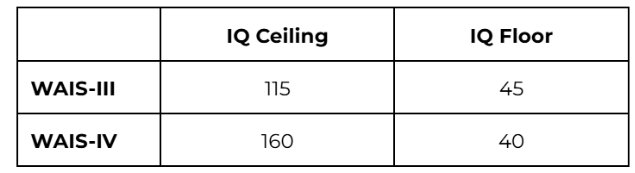
Short Form
a test that has been abbreviated in length to reduce time needed for administration, scoring and interpretation
David Wechsler endorsed the use of this for screening purposes (not to make placement or educational decisions)