Software Testing - 10
 Call Kai
 Learn
Learn Practice Test
 Spaced Repetition
 Match
Match Flashcards
 Knowt Play
1/37

There's no tags or description
Looks like no tags are added yet.
Name | Mastery | Learn | Test | Matching | Spaced | Call with Kai |
|---|
No analytics yet
Send a link to your students to track their progress
38 Terms
What is Testing in this context?
Testing is the process of analyzing a software item to detect the differences between existing and required conditions (that is, bugs) and to evaluate the features of the software item.
Why is Software Testing important?
High-level goal: Ensure software behaves as intended
Software developers are humans
We all make mistakes
These mistakes can lead to faults/bugs in software
Testing helps us to identify and fix bugs!
Preventing a system from failure
Includes identification of security critical bugs (i.e., vulnerabilities)
Mistake
A human action that produces an incorrect result - synonym: Error
Fault
An imperfection or deficiency in a work product where it does not meet its requirements or specifications - Synonyms: Defect, Bug
Failure
An event in which a component or system does not perform a required function within specified limits.
What is the errors flow diagram?

What are the four levels of testing?
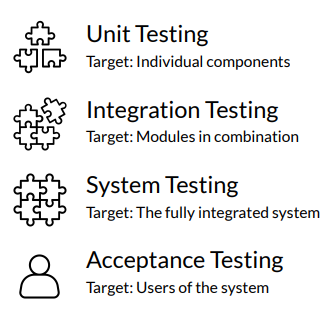
What is Unit Testing?
Tests functionality of basic building blocks (e.g, single functions)
Focuses on components in isolation
May include stubs or drivers to execute test
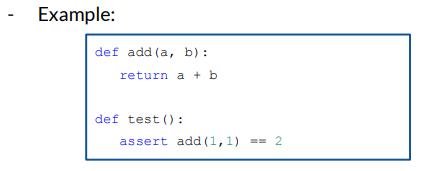
What is integration testing?
Tests functionality of building blocks when combined together
Focuses on interaction between components
Usually groups (unit tested) modules together following fixed strategies:
E.g, top-down, bottom-up, hybrid
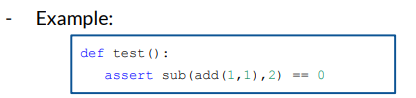
What is system testing?
Tests functionality of fully integrated system
Focuses on interaction between all components and the correctness of system as a whole
May be guided by requirement specifications

What is acceptance testing?
Tests whether system fulfills acceptance criteria (e.g., requirement/specification)
May involve (end-)users of the system
Includes well-known testing types:
Alpha testing, beta testing
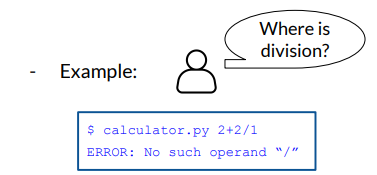
What is a test type?
A group of test activities based on specific test objectives aimed at specific characteristics of a component or system
Focus on specific objectives and characteristics
While test levels focus on which parts of the system are tested
However: each level can also be seen as a test type
What are some example test types?
Regression tests, smoke tests, conformance tests, security tests
What are regression tests?
Tests to ensure that introduced changes do not cause new defects
These defects would be “regressions”
Most common method: re-run all tests after change
If not possible: selection of specific regression tests or prioritization of specific test cases
Does not assess correctness of new parts of the software!
What are smoke tests?
Non-exhaustive tests to assess main/critical functionality of the software
Usually early on in testing/development process
Used to determine if further testing should proceed
If smoke test fails, additional tests make likely no sense!
Examples:
Does the software start?
Can a user provide input?
What are conformance tests?
Tests to ensure that software behaves according to their respective standard/specification
Test cases itself may be standardized as well
May be part of certification process
Especially relevant for safety-critical systems
Example applications:
Compilers
Cellular Basebands
What are security tests?
Specialized tests to find security critical defects in the target software
May be carried out by 3rd-parties, rather than development team
Can focus on different types of security related bugs, for instance:
Logic bugs (e.g., authentication bypass, API misuse, etc.)
Configuration errors (e.g., use of weak ciphers, default credentials, etc)
Memory corruptions (e.g., stack-based buffer overflows, use-after-free, etc)
Examples:
Source code audits, fuzz testing, symbolic execution
Why do we do Test Automation?
Automating test execution and result analysis is highly beneficial - Most languages provide test automation frameworks
CI/CD
Continuous integration and deployment
Commonly used in modern software engineering
- Core ideas:
Merge changes frequently into a single mainline
Before merge, ensure functionality via automated tests
Examples are Github actions and gitlab runners
What is The “Box Model”?
Testing can be classified based on the information provided to the test/tester:
black-box
grey-box
white-box
What does the black-box mean?
- No information about the internal structure
- Tester observes input and output
What does the grey-box mean?
- Partial information about the internal structure
- Tester can create informed tests
What does the white-box mean?
- Full information about the internal structure
- Tester can leverage source code
What is static testing?
- Also called “off-line” testing
- Testing without execution
- Reasons about the code
- May create false-positives
What is dynamic testing?
- Also called “on-line” testing
- Testing by executing the target
- Observes the code’s behavior
- May not cover full program
What is test coverage?
Metrics to understand how complete given tests are
Provides insights which parts of a software are tested
What types of test coverage are there?
Requirement coverage (which of the requirements are tested?)
Compatibility coverage (which hardware/software targets is the target tested with?)
Code coverage (which parts of the code are tested?)
What is code coverage?
Useful metric for security testing
More code coverage == more parts of the system tested
What are the types of code coverage?
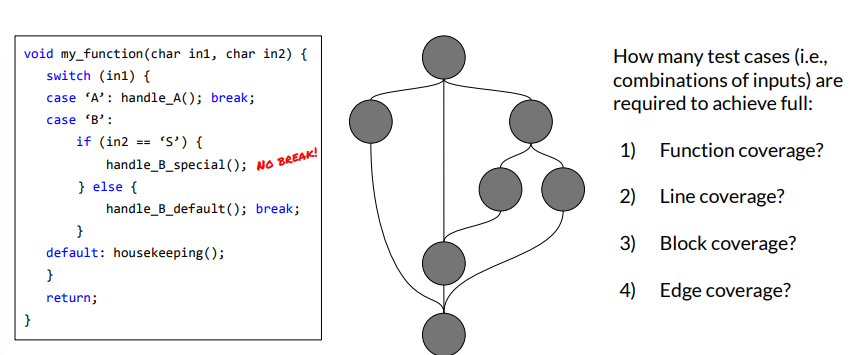
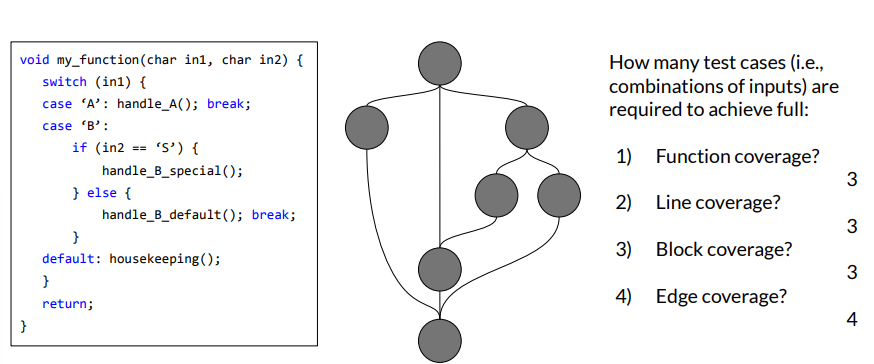
Function coverage
Which parts of the software are executed?
Line coverage
Which parts of the source code are executed?
Block coverage
Which parts of the machine code are executed?
Edge coverage
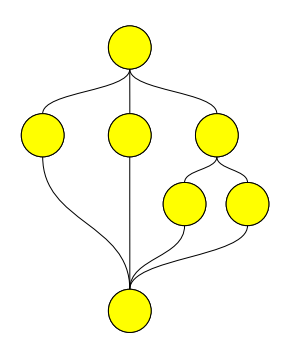
Which parts of the control flow graph are executed?
What are some limitations of code coverage?
Writing complete tests is not trivial!
Edge coverage most complete:
Function coverage may miss large parts of functionality
Line coverage assumes functionality isolated in individual lines
Block coverage does not track all transition
Code coverage may not give insights about data-dependent faults: - E.g., consider off-by-one errors in loops or the arguments to a strcpy call
What is Static Code Analysis?
Most common scenario: source code analysis - However, techniques for static binary code analysis exist as well!
Scales well to full programs - But may report many false positives
What is an example of static code analysis?
Example: Detecting vulnerable calls to APIs
Could be as simple as
$ grep strcpyOr using advanced tooling such as CodeQL [1]
![<ul><li><p>Example: Detecting vulnerable calls to APIs </p><ul><li><p>Could be as simple as <code>$ grep strcpy</code> </p></li><li><p>Or using advanced tooling such as CodeQL [1]</p></li></ul></li></ul><p></p>](https://assets.knowt.com/user-attachments/239b34b2-af0a-4219-8660-b496c1e00cd8.png)
What is Taint Analysis?
Testing techniques which can be implemented both dynamically or statically
Aims to identify flow of user input throughout the program
And whether it can has security implications
Core idea:
Tagging user input and tracking (“tainting”) its use through the program
Check whether tainted values ever reach vulnerable functions (“sinks”) without prior sanitization
What is Fuzzing?
Executing the target program repeatedly with (pseudo-)random input
Mutate existing or generate new input for each run
Monitor program behaviour for crashes
Crashes demonstrate shortcomings (failures) of the target software
Fuzzing has been shown very effective for finding security vulnerabilities
We will have a deep dive next lecture
Scales well to full programs
But may miss substantial parts of the target
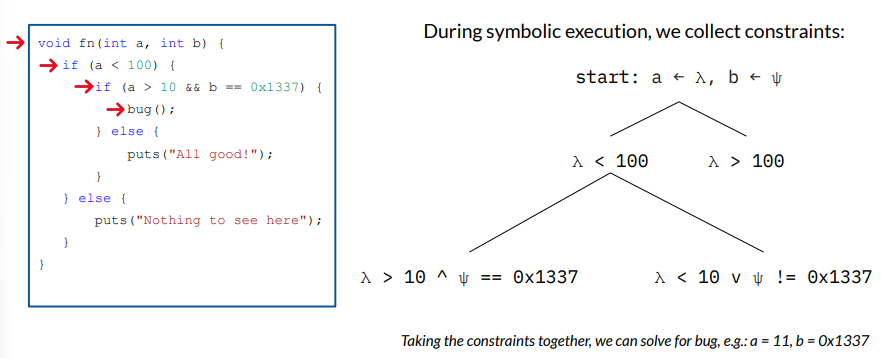
What is Symbolic Execution?
Instead of testing/executing the target with concrete inputs “execute” it with symbolic values
Goal: “Exploring” all states of a program
On each branch, collect constraints on inputs
If test case to reach a certain state is required, invoke a solver
What are the issues with symbolic execution?
- Scalability issues:
State/Path explosion
Constraint solving
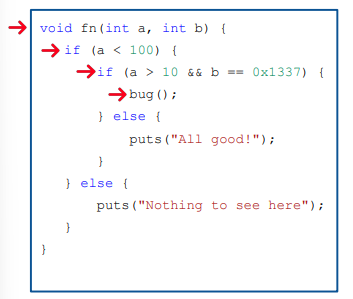
How does symbolic execution work on this code?