full set Organization Behaviour Final Exam
 Call Kai
 Learn
Learn Practice Test
 Spaced Repetition
 Match
Match Flashcards
 Knowt Play
1/174

There's no tags or description
Looks like no tags are added yet.
Name | Mastery | Learn | Test | Matching | Spaced | Call with Kai |
|---|
No analytics yet
Send a link to your students to track their progress
175 Terms
Introduction to Teams: Teams
Two or more people who depend on each other and work together over time to achieve a shared goal
Team Types: Work Teams
A work team is the kind of team that does the organization's regular everyday work
R/F: long life span, high member involvement
Ex: production team members work together to assemble vehicles
Team Types: Management teams
Managers from different departments making big decisions for the whole company
R/F: long life span, moderate member involvement”
Team Types: Parallel Teams
Groups made up of different jobs or departments within an organization who meet to give recommendations or solve important issues that are alongside the normal production of work not the main everyday work itself
R/F: Life span varies, low member involvement”
Team Types: Project Teams
Teams created to do a one-time task, and that task is usually more complex and needs people from different areas to work together
R/F: lifespan varies, member involvement varies
Ex: Launching a new app, opening a new store
Team Types: Action Teams
They come together for a limited amount of time to perform a complex task in a situation that is often high-pressure, visible, and challenging (centered around performing a task)
R/F: life span varies, member involvement varies
Ex: Surgery, flight crew
Team development: Forming
Beginning stage
People are just getting started and trying to understand what they are doing
Team development: Storming
This is the conflict stage
People start pushing their own opinions
Team development: Norming
Team starts to settle down
Team starts getting on the same page
Team development: Performing
Team is working smoothly and effectively
Now the team is not wasting much time on confusion or conflict
Team development: Adjourning
This is the ending stage
The job is over so the team breaks up
For work teams this process might be a quite stressful process depending on how long they worked together for
Punctuated equilibrium model
Another way to explain how teams develop but its used more for project teams then long-term teams
Punctuated equilibrium model: Time
The team quickly falls into a routine that lasts for the first half of the project
Punctuated equilibrium model: Midpoint
Memebers then realize they must change their approach if they want to finish ontime
Punctuated equilibrium model: Time (2)
The team adopts a better plan and sticks with it until the project ends
Team interdependence
The way team members are connected to eachother
There are 3 types: Task, goal and outcome interdependence
Task interdependence
How bad team members need each other to get the work done
4 types of task interdependence
The higher up the scale you go, coordination increases, adaptability increases, productivity decreases,
Task interdependence: Pooled interdependence
The loosest form of task inderpendence
Each team member does their own seperate part of the work, then all of the individual work gets combined at the end
R/F: Not great for adapting and learning from eachother, high productivity and low coordination”
Task interdependence: Sequential interdependence
Team members do the work in a set order, so each person's job depends on the person before them finishing first
Tasks are being done in a prescribed order
Task interdependence: Recriprocal Interdependence
People doing different tasks
Not in a prescribed order, high degree of coordination with high adaptability but lower productivity
Task interdependence: Comprehensive Interdependence
Team members are all so connected that they usually need to constantly coordinate, share info, and adjust to one another while doing the work
R/F: requires high coordination, so lower productivity, but high adaptability
The highest most connected form of task interdependence
Goal interdependence
Team members share the same goal and line up their personal goals with that team goal
Outcome interdependence
Team members share the results or consequences of the team’s performance
High outcome: each person’s reward, evaluation, or success depends a lot on how the whole team performs, not just on their own individual work
Team composition
What kind of people make up a team
There are five different types: member roles, member ability, member personalilty, team diversity, team size
Member roles
They are the jobs or behaviours team members take on to help the team work together
Member roles: Team task roles
Roles that help the team actually get the job done
Member roles: Team building roles
Roles that help the team get along well
They are not mainly about the task itself- they are about keeping the group positive, cooperativem and comfortable (desirable in a team)
Member roles: Individualistic roles
Behaviours that help the person, but not the team. Not desirable in a team
Ex: someone who tries to get attention for themselves
brags about what they did
Team task roles: initiator-contributor
Proposes new ideas
Team task roles: Devils advocate
Someone who points out possible problems in an idea so the team does not make a bad decision
Team task roles: Energizer
Motivates the team to strive to do better
Team building roles: Encourager
The person who builds people up
Team building roles: Compromiser
The person who helps to settle disagreements
Team building roles: follower
Person who goes along with the teams direction once decision is made
Individualistic roles: Recognition seeker
Teammate who wants the spotlight
Individualistic roles: Slacker
Teammate who does not really put in much effort
Member ability: additive tasks
Additive tasks are tasks where team performance depends on the total of all members’ contributions added together
The more each person contributes, the better the team performs.
Example: 4 people each give 5 ideas, so the team produces 20 ideas total.
Member ability: Disjunctive tasks
The most able member has the biggest influence on team performance
Ex: Group is trying to solve a hard puzzle, if one person figures it out the whole team benefits
Member ability: conjunctive tasks
The least able member has the biggest influence on team performance
Team can only go as fast as the weakest link
Ex: 4 people carrying a couch; if one person cant keep up the whole group can be hurt
Member personality: Agreeableness
Promotes harmony and cooperation, but too much can be a problem since no one will challenge weak ideas
Memeber personality: Extraversion
This person bring energy and is comfortable speaking up
But too many can lead to people interrupting and not enough listening, which can be detrimental
Memeber personality: Conscientiousness
This person actually does the work properly (hardworking and dependable)
Even one member low in conscientiousness can be detrimental
Team diversity
Degree to which team members are different from one another
2 perspectives:
Value in diversity problem-solving approach: good for complex/creative work, benefits from other people's ideas/approaches
Similarity-attraction approach: we like to associate with people similar to us
Team diversity: Surface level diversity
Differences in observable characteristics, like race, sex, ethnicity, and age
Has an negative impact at the start because you can see the differences
Team diversity: Deep-level diversity
Differences in things you learn overtime like values, and personality
These differences you dont always see immediately, but you discover them as people work together
Time increases the negative effects of deep-level diversity
Team size
The best team size depends on team types. Bigger teams can help for management and project teams. Bigger teams tend to not work well for production tasks
Complex tasks benefits from more members; more expertise helps gets tasks done
Simpler tasks (production) want as many members as needed to get work done, so they need less coordination to have higher productivity
Team process
Activities and interactions that happen inside a team while the team is working towards the goal
Team process: taskwork process
These are the activities that relate directly to completing the task itself
R/F: Process gains: getting together and realizing you have greater effectiveness together than individual contributions.
Process losses: individual contributions/abilities are worse in a group than expected
Task work process: Creative behaviour- brainstorming
Trying to come up with as many ideas as possible first, without worrying too much about judging them right away
R/F: increases morale, positive feelings, but results in lower quantity/quality than people working alone
Rarely works as intended because of social loading, hesitancy to express ideas, production blocking
Brainstorming: social loafing
People put in less effort when they are working in a group than when they would if they were working alone
Brainstorming: Hesitancy to express ideas
People may hold back their thoughts because they are worried the idea sounds dumb, weird or not good enough
Brainstorming: production blocking
When group members cannot share ideas right away because only one person can talk at a time
Creative behaviour: Nominal group technique
Instead of everyone shouting ideas out right away in a group, people first think ideas on their own, then bring them to the group after
Helps prevent social loafing and production blocking
Decision making- decision informity
Do team members actually know the information they are supposed to know about their own part of the job
Decision making- staff validity
Even if members have information, do they turn it into good advice
Quality of the recommendations
Decision making- Hierarchical sensitivity
The leader does not just hear ideas- the leader has to judge them to give the right amount of weight to each one
Taskwork process: boundary spanning
Doing activities with people who are outside the team
Scout activities: things team members do to get information from outside the team
Team process: Teamwork process
Interpersonal activties that help the team accomplish the task, even though they are not the task itself
Teamwork process- Transition processes
This team is getting ready. it is the planning stage
Happens before and between periods
Teamwork process: Action process
What the team does during the work to keep things moving while work is taking place
Teamwork process: Interpersonal processes
How team members get along with eachother
Happens all the time
Mission analysis
understanding the task, the challenges, and the resources before moving forward (the team is planning ahead)
Coordination
Team members sync their work so everything fits together smoothly (happens while the work is being done)
Poor coordination results in members having to wait on others for information source
Conflict management
What a team does to handle conflict that comes up while the team is working
Relationship: disagreements in interpersonal relationships
Task: disagreements about the team
Team process: Team states
These are the feelings and thoughts team members develop as a result of working together
Team states: Cohesion
The team members feel a strong emotional bond with eachother, level of closeness and connection
If at a moderate level it can have faster motivation, commitment, and performance and lead to conformity and overconfidence
Team states: Potency
The teams shared confidence that it can be successful
Generally beneficial, but too much confidence early on can hurt you
Has a strong positive correlation with team performance
Team states: Mental models
The team has a shared picture in their heads of how the team and task work
Ex: members agree about how conflicts should be managed in the groups
People on the team all understand the same process in the same way
Team states: Transactive memory
You dont need to know everything, as long as our team know who the expert is for each thing
If someone leave it very much disadvantages your team
Transactive memory *Lecture only*
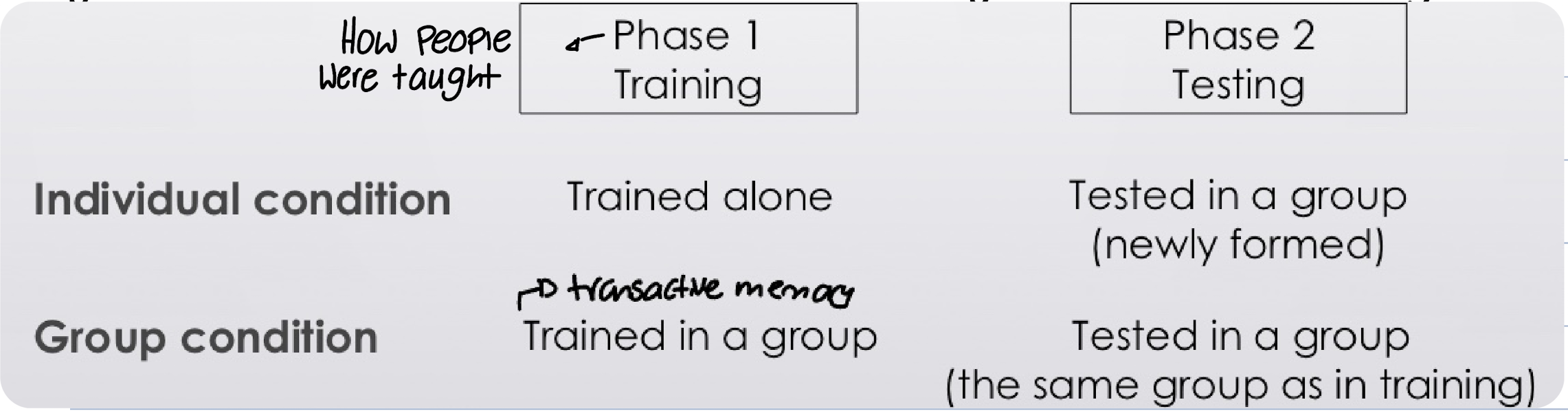
Liang examined transactive memory in a radio assembly task
Transactive memory *Lecture only*: Findings
Compared to groups whose members were trained alone, groups whose members were trained together
Remembered more about how to assemble a radio
Made fewer errors while assembling the radio
Worked at the same speed as those who trained alone
Transactive memory evidence
Memory differentiation: different team members each remember or know different parts
Task coordination: people know who is good at what, they can organize the work better
Task credibility: team members trust one another's knowledge
Transportable teamwork competencies
Training people in general teamwork skills that can carry from one team to another, instead of training people for one specific team
Ex: conflict resolution, goal-setting, and communicatioon
Cross trainning
Teaching team members about duties and responsibilities of their teammates, not just their own job
Purpose: helps the team work better as a whole
Cross-trainning: levels of depth
Personal clarification: Receives information. Told what the other person’s job involves
Positional modelling: observe. You watch how someone else does their job
Position rotation: experience. Members actually experience carrying out the responsibilities of their teammates
Team process training
Giving a team real experiences that help the team learn how to function and perform better together as a whole unit
action learning ex: team practices teamwork by dealing with an actually issue together
Team building
Fun activities that facilitate team problem-solving, trust, relationship building, and clarification of role responsibilities
Not always effective in increasing productivity
Power
Having the ability to influence other peoples behaviour and resist unwanted influence from them in return
Organizational power: Legitimate power
Power that comes from your official position or title
Ex: someone that is above you; coach manager, teacher, team leader, referee
Organizational power: Reward based power
Power by being able to give people what they want (power through rewards)
Ex: teacher gives participation marks to students who contribute in class
Organizational power: Coercive power
Power that comes from being able to punish someone or give them negative consequences
Personal power: expert power
Power that comes from having knowledge, expertise, or a valuable skill
Ex: going to an older coach because they know more than you
Personal power: Referent power
It comes from charisma, attractiveness, likeability or admiration
How likeable you are
You have power because people admire you
Contingencies of power
Factors of how much power someone has
Contingencies of power: Substituability
How easily it would be for someone else to do your job instead of you
Low substituability: not many people can do what you do
High substitutability: lots of people can do what you do (easily replaceable)
Ex: lots of people can teach a cartwheel (low); not many people can teach one (high)
Contingencies of power: discretion
How much freedom you have to make your own decisions
Low: you can make your own decisions
High: you have to ask before you do something
Contingencies of power: centrality
How important your role is to the organization's goal or to getting work done
Low: employee works more on their own, few people rely on them
High: A lot of people depend on that person
Contingencies of power: visability
How noticeable your work and role are to others
Low: people dont know who you are or what value you provide
High: People know who you are and what value you provide
Influence
How you try to get someone to do something, agree with something or see something differently
There are 10 Tactics
Influence: Rational persuasion (most effective)
Using logic, facts and evidence to show why something makes sense
Using proof that something’s a good idea- common sense
Only tactic that can work effectively in upward direction (can inflence people in positions higher than you)
Influence: Inspriational appeal (most effective)
Having people want to do something because it feels meaningful or special to them
Ex: if we work together, we can make this project something to be proud of
purpose of what they are doing
Influence: Consultation (most effective)
Asking someone for their ideas or letting them help decide, so they are more likely to support what you want (ask for their input)
Influence: collaboration (most effective)
Making the request easier by offering help, support, or resources (you actually work with them to do this)
Ex: Can you finish this report today? I’ll send you the data and help with the slides
Influence: Integration (moderately effective)
trying to get someone to like you bu using flattery, praise, or friendliness
Influence: Personal appeals (moderately effective)
Asking based on friendship, loyalty, or your relationship with the person
Do something for me because we are close
Influence: Appraising (moderately effective)
Telling someone why doing something will help them
Explaining what’s in it for them
Ex: can you cover my shift? youll get extra hours and more pay
Influence: Pressure (least effective)
Using threats, demands, or intimidation
closely connected with cocerieve power
May work once or twice but not longterm
Influence: Coalitions (least effective)
Getting other people to help pressure or persuade the target
Teaming up to influence someone in power
Influence: Exchange tactics (least effective)
Offering a reward in return for doing what you want
Ex: Can you cover my shift on Friday? I’ll cover yours next week
Responses to influence tactics
Internalization: target agrees and becomes committed to request (behavioural and attitudinal changes)- most effective
Compliance: Target is willing to perform requests but does so with indifference (behavioural change only)- medium effective
Resistance: Target is opposed to request and attempts to avoid doing it (no change in behaviour or attitude)- least effective