2.4 Cell recognition and the immune system
 Call Kai
 Learn
Learn Practice Test
 Spaced Repetition
 Match
Match Flashcards
 Knowt Play
1/69

There's no tags or description
Looks like no tags are added yet.
Name | Mastery | Learn | Test | Matching | Spaced | Call with Kai |
|---|
No analytics yet
Send a link to your students to track their progress
70 Terms
What is an antigen?
A foreign molecule, protein, glycoprotein, or glycolipid that stimulates an immune response leading to the production of antibodies.
How are cells identified by the immune system?
Each type of cell has specific molecules on its surface, often proteins with a specific tertiary structure, or glycoproteins or glycolipids, that identify it.
What is the first type of cell or molecule the immune system can identify?
Pathogens such as viruses, fungi, and bacteria.
What is the second type of cell the immune system can identify?
Cells from other organisms of the same species, for example in organ transplants.
What is the third type of cell the immune system can identify?
Abnormal body cells, for example tumour cells or virus-infected cells.
What is the fourth type of molecule the immune system can identify?
Toxins released by some bacteria.
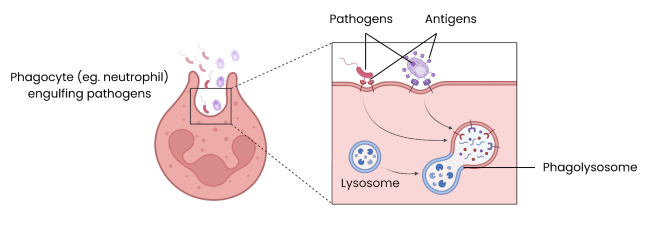
What is the first step in phagocytosis?
Phagocyte is attracted by chemicals released by the pathogen or recognises foreign antigens on the pathogen.
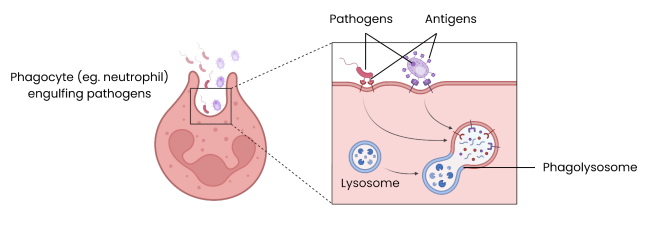
What is the second step in phagocytosis?
Phagocyte engulfs the pathogen by surrounding it with its cell membrane.
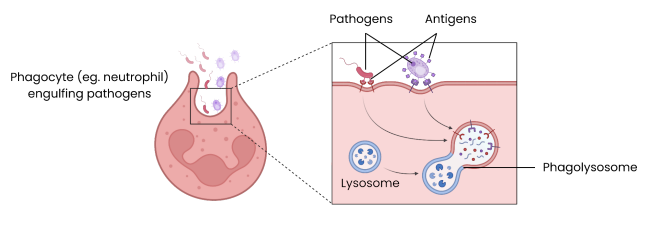
What is the third step in phagocytosis?
Pathogen is contained in a phagosome vesicle in the cytoplasm of the phagocyte.
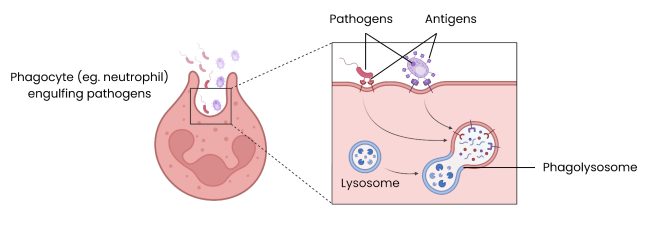
What is the fourth step in phagocytosis?
Lysosome fuses with the phagosome forming the phagolysosome and releases lysozymes, which are hydrolytic enzymes.
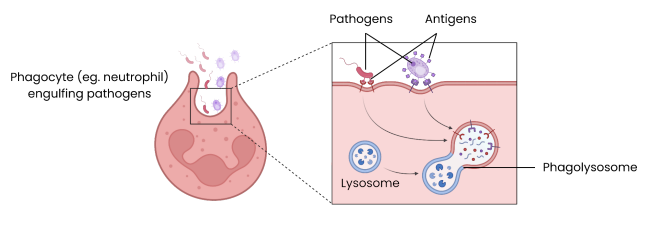
What is the fifth step in phagocytosis?
Lysozymes hydrolyse and digest the pathogen.
What happens after phagocytosis to stimulate the specific immune response?
Antigens are displayed on the phagocyte’s cell-surface membrane, stimulating the specific immune response.
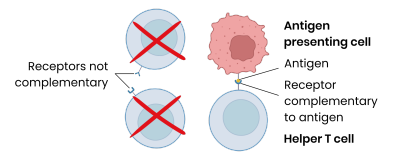
What do T lymphocytes recognise and on which cells?
Helper T lymphocytes recognise antigens on the surface of antigen-presenting cells, for example infected cells, phagocytes presenting antigens, transplanted cells, and tumour cells.
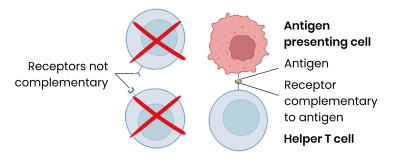
What happens when a helper T lymphocyte with a complementary receptor binds to an antigen on an antigen-presenting cell?
A helper T lymphocyte with a complementary receptor binds to an antigen on an antigen-presenting cell.
The helper T lymphocyte becomes activated and divides rapidly by mitosis to form clones.
What is the first type of cell stimulated by helper T cell clones?
Helper T lymphocyte clones stimulate cytotoxic T cells, which kill infected or tumour cells by producing perforin.
What is the second type of cell stimulated by helper T cell clones?
Helper T cell lymphocyte clones stimulate specific B lymphocytes, which are involved in the humoral response.
What is the third type of cell stimulated by helper T cell clones?
Helper T cell lymphocyte clones stimulate phagocytes, which engulf pathogens by phagocytosis.
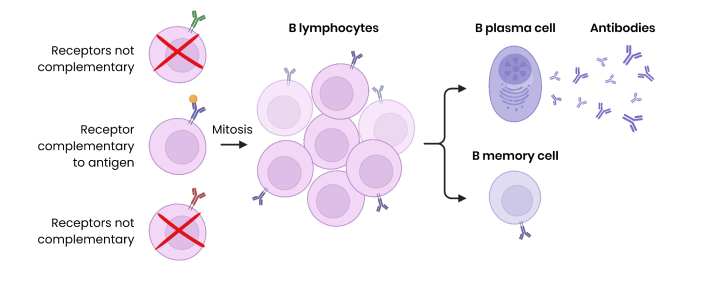
What type of antigen can B lymphocytes recognise?
B lymphocytes can recognise free antigens, for example in blood or tissues, not just antigens on antigen-presenting cells.
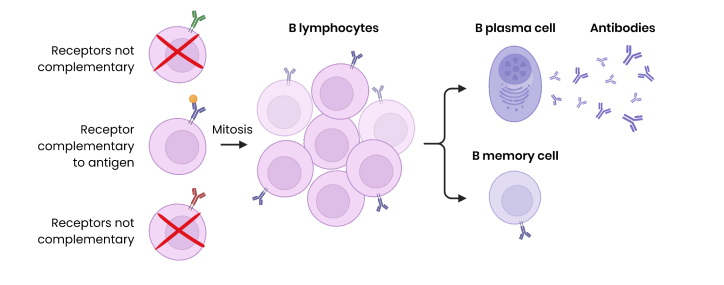
What is the first step in the humoral response?
A specific B lymphocyte with a complementary receptor binds to an antigen.
It is then stimulated by helper T cell lymphocytes which release cytokines, causing it to divide rapidly by mitosis to form clones.
It undergoes clonal expansion.
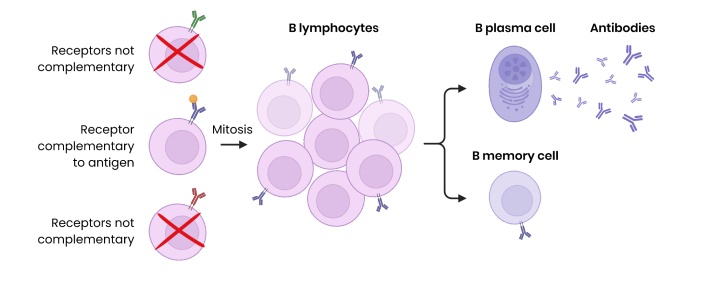
What do some B lymphocyte clones differentiate into and what do they do?
Some clones differentiate into B plasma cells, which secrete antigen-specific antibodies.
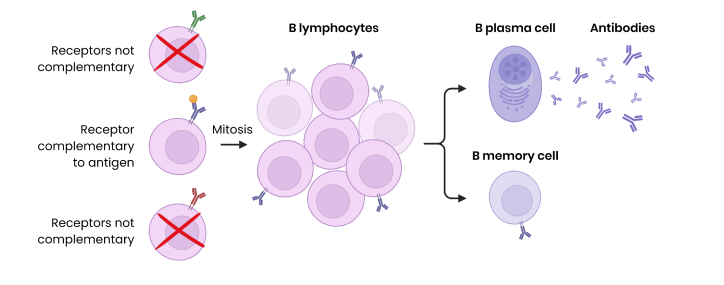
What do other B lymphocyte clones differentiate into and what is their function?
Some clones differentiate into B memory cells, which remain in the blood for the secondary immune response.
What type of protein structure do antibodies have?
Quaternary structure proteins made of 4 polypeptide chains.
Which cells secrete antibodies?
B plasma cells secrete antigen-specific antibodies.
What do antibodies bind to and what do they form?
Antibodies bind specifically to antigens, forming antigen-antibody complexes.
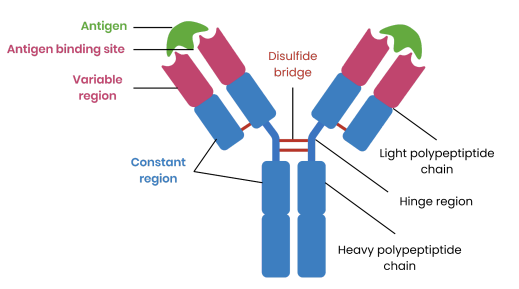
What are the two types of polypeptide chains in an antibody?
Light polypeptide chains and heavy polypeptide chains.
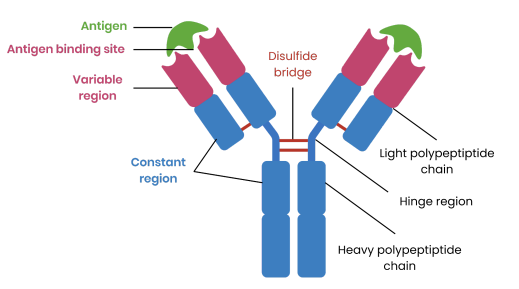
What are the variable and constant regions of an antibody?
The variable region contains the antigen binding site.
The constant region is involved in other functions such as binding to phagocytes.
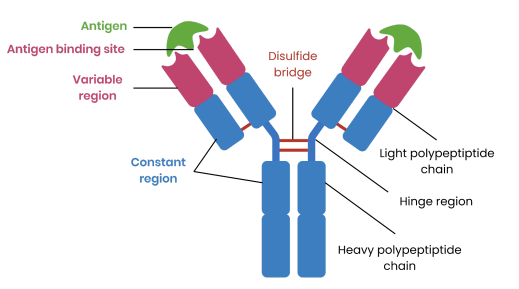
What bonds hold antibody chains together and what allows flexibility?
Disulfide bridges hold the chains together.
The hinge region allows flexibility.
How do antibodies bind to antigens?
Antibodies have a specific tertiary structure, so their variable region binds to a complementary antigen on a pathogen, forming an antigen-antibody complex.
How do antibodies cause pathogens to clump together?
Each antibody binds to two pathogens at a time, causing agglutination of the pathogens.
What do antibodies attract to the site of infection?
Antibodies attract phagocytes.
How do phagocytes use antibodies to destroy pathogens?
Phagocytes bind to the antibodies and phagocytose many pathogens at once.
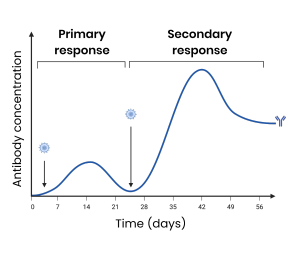
Describe the antibody production during the primary immune response.
Antibodies are produced slowly and at a lower concentration.
It takes time for specific B plasma cells to be stimulated to secrete antigen-specific antibodies.
What cells are produced during the primary immune response?
B memory cells are produced during the primary immune response.
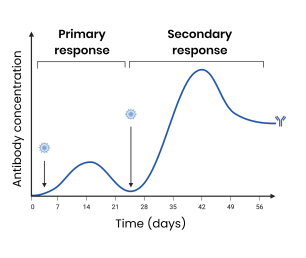
Describe the antibody production during the secondary immune response.
Antibodies are produced faster and at a higher concentration.
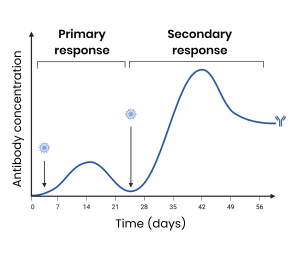
How does the secondary immune response produce antibodies more rapidly?
B memory cells rapidly divide by mitosis, producing clones that differentiate into specific B plasma cells. These plasma cells then secrete antigen-specific antibodies faster and at a higher concentration.
What is a vaccine?
Introduction of antigens, for example by injection, which could be from attenuated or dead or weakened pathogens, stimulating the formation of memory cells.
What is the first step in how a vaccine provides protection?
A specific B lymphocyte with a complementary receptor binds to the antigen.
What is the second step in how a vaccine provides protection?
A helper T lymphocyte with a complementary receptor binds to an antigen on an antigen-presenting cell.
This stimulates the B lymphocyte.
What is the third step in how a vaccine provides protection?
The B lymphocyte divides rapidly by mitosis to form clones.
It undergoes clonal expansion.
What is the fourth step in how a vaccine provides protection?
Some clones differentiate into B plasma cells, which secrete antigen-specific antibodies.
What is the fifth step in how a vaccine provides protection?
Some clones differentiate into B memory cells, which remain in the blood for the secondary immune response.
What happens on secondary exposure to the antigen?
B memory cells rapidly divide by mitosis, producing clones that differentiate into specific B plasma cells. These plasma cells then secrete antigen-specific antibodies faster and at a higher concentration.
What is herd immunity?
A large proportion of the population is vaccinated, reducing the spread of the pathogen.
How does herd immunity protect unvaccinated individuals?
A large proportion of the population is immune, so they do not become ill from infection.
Fewer infected people to pass the pathogen on, so unvaccinated people are less likely to come into contact with someone who has the disease.
What is required for active immunity to develop?
Initial exposure to an antigen, for example from a vaccine or primary infection.
Are memory cells involved in active immunity?
Yes, memory cells are involved.
Where do antibodies come from in active immunity?
B plasma cells secrete antigen-specific antibodies.
How quickly does active immunity develop?
It is slow and takes longer to develop.
How long does active immunity last?
Long-term immunity, as B memory cells rapidly divide by mitosis, producing clones that differentiate into specific B plasma cells. These plasma cells then secrete antigen-specific antibodies faster and at a higher concentration.
Is exposure to an antigen required for passive immunity?
No, there is no exposure to an antigen.
Are memory cells involved in passive immunity?
No, memory cells are not involved.
Where do antibodies come from in passive immunity?
Antibodies are introduced from another organism, for example through breast milk or across the placenta from the mother.
How quickly does passive immunity develop?
It is faster acting.
How long does passive immunity last?
Short-term immunity, as antibodies are hydrolysed by endopeptidases, exopeptidases, or dipeptidases.
What causes antigens on pathogens to change shape?
Gene mutations alter the DNA sequence of the pathogen.
This changes the amino acid sequence in the antigenic protein.
The altered amino acid sequence changes the antigen’s tertiary structure.
Why does immunity from a vaccine or prior infection no longer work against a changed antigen?
B memory cell receptors cannot bind to or recognise the changed antigen on secondary exposure.
Specific antibodies are not complementary and cannot bind to the changed antigen.
Give examples of diseases where antigen variability affects immunity.
New flu vaccines are developed yearly.
There is no vaccine for HIV.
A person can catch a cold many times.
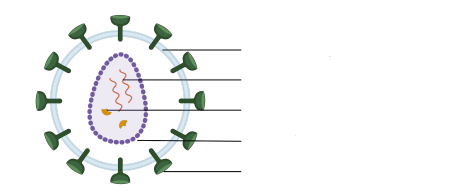
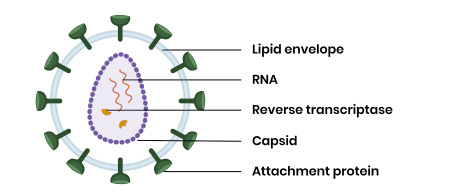
What are the main structural components of an HIV particle?
Lipid envelope.
Attachment proteins.
Capsid.
RNA.
Reverse transcriptase.
What is the first step in HIV replication?
HIV attachment proteins attach or bind to complementary receptors on the helper T cell.
What happens after attachment proteins bind to the helper T cell?
The lipid envelope fuses with the cell-surface membrane, releasing the capsid into the cell.
What happens once the capsid is inside the helper T cell?
The capsid uncoats, releasing RNA and reverse transcriptase.
What does reverse transcriptase do?
Reverse transcriptase converts viral RNA to DNA.
What happens to the newly formed viral DNA?
Viral DNA is incorporated into the helper T cell DNA, where it may remain latent.
How are viral proteins produced?
Viral DNA is transcribed into HIV mRNA.
HIV mRNA is translated into new HIV proteins, including capsid and enzymes.
How are new HIV particles released from the cell?
Virus particles are assembled and released from the cell via budding.
How does HIV lead to the destruction of helper T cells?
HIV infects and kills helper T cells as it multiplies rapidly.
Why does the immune system deteriorate in AIDS?
Helper T cells cannot stimulate cytotoxic T cells, B lymphocytes, or phagocytes.
B-plasma cells cannot secrete as many antigen-specific antibodies for agglutination and destruction of pathogens.
What is the consequence of a deteriorating immune system?
The body becomes more susceptible to opportunistic infections.
Pathogens reproduce, release toxins, and damage cells.
Why do viruses lack metabolic processes that antibiotics could target?
Viruses do not have metabolic processes, for example they do not synthesise proteins, as they have no ribosomes.
What bacterial features are absent in viruses?
Viruses do not have bacterial enzymes or a murein cell wall.