Fluid Balance 216A (copy G. Audenart)
 Call Kai
 Learn
 Practice Test
 Spaced Repetition
 Match
 Flashcards
 Knowt Play
1/128

Earn XP
Description and Tags
129 Terms
0.5-1ml/kg/h
how much urine per hour
220lbs
if the patient weighs 100 kg how many pounds does the patient weigh
what % of body fluid is water
60%
where is water in the body and %
ICF (40% in cells, intracellular fluid)
ECF (plasma 20%)
Where is ECF distributed
16% interstitial - aka fluid between cells
20% in plasma
Edema
High interstitial fluid can cause edema, which can cause crackles and create difficulties breathing.
continuous movement of water
need good lymph circulation
5L blood
plasma 3L only part of volume
hypotension
low blood volume
CNS injury can impact
(dis)ability to regulate vitals
fluid regulation
homeostasis
baroreceptors
mechanoreceptors in walls of BV and heart, detect BP
jutxaglomerulator in nephron of kidney, detects BP changes, and responds
doesn’t fx w/out inflammation
triggers vasomotor center in medulla
vasomotor center in medulla
triggered by baroreceptors
low perfusion activates SNS which releases norepinephrine
norepinephrine
triggers vasoconstriction
this is released from the adrenal glands
response to low BP to help raise it
-also lungs dilate
kidneys
detect the drop in perfusion pressure and release renin. Adjusts how much water/electrolytes are kept/excreted.
renin
converts angiotensinogen to angiotensin I
angiotensin I
converted to angiotensin II by ACE in the lungs
angiotensin II
causes vasoconstriction on arteries which raises bp and stimulates adrenal cortex to release aldosterone
aldosterone
tells kidneys to reabsorb sodium and water and excrete potassium.
Water follows retained sodium and raises blood volume and pressure
hypothalamus
detects low bp and signals posterior pituitary to release ADH
ADH
causes water reabsorption and less urine output = increasing blood volume and BP.
From hypothalamus to kidneys
I&O
intake should be greater than or equal to output
oliguria
low output of urine
<o.2ml/kg/h
creatinine clearance
check kidney function by checking this bloodwork
electrolytes in body
sodium, potassium, calcium, chloride
patients that experience fluid balance issues or losses
GI patients, and any crucial organ dysfunction
osmolality
dependent on number of dissolved solutes in a fluid
-like sodium, glucose, urea
measured osmolality
275-295 mOsm/kgH20
changes in osmolality
can cause water to move to different compartments via osmosis (+aquaporin channels)
-cells, interstitial fluids, plasma
dehydration
increases osmolality
-high electrolytes compared to water
overhydration
decreases osmolality
-low electrolytes compared to water
can lead to cell swelling (edema)
occurs when replacing water but not electrolytes
IV fluid admin
aims to maintain homeostasis and correct fluid imbalance
severe changes in sodium and water balance
can cause confusion, seizures, other neuro problems.
Blood tests
can measure substances of liquid portion of blood to assess fluid balance, electrolyte levels and organ function.
Bicarbonate
alkaline substance, balanced via kidneys. helps maintain body’s acid-base balance
Process of protein breakdown
dietary proteins
digestion → amino acids
Amino acids are used to build proteins and other substances
excess nitrogen turned in urea (produced in liver)
Kidneys filter urea into urine.
Urea and kidneys
urea build up causes changes in kidney function
Electrolytes and extracellular fluid
high in sodium, chloride and calcium
Electrolytes and Intracellular fluid
High in potassium, phosphate, magnesium
Abnormal Potassium levels
can affect electrical activity of heart and cause arrythmias
Magnesium and nerves
magnesium supports normal neuromuscular function and cellular reactions
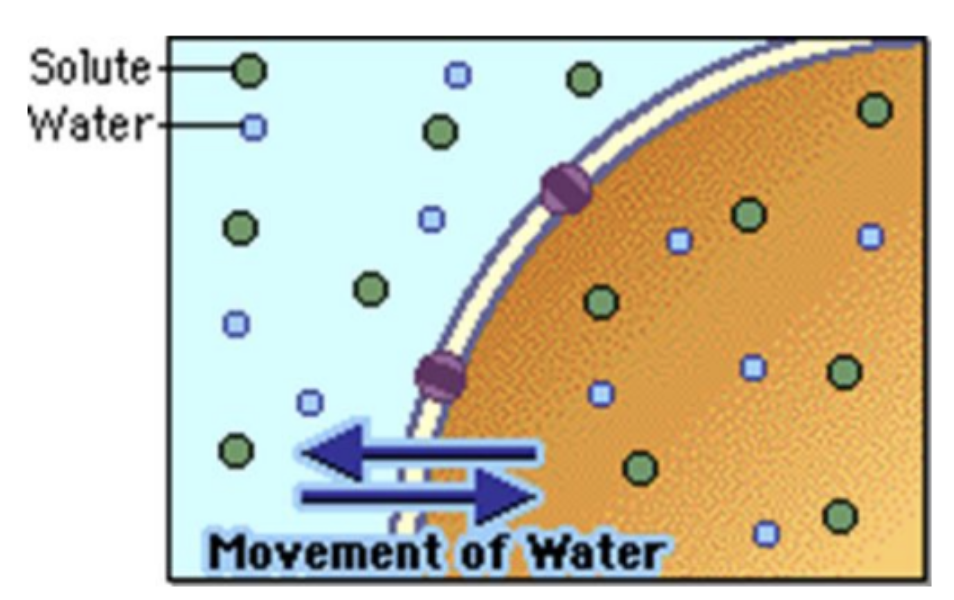
osmosis
mov’t of H2O from low solute to high solute (dilutes)
-how IV fluid works
-the correct iv fluid will achieve the desired shift
tonicity
clinical application of osmolality
-a relative (to blood) measurement of IV fluid’s osmolality
-relates osmolality of the fluid to that of plasma
all iv fluids
are dispensed according to their ‘tonicity’
fluid and tonicity
tonicity dictates fluid movement btw compartments
sodium and dextrose
iv fluids tonicity’s main solutes
isotonic fluid
same as plasma (same osmolality)
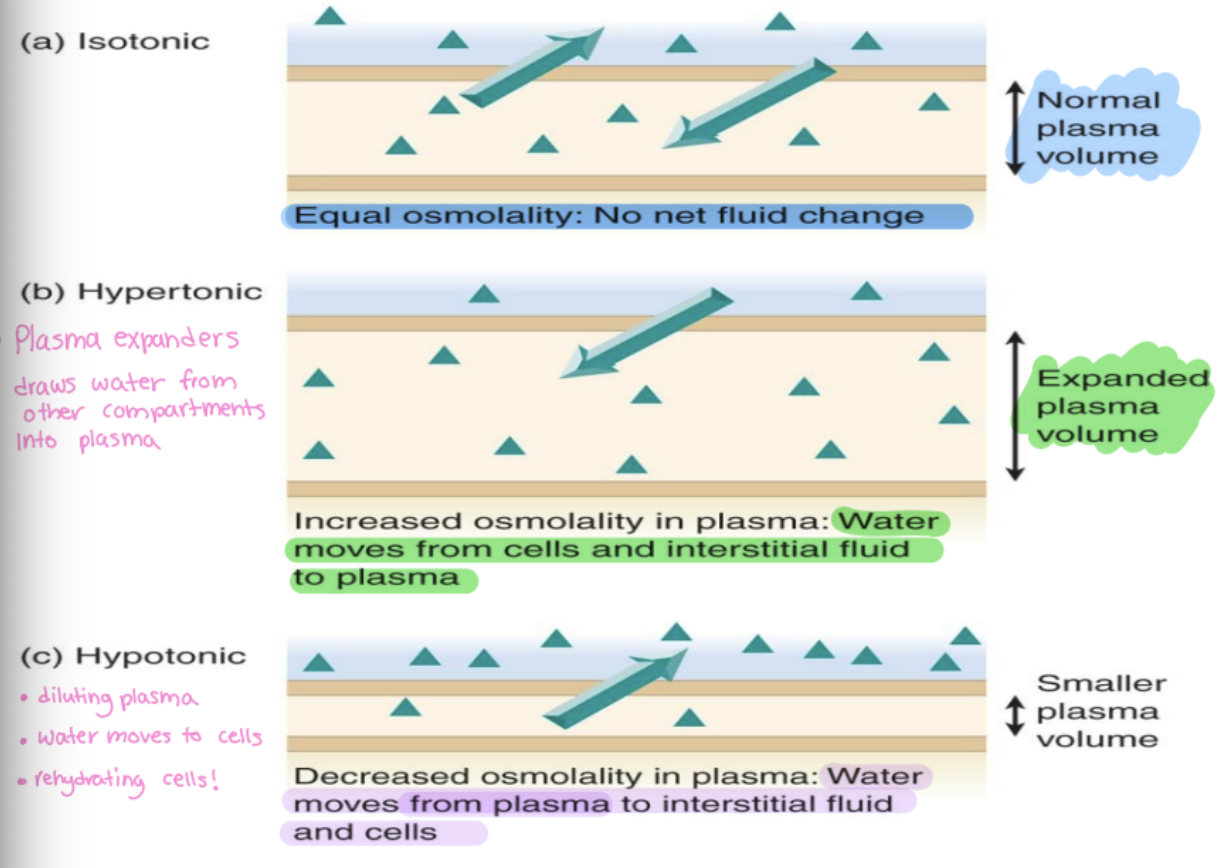
isotonic fluid effect
no major net water shift. ex NS.
hypertonic fluid
higher than plasma
-plasma expanders, draws water from other compartments into plasma
-increased osmolality in plasma
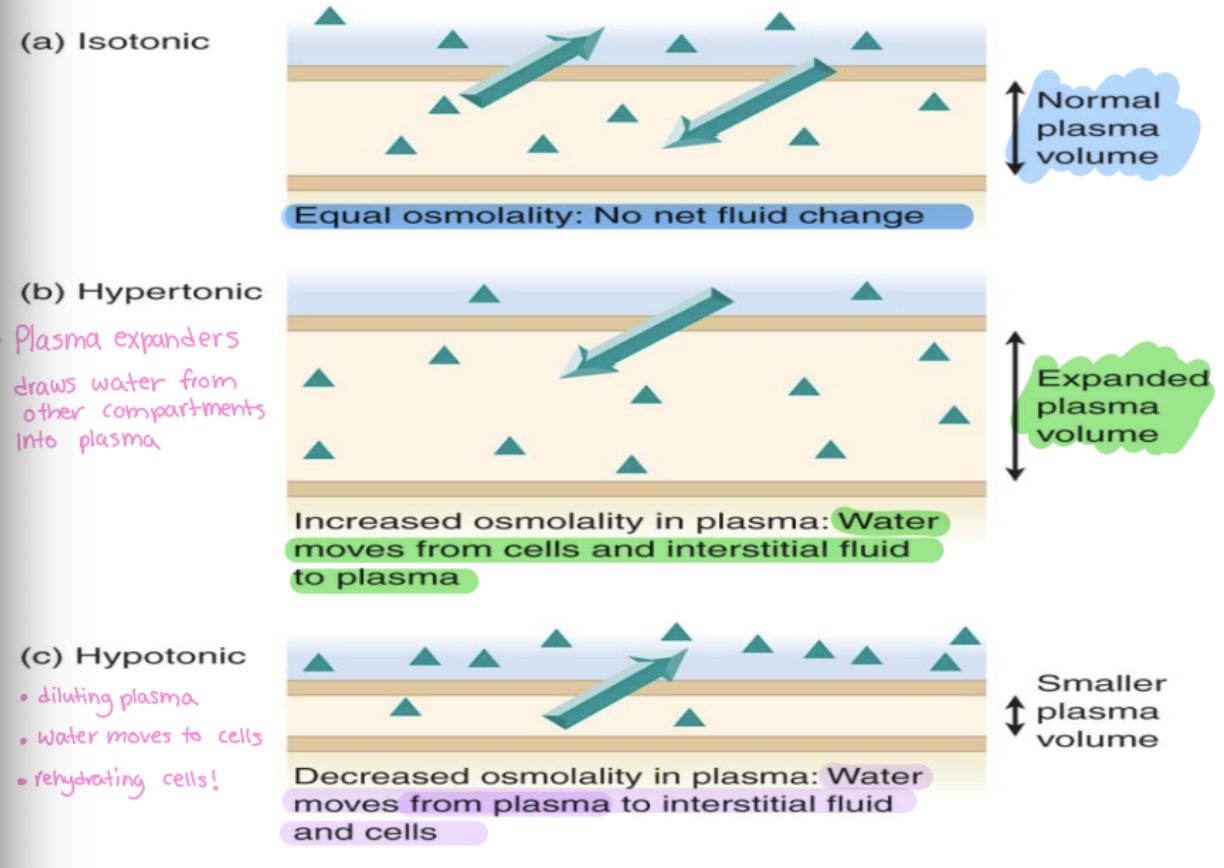
hypertonic fluid effect
higher effective solute concentration than plasma, so water moves out causing shrinking.
hypotonic fluid
lower than plasma
-diluting plasma, water moves to cells and interstitial fluid
-rehydrating cells
-smaller plasma volume
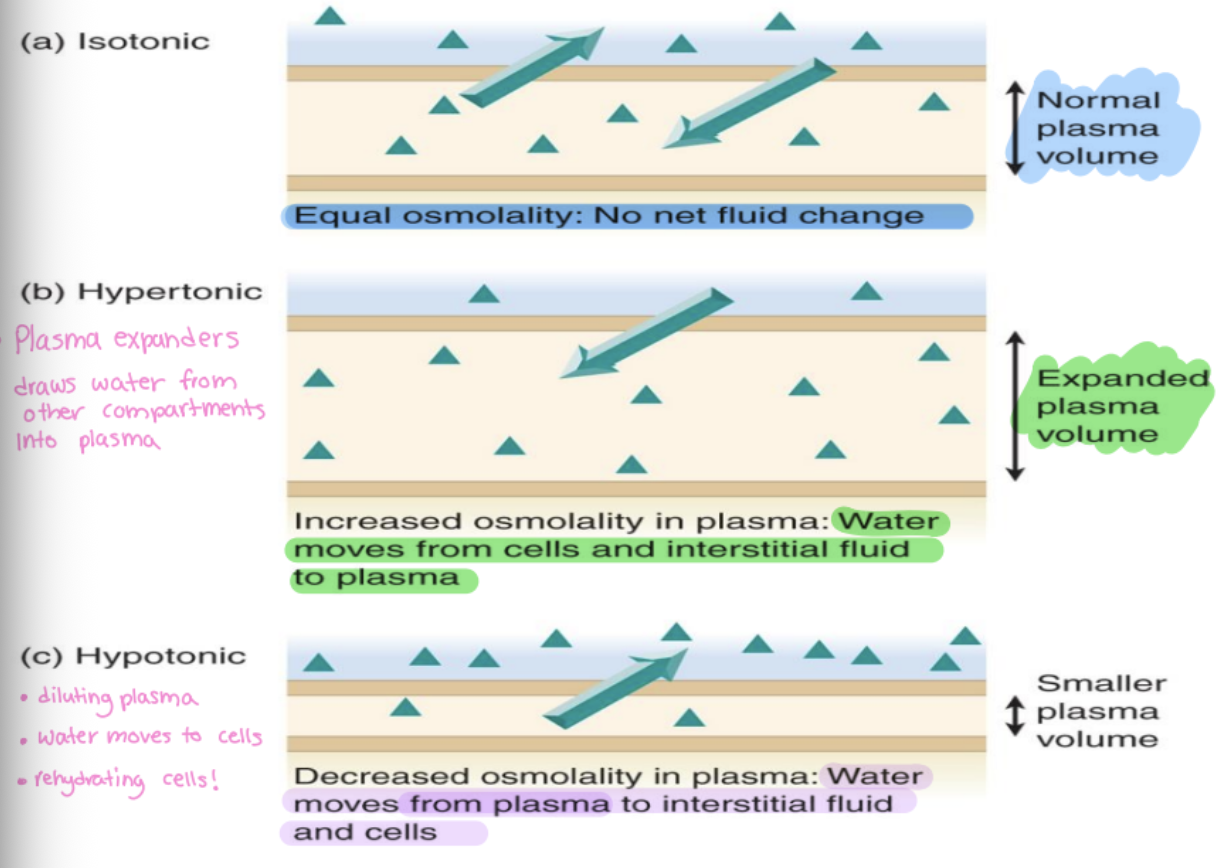
hypotonic fluid effects
lower effective solute concentration than plasma, water moves into cells causing swelling
iv fluid categories
colloids and crystalloids
colloids
-protein based iv fluid
-stay in circulation, can’t cross membranes.
-aka plasma expanders: bring water to plasma
tx of hypovolemic shock
colloids (contra. in most other cases-not first line)
due to no pass via capillaries and high renal workload (need high kidney fx - risk of fluid overload and high strain)
EX: plasbumin, alburex
what is hypovolemic shock
loss of significant blood or fluid.
iv fluid colloids
albumin
crystalloids
most common iv fluids
-H2O + electrolytes + other solutes (ex. glucose)
-easily move btw ECF & ICF
-tonicity directs fluid movement
isotonic in the ‘bag’
although it is this in the bag, it will be hypertonic in the body due to protein content
water moves towards, protein can’t move. eg Albumin 5%
hypertonic in bag
if dextrose is the solute making it ‘hypertonic’ in the bag, once in the body dextrose is quickly utilized = the remainder fluid will become more isotonic or even hypotonic
-D5 ½ NS (mildy hypertonic in bag d/t dextrose)
fluid maintenance
meeting body requirements
-oral intake (eating/feeding tube); IV infusion; SC infusion
- intake may not work for GI due to SNS stimulation, can be switched to IV
fluid resuscitation
replacing deficits
-PO if minor; IV if concerning
-goal: adequate perfusion → rescue intravascular volume
fluid restriction
restricted fluid intake
NPO
nothing by mouth, all fluids given IV (often pre/post surgery, GI issues, intubated)
skin is big hint
organ not vital to life, lack perfusion when SNS stimulated
adult fluid calculation
35ml/kg/day of water
-electrolytes (potassium, sodium, chloride)
If NPO for >3 days
consider additional nutrition, at risk for malnutrition
dextrose adult fluid calc
50-100 g/day of glucose to limit ‘starvation’ ketosis
-need minimum
dextrose calories
1L of dextrose has 170 cal
paediatric fluid calc
4/2/1 rule
-4ml/kg/hr for 1st 10kg of body weight
-2ml/kg/hr for 2nd 10kg of body weight
-1ml/kg/hr for the remaining kgs
common isotonic crystalloids
normal saline 0.9%
lactated ringer’s (LR or RL)
Plasma-Lyte 148
D5W
D5.2NS
plasma lyte a
has components turn into bicarb
-alkylizes
-normal blood ph = 7.35-7.45, need to consider, shouldn’t use when in homeostasis
common isotonic colloids
-isotonic in bag, hypertonic in body
5% albumin
dextran 40
dextran 70
hydroxyethyl starch 6% (higher in hypertonic) (tetrastarch, heptastarch - rescue not first choice)
NS 0.9% contents
Contents per L:
154 mEq Na
154 mEq Cl
NS tonicity
isotonic
-#1 resuscitation fluid
adults ns
500 ml bolus, reassess, keep adding and reassess
paediatrics ns
15ml/kg, reassess, switch to D5 ½ NS (77mEq)
ns s/e
if prolonged use (>2days)
hyperchloremia, low other electrolytes
no dextrose
hypochloremia
low levels of chloride
LR contents
per L:
-Na 130 mEq
-Potassium 4 mEq
-Calcium 2.7 mEq
-Chloride 109 mEq
-Sodium Lactate 28mEq (metabolized into bicarbonate)
LR
isotonic tonicity
side effects: hyperkalemia, no dextrose
pediatric contraindication: high electrolytes
Plasma-Lyte 148 contents
Per L:
Na 140 mEq
Potassium 5 mEq
Mg 3 mEq
Chloride 98 mEq (normo-chloremic)
Aklalizing agents: 27 mEq and 23 mEq gluconate - (not for metabolic acidosis tx)
Plasma Lyte 148
21 calories
common choice for post OR
Caution: hypersensitivty reactions
Dextran 40 contents
large polysaccharide
contains some 0.9% NS
Dextran 40
Stays in circulation - volume expander.
Binds RBC and platelets, reduces aggregation: antiplatelet fluid, reduces blood viscosity, risk of bleeding.
common hypertonic fluids characteristics
-fluid out of cells, tonicity high plasma
-high glucose &/or high sodium
-D5NS (may be isotonic in body bc demand is high)
-D5LR
Common Hypertonic Fluids: names
D5NS
D5LR
D5Plasma-Lyte
D10W (dextrose 10% in water)
D5 0.45%NS (D5 ½ NaCl; D5.45 NS) (hypertonic in bag = becomes isotonic quickly)
3% NaCl
25% Albumin (colloid)
3% NaCl
high sodium, give small dose and reassess
-tx for head injury to lower ICP (cerebral edema) (shrink cells - water into plasma)
-hypertonic fluid
-crystalloid
25% albumin
colloid
-tx: resuscitation fluid option, watch fluid shift
-common hypertonic fluid
D5.45 NS content per L
50g dextrose
77 mEq Na
77 mEq Cl
D5.45 ns
hypertonic (mildly)
1st choice paediatric maintenance fluid (+consider adding KCl)
Good if dextrose required
-s/e hyponatremia
Hyponatremia
Low blood sodium
25% Albumin contents
per L:
250g albumin
130-160 mEq Na
25% albumin
hypertonic tonicity
colloid
biologic - from donors (heat treated to eliminate pathogens)
plasma volume expander extreme!
3.5 times it volume of additional fluid into circulation in 15 minutes (infuzed volume, 100 ml → acts like 350ml)
common hypotonic fluids
Fluid into cells, low NaCl or low dextrose
0.45% ns (1/2 ns)
3.3% dextrose 0.3% sodium (2/3 1/3) short term not maintenance
D5 0.2% NS (good dextrose, less na)
hypotonic application
dehydrated patient with high serum solute “hypernatremic dehydration'‘ → water loss to ECF > fluid and solute loss, high na in blood
-h20 shifting into ECF (circulation) need fluid back into cells
-administer hypotonic fluids to shift some fluid back into cells
GI bleed upper potential causes
PUD
esophageal varices (barrets esophagus)
esophagitis
Mallory-Weiss tears
lower gi bleed
tumors,
inflammatory bowel disease
Diverticular disease
Colon polyps
Hemmorrhoids
Anal Fissures
Proctitis (inflammation of rectum)
gi bleed tx
stop taking: NSAIDs and drugs that decrease clotting (antiplatelets, anticoagulants, thrombolytics). Analayze Blood Work, determine infectious agents
IV fluid resuscitation/maintenance
Blood products
Abx if pathogen
Adjunct tx: PPI’s (symptom relief)
assess for gi bleed
VS (map), peripheral pulses, dx to tx cause, endoscopt or colonoscopy, bw, pathogen specific