Unit 10 Evolution
 Call Kai
 Learn
Learn Practice Test
 Spaced Repetition
 Match
Match Flashcards
 Knowt Play
1/38

Earn XP
Description and Tags
study ts
Name | Mastery | Learn | Test | Matching | Spaced | Call with Kai |
|---|
No analytics yet
Send a link to your students to track their progress
39 Terms
Herclitus
universe changes
Aristotle
Spontaneous generation - organisms come from non-living things.
Cuvier
Species dont change, extinction happens
Linnaeus
classified species based on fixed traits
Buffon
Species can change, but they don’t turn into other species.
Lamarck
Inheriance of acquired traits
Erasmus Darwin
All life comes from one ancestor
Hilaire
Monstrous births lead to new species
Chambers
The universe, and species, change
Biological fitness
ability to survive and reproduce
Adaptation
trait that is benficial in a given/specific environment
Four Principles
Variation: differences exist in a population because of mutations and sexual reproduction
Overproduction: not every individual can survive, creating competition
Adaptation: organisms w/ beneficial traits will survive and reproduce
Descent w/ mod: In an unchanging environment, there will be mroe individuals with beneficial traits in each generation
Selective pressures make some traits _____ and some traits ___
beneficial and deletarious
Selective pressure examples
Competition, Predation, CLimate, Disease, and Humans
Example of selective pressures
Documented drought effects in 1977 and 2003.
1977: Plants w/ small seeds die, leaving only large seeds for birds, and birds with big beaks live
2003: Plants w/ big seeds die, leaving only small seeds for birds, and birds with small beaks live.
Darwin’s influences
Gradualism: Earth changes over time
Uniformitarianism: processes that change Earth over time are uniform throughout time
Populations are limited by resource availability
Voyage of HMS Beagle: Darwin observed variation in species (finches) and he saw adaptations to their environment (also finches)
Theory of Natural Selection
Mechanism by which evolution occurs
Individuals who have inherited beneficial traits will produce more offspring than others
Bio fitness (mentioned on other slide)
Adaptation (other slide)
Four Principles (other slide)
Fossils
Preserved remains of living things
Species change over time
T. rex
Biogeography
Geographical distribution of organisms
Species change over time
Darwin’s finches (island based)
Embryology
Study of embryos and development
similarities indicate common ancestor
Fish and human
Homologous Structures
Different functions, same structure
Similarities indicate a common ancestor
Horse vs Human legs
Analogous Structures
Different structures, same function
Difference in structure indicates a DISTANT common ancestor
Bat wing and Butterfly wing
Vestigial Structure
Body part with lbarely any function
Species change over time
Tailbone (human)
DNA comparison
Compare sequences of DNA from different species
Similarities indicate a common ancestor
Humans vs Chimps (98% shared DNA sequence)
Protein Comparison
Comparing amino acid sequences of different species
Similarities indicate a common ancestor
Human and Gorilla
Allele Frequency
Percentages of alleles in a population
Gene Flow
Movement of alleles from one pop to another
Genetic Drift
Change in allele frequency in a small population
Bottleneck effect
Event that drastically reduces the pop, causing genetic drift
Founder Effect
A small group colonizes a new area, causing genetic drift
Intersexual Selection
One sex of species chooses characteristics, challenging allele frequencies (ornaments = Inter)
Intrasexual Selection
One sex competes for mates, choosing better competitions
Artifical Selection
Humans select for certain traits of a species, changing allele frequencies
Species
group of organisms that can produce viable, fertile offspring (babies that can make babies)
Speciation
one species splitting into two
Conditions Necessary for this: Natural Selection and Isolation
Types of isolation
Mechanical: members of different pops can’t have viable babies
Behavioral: Different pops adapt different mating behaviors
Geographic: pops separated by physical barrier
Temporal: pops have different mating seasons
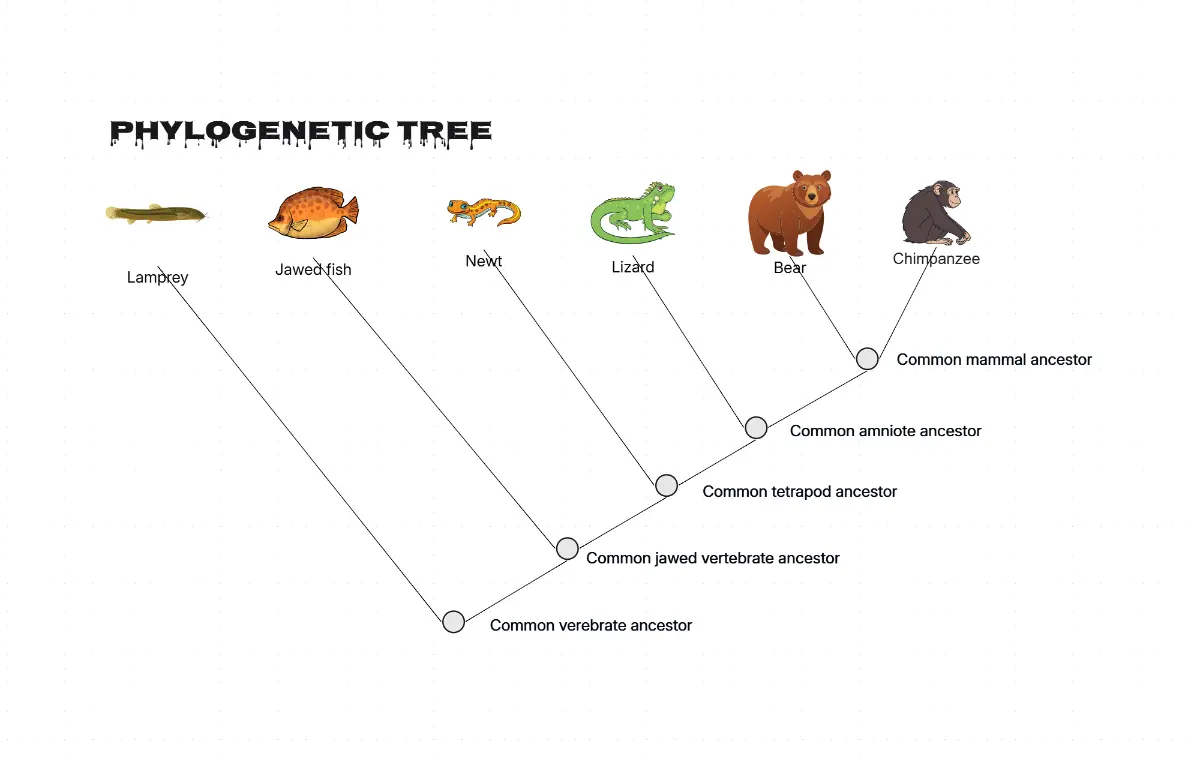
Read the Cladogram and answer:
How are Chimps and Bears related?
Which animals have common tetrapod ancestors?
What is the youngest animal present?
Common mammal ancestor
Newt, Lizard, Bear, and Chimp
Chimp
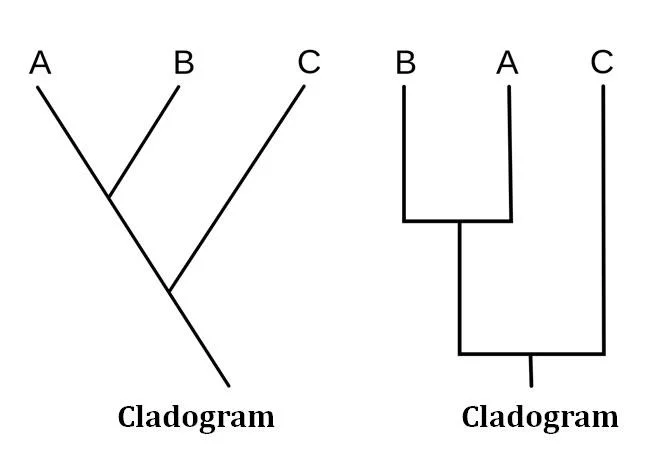
Read the Cladogram and answer for the RIGHT SIDE ONLY:
Which are the most related
Which one is the youngest
Is C related to B
A and B
Trick Question: they’re all the same age (im rly funny)
Yes, through the node on the bottom
Good luck - this is the end of the slides unless u decided to click shuffle, so keep going if u shuffled the cards.
Final stretch, last test; get a good grade so u don’t take the final. U got it. I believe.