Pericyclic reactions
 Call Kai
 Learn
Learn Practice Test
 Spaced Repetition
 Match
Match Flashcards
 Knowt Play
1/51

There's no tags or description
Looks like no tags are added yet.
Name | Mastery | Learn | Test | Matching | Spaced | Call with Kai |
|---|
No analytics yet
Send a link to your students to track their progress
52 Terms
What are pericyclic reactions?
The concerted processes in which bond orbitals overlap in a continuous cycle in the transition state, forming the product.
There is no preferred direction of electron movement.
The orbitals form a ring, overlapping to form the continuous cycle.
How do you determine the phases of orbitals?
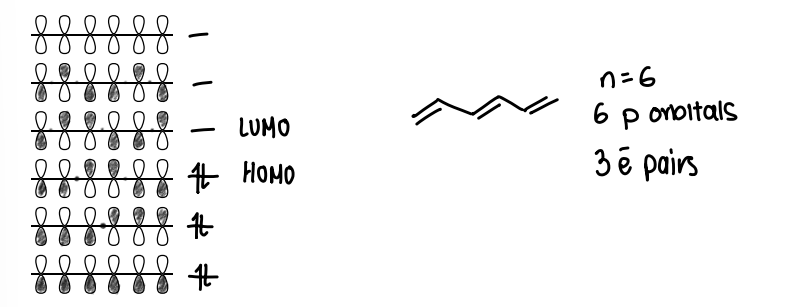
For an alkene with n amount of p-orbitals, draw n horizontal lines to act as MOs.
On each line, draw n amount of p-orbitals with an increasing number of nodes, each MO must be symmetric or anti-symmetric.
Shade the p-orbitals, inverting the phase at each node.
Fill the orbitals with electrons, therefore determining the HOMO and LUMO.
How do you determine orbital coefficients?
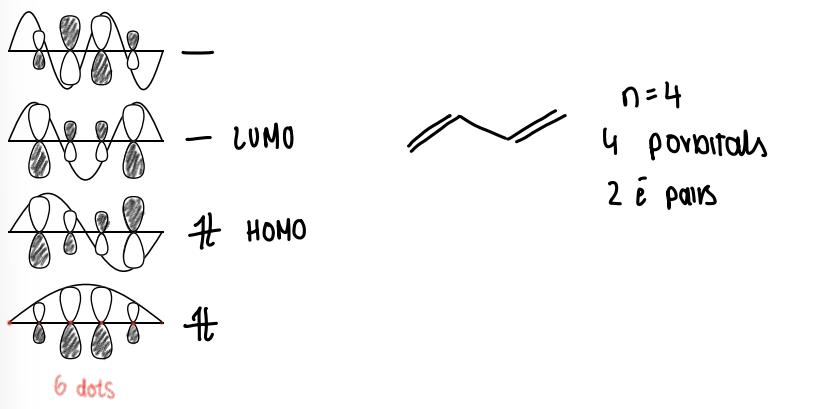
Draw a line with n+2 equally spaced dots.
Superimpose sine waves onto the lines so that they start and end at the terminal dots.
The number of times the sine waves cross the line increases incrementally.
The height of the p-orbitals on each dot equals the size of the orbital coefficient.
The phase is inverted at each node (where the wave crosses the line).
What does the orbital coefficient show?
It is a reflection of electron density on the corresponding atom.
How do you find orbital coefficients for substituted polyalkenes?
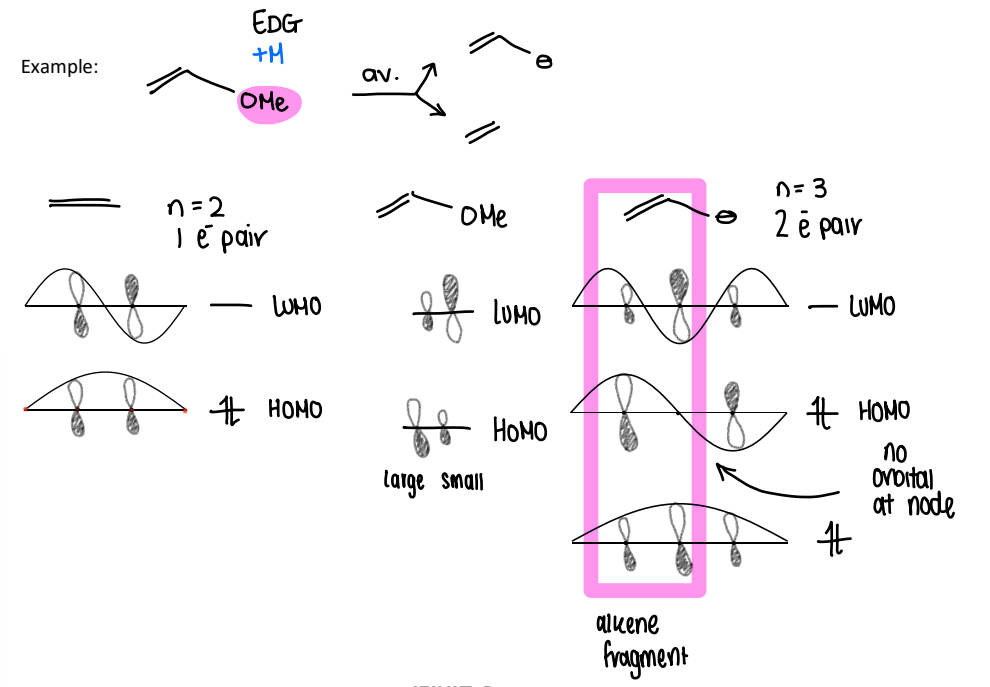
Replace the substituent with:
A CH2+ group for EWG.
A CH2- group for EDG.
Determine the orbital coefficient as normal.
The HOMO and LUMO coefficients are assumed to be the average between the unsubstituted compound and the alkene fragment with the CH2+/CH2- group.
The alkene fragment is the first 2 orbitals that correspond to the double bond.
How do EDG/EWG affect the energies of the HOMO/LUMO?
The EDG adds electrons to the orbitals, therefore making it easier to remove them. The HOMO and other orbitals tend to increase in energy.
The EWG remove electrons from the orbitals, making it easier to add new ones. The LUMO tends to decrease in energy.
What is conservation of orbital symmetry?
The symmetry of the orbitals with respect to any symmetry operations of the molecule must be conserved in moving from starting material to product.
The sigma1 and sigma2 planes of symmetry must be retained.
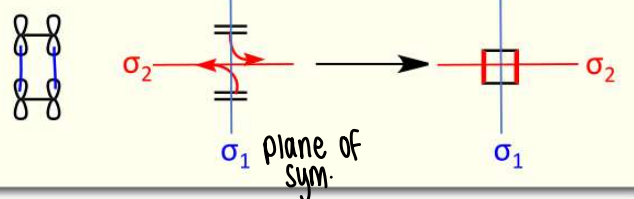
How are orbital symmetries conserved in molecular orbitals?
The bonding orbitals can be antisymmetric or symmetric down the two planes of symmetry, they must form MOs which retain their symmetry.
MOs with no nodes form bonding orbitals, MOs with nodes form the antibonding orbitals as they are unfavourable.
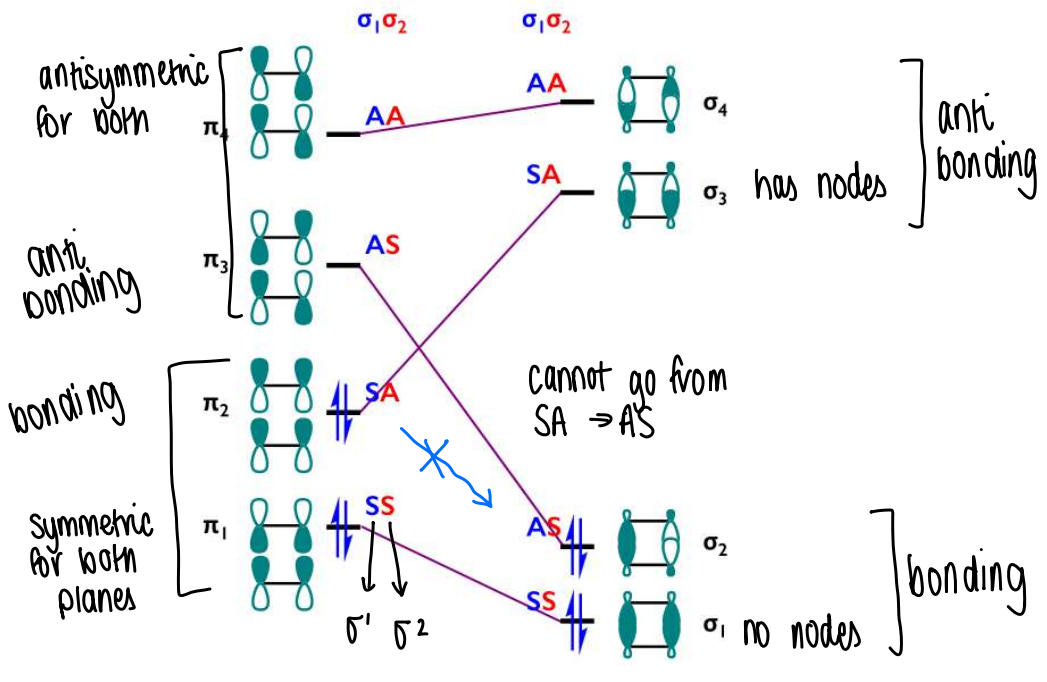
How is the frontier MO approach used to determine if a reaction is allowed?
Draw a curly arrow mechanism.
Work out which component will use HOMO and which will use LUMO for overlap.
Determine the phases of overlapping orbitals.
Phases of orbitals forming new bonds should match, however rotation may be needed to allow overlap.
If the orbitals rotate in the same direction to overlap with the same phase, the reaction is symmetry allowed.
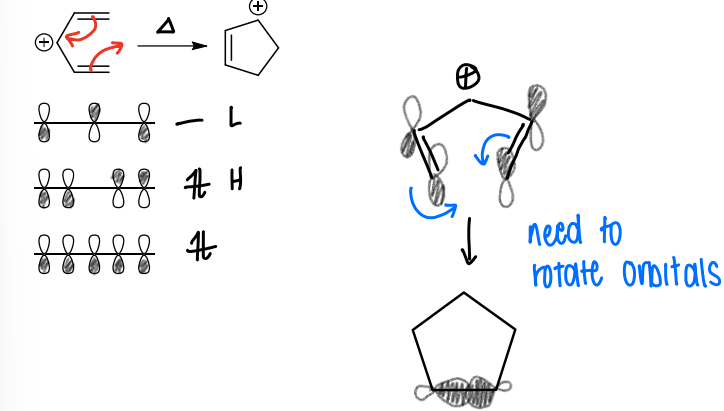
What are the Woodward-Hoffman rules for thermal reactions?
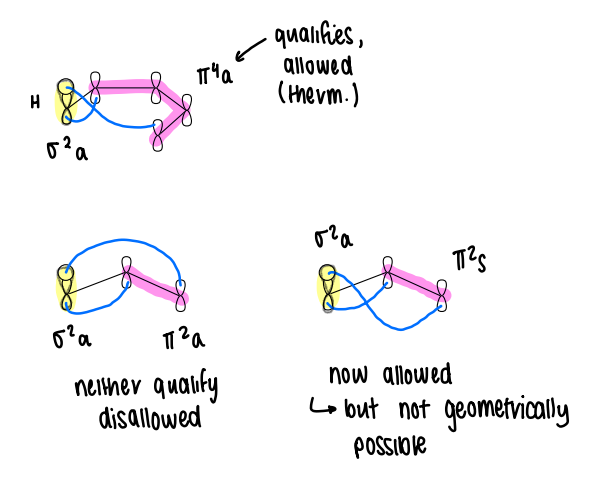
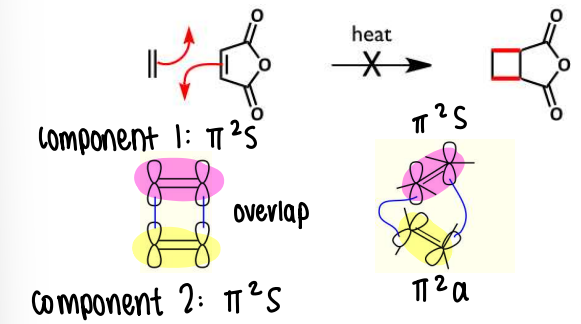
A thermal pericyclic reaction is symmetry allowed if (4q+2)s + (4r)a is an odd number.
s= suprafacial components, a= antarafacial components.
The (4q+2) components are allowed as multiples of 4+2.
The (4r) components are allowed as multiples of 4.
Components are continuous groups of connected atoms with the same type of reacting orbitals (sigma or pi).
What are suprafacial components?
Where the reaction occurs on the same face of the component.
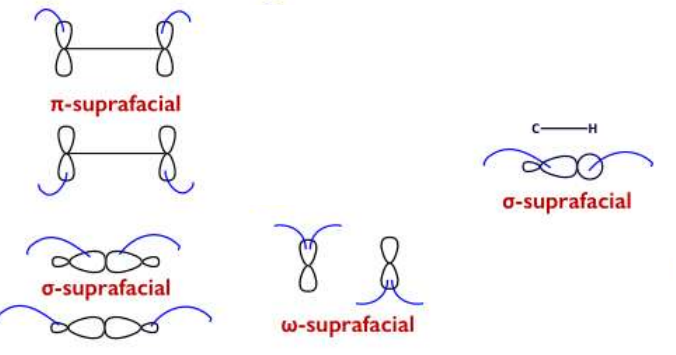
What are antarafacial components?
Where the reaction occurs on opposite faces of the component.
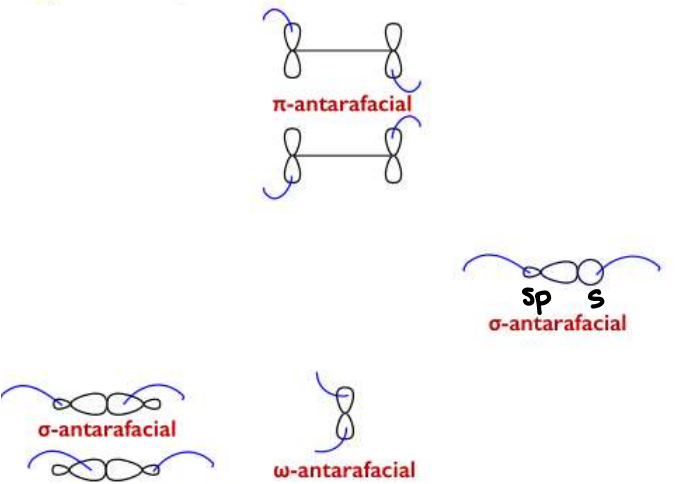
How are the Woodward-Hoffman rules applied to determine if the reaction is allowed?
Draw the curly arrow mechanism and identify components.
Draw a 3D shape to show overlapping components.
Label components as supra or antarafacial.
Apply the rules.
What are the Woodward-Hoffman rules for a photochemical reaction?
It is symmetry allowed if (4q+2)s+(4r)a is an even number
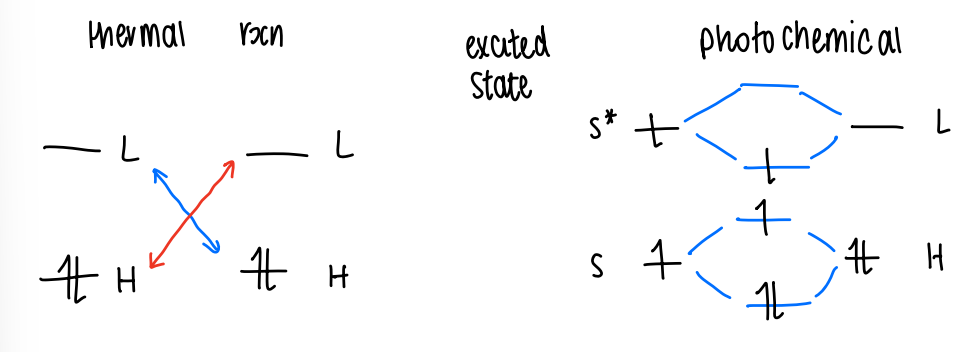
What are the differences in the orbital interactions in thermal and photochemical reactions?
In a thermal reaction there is interaction between the HOMO and LUMO orbitals.
Photochemical reactions have interactions between the SOMO (singly occupied MO) and the HOMO and LUMO.
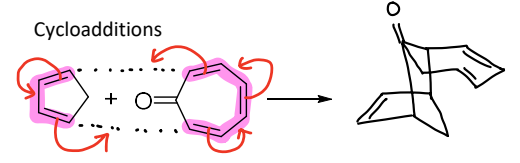
What are cycloadditions?
Two cyclic molecules react to form a single molecule.
What are electrocyclic reactions?
An unsaturated molecule reacts with itself to form a cyclic molecule.
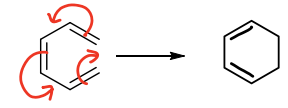
What are sigmatropic rearrangements?
A bond is broken, allowing the formation of a new bond.
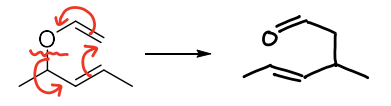
What are group transfer reactions?
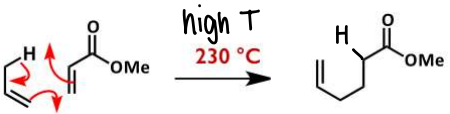
A reaction in which one group of atoms is moved to another part of the same molecule or a different molecule.
Usually at high T.
E.g. alder-ene reaction
Are pericyclic reactions reversible?
Most are reversible- the rules can be used in either direction.
What is the nomenclature for cycloadditions?
[m+n], where m and n are the number of electrons in each component.
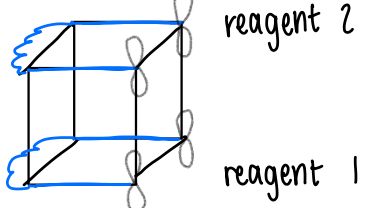
How do you draw a pericyclic reaction mechanism?
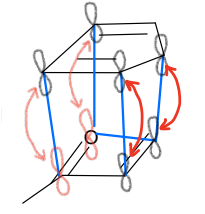
It is best to draw the reactants on opposite sides of a cube to display the overlap of the orbitals.
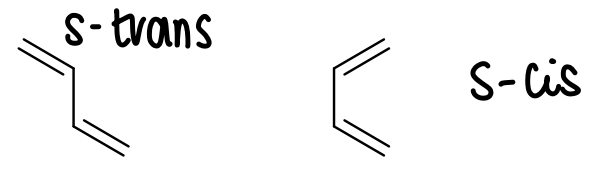
What is the difference in reactivity of s-cis and s-trans dienes in diels-alder reactions?
The s-trans conformer is more stable, but is unreactive.
The s-cis allows overlap of the orbitals, therefore it is the reactive conformation.
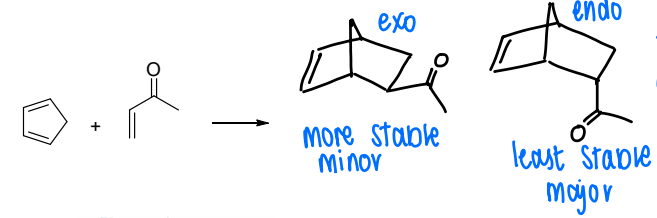
What are exo and endo products?
Endo = pointing “under” / towards the main π system. This is the least stable but major product in this reaction.
Exo = pointing “outward” / away from the π system. This is the most stable but minor product.
What are secondary interactions?
Favourable interaction of orbitals not in the reacting components which can lead to the formation of the major product.
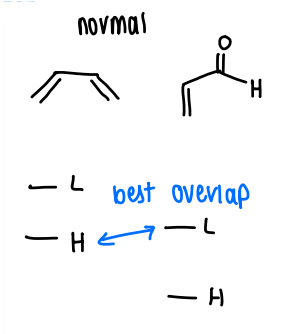
What are ‘normal’ electronic demand diels-alder reactions?
The reaction is accelerated by electron withdrawing groups on the dieneophile and electron donating groups on the diene.
This means the alkene provides the LUMO and the diene provides the HOMO.
What are inverse electronic demand diels-alder reactions?
They are rare, requiring electron donating groups on the dieneophile and electron withdrawing groups on the diene.
The alkene therefore provides the HOMO and the diene provides the LUMO.
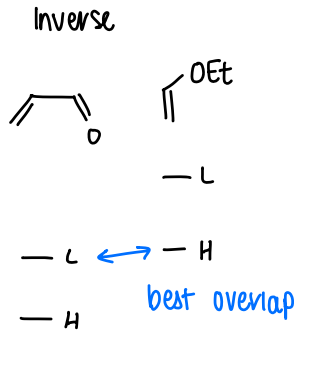
How are Lewis acid catalysts used for pericyclic reactions?
The catalyst reduces electron density on the alkene, therefore lowering the LUMO and HOMO energies, giving better orbital overlap.
The AlCl3 chelates to the oxygen lone pairs.
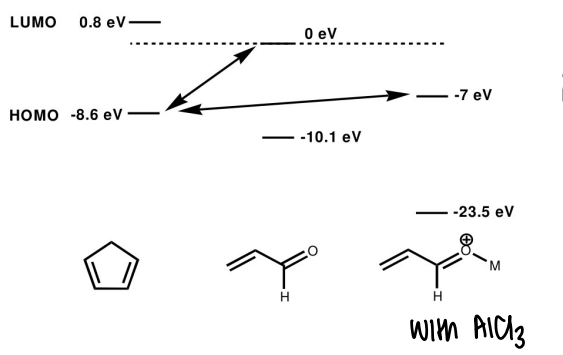
Why is a stoichiometric amount of the LA catalyst used?
The complexation to the metal is reversible, therefore an exact amount is not needed.
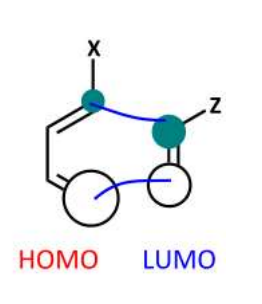
How do substituents effect regiochemistry of diels-alder reactions?
Favourable overlap occurs between similar sized orbitals, e.g. orbitals with larger coefficients have more favourable overlap.
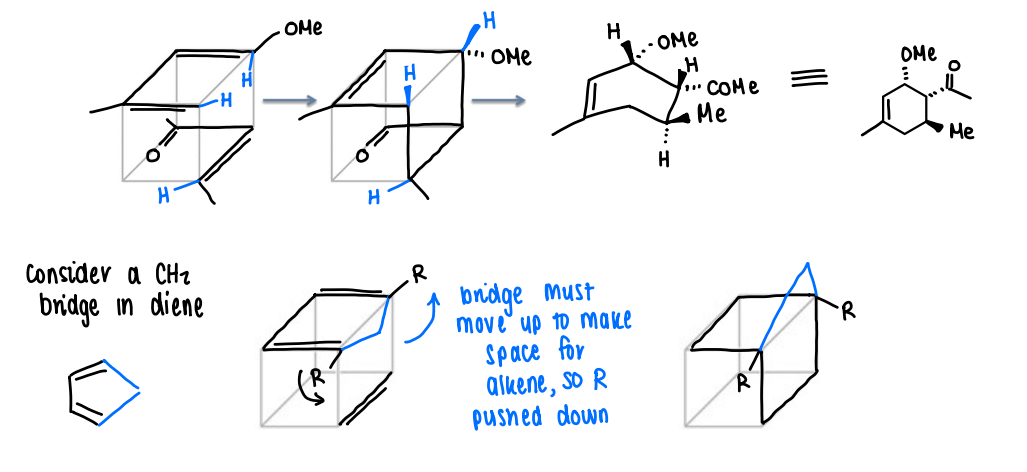
How can stereochemistry be predicted with the cube model?
The formation of the new bonds between the two molecules causes the substituents to be pushed up/down to accommodate.
E.g. a bridge must move up to make space for the alkene to bond, so the R groups are pushed down.
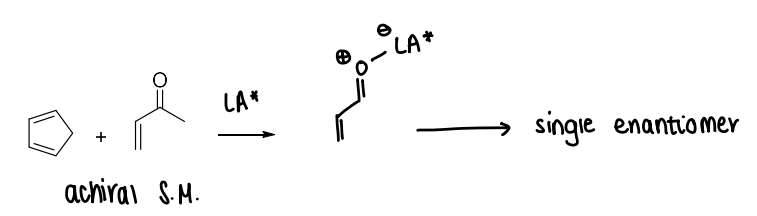
How do you form a single enantiomer?
Use a chiral lewis acid catalyst, the reactant must have a lone pair to coordinate to the LA.
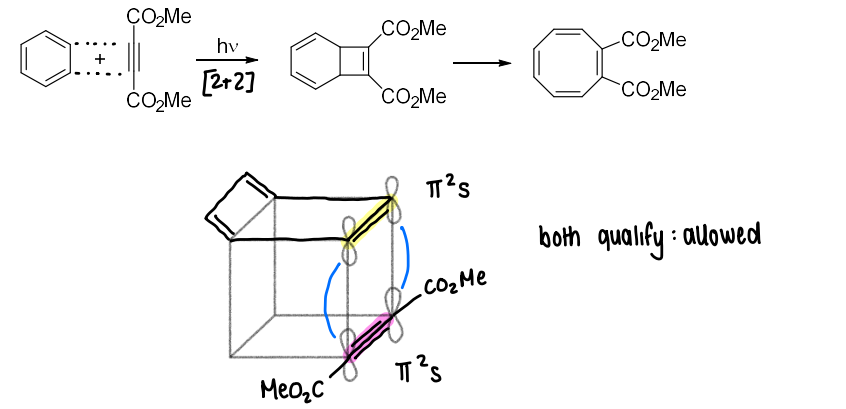
When are [2+2] reactions allowed?
When they occur photochemically as Woodward-Hoffman rules are reversed.
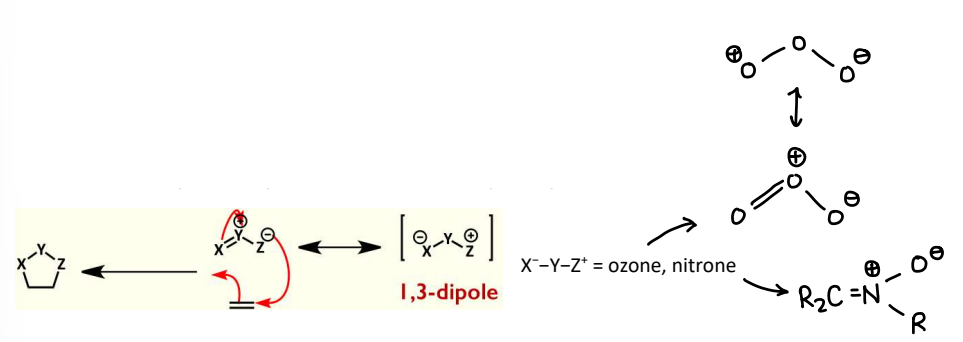
What are 1,3-dipole cycloadditions?
The addition of a 1,3-dipolar compound with an alkene.
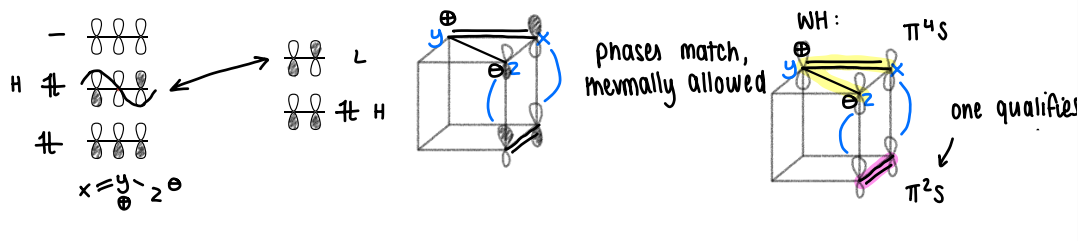
How are 1,3-dipolar cycloadditions shown to be allowed?
Using MO theory, the phases can be seen to match and therefore it is thermally allowed.
Using WH rules, there is only one qualifying component and so it is thermally allowed also.
What are [2+2+2] cycloadditions?
Additions between three components containing 2 p orbitals interacting.
The three components interact in a ring.
The p orbitals must rotate to form a horizontal sigma bond
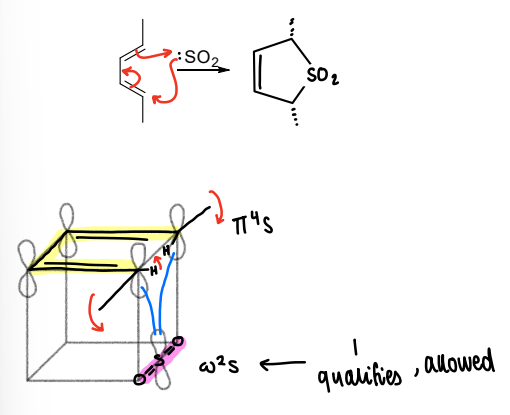
What are cheletropic reactions?
Cycloadditions with two sigma bonds formed/broken to the same atom.
The SO2 molecule can be displayed on one side of the cube.
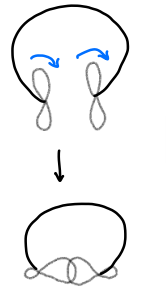
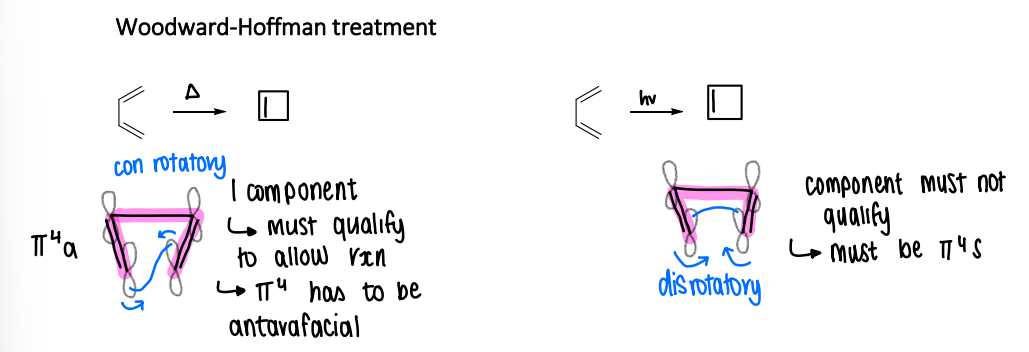
What is conrotatory movement?
The orbitals rotate in the same direction to overlap.
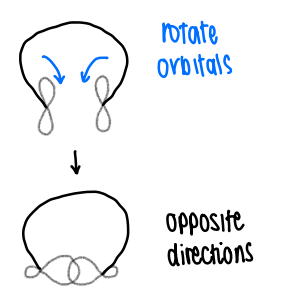
What is disrotatory movement?
The orbitals rotate in different directions to overlap.
What are electrocyclisations?
Reactions in which the orbitals must rotate in order to react.
May be geometrically constrained.
How is frontier MO theory used to describe electrocyclisations?
Use HOMO for thermal reactions and SOMO* for photochemical reactions to determine the phases.
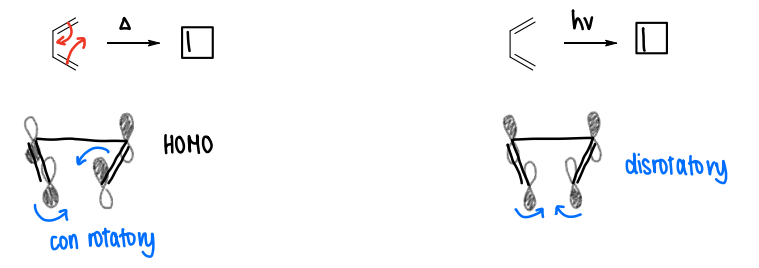
How are Woodward-Hoffman rules used to describe electrocyclisation?
Use the rules to determine how many components must qualify to allow the reaction, therefore determining whether the components should be antarafacial or suprafacial.
Rotate to allow this interaction.
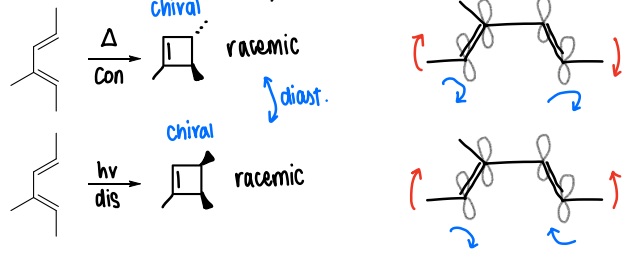
How do electrocyclisations form different stereoisomers?
The rotation of the orbitals causes the rotation of the substituents connected to these atoms.
Are electrocyclisations reversible?
The reversibility depends on the relative rates of the forward and backward reactions, many are reversible although equilibrium is hard to achieve.

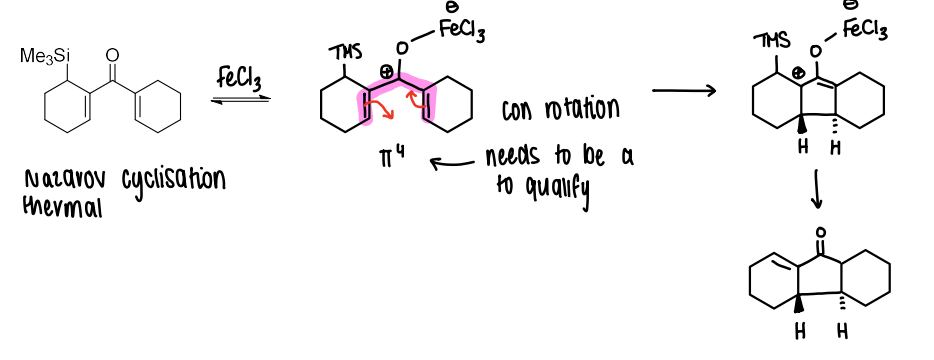
What is the Nazarov cyclisation?
FeCl3 is used as a catalyst, coordinating to the carbonyl.
This is allowed thermally.
What are sigmatropic rearrangements?
The migration of a sigma bond from one end of a pi system to the other.
[m,n], where m and n are the number of atoms from the point of breakage to the end of the molecule. m refers to the atoms towards the double bond.
![<p>The migration of a sigma bond from one end of a pi system to the other.</p><p>[m,n], where m and n are the number of atoms from the point of breakage to the end of the molecule. m refers to the atoms towards the double bond.</p>](https://assets.knowt.com/user-attachments/aaaca241-5336-4e77-a53f-c480f21f0dc2.png)
What are Cope rearrangements?
The movement of the double bonds in a molecule.
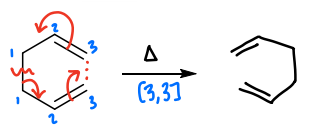
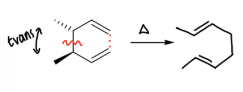
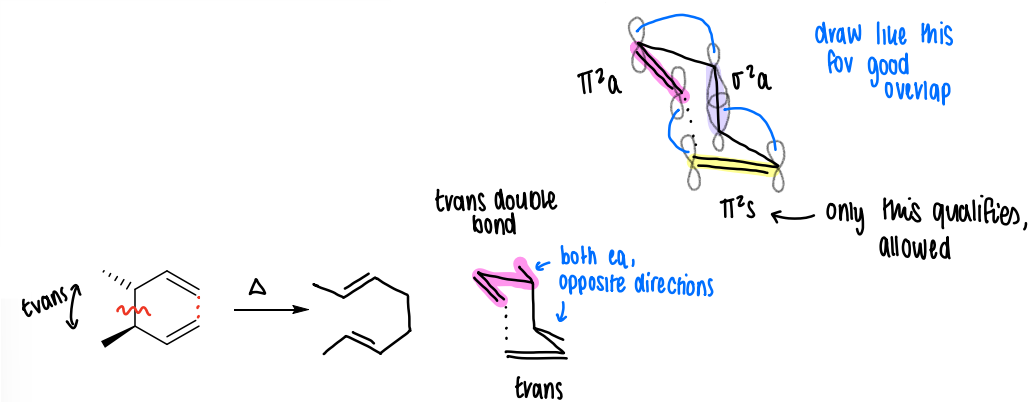
How can a Cope rearrangement be drawn to display good overlap?
Draw as a chair-like state.
This shows the stereochemistry of the substituents, if both are equatorial they are going in opposite directions.
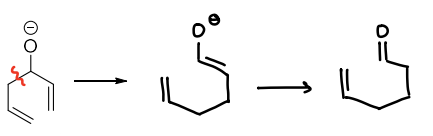
What are oxy-Cope rearrangements?
Similar to Cope, but an oxygen is located on the end of the molecule. The rearrangement forms a carbonyl.
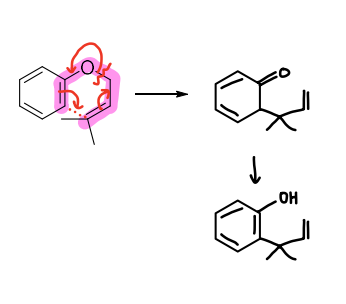
What are Claisen rearrangements?
There is an oxygen located in the chain, forming a carbonyl.
This can then be further reacted to form an alcohol.
What are hydride shifts?
The movement of a hydride from one section of a molecule to the other.
Usually [1,5]
How can hydride shifts be drawn to display orbital overlap?
Can use MO rules/WH rules to determine if allowed.
The hydride orbital is represented by an sp hybrid orbital which can interact via antarafacial or suprafacial overlap.