8. B1.1 Carbohydrates and lipids
 Call Kai
 Learn
Learn Practice Test
 Spaced Repetition
 Match
Match Flashcards
 Knowt Play
1/34

There's no tags or description
Looks like no tags are added yet.
Name | Mastery | Learn | Test | Matching | Spaced | Call with Kai | Chat |
|---|
No analytics yet
Send a link to your students to track their progress
35 Terms
Main groups of biomolecules
Carbohydrates
Monosaccharides
Glucose
Galactose
Fructose
Ribose
Disaccharides
Maltose (glu + glu)
Lactose (galact. + galact.)
Sucrose (glu +fruct.)
Polysaccharides
Starch
Glycogen
Cellulose
Chitin
Proteins
E.g molecules
Enzymes
Antibodies
Peptide hormones
Lipids
Triglycerides
Fat stored in adipose cells
Phospholipids
Lipids forming a bilayer in cell membranes
Nucleic acids (DNA and RNA)
Steroids
Nucleotides
DNA
RNA
ATP
Carbon
Carbon compounds referred to as the building blocks of life
Carbon atoms has 4 electrons in its 2nd electron shell and can form 4 covalent bonds (borrows), allowing for a variety of stable compounds to exist
Covalent bonds
A type of bond in which a pair of electrons are shared between 2 neighbouring atoms.
Strongest bonds found in biomolecules
Provide stability
Only broken during specific chemical reactions with other molecules
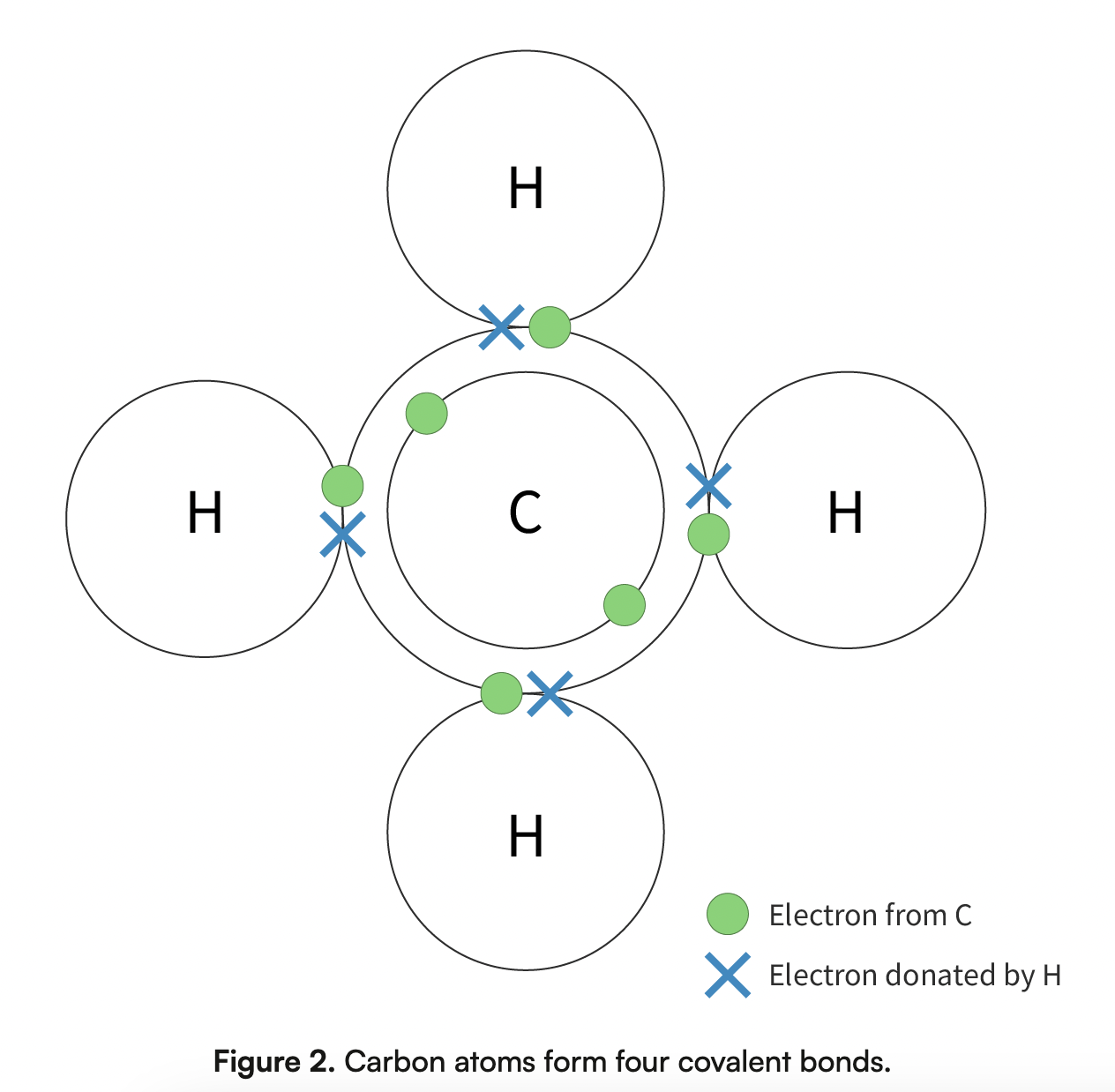
Covalent bonds formed by carbon
Carbon can form different types of covalent bonds with other carbon atoms or other types of atoms.
Giving rise to different forms
linear chain
branched chain
rings (cyclic) structures
Macromolecules
large molecules made up of smaller molecules called monomers
relative atomic mass of above 10,000 atomic units
Condensation / polymerisation reaction
chemical reaction that links one monomer to another
by-product of the reaction is water (removal)
catalysed by enzymes
E.g triglyceride formation
1 glycerol, 3 fatty acids
3 ester bonds formed
3 water molecules released
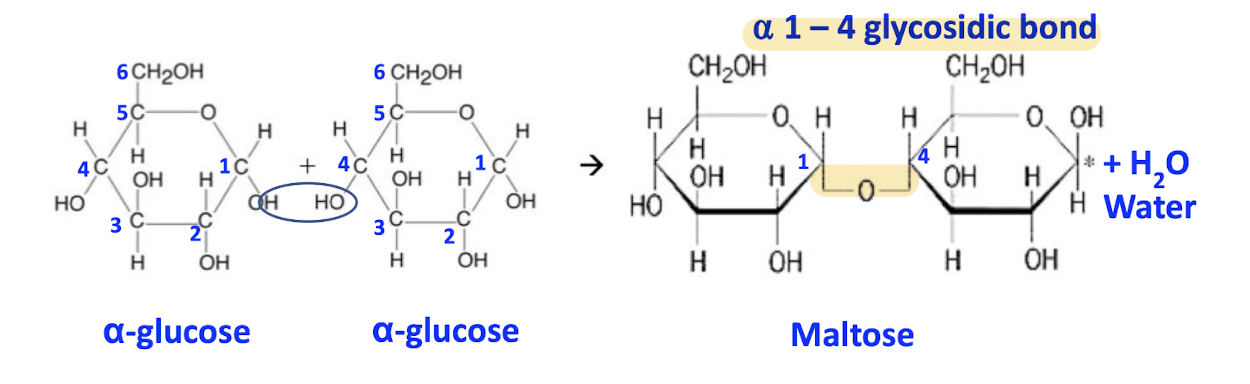
E.g maltose formation
1 glucose, 1 glucose
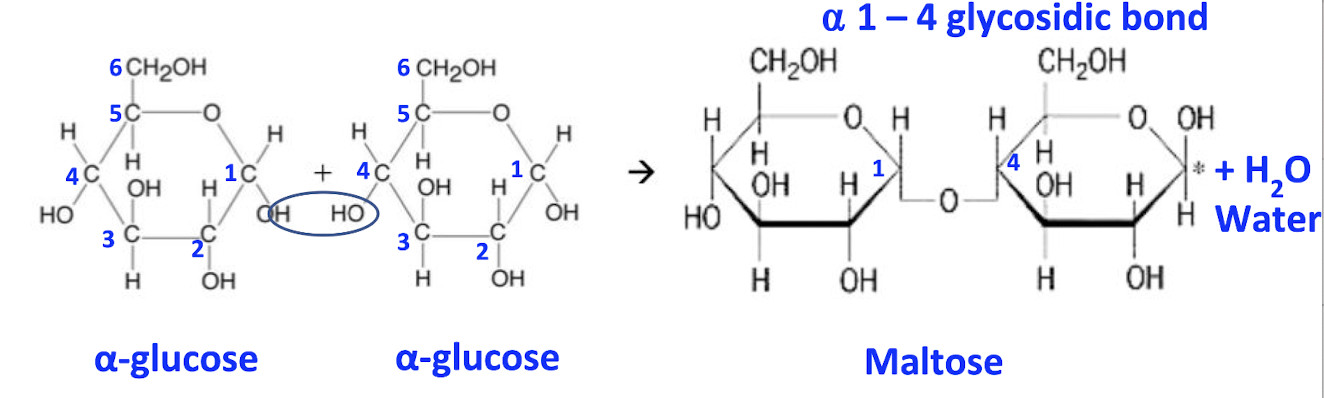
OH group on carbon-1 of one glucose attacks the -OH group on carbon-4 of the other glucose molecule
carbon-x, x is the position of the carbon in the compound in a clockwise direction!
1,4-glycosidic bond is formed
1 water molecule released
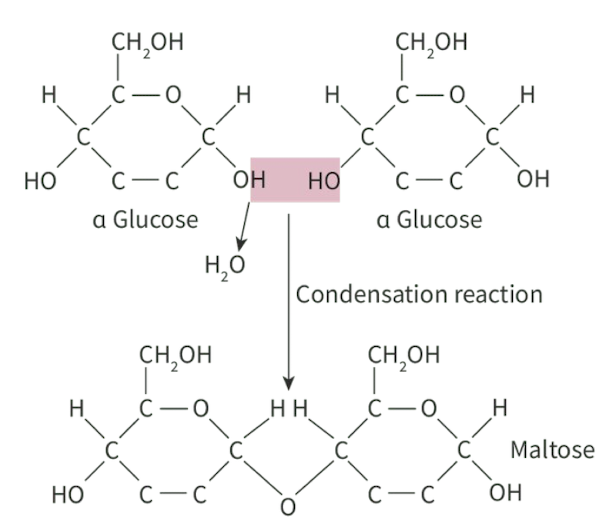
Label α-glucose on left side of eqn
Number the carbon atoms (6th is projected out)
Box up the hydroxyl group of the carbon-1 and carbon-4 atoms
Circle 2 H atoms and 1 O atom on the left that will form water molecule
Label maltose molecule
Add 1 water molecule on the product / right side of eqn
Name the bond formed
Hydrolysis (digestion)
Digestion of polymers can occur in
all cells as they can produce enzymes
in the gut of animals as enzymes are secreted
decomposers release enzymes into their environment to hydrolyse polymers around them so that they can absorb monomers
Hydrolysis requires water (add) and enzymes
Monosaccharides
Single unit of carbohydrate
Usually have 3 to 7 carbon atoms
Classified by the no. of carbon atoms they contain
Pentoses (5 carbon atoms) e.g ribose
Hexoses (6 carbon atoms) e.g glucose, galactose, fructose
Glucose
Hexose sugar
Formula: C6H12O6
Can exist in ring form or linear
2 isomers
α-glucose (alpha-glucose)
β-glucose (beta-glucose)
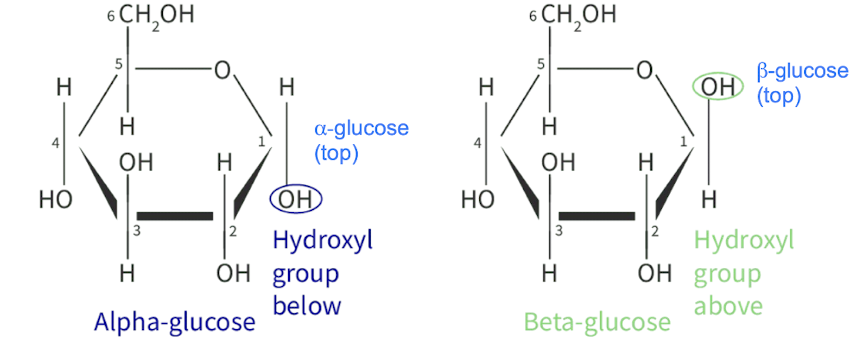
D-glucose and L-glucose
Difference is positioning of the 3 hydroxyl groups & 1 hydrogen group
D-glucose
RIGHT
L-glucose
LEFT
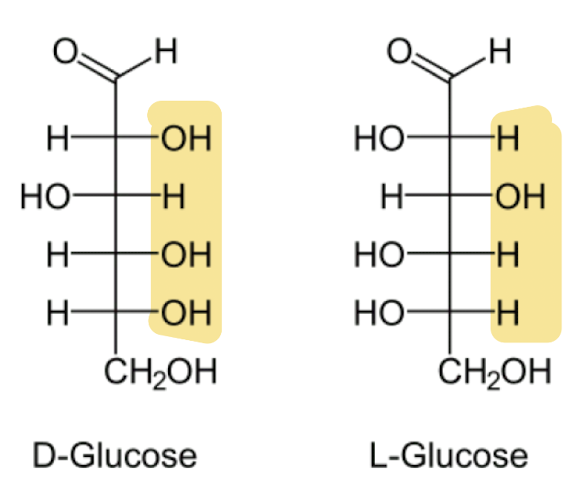
D-glucose and L-glucose
•α-L-glucose is the mirror image of α-D-glucose.
•β-L-glucose is the mirror image of β-D-glucose.
•*the “mirror” would be the plane of the ring, hence the oxygen and the carbon atoms do not change positions
Form and function of glucose
solubility in water
function an energy storage molecule
monomer / building block for polymers / polysaccharides
Solubility of glucose
Glucose is a polar molecule (i.e. having partial positive and negative charges)
Present of – OH groups enables formation of hydrogen bonds with water molecules
Hydrophilic
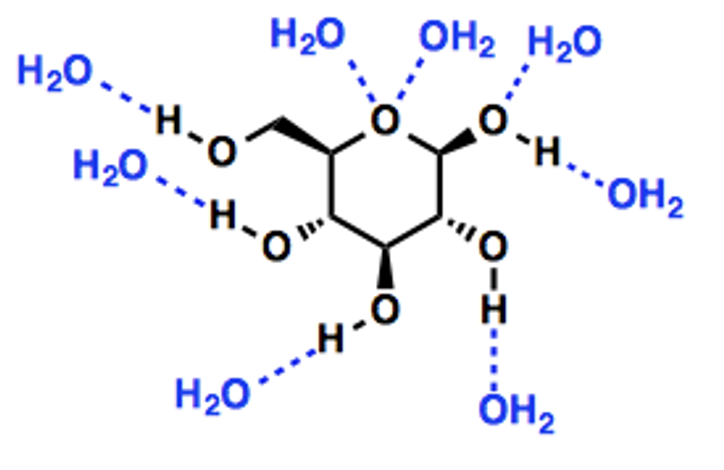
Energy storage
Glucose is a respiratory substrate used by most cells for cellular respiration to produce ATP for various functions
Energy stored in the C-C (carbon-carbon) and C-H (carbon-hydrogen) bonds of glucose
One molecule of glucose can produce a large amt. of ATP energy
water and carbon dioxide are the by-products
What are the components of starch?
2 polysaccharides
amylose
amylopectin (major component)
they are both composed of alpha-glucose monomers
Amylose and amylopectin allow more glucose molecules to be stored in a fixed volume
What are the characteristics of amylopectin?
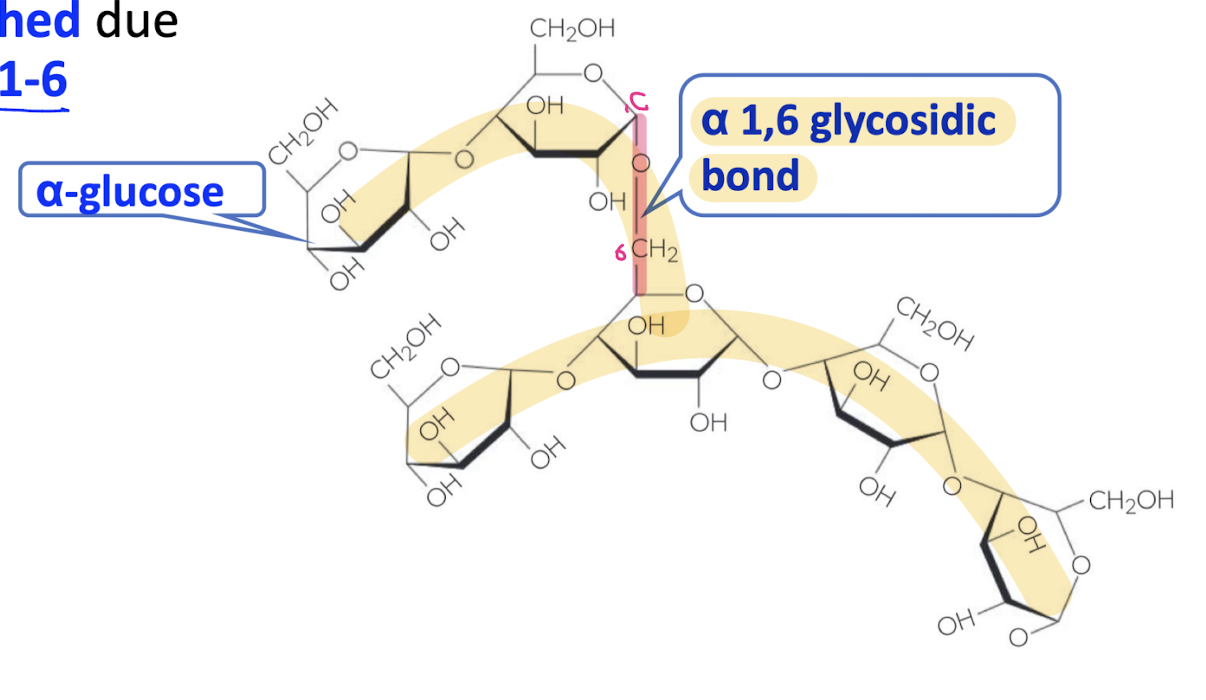
branched due to the presence of alpha 1-6 glycosidic bonds
Storage of starch
in specialised plant structures (seeds, roots etc.)
starch is compact in structure due to its coiling and branching during polymerisation
allows for efficient storage in a small space
Amylose and amylopectin are relatively insoluble
large molecular size
maintain osmotic balance within organism
How is starch utilised?
plant in need of glucose
starch is broken down through hydrolysis
releases glucose molecules
glucose used as a source of energy
to carry out various cellular processes such as growth and photosynthesis
What is glycogen?
primary storage form of glucose in animals and yeast
relatively insoluble
large molecular size
helps maintain osmotic balance within an organism
found in the liver and muscles of animals
What are the components of glycogen?
monomer: alpha-glucose
joined by alpha 1-4 glycosidic bonds and alpha 1-6 glycosidic bonds
branched
more so than amylopectin despite being structurally similar
compact, enabling efficiency
Where is glycogen stored and how is it utilised?
liver
when blood glucose levels dropped
break down glycogen by hydrolysis
release glucose molecules into the bloodstream
muscle cells
store glycogen primarily to provide energy for muscle contraction during exercise
when energy is needed
glycogen broken down into glucose molecules which can be used for cellular respiration (produces energy by breaking down glucose, to generate ATP)
Draw the condensation reaction to form maltose from glucose
label the type of glucose molecules on the left side of the equation
number the carbon atoms of the 2 glucose atoms on the left
the condensation reaction involves the hydroxyl group of carbon -4 and the hydroxyl group of carbon 1 that are closest to each other — highlight these hydroxyl groups (-OH)
Circle 2Hs and 1O on the left side of the equation that will form the water molecule
Complete the equation by adding water on the product side
Label the disaccharide
Name the bond formed
Draw the condensation reaction to form the branch point in glycogen or amylopectin
Label the type of glucose molecules on the left side of the equation
Number the carbon atoms of glucose
The condensation reaction involves the hydroxyl group of carbon -1 and the hydroxyl group of carbon 6 that are closest to each other — highlight these hydroxyl groups (-OH) on the left side of the equation
Circle 2Hs and 1O on the left side of the equation that will form the water molecule
Add water on the product side
Label the bonds (1-4, 1-6)
What is cellulose?
complex polysaccharide that serves a structural function
monomer: Beta-glucose
an essential component of the plant’s cell wall
STRUCTURE:
the molecule of glucose have to be vertically flipped (rotated 180 degrees) in an alternating pattern
allows the OH (hydroxyl group) on carbon-1 and carbon-4 of 2 B-glucose molecules to be closer to each other
H2O molecule is removed, leaving just one O in the middle
allowing the B-1, 4 glycosidic bond is formed
a straight chain
due to alternating orientations of beta-glucose molecules
allows the cellulose molecules to form long, unbranched chains
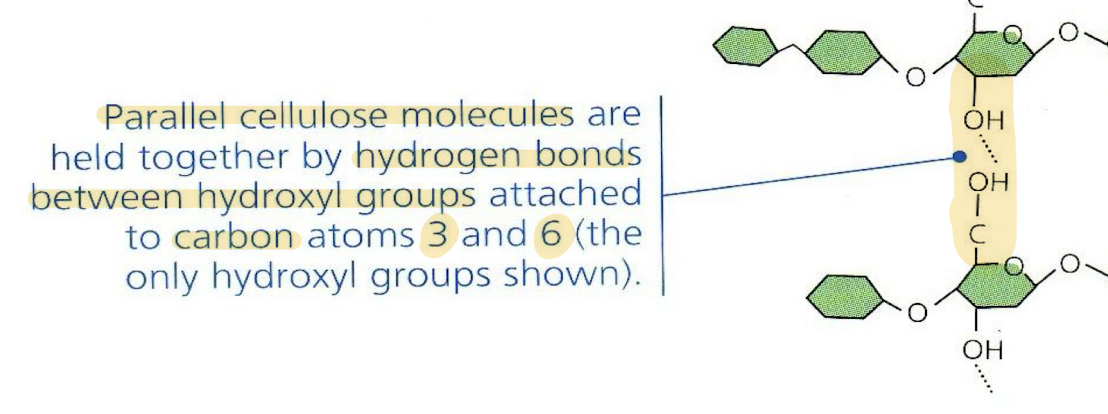
grouped into bundles called microfibrils
The microfibrils are held together by hydrogen bonding that occurs between adjacent cellulose molecules.
FUNCTION:
As a result of the cross-linking of cellulose by hydrogen bonds, these microfibrils have high tensile strength
This tensile strength is critical for its function in plants, where it forms an essential component of the cell wall

What are glycoproteins?
proteins that have one or more carbohydrates attached to them.
found embedded in cell membranes (plasma membrane)
carbohydrate portion of the glycoprotein faces the exterior of the cell
it serves 4 functions
Cell-cell recognition
Receptors
Ligands
Structural support
How does glycoproteins play a part in cell-cell recognition?
Glycoproteins on cell membranes are known as antigens
act as markers on the surface of cells, allowing them to identify each other and interact appropriately.
They are important for immune response
The immune system recognises the body’s cells “self” via antigen-receptor interactions
The immune system can also identify foreign pathogens “non-self” by antigen-receptor interactions
e.g immune cells recognise and attack foreign cells that display different glycoproteins on their surface, such as viruses or bacteria.
Definition of Antigens: An antigen is any molecule, including proteins, lipids, or glycoproteins, that the immune system can react to.
What is the role of glycoproteins in ABO blood groups?
Blood types are categorised by the type of glycoproteins (antigens) on the cell membrane of red blood cells
A and B antigens have an impact on blood transfusion
When incompatible blood types are mixed, the immune system will recognise the other glycoproteins (antigens) as foreign molecules and attack.
Antibodies (Plasma) vs. Antigens (RBC Surface): Your blood plasma contains antibodies against the antigens not present on your red blood cells.
Type A: Contains A-antigens and anti-B antibodies.
Type B: Contains B-antigens and anti-A antibodies.
Type AB: Contains both antigens and no antibodies (universal recipient).
Type O: Contains no antigens but has both anti-A and anti-B antibodies (universal donor)
E.g When incompatible blood is introduced (e.g., Type B blood into a Type A person), the anti-B antibodies immediately bind to the foreign B-antigens. This immune response causes hemolysis (destruction of RBCs) and agglutination (clumping), forming clumps of blood that blocks blood vessels, which may be fatal.


What are the types and properties of lipids?
Lipids = fats (mainly made of C, H and O)
Fats are liquid at body temperature (37 ℃) but solid at room temperature (20 ℃)
Whereas oils are liquid at both body temperature and room temperature
Waxes having melting points above 37 ℃
Cholesterol is another type of lipid
Steroids have a typical 4 ring structure
Properties
non-polar
can dissolve in non-polar solvents
What are the essential structural features of fatty acids?

How are triglycerides and phospholipids formed?


What are the different saturation levels of lipids and how do they come about?
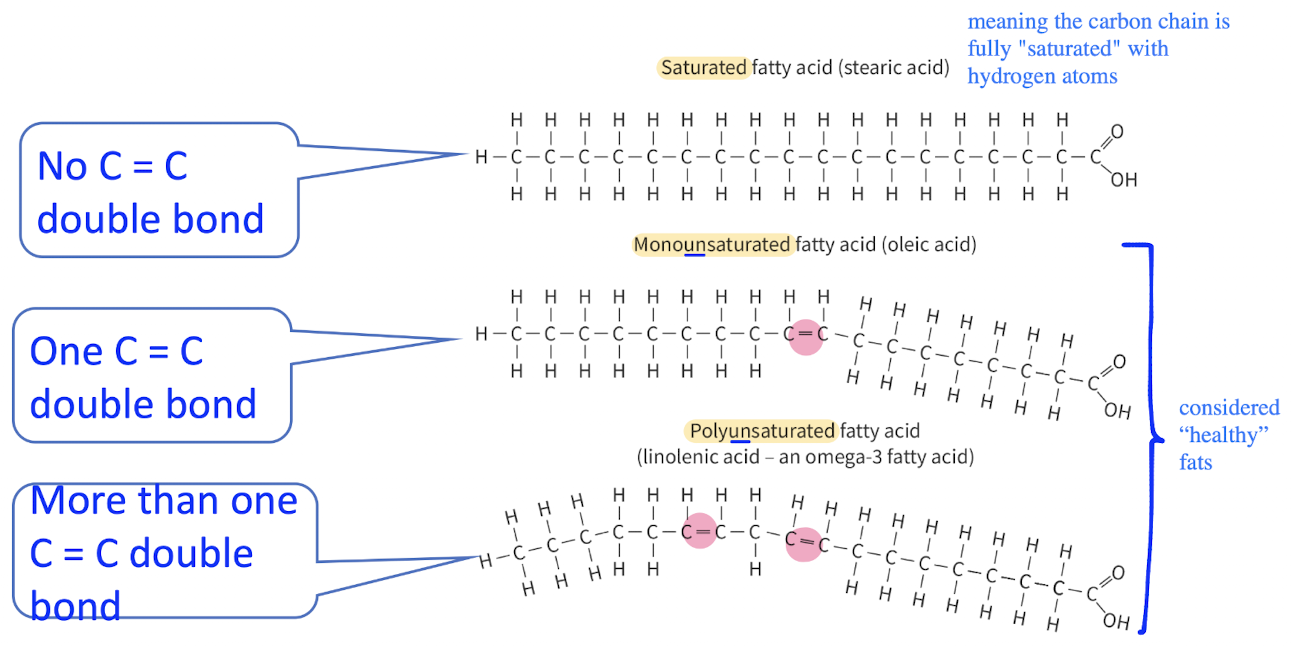
Saturated fatty acids
Function: pack closer to each other, fats made of these chains to have a higher melting point
Unsaturated fatty acids
Function: cannot pack closer to each other, fats made of these chains to have a lower melting point
Unsaturated have diff isomers:
cis isomers
hydrogen atoms are nearly always on the same side of the double bond
trans isomers
hydrogen atoms are on opposite sides of the double bonds

What are the consequences of lipid contents in our diet? (meh)
Diets rich in lipids
may result in obesity
increases risk of Type II diabetes and high blood pressure
Diets low in lipids
insufficient energy from fatty acids
the body uses amino acids from proteins for respiration instead of using them to build muscles and other tissues
Prolonged low-energy diet results in proteins from muscles being broken down into amino acids for energy
What are the functions of lipids in storing energy?
lipids are normally used for long-term energy storage.
The lipids that are used are fats (solid)
They are stored in specialized groups of cells called adipose tissue.
Adipose tissue is located immediately beneath the skin and also around some organs including the kidneys.
Why?
Lipids are chemically stable, so energy is not lost over time
Lipids are more efficient than carbohydrates for long-term energy storage
The amount of energy released in cell respiration per gram of lipids is double the amount released from a gram of carbohydrates.
requires less mass for the same amount of energy which is essential for animals such as birds and bats that fly
Storing lipids is important for animals that hibernate or have to survive long unfavourable seasons
Plants store lipids for energy in seeds and fruits
Fats are hydrophobic—less likely to associate with water in adipose tissue—while glycogen will be associated with water, increasing its overall mass
What are the non-energy storage related functions of lipids? (meh)
Provide thermal insulation
As lipids are poor conductors of heat, used as heat insulators.
This is the reason for much of our stored fat being in sub-cutaneous adipose tissue next to the skin.
Increase buoyancy
e.g blubber in seals as lipids are less dense
Shock absorber
when fats is liquid at body temp
reason why adipose tissue around the kidneys and some other organs.
Metabolic water
is water produced from respiration of lipids
Lipids contain a lot of hydrogen (in the C – H bonds)
During respiration oxygen is combined with hydrogen to produce metabolic water
Supplies water
e.g camel humps
Ability of non-polar steroids to pass through the phospholipid bilayer
the inner region of the phospholipid layer is hydrophobic —> non-polar
Steroids structure
Four fused rings of carbon atoms
Few polar groups, so most steroids are non-polar
Cholesterol
is a steroid
In the phospholipid bilayer: Functions to control the fluidity of the membrane
Hormones
are steroid in nature
E.g. testosterone and estrogen (estradiol)
Hence they are non-polar (hydrophobic)
What happens when they pass through?
