PSYCH- Early Childhood
 Call Kai
 Learn
Learn Practice Test
 Spaced Repetition
 Match
Match Flashcards
 Knowt Play
1/20

There's no tags or description
Looks like no tags are added yet.
Name | Mastery | Learn | Test | Matching | Spaced | Call with Kai |
|---|
No analytics yet
Send a link to your students to track their progress
21 Terms
Changes in Gross and Fine Motor Skills in Early Childhood
Age 2
Gross motor skills:
Can kick a ball without losing balance
Can pick up objects while standing, without losing balance (This often occurs by 15 months. It is a cause for concern if not seen by 2 years).
Can run with better coordination. (May still have a wide stance).
Fine motor skills
Able to turn a door knob
Can look through a book turning one page at a time
Can build a tower of 6 to 7 cubes
Able to put on simple clothes without help (The child is often better at removing clothes than putting them on)
Age 3
Gross motor skills
Can briefly balance and hop on one foot
May walk up stairs with alternating feet (without holding the rail)
Can pedal a tricycle
Fine motor skills
Can build a block tower of more than nine cubes
Can easily place small objects in a small opening
Can copy a circle
Can draw a person with 3 parts
Can feed self easily
Age 4
Gross motor skills
Shows improved balance
Hops on one foot without losing balance
Throws a ball overhand with coordination
Fine motor skills
Can cut out a picture using scissors
Can draw a square
Manages a spoon and fork neatly while eating
Puts on clothes properly
Age 5
Gross motor skills
Has better coordination (getting the arms, legs, and body to work together)
Skips, jumps, and hops with good balance
Stays balanced while standing on one foot with eyes closed
Fine motor skills
Shows more skill with simple tools and writing utensils
Can copy a triangle
Can use a knife to spread soft food
Nutritional Concerns
“Just Right” (or just-so) phenomenon in childhood
• Children desire consistency
• Even slight changes in daily routine can cause the child to be upset
• Familiarity of such ritualistic behaviors seem to bring a sense of security and general reduction in childhood fears and anxiety
Lack of Balanced Diet
• Added sugars and solid fats contribute to 40% of daily calories for children and teens in the US. Approximately half of these empty calories come from six sources: soda, fruit drinks, dairy desserts, grain desserts, pizza, and whole milk (CDC, 2015).
• Young children who grow accustomed to high fat, very sweet and salty flavors may have trouble eating foods that have subtler flavors, such as fruits and vegetables
Tips for establishing healthy eating patterns
• Recognize that appetite varies
• Keep it pleasant
• No short order chefs
• Limit choices
• Serve balanced meals
• Do not bribe
How can we do this realistically?
Piaget’s Preoperational Stage- ages 2-7
• Children use symbols to represent words, images, and ideas, which is why children in this stage engage in pretend play.
• Children also begin to use language in the preoperational stage, but they cannot understand adult logic or mentally manipulate information.
• The term operational refers to logical manipulation of information, so children at this stage are considered pre-operational. Children’s logic is based on their own personal knowledge of the world so far, rather than on conventional knowledge
Piaget’s Preoperational Stage – Pretend Play
The preoperational period is divided into two stages: pretend play
• Symbolic function substage (ages 2 and 4)
• Characterized by the child being able to mentally represent an object that is not present and a dependence on perception in problem solving.
• Intuitive thought substage (ages 4 to 7)
• Marked by greater dependence on intuitive thinking rather than just perception (Thomas, 1979). Children think automatically without using evidence.
• Children ask many questions as they attempt to understand the world around them using immature reasoning.
Piaget’s Preoperational Stage – Perspectives
Egocentrism
• Refers to the tendency of young children not to be able to take the perspective of others, and instead the child thinks that everyone sees, thinks, and feels just as they do.
Conservation
• Refers to the ability to recognize that moving or rearranging matter does not change the quantity.
• Centration refers to focus on only one characteristic of an object to the exclusion of others.
Animism refers to attributing life-like qualities to objects.
Vygotsky’s Sociocultural Theory of Cognitive Development
Zone of proximal development (ZPD)
• Occurs when children can almost perform a task, but not quite on their own without assistance.
Scaffolding
• Refers to the temporary support that parents or teachers give a child to do a task
Vygotsky’s Sociocultural Theory of Cognitive Development - Speech
Egocentric Speech
• Speech that is focused on the child and does not include another’s point of view.
• This occurs when you are struggling with a problem, trying to remember something, or feel very emotional about a situation.
Private Speech (inner speech)
• Children talk to themselves in order to solve problems or clarify thoughts. As children learn to think in words, they do so aloud before eventually closing their lips and engaging in private speech or inner speech.
Children’s Understanding of the World
Theory of mind
• The ability to think about other people’s thoughts. This mental mind reading helps humans to understand and predict the reactions of others, thus playing a crucial role in social development
Diverse-desires
Understanding that two people may have different desires regarding the same object.
Diverse-beliefs
Understanding that two people may hold different beliefs about an object.
Knowledge access (knowledge/ignorance)
Understanding that people may or may not have access to information.
False belief
Understanding that someone might hold a belief based on false information.
Language Development
Vocabulary Growth
A child’s vocabulary expands between the ages of two to six from about 200 words to over 10,000 words. This “vocabulary spurt” typically involves 10-20 new words per week and is accomplished through a process called fast-mapping
Fast-mapping
• Words are easily learned by making connections between new words and concepts already known.
Overregularization
• Children learn rules of grammar as they learn language but may apply these rules inappropriately at first. For instance, a child learns to add “ed” to the end of a word to indicate past tense. Then form a sentence such as “I goed there. I doed that.” This is typical at ages two and three. They will soon learn new words such as “went” and “did” to be used in those situations
Erikson’s 3rd Stage
Initiative versus guilt
• Children use perceptual, motor, cognitive, and language skills to make things happen.
• Children exuberantly move out into wider social world on their own initiative.
• Initiative and enthusiasm may bring guilt, which lowers self-esteem.
To reinforce taking initiative, caregivers should offer praise for the child’s efforts and avoid being critical of messes or mistakes. Placing pictures of drawings on the refrigerator, purchasing mud pies for dinner, and admiring towers of legos will facilitate the child’s sense of initiative.
Self-Control
Delayed Gratification
• The ability to hold out for a larger reward by forgoing a smaller immediate reward
“Marshmallow Test”: children are confronted with the choice of a small immediate reward (a marshmallow) and a larger delayed reward (more marshmallows).
Walter Mischel and his colleagues over the years have found that the ability to delay gratification at the age of four predicted better academic performance and health later in life (Mischel, et al., 2011).
Gender
Gender Identity
• A person’s sense of self as a member of a particular gender
Gender Roles
• The expectations associated with being male or female, are learned in one’s culture throughout childhood and into adulthood
Theories of Gender Development
Social Learning Theory
• Behavior is learned through observation, modeling, reinforcement, and punishment (Bandura, 1997).
Gender Schema Theory
• Children develop their own conceptions of the attributes associated with maleness or femaleness.
• Once children have identified with a particular gender, they seek out information about gender traits, behaviors, and roles
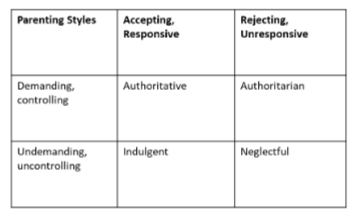
Baumrind’s Parenting Styles- Response vs. Control
Authoritarian
• Parents exhort child to follow directions and respect their work and effort
• Allows little verbal exchange
• Associated with children’s social incompetence
• Linked to child’s higher level of aggression
Authoritative
• Encourages children to be independent but still places limits and controls on their actions
• Extensive verbal give-and-take is allowed
• Associated with children’s social competence
• Children are more prosocial
Neglectful
• Parent is uninvolved in the child’s life
• Associated with children’s social incompetence and lack of self-control
• Children externalize problems
Indulgent
• Parents are highly involved with their children but place few demands or controls on them
• Associated with children’s social incompetence and lack of self-control
• Associated with children not respecting others
• Children may be domineering, egocentric, noncompliant, and have difficulties in peer relations
Sibling Relationships
Important characteristics
• Emotional quality of the relationship
• Familiarity and intimacy of the relationship
• Variation in sibling relationships
Birth order
• Compared with later-born children, firstborn children have been described as more adult-oriented, helpful, conforming, and self-controlled.
• Only children often are achievement-oriented.
Parten’s Classification of Types of Play in Preschool Children
Unoccupied Play
Children’s behavior seems more random and without a specific goal. This is the least common form of play.
Solitary Play
Children play by themselves, do not interact with others, nor are they engaging in similar activities as the children around them.
Onlooker Play
Children are observing other children playing. They may comment on the activities and even make suggestions but will not directly join the play.
Parallel Play
Children play alongside each other, using similar toys, but do not directly act with each other.
Associative Play
Children will interact with each other and share toys but are not working toward a common goal.
Cooperative Play
Children are interacting to achieve a common goal. Children may take on different tasks to reach that goal
Match the Motor Skills with the appropriate age
Skips, jumps and hops with good balance
Age 5
Can build a block tower of more than 9 cubes
Age 3
Able to put on simple clothes without help
Age 2
Hops on one foot without losing balance
Age 4
Match the Preoperational Stage with the appropriate term
Focus on only characteristic of an object to the exclusion of others
Centration
Not being able to take the perception of others
Egocentrism
Attributing life-like qualities to objects
Animism
Match the descriptions and components of Theory of Mind
Two different desires regarding the same object
Diverse-desires
Two people may hold different beliefs about an object
Diverse-beliefs
People may not always express their true emotions
Hidden emotion
Belief based on false information
False Belief
People may or may not have access to information
Knowledge access (knowledge/ignorance)
Match each concept with the appropriate parenting style.
Disengaged from child with non-responsive demands
Uninvolved
Maturity demands on children are unreasonable high
Authoritarian
Expectations of children are below what is reasonable respected of them (Regina George's mom)
Permissive
Supportive parenting with the allowance of constructive mistakes
Authoritative
Match the description with the appropriate category of types of play.
Observing but not joining the play
onlooker play
Behavior is random without a specific goal
unoccupied play
Interaction to achieve a common goal
cooperative play
Playing alone and not interacting with others
solitary play
Playing alongside others but not directly interacting
parallel play
Interacting with others and sharing toys but not working toward a common goal
associative play