GCII - Midterm 2 Vocab 2
 Call Kai
 Learn
Learn Practice Test
 Spaced Repetition
 Match
Match Flashcards
 Knowt Play
1/59

There's no tags or description
Looks like no tags are added yet.
Name | Mastery | Learn | Test | Matching | Spaced | Call with Kai | Chat |
|---|
No analytics yet
Send a link to your students to track their progress
60 Terms
Equilibrium constant (K)
A numerical value that expresses the ratio of the concentrations of products to reactants at equilibrium for a reversible chemical reaction at a given temperature.
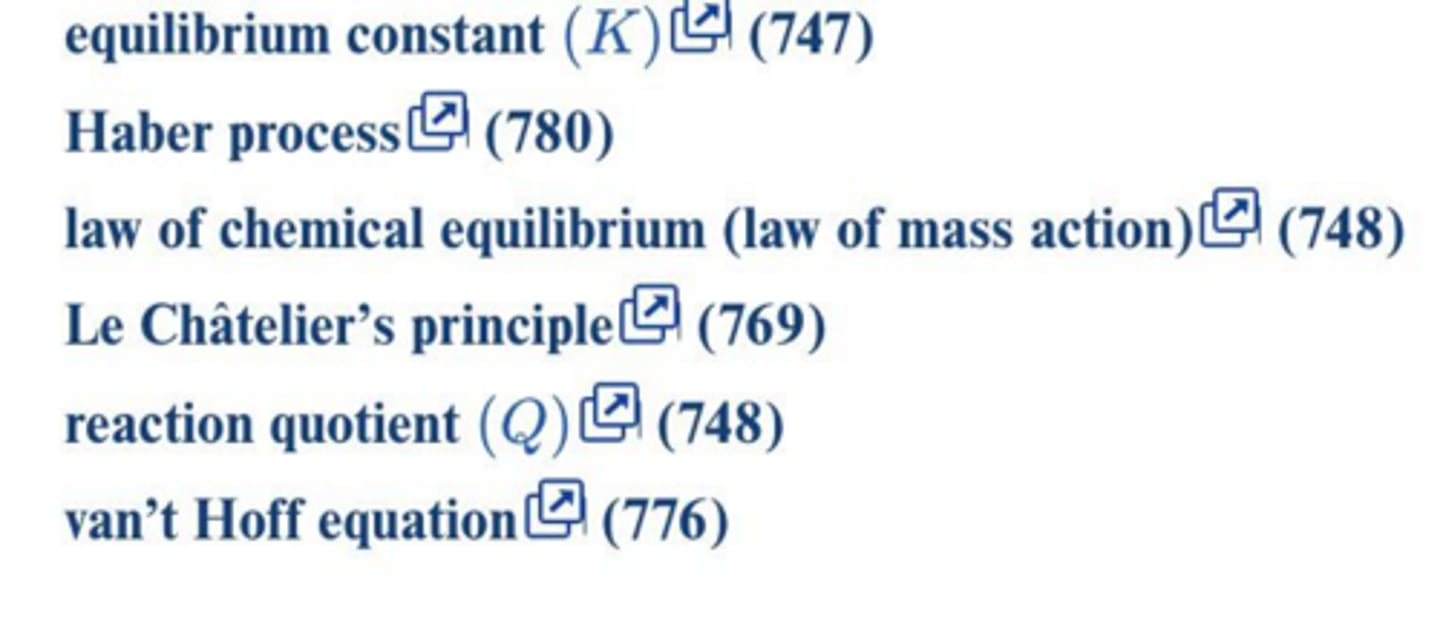
Haber process
An industrial method for synthesizing ammonia from nitrogen and hydrogen gases, typically using high pressure and temperature, and a catalyst.
Law of chemical equilibrium (law of mass action)
A principle stating that at equilibrium, the rate of the forward reaction equals the rate of the reverse reaction, and the concentrations of reactants and products remain constant.
Le Châtelier's principle
A principle stating that if an external change is applied to a system at equilibrium, the system will adjust itself to counteract that change and restore a new equilibrium.
Reaction quotient (Q)
A ratio that expresses the relative concentrations of products and reactants at any point in a reaction, used to determine the direction in which a reaction will proceed to reach equilibrium.
van't Hoff equation
An equation that relates the change in the equilibrium constant of a reaction to the change in temperature, providing insight into how temperature affects chemical equilibria.
Acid-base indicator
A substance that changes color in response to changes in pH, used to determine the acidity or basicity of a solution.
Acid-dissociation constant (Ka)
A measure of the strength of an acid in solution, defined as the equilibrium constant for the dissociation of an acid into its conjugate base and a proton.
Adduct
A complex formed from the addition of two or more distinct molecules, often involving a Lewis acid and a Lewis base.
Amphiprotic
A substance that can act as both an acid and a base, capable of donating and accepting protons.
Arrhenius acid
A substance that increases the concentration of hydrogen ions (H+) in aqueous solution.
Arrhenius base
A substance that increases the concentration of hydroxide ions (OH-) in aqueous solution.
Autoionization
The process in which a substance, such as water, ionizes itself to produce ions.
Base-dissociation constant (Kb)
A measure of the strength of a base in solution, defined as the equilibrium constant for the dissociation of a base into its conjugate acid and a hydroxide ion.
Brønsted-Lowry acid-base definition
An acid is a proton donor, and a base is a proton acceptor.
Conjugate acid-base pair
A pair of species that differ by the presence or absence of a proton, where one can be converted to the other by the gain or loss of a proton.
Hydronium ion (H3O+)
The ion formed when a water molecule gains a proton, representing the presence of acidity in a solution.
Ion-product constant for water (Kw)
The equilibrium constant for the autoionization of water, equal to the product of the concentrations of hydronium and hydroxide ions in pure water at a given temperature.
Leveling effect
The phenomenon where strong acids and bases are leveled to the strength of the strongest acid or base that can exist in a given solvent.
Lewis acid-base definition
An acid is an electron pair acceptor, and a base is an electron pair donor.
Neutralization
The reaction between an acid and a base that produces water and a salt, typically resulting in a solution with a pH close to 7.
pH
A measure of the acidity or basicity of a solution, defined as the negative logarithm of the hydrogen ion concentration.
Polyprotic acid
An acid that can donate more than one proton per molecule, such as sulfuric acid.
Proton acceptor
A substance that can accept a proton (H+) in a chemical reaction, typically a base in Brønsted-Lowry theory.
Proton donor
A substance that can donate a proton (H+) in a chemical reaction, typically an acid in Brønsted-Lowry theory.
Activation energy (Ea)
The minimum energy required for a chemical reaction to occur.
Active site
The specific region of an enzyme where substrate molecules bind and undergo a chemical reaction.
Arrhenius equation
A formula that relates the rate constant of a reaction to the temperature and activation energy, typically expressed as k = Ae^(-Ea/RT).
Average rate
The change in concentration of a reactant or product over a specific time interval.
Bimolecular reaction
A reaction that involves two reactant molecules colliding to form products.
Catalyst
A substance that increases the rate of a chemical reaction without being consumed in the process.
Chemical kinetics
The study of the rates of chemical reactions and the factors affecting them.
Collision theory
A theory that states that for a reaction to occur, reactant molecules must collide with sufficient energy and proper orientation.
Effective collision
A collision between reactant molecules that results in a chemical reaction.
Elementary reaction (elementary step)
A single step in a reaction mechanism that describes a direct transformation of reactants to products.
Enzyme
A biological catalyst that accelerates chemical reactions in living organisms.
Enzyme-substrate complex (ES)
The temporary complex formed when an enzyme binds to its substrate.
Frequency factor
A constant that represents the frequency of collisions in the Arrhenius equation.
Half-life (t1/2)
The time required for the concentration of a reactant to decrease to half its initial value.
Heterogeneous catalyst
A catalyst that is in a different phase from the reactants, typically solid in a liquid or gas reaction.
Homogeneous catalyst
A catalyst that is in the same phase as the reactants, usually in a solution.
Hydrogenation
A chemical reaction that adds hydrogen to a compound, often used in converting unsaturated fats to saturated fats.
Induced-fit model
A model of enzyme action that suggests the enzyme changes shape to fit the substrate upon binding.
Initial rate
The rate of reaction measured at the very beginning of the reaction, when concentrations of reactants are at their highest.
Instantaneous rate
The rate of reaction at a specific moment in time, determined by the slope of the tangent to the concentration vs. time curve.
Integrated rate law
An equation that relates the concentration of reactants to time for a specific order of reaction.
Lock-and-key model
A model of enzyme action that suggests that the enzyme's active site is exactly complementary to the shape of the substrate.
Molecularity
The number of reactant molecules involved in an elementary reaction.
Rate constant
A proportionality constant in the rate law that is specific to a given reaction at a given temperature.
Rate-determining (rate-limiting) step
The slowest step in a reaction mechanism that determines the overall rate of the reaction.
Rate law (rate equation)
An equation that relates the rate of a reaction to the concentration of reactants, typically expressed as rate = k[A]^m[B]^n.
Reaction energy diagram
A graphical representation of the energy changes during a chemical reaction, showing the energy of reactants, products, and the activation energy.
Reaction intermediate
A species that is formed during the reaction but is not present in the final products.
Reaction mechanism
The step-by-step sequence of elementary reactions by which overall chemical change occurs.
Reaction orders
The powers to which the concentration of reactants are raised in the rate law, indicating their effect on the reaction rate.
Reaction rate
The speed at which reactants are converted into products in a chemical reaction.
Substrate
The reactant molecule that an enzyme acts upon.
Transition state (activated complex)
A transient state during a chemical reaction where reactants are in the process of being converted to products.
Transition state theory
A theory that describes how chemical reactions occur through the formation of a transition state.
Unimolecular reaction
A reaction that involves a single reactant molecule undergoing a transformation.