Bacterial Cell Structures
 Call Kai
 Learn
Learn Practice Test
 Spaced Repetition
 Match
Match Flashcards
 Knowt Play
1/59

There's no tags or description
Looks like no tags are added yet.
Name | Mastery | Learn | Test | Matching | Spaced | Call with Kai |
|---|
No analytics yet
Send a link to your students to track their progress
60 Terms
What does binary fission require?
ATP
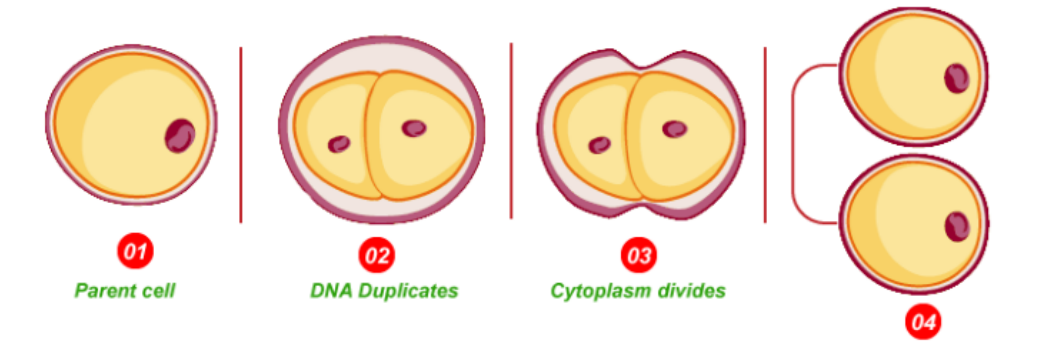
What are the 4 stages of binary fission
Parent cell, DNA replication, Cytoplasm divides, Two daughter cells
What does the doubling time/generation time refer to?
the time required for the amount in a colony to double
What are the advantages of binary fission?
-Widely dispersed populations can still reproduce
-Cells are identical to their parents and should survive well if conditions don't change
-Rapid reproduction
What are the disadvantages of binary fission
-Cells are identical to parents and so are vulnerable to the same environmental stresses
-Unchanging cells may be slow to take advantage of new energy and nutrition sources
How many bacteria are in a cm² of a human?
10^8 bacteria/cm 2
What is pathogenesis
the mechanism/s a microbe uses to cause a disease state
What is virulence
The relative ability for a microbe to cause disease
What is infection?
refers to the replication of a pathogen in or on its host
What is disease
occurs when specific signs/symptoms are associated with infection
What are virulence factors?
Cell surface or secreted factors which give them a survival advantage in the host
What are primary pathogens?
tend to produce disease readily in healthy hosts
What are opportunistic pathogens?
generally only cause disease when they gain entry to an unusual site or when the host has a weakened immune system (immunocompromised)
What is a carrier?
Infected but not diseased
What is the bacterial capsule?
An outer layer of polysaccharides that covers the cell wall of many different bacterial species
What is the function of the bacterial capsule
protect bacteria from toxic compounds and desiccation
allow bacteria to adhere to surfaces
help bacteria escape the immune system of the host
What is chemotaxis
rapid movement of bacterial cells
towards more desirable environments or
away from those less desirable
What are the 3 working parts of a flagellum
• the basal body working as a rotary motor
• the filament as a screw propeller
• the hook as a universal joint connecting the
filament to the motor
What’s positive chemotaxis?
toward a higher concentration of a chemical stimulus.
What’s negative chemotaxis
away from a higher concentration of a chemical stimulus
What are bacterial fimbriae?
Short, hair-like protein structures on the surface of bacteria that help them attach to surfaces or host cells
What are adhesins
The hair like proteins that sit at the end of fimbriae
What’s an epithelial cell?
forms the protective layers covering body surfaces and lining internal organs and cavities.
What is the role of adhesin molecules
allow bacteria to adhere to host cells by docking, like a lock and key
What is the bacterial endospore?
a highly resistant cell to preserve
the cell's genetic material in times of extreme stress
Which two bacterial genera produce endospores?
Bacillus and Clostridium
What does the endospore consist of?
genome, cytoplasm, specialised coating
What are cytotoxins, neurotoxins, enterotoxins and super antigens?
exotoxins
What are cytotoxins?
cause cell lysis/bursting
What are neuerotoxins?
affect neurotransmitter release
What are enterotoxins?
cause electrolyte imbalance in the gut
What are superantigens?
cause an excessive immune response
Whats an example of cytotoxins
– Gas gangrene caused by Clostridium perfringens.
– The bacterial infection produces toxins that release gas and cause tissue death
What’s an example of neuerotoxins
Tetanus, botulism caused by Clostridium species
Whats an example of a disease casued by enterotoxins?
Food poisoning, diarrhoea
Whats an example of a disease caused by superantigens?
Toxic shock
How does botox work?
A protein exotoxin that actively interferes with nerve signalling
Why is LPA a virulence factor?
elicits an inflamtory response
Where is LPA found?
In the cell wall of gram negative bacteria
How does the capsule hide the c3b markers?
acts as a physical barrier
What does a c3b marker do?
a complement protein
causes cell destruction
How are fimbria bacterial infections treated?
release molecules that mimic the surface structures the bacteria would bind to
similar to agglutination
How do endotoxins differ from exotoxins
endotoxins are lipid A within the cell wall
exotoxins are produced and secreted
What do Clostridial exotoxins do (tetanus)
-Continual release of acetylcholine
-Increasing stiffness of the muscles due to spasms
What do Botulism toxins do
• Blocks release of acetylcholine (responsible for muscle contractions)
• Causes flaccid paralysis
Why do some bacteria not cause disease?
Irrelevant virulence factors
Immune system keeps quantity appropriate
Not infectious in the body part they are colonising
What is the bacterial capsule
an outer layer of polysaccharides
Where does the bacterial capsule cover
the cell wall
Which receptors on the cell membrane tag for phagocytosis?
C3b
How do flagella move in order to achieve a straight line?
unidirectionally
What is on the end of fibrae?
adhesins
How do adhesins work
via lock and key mechanism with epithelial cells
What two genus procure endospores?
Bacillus and Clostridium
Can exotoxins travel?
Yes, to far away from the site of infection
What is responsible for muscle contraction?
Acetylcholine
What disease does Clostridium tetani cause?
tetanus
What disease does Clostridium botulinum cause
botulisim
What is the mechanism of tetanus disease
continual release of acetylcholine
What is the mechanism of botulism disease
blocks release of acetylcholine
How does botox work?
blocks release of acetylcholine via neurotoxins