Sedimentary stuctures
 Call Kai
 Learn
Learn Practice Test
 Spaced Repetition
 Match
Match Flashcards
 Knowt Play
1/31

There's no tags or description
Looks like no tags are added yet.
Name | Mastery | Learn | Test | Matching | Spaced | Call with Kai |
|---|
No analytics yet
Send a link to your students to track their progress
32 Terms
Define current crescents.
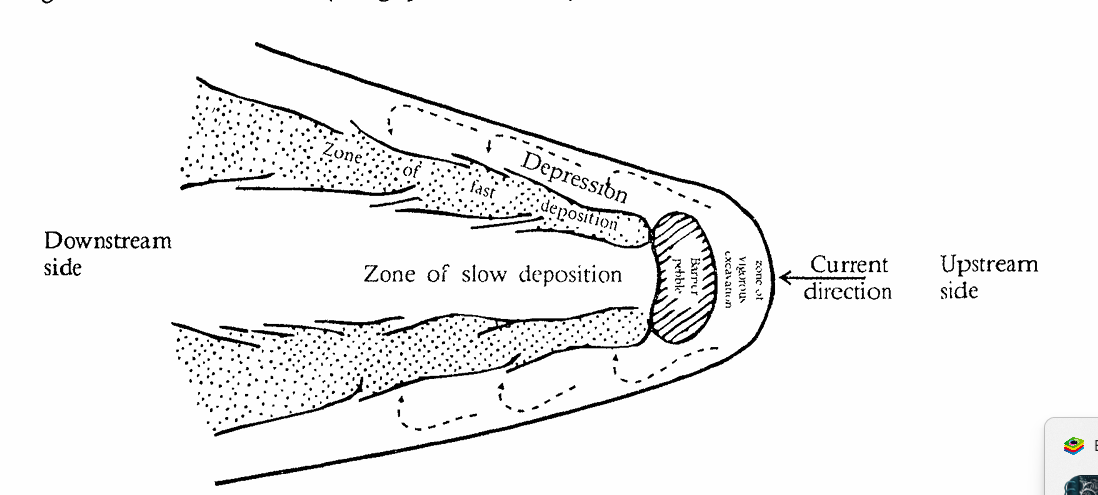
Obstacles like pebbles leave crescentic marks on soft sediment surface. These are called current crescents.
How do the current crescents form?What is the significance of current crescents?
Continued excavation of sand on the upstream side of the obstacle due to the formation of a vortex leads the formation of a current crescent.
Current crescents maybe used as palaeocurrent indicators.
Under suitable condition the scour width in current crescent preserved
in geological record may serve ,as an indicator of flow velocity responsible for
generation of the scour
Name the tool marks.
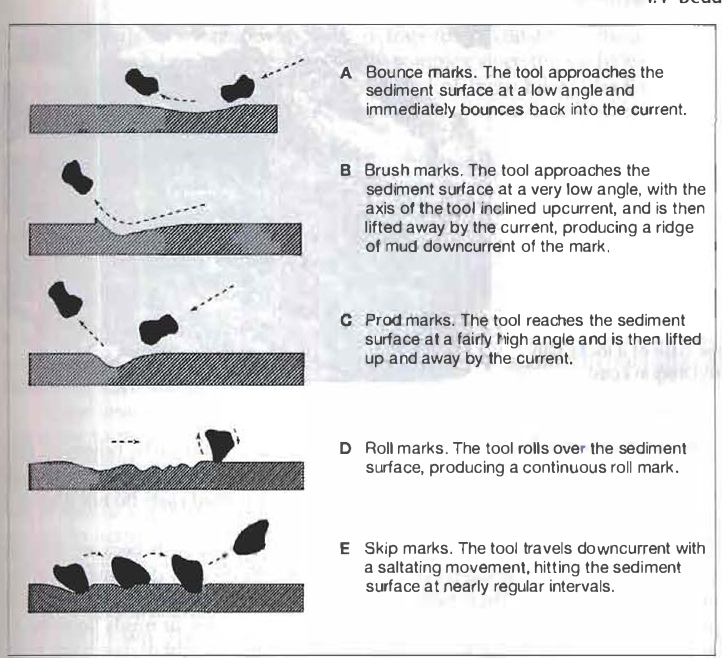
Groove marks
Chevron marks
Prod marks
Bounce marks
Skip Marks
Brush marks
Roll marks
BCGP S
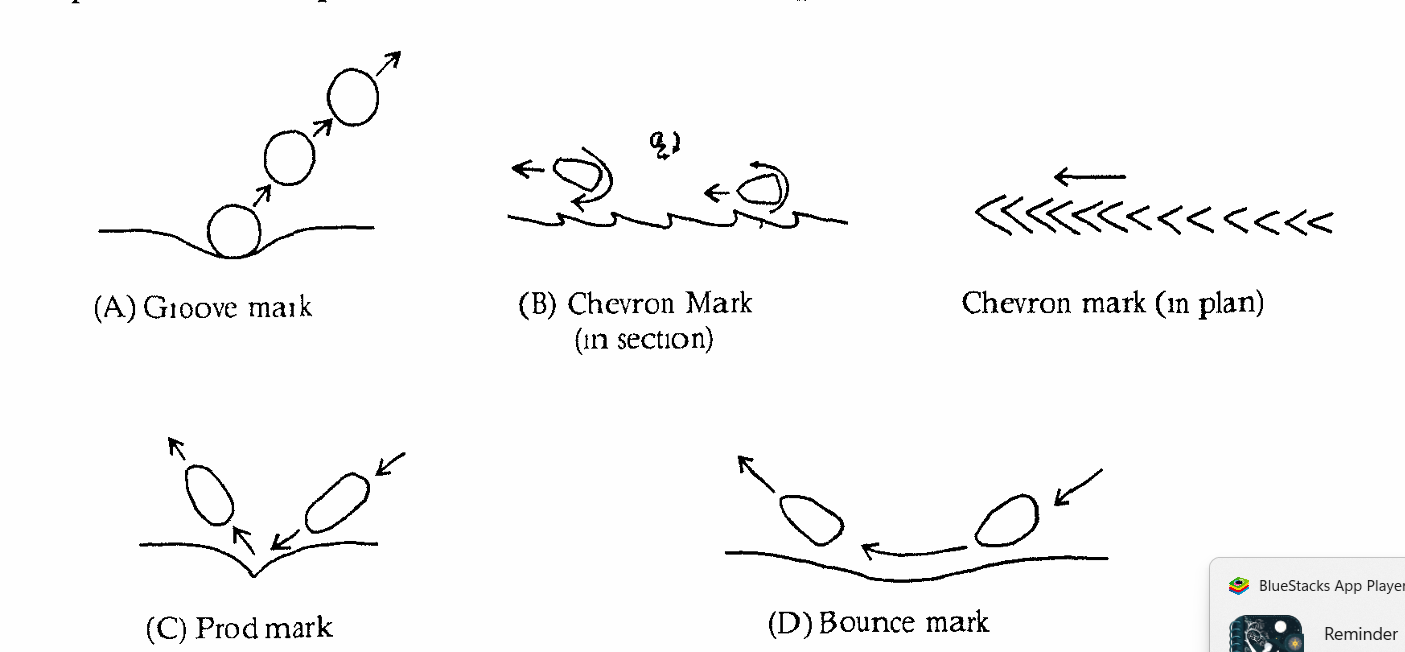
Groove marks
Groove marks are long, lmear depresslOns produced by objects rolled or dragged on
soft sedIment surface . Groove marks are often preserved on the
undersurface of flysch sedIments as sole marks.
Chevron marks
Chevrons are contInuous V-shaped marks (Vs pointing down-current) arranged in
straight lines . Tool 'dancing'momentarily over cohesive sedIment surface,
before advancing forward, produce these marks.
Prod Marks
Prod marks are asymmetncal elongate V-shaped depressions produced by objects
hIttmg a sedIment surface momentanly.
Bounce marks
Objects approachmg the sediment surface at a low angle produce bounce marks
Symmetncal depressIons, tapenng both In the up-and down-current directions, are
produced m the process 'The current soon lifts up the tool (Fig 5 35D)
Define penecontemporaneous structures. And give suitable examples.
The structures formed during or immediately after deposition, before consolidation are called penecontemporaneous structures.These are sedimentary layers that have been deformed , distorted or disturbed by inorganic species.
Load structures, Ball and pillow, Convolute bedding, Dish and pillar, Water escape, Slump, Intraformational Conglomerate, Clastic dykes, Deformed ripple
BCD ICD LS
Lord Bramha creates divine Indras chariot daily
Convolute laminations, gutter cast, , Skip marks, Dish structures. Out of these which one cannot be identified in vertical sections.
Dish structure cannot be identifed in vertical section.Other three can be identified in vertical section.GATE 2015
Define gutter casts and ridges and furrows.
Linear features formed on the bed due to turbulence are called ridges and furrows they are small scale(mm) . The very same thing in centimetre scale is called gutter cast.
Define mud cracks. What is the other name for it?How are they formed?
The other name for mud crack is sun cracks. They are formed due to dessication.
What are the structures that can be used as way up indicators?
Mud cracks, Synerisis cracks, Raindrop imprints, Trough cross bedding, graded bedding, wave ripple, load and flame, sole marks,
MIGHTY SHIVA ROARED. TRISHUL GAVE WATER. LAKSHMI SMILED.
Load casts, Flute casts, Dropstones, Stromatolites, Current crescent. Name the process by which they form. One word answer.
gravitational instability, Cross bedding,Migration of mega ripples, turbulent scour, Melting ice, Biogenic action, Erosion of cohesive sediment.
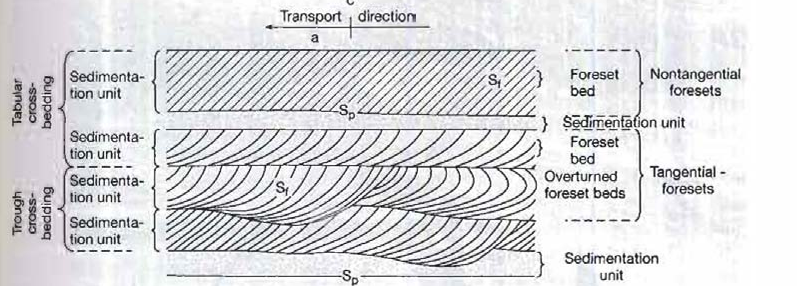
Differentiate between tabular and trough cross bedding.
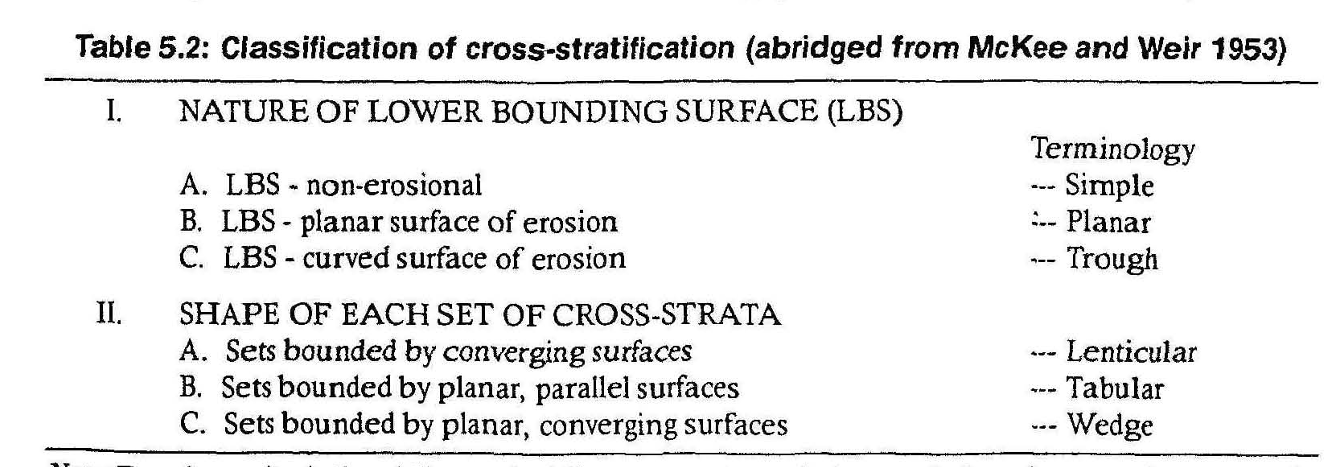
In case of tabular cross bedding the bounding surfaces are ALWAYS planar, and COMMONLY the foresets are inclined and planar. But in rare instances , the foresets maybe curved, maintaining a tangential relationship to the basal surface.Tabular cross bedding is formed in lower flow regime.
In case of trough cross bedding one or both the bounding surfaces are curved. So at least 1 bounding surface must be curved.Commonly the foreset is also curved, having a tangential relationship with the basal surface.
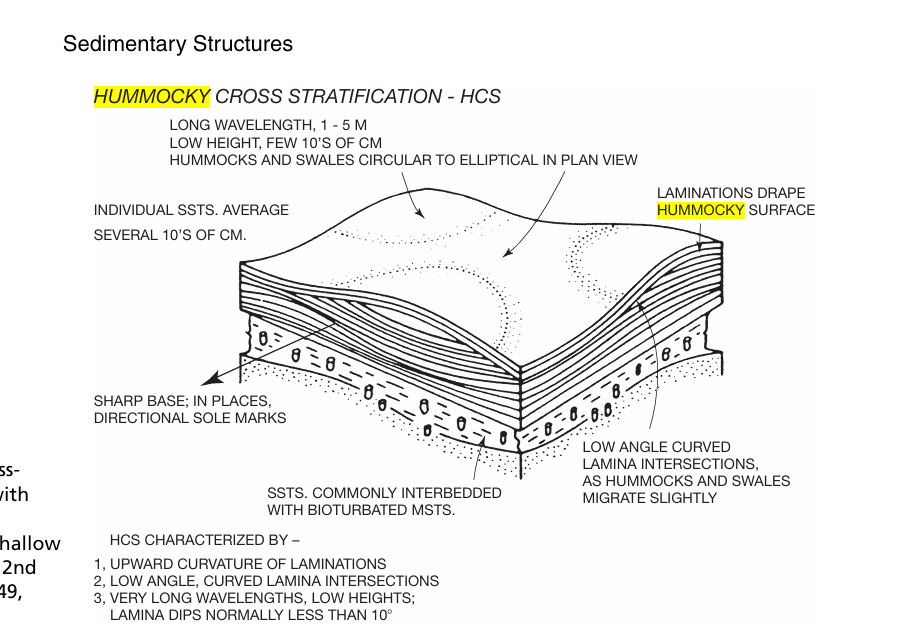
Define hummocky cross stratification. What is its other name?How is it formed? In which environment is it commonly found?
Hummocky cross stratification can be defined as undulating sets of cross laminae that are both convex up(hummocks) and concave up(swales). They have wavy erosional bases and rippled bioturbated tops.The other name is hummocky mega ripples.These are 3d , elliptical , circular mounds(hummocks) separed from each other by swales.
They are formed due to strong surges of oscillatory flow during stormy conditonns. They are commonly found in marine environments. It is not possible to ascertain the paleocurrent direction from this strcuture.
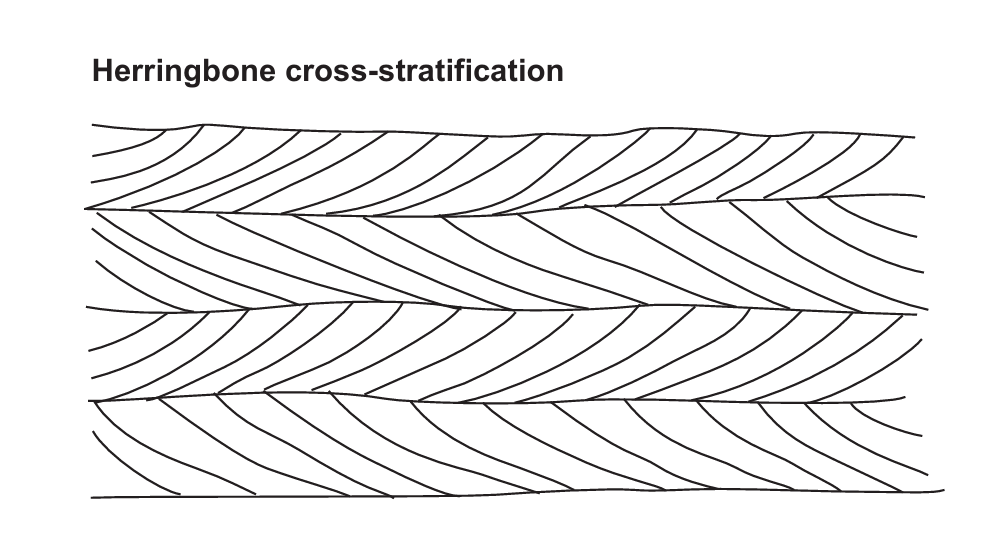
Define herringbone cross stratification. In which environment is it found? Which section best represents it?
Herringbone cross stratification can be defined as a structure that is formed due to alternating directions of migration of ripples and dunes.
It is important to know that during a flood tide and ebb tide, one is stronger and the other weaker, meaning that the effect of the weaker one can be obliterated by the stronger one. So, if the flood tide is stronger, then a cross bed develops in the direction of flood tide over the course of many years. After that, an exactly opposite dipping cross bed is formed, most probably due to the ebb tide becoming stronger.
This reversal in the direction of the strong current leads to the formation of herringbone cross stratification.
It is characteristic of tidal environments. And it is best represented in vertical sections.
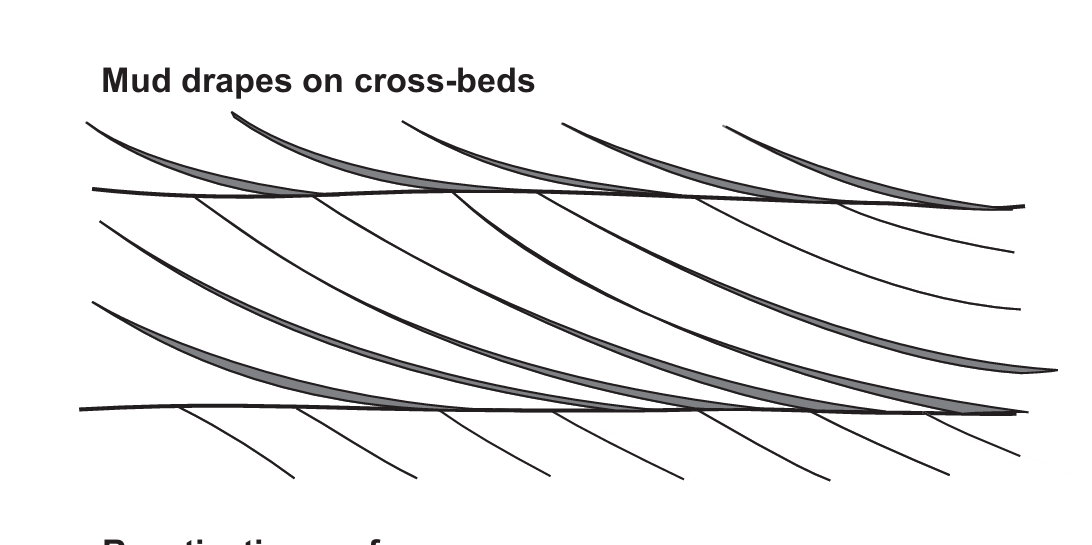
Define mud drapes. How do they form?
Mud drapes are depositional structures formed during low flow velocity.
-During the reversal in current direction when the flow velocity decreases, mud layers are deposited.
-Later, even when the flow velocity increases these layers are not removed as they are cohesive.
-They can be also found along foresets of cross beds.
-Although they can be found in fluvial environments, they are generally observed in tidal settings.
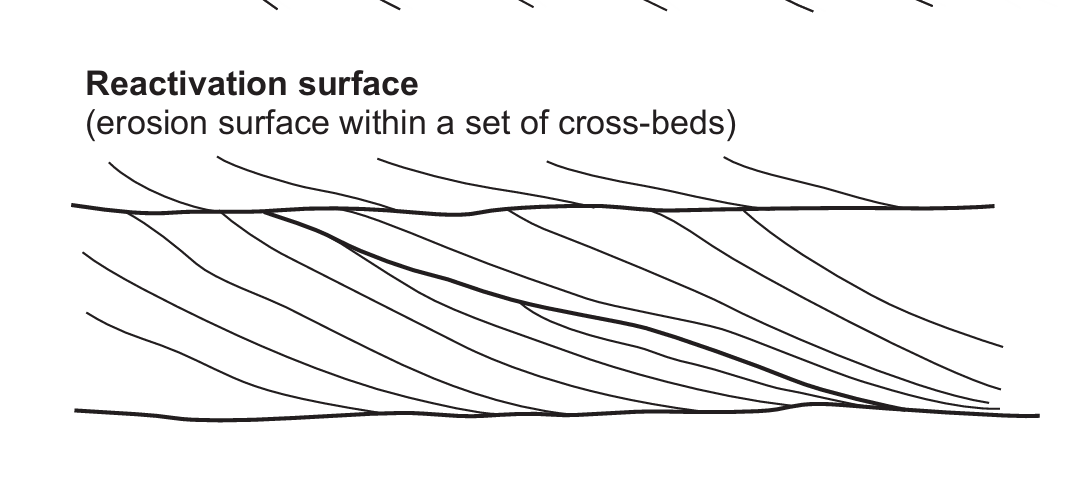
Define reactivation surfaces.
Reactivation surfaces are formed due to reversal of current direction
-Unidirection cross beds develop an erosional surface once the current is reversed.
-Again , if the current assumes its former direction, the cross beds continue to be deposited as if nothing happened.
-Here, the surface of erosion formed due to a momentary change in current direction is called a reactivation surface.
Define dish and pillar structure. How do they form?Where are they commonly found?
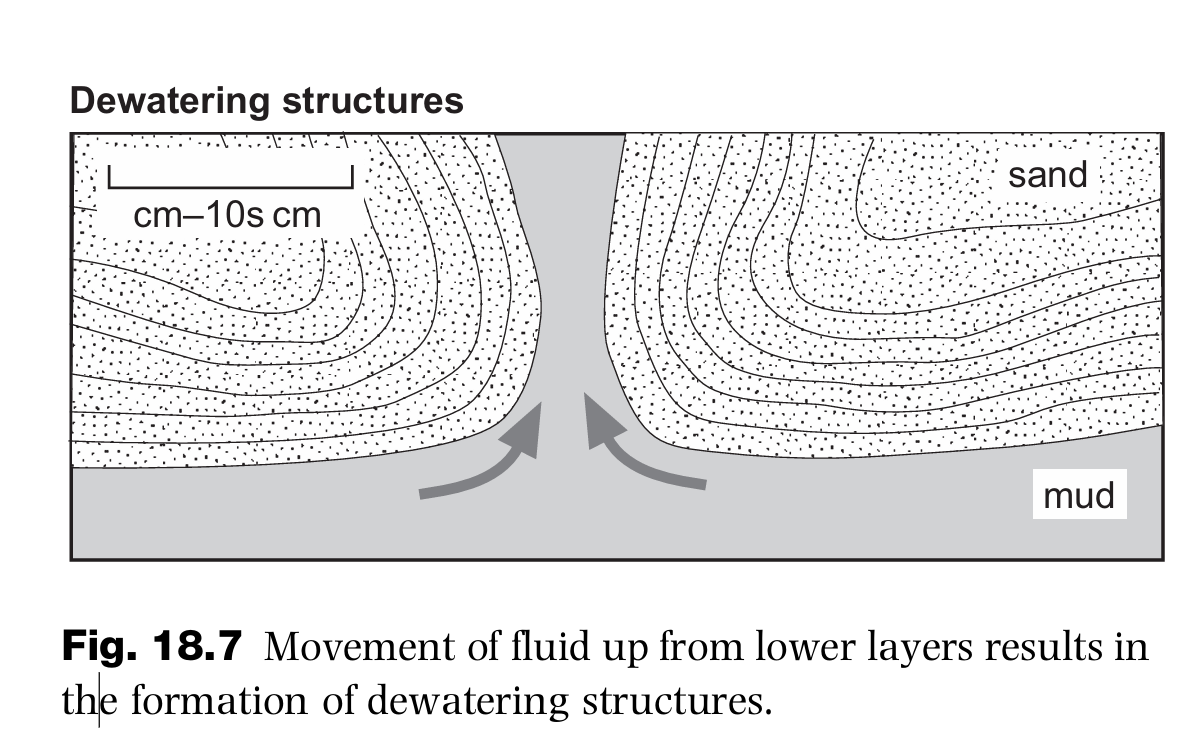
-Dish and pillar both are dewatering structures.
-Dish is a concave upward clayey lamination found in sandstones and siltstones.
-When a semi permeable laminae like clay or shale acts as a barrier to upward moving water flow, the fine particles carried by water are retarded and deposited in that laminae itself. This produces dish.
-At the same time, when enough presseure builds up, the sediment laden water forces its way upward , creating vertical depositional structures called pillar.The other name for pillar is elutriation pipes.
-Pillar is not a stratification structure while dish is.
-They are commonly found in turbidites and liquified flows.
Define adhesion ripples. Show the diagram.
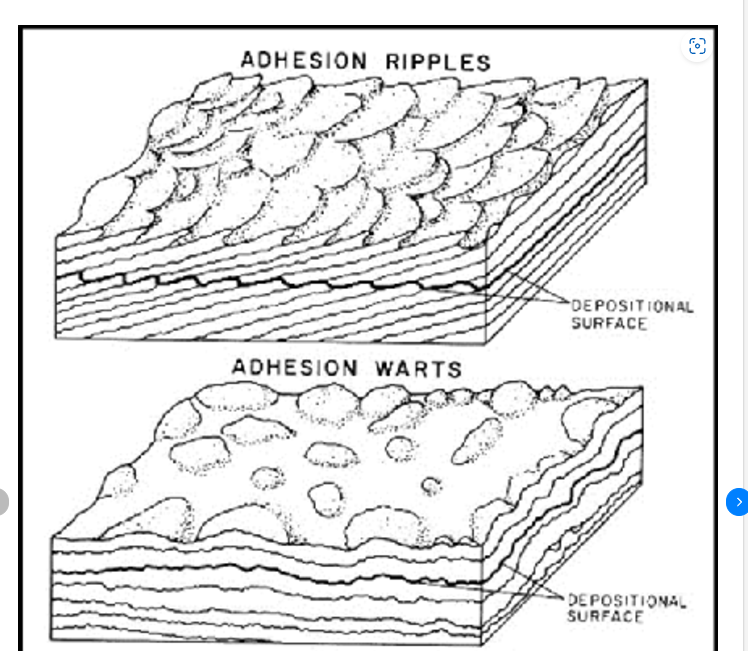
Dry sand grains in aeolian environment coagulate into minute lumps due to sprinkling of water, such as during light rains. These lumps are known as warts.
Adhesion ripples form when deflated sand grains adhere to a wet surface. Irregular adherance of sand grains give rise to a crinkled structure, more or less forming a ripple like pattern.
-Adhesion ripples can be used as way up indicator.
Define ladder back ripple with a diagram. How is it formed? In which environment is it found?
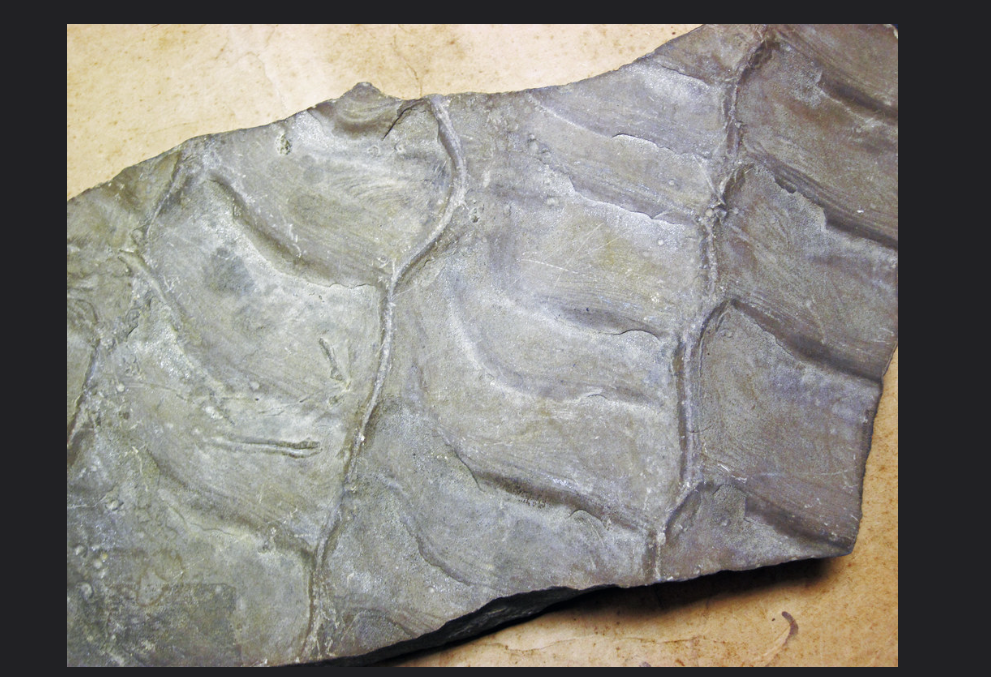
Simply put, ladder back ripples are interference ripples in which subordinate ripples occupy the troughs of the dominating ripple. The interfering ripples are oriented at an high angle to each other.
They are indicative of inter-tidal environment.
Define double mud drape. Show the diagram and explain its process of formation. In which environment is it found?
Double mud drape is a depositional sedimentary structure formed during slack water conditions. As the name suggests, there are two mud drapes, one forming during the slack water conditon when the dominating current reverses its direction and the other forming when the subordinate current reverses its direction.
Reactivation surfaces may also be commonly associated with double mud drapes.
Double mud drapes are characteristic of sub-tidal environments.
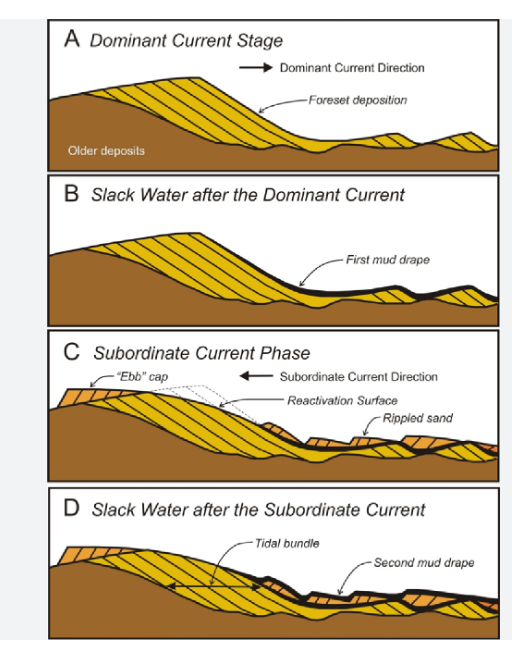
Name the sedimentary structures formed in tidal flats.
Herringbone
Muddrapes
Tidal bundles
Reactivation surfaces
Mud- cracks
Wave ripple
Trace fossils
Ladder back ripple
Rain prints
Hanuman made tides roar, making waves to level Ravana.
Name the structures that are preserved on the top surface of the bed.
Mud cracks
Synerises cracks
Swash marks
Rill marks
Water recession marks
Wrinkle marks
Raindrop imprints
Current crescent
What is the difference between mud crack and synerises cracks?
Mud cracks occur at the sediment-air interface wheras synerises cracks occur due to sediment-water interface.
Mud cracks are generally polygonal whereas synerises cracks are generally spindle shaped and discontinous.
Define synerises cracks. How do they form?
Synerises cracks are shrinkage cracks that form at the water-sediment interface due to dewatering.
The H20 is likely to be removed by brine that sucks out water from the mud.
What are the structures that indicate intemittent sub-aerial exposure?
Raindrop imprints, Water recession marks, Wrinkle marks, Swash marks.
Define rain imprints. What is its significance?
These are circular depressions with raised rims, formed due to the impact of raindrops on soft sediment surface.
Define swash marks.What is its significance?
Swash marks are indicative of farthest line of encroachment of waves on land. They consis lobate ridges of sand convex to the land.
Define rill marks.
They are dendritic , bifurcating erosional features.
They are formed when water drains out on soft sediment surface.
Inter-tidal deposits
Mud-cracks, rainprints, ladderback ripple/interference ripple
Double mud drape is found in
sub-tidal