Strength of Materials Master MCQ
 Call Kai
 Learn
Learn Practice Test
 Spaced Repetition
 Match
Match Flashcards
 Knowt Play
1/106

There's no tags or description
Looks like no tags are added yet.
Name | Mastery | Learn | Test | Matching | Spaced | Call with Kai |
|---|
No analytics yet
Send a link to your students to track their progress
107 Terms
How many internal loadings are there on a section of a member in two dimensions?
3; Normal force, shear force, and bending moment
Stress is an internal force acting on a unit area
Yes
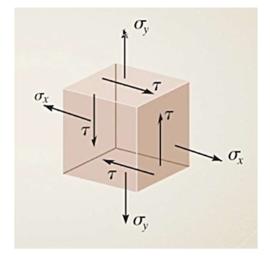
Is normal stress always perpendicular to shear stress?
What is a pascal?
N/m² (force per unit area)
A material is homogeneous if it has the same physical and mechanical properties throughout
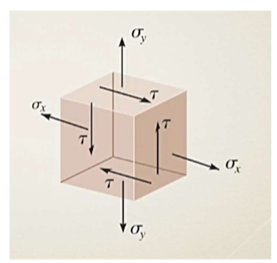
In general, how many stress components act on a differential element in two dimensions?
3; normal stress in the x and y directions and then shear stress (coplanar)
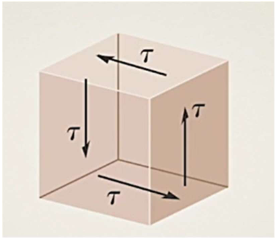
Is it possible to have the state of stress at a point as shown?
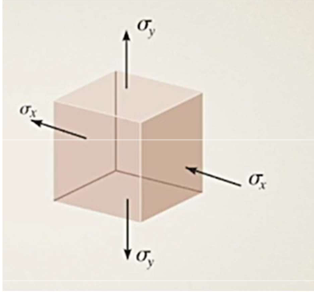
Is it possible to have the state of stress at a point as shown?
The normal stress in the X direction must be equal and opposite (in this case)
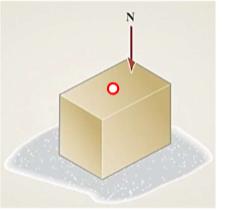
When the force N is applied to a member, can σ_avg = N/A be used to determine the stress in the member?
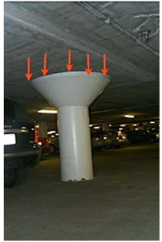
The stress acting on this column is called bearing stress
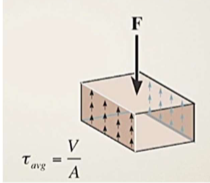
For small connections, can shear stress be assumed to be uniformly distributed over the cross section?
In the SI system of units, are both the normal and shear stress measured in pascals?
1 MPa
10^6 Pa
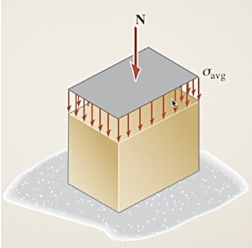
In order to find the average normal stress, is it necessary for the material to be homogeneous and isotropic?
An isotropic material has the same properties in all directions?
We use allowable stresses for design because the loads and geometry are not fully known, materials degrade, and their properties are not exactly known.
The factor of safety is the ratio of the failure load divided by the allowable load.
F.S. = σ_fail/σ_allow
Can the factor of safety ever be less than one?
Is the factor of safety for normal stress equal to the factor of safety for shear stress?
Behavior in shear is different than the behavior in tension or compression
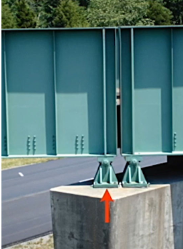
Is this support subject to bearing stress?
Because normal strain results from the change in length of a line segment, in the SI units can it be measured in meters?
Units for strain typically mm/mm (dimensionless); a length/length = dimensionless
Is a normal strain of 0.003 mm/mm equivalent to 0.003 in/in?
Strain is a dimensionless quantity
A change in shape is known as deformation
A change in position from one location to another is called a displacement.
Shear strain refers to the change in the angle between two small line segments within the body that were originally perpendicular to one another.
γ = π/2 - θ
Can shear strain be negative?
γ = π/2 - θ
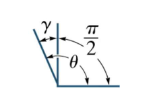
Does shear strain have units?
Is a radian a dimensionless unit?
Is it possible to subject a material to a normal strain and no shear strain?
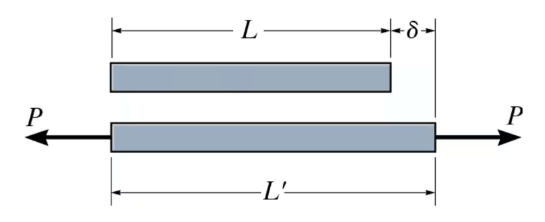
Is engineering stress calculated using the original cross-sectional area of the specimen at the time the force is measured?
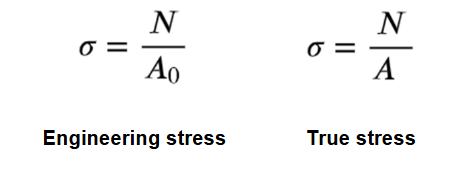
Is it possible to directly measure stress?
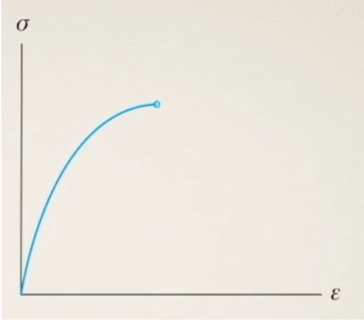
Is this material linear elastic?
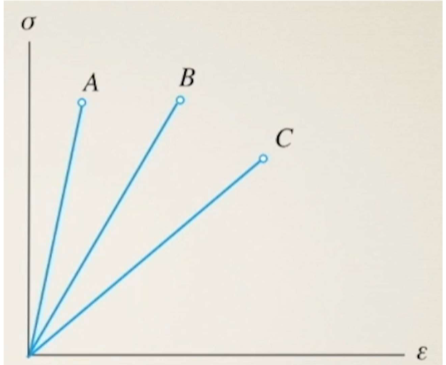
Which material is the softest?
Hooke’s Law: σ = Eε
Brittle materials exhibit necking.
Brittle materials do not undergo plastic deformation; they tend to crack under strain at high stress.
Does necking occur throughout the entire length of a specimen?
The slope of the straight-line portion of the stress-strain diagram is called the modulus of elasticity.
Hooke’s Law: σ = Eε
What does the X-axis in a stress-strain curve indicate?
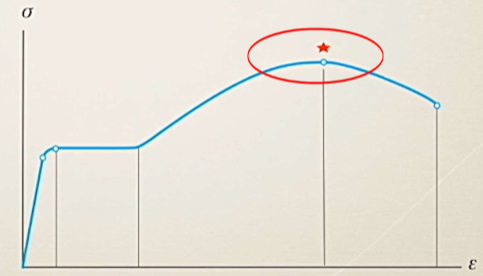
This point is called?
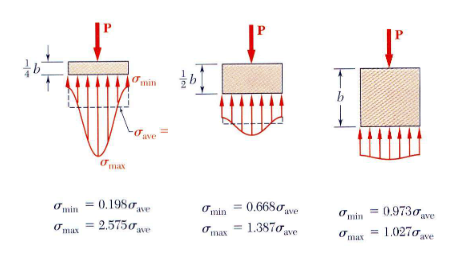
Saint-Venant’s Principle states that the stress under a load tends to even out as one moves away from the point of application of the load.
What is E called?
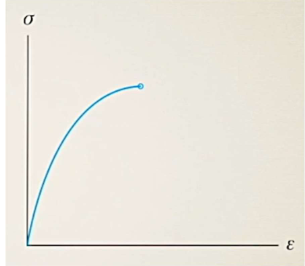
Can δ = NL/AE be used to determine the displacement of a bar if the stress-strain diagram has the shape shown?
In the formula δ = NL/AE, does N indicate the external force acting on the member?
N represents the internal loading within the member
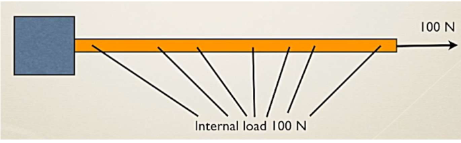
Can the principle of superposition be used if the material yields?
When it yields, it enters the plastic region (not the elastic region), s.t. displacement of an axially loaded member cannot be applied (requires elastic region)
Can the principle of superposition be used if the material deforms a large amount?
Use when the material only has small displacements when loaded
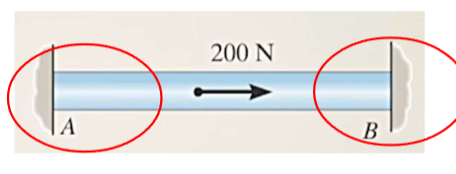
Can the reactions at A and B be determined from the equations of equilibrium?
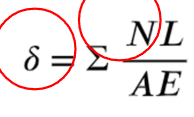
What type of equation is this?
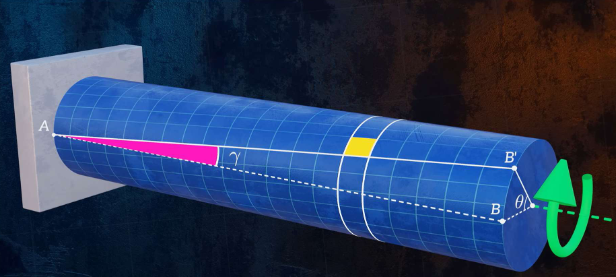
When a torque is applied to a shaft having a circular cross-section, will the longitudinal lines along the shaft remain straight as the shaft is twisted?
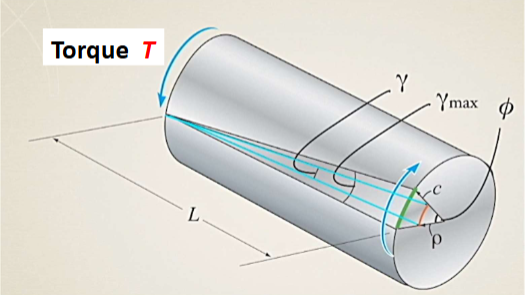
If a torque causes the material of a shaft having a circular cross-section to yield, will the shear strain vary linearly from zero at the center of the shaft to a maximum at the outer surface?
When a tube having a circular cross-section is subjected to a torque, will the cross-section remain plain after it is twisted?
Can the torsion formula be used if the material is nonlinear elastic?
The material must be linear elastic, since Hooke’s law was used in the derivation s.t. τ = Gγ
Can the torsion formula be used if the cross-section is elliptical?
The cross-section must always be circular
What is J for a solid shaft?
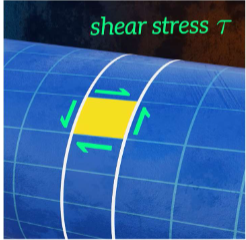
Will the application of torque on a shaft having a circular cross-section cause shear stress along the length of the shaft?
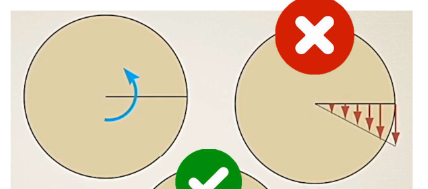
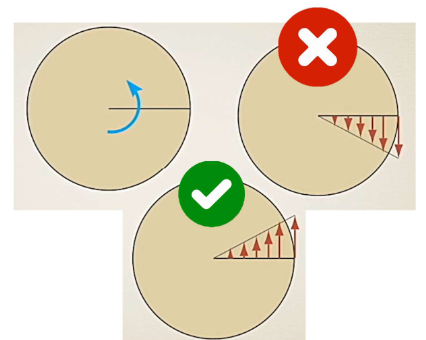
Is the shear stress distribution shown correct along the radial line?
Use RHR to find proper shear stress distribution in the positive direction
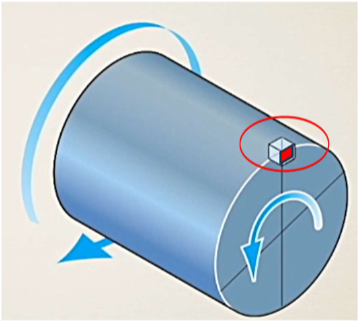
In what direction does the shear stress act on the face of the element?
Is G called the modulus of elasticity in τ = Gγ?
G is the shear modulus
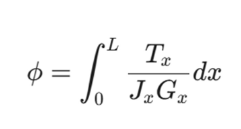
Can φ = TL/JG be used to determine the angle of twist of a shaft having a rectangular cross-section?
Can φ = TL/JG be used if the material is nonlinear elastic?
The material must be linear elastic and not yield.
Can φ = TL/JG be used to determine the angle of twist of a shaft if the torque varies along the length of the shaft?
Can the polar moment of inertia be a negative quantity?
It’s a geometric property of the area of the cross-section and is always positive.
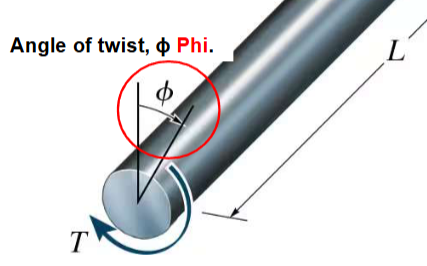
What are the units for φ?
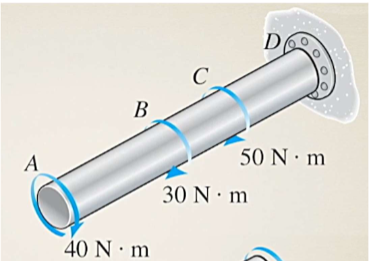
Determine the internal torque for region AB of the shaft?
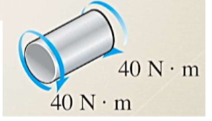
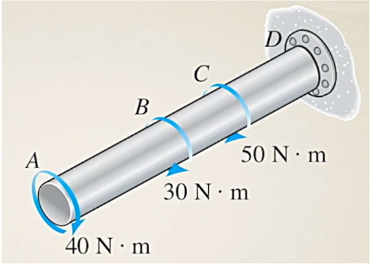
Determine the internal torque for region BC of the shaft.
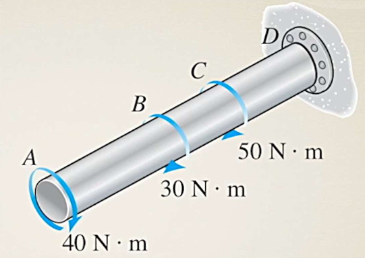
Determine the internal torque for region CD of the shaft.
Is the slope of the moment diagram equal to the shear?
dM/dx = V
Is the area under the load diagram equal to the change in the moment?
It’s equal to the change in the shear; w = dV/dx = d²M/dx²
If a couple moment acts on a beam, will there be a jump in the shear diagram?
There will be a jump in the moment diagram.
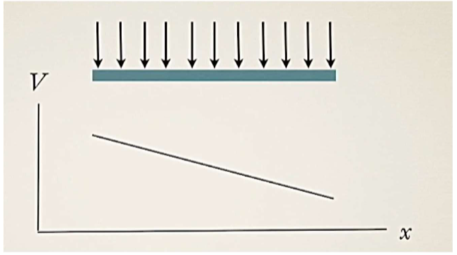
Is this the correct shape for the shear diagram given the loading on the beam?
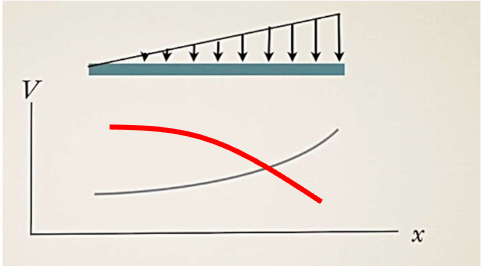
Is this the correct shape for the shear diagram given the loading on the beam?
dV/dx = w
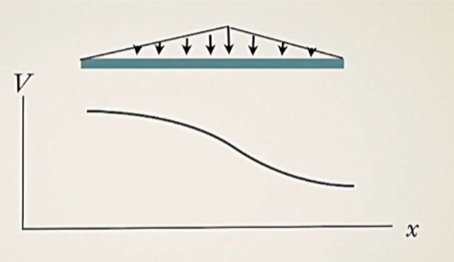
Is this the correct shape for the shear diagram given the loading on the beam?
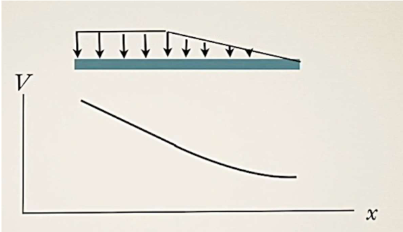
Is this the correct shape for the shear diagram given the loading on the beam?
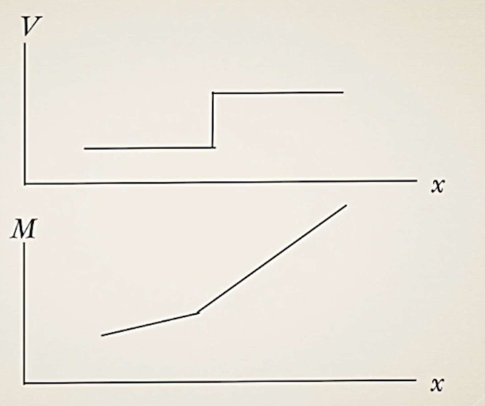
Is this the correct shape of the moment diagram given the shear diagram?
dM/dx = V
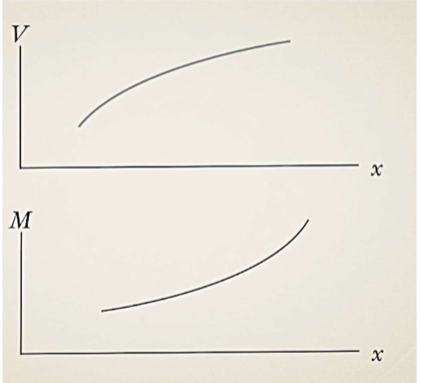
Is this the correct shape of the moment diagram given the shear diagram?
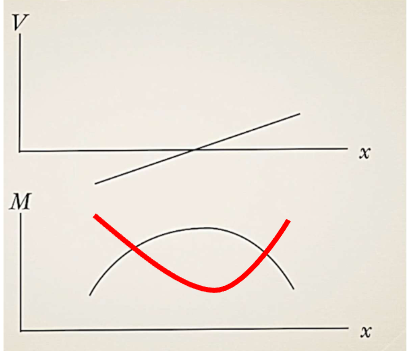
Is this the correct shape of the moment diagram given the shear diagram?
Is the bending stress at the neutral axis always equal to 0?
σ = -(y/c)σ_max
Is it possible to have two neutral axes for a cross-section?
The neutral axis passes through the center of the cross-section
Can the flexure formula only be used if the material is linear elastic?
ε = -(y/c)ε_max
Can the flexure formula be used if the member is curved?
The member can have a slight taper, but in general it must be straight
Can the flexure formula be used if the material is non-homogeneous
The stress at the neutral axis is always 0, but can there be some strain at the neutral axis?
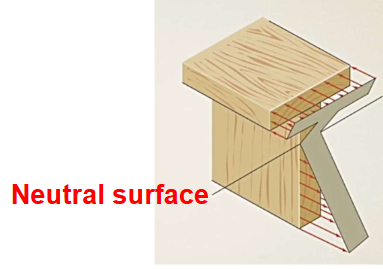
Is it possible for the maximum tension stress to be different from the maximum compression stress in the beam?
ε = -y/ρ; the neutral surface depends on the shape of the cross-section s.t. the max tension/compression stress may not always be equal
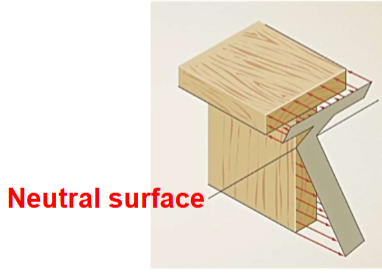
Is the bending stress the largest at the maximum distance from the neutral axis?
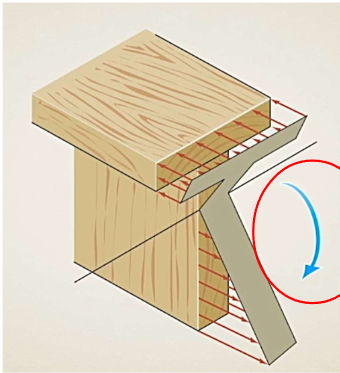
Is the bending stress over the cross-section shown correctly?
As seen in the diagram, the bending stress moves CCW based on the tension/compression stresses shown
Can the moment of inertia of an area sometimes be negative?
Area is always a positive quantity
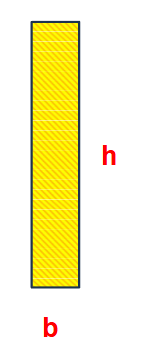
What is the moment of inertia of a rectangle about its centroidal axis?
Is the moment of inertia of the area always smaller about its own centroidal axis than it is about some other axis?
Due to the parallel axis theorem, I_new = I_c + Ad² (Ad² term causes I_cm < I_new)
Is it always necessary that the material be linear elastic when applying the shear formula?
Obviously, this applies for all other equations we utilize in SoM.
Can the shear formula be used when the material yields?
As usual, the material must be linear elastic and the stress cannot exceed the proportional limit (elastic)
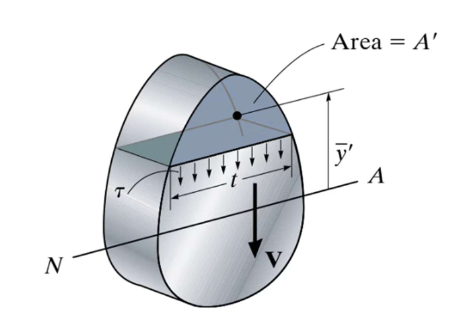
The shear formula assumes the stress is constant along the width of the member?
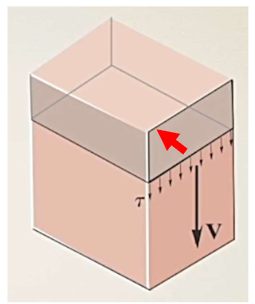
In what direction does the longitudinal shear stress act along the length of the beam?
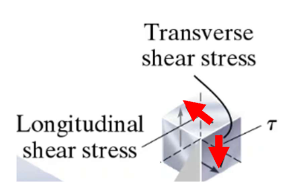
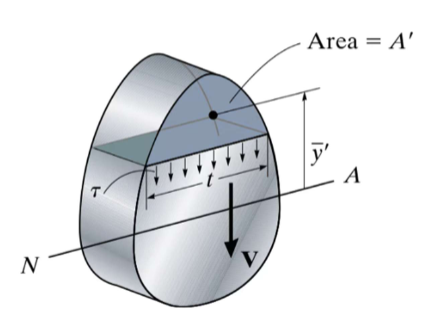
Does the shear formula give the average shear stress across the width of the member?
Can the shear formula be used if the material is non-homogeneous
Material must be homogeneous, linear elastic, and non-yielding to be analyzed by any SoM equations
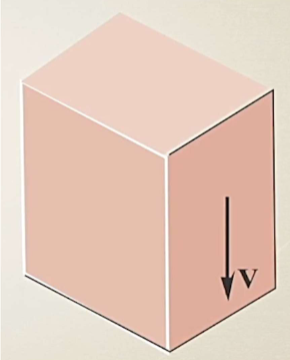
Where on the beam cross-section is Q = 0
Q = ŷ’A’
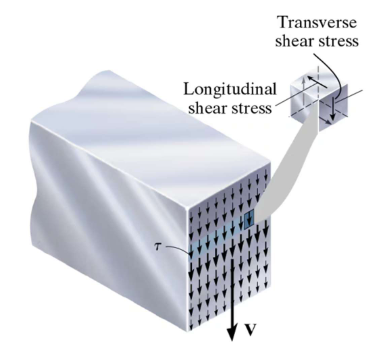
For a rectangular cross-section, will the maximum shear stress occur at the neutral axis?
Is it always true that the maximum shear stress occurs where Q is a maximum?
Ratio Q/t must be a maximum
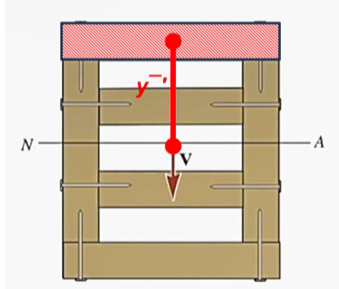
Is Q the moment of area of the cross-section about the neutral axis that is above or below the point where the shear stress or the shear flow is to be determined?
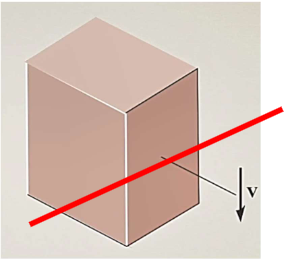
For a rectangular cross-section, where is shear flow greatest?
q = VQ/I; Q = ŷ’A’
Can the shear flow formula be used when the material yields?
Can the shear flow formula be used if the material is non-homogeneous?
Can shear flow on a beam only be determined if the material is linear elastic?