Speech & Hearing Sciences Ch. 8
 Call Kai
 Learn
Learn Practice Test
 Spaced Repetition
 Match
Match Flashcards
 Knowt Play
1/19

There's no tags or description
Looks like no tags are added yet.
Name | Mastery | Learn | Test | Matching | Spaced | Call with Kai |
|---|
No analytics yet
Send a link to your students to track their progress
20 Terms
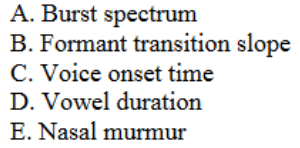
Which acoustic cue is most directly affected by transglottal airflow during stop production?
voice and onset time
Voiceless stops always exhibit complete silence during the stop gap regardless of context.
false
The time between stop release and onset of voicing is called ________.
voice onset time (VOT)
How does VOT differ between voiced and voiceless stops.
Voiced stops typically have short, zero, or negative VOT (prevoicing), whereas voiceless stops have longer positive VOT, often with aspiration.
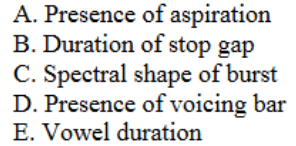
Which feature best distinguishes bilabial from velar stops acoustically?
Spectral shape of burst
Aspiration occurs after both voiced and voiceless stops equally.
false
Simultaneous articulation of adjacent phonemes is called ________.
coarticulation
Describe anticipatory vs retentive coarticulation.
Anticipatory coarticulation is when an upcoming sound influences the current sound; retentive coarticulation is when effects of a preceding sound carry over into the following sound.
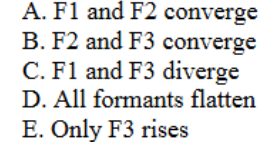
Which pattern would indicate a velar “pinch”?
F2 and F3 converge