Final Exam (all material) - Microbio
 Call Kai
 Learn
Learn Practice Test
 Spaced Repetition
 Match
Match Flashcards
 Knowt Play
1/656

There's no tags or description
Looks like no tags are added yet.
Name | Mastery | Learn | Test | Matching | Spaced | Call with Kai |
|---|
No analytics yet
Send a link to your students to track their progress
657 Terms
what does CRISPR stand for?
clustered regularly interspaced short palindromic repeats
why can’t we use restriction endonucleases to edit DNA in cells?
their recognition sequences occur too frequently in the genome
what is CRISPR?
a form of bacterial adaptive immunity
gives bacteria a way to remember prior, unsuccessful phage infections and defend against them
how did researchers find out about CRISPR loci?
found that bacterial genomes often had arrays of short repeat sequences separated by random-looking spacer sequences—> spacer sequences very important
what are spacer sequences in the CRISPR locus?
sequences acquired from phage DNA after unsuccessful infections
essentially a memory of prior unsuccessful phage infections
how are new spacers formed from the CRISPR system?
CRISPR systems have dedicated enzymes (Cas1, Cas2) that cut out phage DNA and insert them into the bacterial genome
what happens to spacer arrays in the genome in CRISPR
transcribed into a long RNA
RNA is processed into short guide RNAs (gRNAs)—> the other side of gRNA is constant, which helps load it into the main CRISPR enzyme
each gRNA has a segment that is complementary to phage DNA
how does the CRISPR system (Type II), using gRNAs, prevent phage infection
guide RNAs dock onto enzyme Cas9 (DNA nuclease)
gRNA guides Cas9 to complementary sequences of DNA
in subsequent phage infection, the gRNA derived from the prior phage encounter can guide CAs9 to cleave phage DNA
what is Cas9?
a DNA nuclease enzyme
unlike restriction endonucleases, it can’t recognize any DNA sequences on its own—> requires the gRNA as a guide
how can researchers use CRISPR as a super-specific nuclease?
design custom gRNA sequences that target the CRISPR machinery to specific sequences of DNA→ cleave it
cell will try to repair the break using similar sequences as a guide
specialized repair templates cam also be introduced that encourage the cell to make specific edits (can make mutations, deletions, insertions)
what is the purpose of engineering enzymatically defective Cas9 that tightly binds to DNA, but doesn’t cleave?
can be used to block transcription of specific genes
what are some proteins that may be bound to Cas9?
fluorophores, transcriptional activators
chimeric embryo
only certain lineages of cells carry a mutation
can CRISPR/Cas9 enzymes be injected into individual cells?
yes, and it will successfully edit DNA
can be used to create a chimeric embryo, where only certain lineages of cells carry a mutation
what is an example of the first ex vivo CRISPR therapy?
approved in US in 2023 to treat sickle cell disease
hematopoietic stem cells are modified outside the body to correct the mutation, then are reintroduced
how can ex vivo CRISPR be used to treat cancer?
can be used to modify T-cells from a cancer patient
immune cells are modified to target a protein enriched on those specific tumor cells
modified T-cells reintroduced into the patient, directing the immune system to attack the tumor
CAR T therapy
what are the various applications of CRISPR?
-make targeted deletions/mutations/insertions in bacterial and eukaryotic cells for research
-use dCas9 to inhibit expression of essential genes
-construct high-throughput cell-based screens incorporating individual mutations or gene deletions
-rapidly engineer recombinant organisms, eg for agriculture or biofuels
-use in conjunction with gene therapy to edit patient DNA to treat genetic disorders
what are the limitations to CRISPR/Cas9?
there is some rate of off-target Cas9 mutations, so mutations can be made elsewhere in the genome. This is hard to detect, and raises concerns of cancer in therapeutic contexts
what is phenylketonuria?
inherited metabolic disease
the metabolic enzyme in phenylalanine hydroxylase converts the amino acid phenylalanine into tyrosine
if the enzyme is inactive due to a mutation, phenylalanine (and derivatives) accumulate in tissues, especially in the brain, causing developmental and intellectual disorders
treatment usually requires following a modified diet; intervention at birth can prevent symptom onset (injectable enzyme therapy was recently developed)
how might you introduce a functional copy of the gene encoding phenylalanine hydroxylase in a patient with phenylketonuria?
introduce an extra copy of the functional gene to cells in the patient
directly edit the genome of some cells in patient to correct the defect
isolate cells, modify them in vitro, then re-introduce them to a patient
what is gene therapy by a viral vector?
we can engineer viral particles that carry custom genetic information, for example, a functional copy of a non-functional gene
these viral particles don’t carry their normal viral genome and cannot replicate
introduced DNA can persist in treated cells for years, so one dose can have a long effect
what are the concerns of gene therapy by viral vector?
safety→ patient can have a massive immune response to the virus used to transport the gene
ex. Jesse Gelsinger died from a massive immune response to the adenovirus vector → took 15 years for the field to work past these issues
how can we prevent creating a viral infection when using viral vectors in gene therapy?
by using adeno-associated virus (AAV)
AAV is a tiny ssDNA virus that doesn’t encode enough genes to replicate independently
it can only replicate when the cell is co-infected with adenovirus (or some other helper virus)
AAV uses the adeno-virus encoded proteins to replicate
what virus does gene therapy use for viral vectors to prevent infection?
recombinant AAV vectors, since they can’t cause sustained viral infections, even if wild-type AAV were accidentally introduced
what is the ideal disease to treat by gene therapy?
disease caused by a defective copy of a single gene
many metabolic disorders meet this criteria
—many disorders that can be treated are quite rare
other targets: spinal muscular atrophy, T-cell modification to target cancer (CAR-T), mitochondrial disorders, arthritis, angiogenesis to treat circulatory disorders, etc.
Luxturna
approved in 2018 to treat a specific form of congenital blindness
AAV vector is delivered by injection to the retina
costs $850,000
Hemgenix
approved in 2022 to treat hemophilia B
AAV vector targets the liver, introducing a functional copy of blood clotting Factor IX
fomites
inanimate objects that may carry microbial contamination
may be treated with more aggressive control methods, or for a longer time, to achieve lower levels of contamination
Disinfection
use on fomites
reduces or destroys microbial load of an inanimate item through application of heat or antimicrobial chemicals
cleaning surfaces like lab benches, clinical surfaces, bathrooms
ex. chlorine bleach, phenols (Lysol) glutaraldehyde
what method for controlling microbial growth should be used for cleaning surfaces like laboratory benches, clinical surfaces, and bathrooms?
disinfection
ex. chlorine bleach, phenols (Lysol) glutaraldehyde
sanitization
use on fomites
reduces microbial load of an inanimate item to safe public health levels through application of heat or antimicrobial chemicals
commercial dishwashing of eating utensils, cleaning public restrooms
ex. detergents containing phosphates, industrial strength cleaners containing quaternary ammonium compounds
what method for controlling microbial growth should be used for commercial dishwashing of eating utensils, cleaning public restrooms?
sanitization
ex. detergents containing phosphates (Finish), industrial strength cleaners containing quaternary ammonium compounds
sterilization
completely eliminates all vegetative cells, endospores, and viruses from an inanimate item
preparation of surgical equipment and of needles used for injection
ex. pressurized steam (autoclave), chemicals, radiation
what method for controlling microbial growth should be used for preparation of surgical equipment and of needles used for injection?
sterilization
ex. pressurized steam (autoclave), chemicals, radiation
what methods for controlling microbial growth should only be used on fomites (as opposed to skin)
disinfection, sanitization, sterilization
what controlling microbial growth techniques can be used on living tissue?
antisepsis, degerming
antisepsis
reduces microbial load on skin or tissue through application of an antimicrobial chemical
cleaning skin broken due to injury; cleaning skin before surgery
ex. boric acid, isopropyl alcohol, hydrogen peroxide, iodine (betadine)
what method for controlling microbial growth should be used for cleaning skin broken due to injury; cleaning skin before surgery
antisepsis
ex. boric acid, isopropyl alcohol, hydrogen peroxide, iodine (betadine)
degerming
reduces microbial load on skin or tissue through gentle to firm scrubbing and the use of mild chemicals
handwashing
ex. soap, alcohol swab
what is an application of degerming?
handwashing using soap or an alcohol swab
aseptic technique
involves a set of protocols that maintain sterility (asepsis), thus preventing contamination of the patient with microbes
what can failure of aseptic technique cause?
can put a clinical patient at risk for sepsis, a systemic inflammatory response to systemic infection
what is sepsis?
a systemic inflammatory response to systemic infection
what are the categories of microbial control methods?
physical→ heat, radiation
chemical→ gas, liquid
mechanical removal→ filtration
biological→ virus, toxin
individual methods are typically tailored to work on either object or living organisms
what are the physical microbial control methods?
heat
refrigeration and freezing
pressure
desiccation
radiation
filtration
what are the chemical microbial control methods?
gas, liquid
what are the mechanical removal microbial control methods?
filtration
what are the biological microbial control methods?
virus, toxin
what represents how treatments don’t kill all microorganisms instantly?
microbial death curve
-killing is a probabilistic process
-microbial populations usually die exponentially (fixed percentage dies per unit time)
-gives a straight line on a semi-log plot
-efficacy of killing agent is measured by D-value→ decimal reduction time; time to kill 90%= 1 Log10 unit
what is the D-value on a microbial death curve?
how the efficacy of a killing agent is determined
stands for decimal reduction time
time to kill 90%= 1 Log10 unit
what is heat killing a function of?
temperature and time
various microorganisms respond differently to high temps; endospore formers such as Clostridium botulinum are more heat tolerant
boiling does not kill all microbes→ some endospores survive >20 hours of boiling (and it’s less effective at higher altitudes)
methods of heat controlling microbial growth
boiling (100ºC, sea level)→ denature proteins, alters membranes
dry-heat oven (170ºC, 2 hrs)→ denatures proteins, alters membranes, dehydration, dessication
incineration (flame)→ destroy by burning
autoclave (121ºC, 15 min, 15psi)→ denatures proteins, alters membranes
pasteurization (varies, typically 72ºC, 15s)→ denature proteins, alter membranes
autoclaves
rely on moist heat sterilization and raise temps above the boiling pt. of water; considered the most effective method of sterilization
internal indicators used to ensure sterilization—> heat sensitive autoclave tape, biological indicator spore test (determine if endospores are killed)
pasteurization
boiling and autoclaving damage foods—> this method uses heat, but does not render the food sterile (to preserve it)
reduces the number of spoilage-causing microbes while maintaining food quality
Steps:
-LTH (low temp. holding)= 63ºC, 30 min
-HTST (high temp., short time)= 72ºC, 15s → lowers bacterial #s while preserving quality of milk
-UHT (ultra high temp.)= 138ºC >2s → UHT pasteurized milk can be stored for a long time in sealed containers w/o being refrigerated
what are the steps to pasteurization?
-LTH (low temp. holding)= 63ºC, 30 min
-HTST (high temp., short time)= 72ºC, 15s → lowers bacterial #s while preserving quality of milk
-UTH (ultra high temp.)= 138ºC >2s → UHT pasteurized milk can be stored for a long time in sealed containers w/o being refrigerated
refrigeration
0-7ºC
inhibits metabolism (slows/arrests cell division)
preservation of food or laboratory materials (solutions, cultures)
freezing
below -2ºC
stops metabolism, may kill microbes
long-term storage of food, laboratory cultures, or medical specimens
-bacterial cultures and medical specimens requiring long term storage or transport are often frozen at ultra-low temps (dry ice -70ºC or liquid nitrogen tanks -196ºC)
what are methods that use pressure to control microbial growth?
high-pressure processing (100-800 MPa)—> denatures proteins, can cause cell lysis; preservation of food
hyberbaric oxygen therapy (air pressure 3x higher than normal)→ inhibits metabolism and growth of anaerobic microbes; treatment of certain infections (ex. gas gangrene)
how can pressure be used to preserve food?
kills microbes while maintaining food quality and extending shelf life. High pressure between 100 and 800 MPa (sea level is ~0.1MPa) kills vegetative cells by denaturing proteins
how can pressure be used clinically in treatment of infections?
hyperbaric oxygen therapy is used; patient breathes pure oxygen at ~1-3 atmospheres (atm)
inhibits the growth of oxygen-sensitive or anaerobic bacteria
what are forms of desiccation?
simple (drying)→ inhibits metabolism; dried fruits, jerky
reduce water activity (addition of salt or water)→ inhibits metabolism and can cause lysis; salted meats and fish, honey, jams and jellies
lyophilization (rapid freezing under vacuum)→ inhibits metabolism; preservation of food, laboratory cultures, or reagents
what does removing water (simple desiccation) do to bacteria?
slows/halts bacterial growth w/o killing microbes
lyophilization
involves freezing and applying vacuum so that water is lost by sublimation
combines both exposure to cold temperatures and desiccation
how can water activity/water content be lowered?
by adding solutes such as salts or sugars
at very high concentration of salts/sugars, the amount of water in microbial cells is reduced dramatically due to osmosis
ionizing radiation (sterilization)
x-rays, gamma rays, and high E e- beams
penetrates cells, directly damages biological molecules
causes DNA mutations, leading to cell death
x-rays and gamma rays penetrate paper and plastic to sterilize packaged materials
nonionizing radiation
ultraviolet (UV) light
less energetic, less penetrating. Used for surface disinfection
causes thymine dimers to form between adjacent thymines in DNA
disinfection of surfaces in laboratories and rooms in healthcare environment, and disinfection of water and air
filtration
physical separation of microbes from air or liquid
uses filters with pores of specific sizes
ideal when liquids contain heat-sensitive components
ex. High efficiency particulate air (HEPA) filters, membrane filters
High efficiency particulate air (HEPA) filters
pores ~0.3 µm filter out bacteria, endospores, and many viruses
efficiency is 99.97% for particles of 0.3 µm diameter or morem
membrane filters
porous membranes with defined pore sizes
microbes removed by physical screening
-cellular microbes ≥ 0.2 µm
-viruses ≥ 0.1 µm
face masks
surgical and K95 respirators reduce outward particle emission rate by 90% and 74%
for coughing, which produced the highest rates of particle emission for all expiratory activities tested, wearing homemade masks considerably reduced the fraction of large particles (> 0.8 µm)
chemicals that can be used for disinfection
phenolics—> denature proteins, disrupt membranes
metals→ bind to proteins and inhibit enzyme activity
halogens→ oxidation and destabilization of cellular macromolecules
alcohols→ denature proteins, disrupt membranes
surfactants→ lowers surface tension of water to help with washing away of microbes, and disruption of cell membranes
bisbiguanides→ disruption of cell membranes
alkylating agents→ inactivation of enzymes and nucleic acid
peroxygens→ oxidation and destabilization of cellular macromolecules
supercritical gases→ penetrates cells, forms carbonic acid, lowers intracellular pH
chemical food preservatives→ decrease pH, inhibit enzymatic function
natural food preservatives→ inhibition of cell wall synthesis
Chemical control of microbial growth: how do phenolics inhibit microbes?
denature proteins, disrupt membranes
Chemical control of microbial growth: how do metals inhibit microbes?
bind to proteins and inhibit enzyme activity
Chemical control of microbial growth: how do halogens inhibit microbes?
oxidation and destabilization of cellular macromolecules
Chemical control of microbial growth: how do alcohols inhibit microbes?
denature proteins and disrupt membranes
Chemical control of microbial growth: how do surfactants inhibit microbes?
lowers surface tension of water to help with washing away of microbes, and disruption of cell membranes
Chemical control of microbial growth: how do bisbiguanides inhibit microbes?
disruption of cell membranes
Chemical control of microbial growth: how do alkylating agents inhibit microbes?
inactivation of enzymes and nucleic acid
Chemical control of microbial growth: how do peroxygens inhibit microbes?
oxidation and destabilization of cellular macromolecules
Chemical control of microbial growth: how do supercritical gases inhibit microbes?
penetrates cells, forms carbonic acid, lowers intracellular pH
Chemical control of microbial growth: how do chemical food preservatives inhibit microbes?
decrease pH and inhibit enzymatic function
Chemical control of microbial growth: how do natural food preservatives inhibit microbes?
inhibition of cell wall synthesis (Nisin)
disk diffusion method
assesses the effectiveness of chemical microbial agents
filter disks containing chemical placed on an agar plate inoculated w bacterium
compound diffuses and causes zones of inhibition of microbial growth
size of zone correlates w/ potency of compound
in-use test
determines whether an actively used solution of disinfectant in a clinical setting is microbially contaminated
-add an amount of disinfectant to a sterile broth and plate it→ if there are more than 5 colonies growing on either plate that incubate @ 37ºC for 3 days or @ room temp for 7 days, the disinfectant solution is contaminated
Koch’s postulates
link infectious agent with a disease
-causative microbe must be present in diseased organisms, but not healthy organisms
-must be able to isolate the causative organism in pure culture
-must be able to infect healthy organism with the isolated culture
-must be able to re-isolate microbe from experimentally infected organism
do Koch’s postulates hold true for all infectious diseases?
no
-some pathogens are part of the normal microbiome
-some diseases involve multiple agents, or can be caused by different microbes
-some infections have varied symptoms (pleiotropic)
-some infectious agents can’t be cultured
pathogens cause…
infectious disease in host organisms
host is a source of nutrients
primary pathogens
almost always cause disease
ex. some Salmonella enterica strains; enterohemorrhagic E. coli
opportunistic pathogen
common
normally exist outside of the host
cause infection under the right circumstances age, weakened immune system, injury
ex. Staphylococcus epidermis
obligate pathogens
cannot exist outside of host in the natural environment (perhaps can be cultured in lab)
ex. Chlamydia, Rickettsia, Mycobacteria
how do pathogens often exist as?
in a reservoir; natural population outside of the host
-ex. drinking water supply, soil, etc.; animal population—> zoonoses; organisms that spread the infection—> vectors
zoonoses
pathogens existing in an animal population
ex. rabies and influenza
vectors
organisms that spread pathogens
-arthropods like mosquitos carrying malaria
extracellular pathogens
exist on or in host fluids and tissues, but do not enter host cells
may move thru circulatory system or migrate through the matrix between host cells
can directly encounter elements of the immune system
ex. E. coli, Staphylococcus aureus, Helicobacter pylori, Borella burgdorferi
intracellular pathogen
microbes enter and multiply within host cells
allows them to evade many elements of the host immune system
ex. Listeria monocytogenes, Mycobacterium tuberculosis, Salmonella enterica, Legionella pneumophila
what is the characteristic pattern of infection progression?
incubation period, prodromal stage, period of illness, period of decline, convalescence
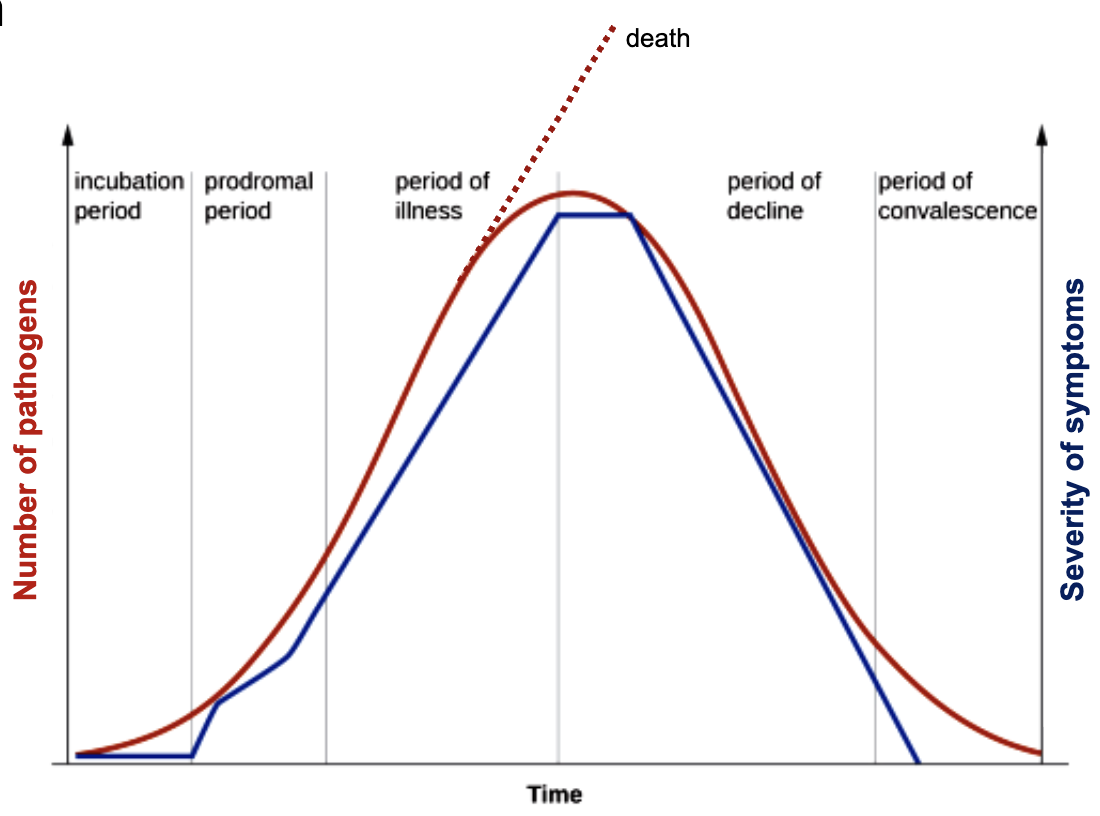
infection progression: incubation period
pathogen entry, before symptoms
infection progression: prodromal stage
first onset of symptoms
infection progression: period of illness
disease is most severe, symptoms apparent
infection progression; period of decline
body fights off infection