3.4.2 - DNA and protein synthesis
 Call Kai
 Learn
Learn Practice Test
 Spaced Repetition
 Match
Match Flashcards
 Knowt Play
1/11

There's no tags or description
Looks like no tags are added yet.
Name | Mastery | Learn | Test | Matching | Spaced | Call with Kai |
|---|
No analytics yet
Send a link to your students to track their progress
12 Terms
What is a codon?
3 bases on RNA that code for a specific amino acid
What is the genome?
The complete set of an organisms DNA in a cell
What is the proteome?
The full range of proteins that a cell is able to produce
Where is tRNA located?
In the cytoplasm
What is the structure of tRNA?
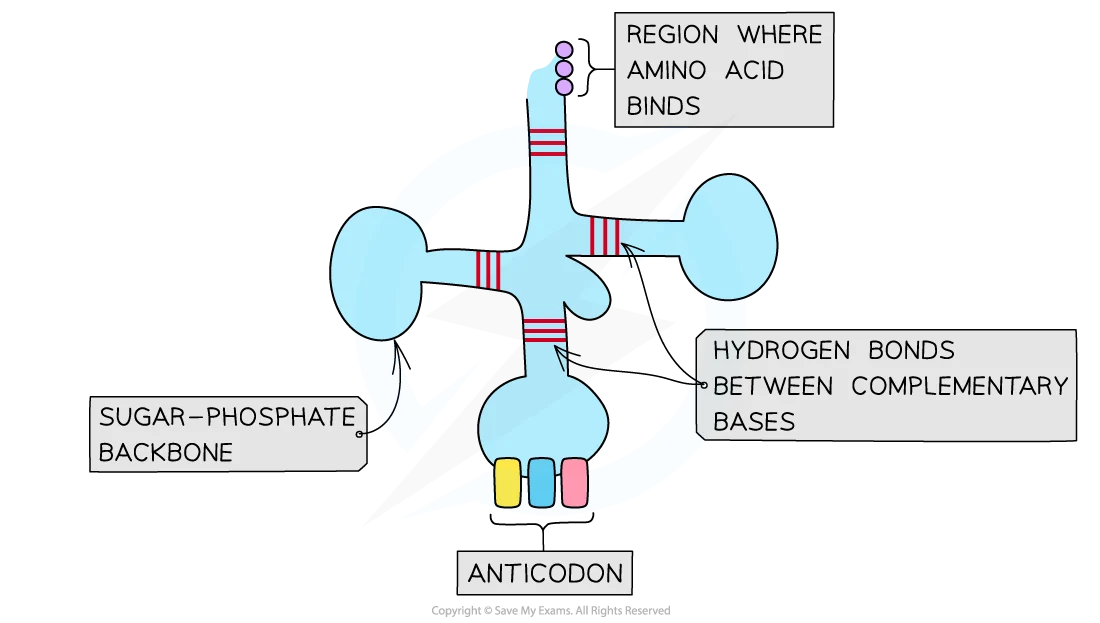
What holds the shape of tRNA together?
H bonds
What is an anticodon?
A triplet of RNA bases that are complementary to codons on the mRNA molecule
What is rRNA used for?
It combines with proteins to make ribosomes
Why is mRNA being shorter an advantage?
It is able to fit through nuclear pores
Describe the steps in transcription
The H bonds between DNA bases break causing the double helix to unwind and separate leaving bases exposed
Only one of the strands acts as a template and free nucleotides align to exposed bases due to complementary base pairing
RNA polymerase then forms phosphodiester bonds between the RNA nucleotides
What is splicing?
When introns are removed for pre-mRNA
Describe the steps in translation
The modified mRNA leaves the nucleus and mRNA attaches to a ribosome
A tRNA molecule - with a specific amino acid -will bind to the complementary codon on mRNA via its anticodon
The ribosome joins the amino acids together using a peptide bond
ATP is needed for the joining of the amino acids and also to join the amino acid to the tRNA molecule
The ribosome moves along the mRNA and the process repeats with new tRNA molecules binding and more amino acids joining together
This continues until a stop codon is reached and the polypeptide is released from the ribosome