Gen Chem 2 Midterm
 Call Kai
 Learn
Learn Practice Test
 Spaced Repetition
 Match
Match Flashcards
 Knowt Play
1/129

There's no tags or description
Looks like no tags are added yet.
Name | Mastery | Learn | Test | Matching | Spaced | Call with Kai |
|---|
No analytics yet
Send a link to your students to track their progress
130 Terms
gas
Identify the state of matter that is the most compressible.
3
In DNA, cytosine and guanine hydrogen bond to each other with ________ hydrogen bonds.
CH3CH2CH3
Identify the compound with the lowest boiling point.
Ice is less dense than water.
Explain why ice floats in water.
critical temperature
Give the term for the temperature at which the gas and liquid phases form a supercritical fluid.
11.46
The enthalpy change for converting 1.00 mol of ice at -25.0°C to water at 60.0°C is ______ kj. The specific heats of ice, water, and steam are 2.09 J/gK, and 1.84 J/gK, respectively.
5.53 kJ
Calculate the total quantity of heat required to convert 25.0 g of liquid CCl4(l) from 45.0°C to gaseous CCl4 at 76.8°C (the normal boiling point for CCl4).
350 kJ
How much heat is released when 115 g of steam at 100.0°C is cooled to ice at -15.0°C? The enthalpy of vaporization of water is 40.67 kJ/mol, the enthalpy of fusion for water is 6.01 kJ/mol, the molar heat capacity of liquid water is 75.4 J/(mol ∙ °C), and the molar heat capacity of ice is 36.4 J/(mol ∙ °C).
fusion, followed by vaporization
Consider the phase diagram below. If the dashed line at 1 atm of pressure is followed from 90 to 450°C, what phase changes will occur (in order of increasing temperature)?
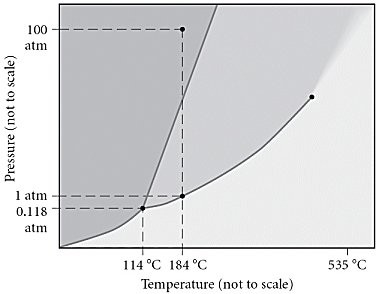
4.95 kJ
Ethanol (C2H5OH) melts at -114°C. The enthalpy of fusion is 5.02 kJ/mol. The specific heats of solid and liquid ethanol are 0.97 J/gK and 2.3 J/gK, respectively. How much heat (kJ) is needed to convert 25.0 g of solid ethanol at -125°C to liquid ethanol at -80°C?
edge length = 2√2r, 74% packing efficiency
Identify the characteristics of a face-centered cubic cell.
graphite.
An allotrope of carbon that consists of flat sheets of carbon atoms covalently bonded together as interconnected hexagonal rings is called

Which of the following represent the addition polymer formed from the compound below?
CH2=CHCl
polyurethane
Identify the condensation polymer.
edge length = 4r/√3, 68% packing efficiency
Identify the characteristics of a body-centered cubic cell.
6
How many O2- ions are around each Mg2+ ion in MgO, which has a cubic unit cell with O2- ions on each corner and each face?
Cu SO4
Which of the following forms an ionic solid?
4 Mg2+ ions and 4 O2- ions
MgO crystallizes in a cubic unit cell with O2- ions on each corner and each face. How many Mg2+ and O2- ions are in each unit cell of MgO?
MgO
Which of the following substances should have the highest melting point?
495 pm
What is the edge length of a face-centered cubic unit cell made up of atoms having a radius of 175 pm?
Carbon dioxide
________ is the gas dissolved in carbonated drinks.
molality
Give the term for the amount of solute in moles per kilogram of solvent.
molarity
Give the term for the amount of solute in moles per liter of solution.
miscible
If two substances are soluble in all proportions then they are ________ in each other.
ethylene glycol (HOCH2CH2OH)
Which of the following compounds will be most soluble in ethanol (CH3CH2OH)?
0.500 M
Calculate the molarity of a solution that contains 0.300 moles of LiF in 0.600 L of water.
109
Parts per billion requires a multiplication factor of ________.
18.1 g
What mass of SrBr2 is contained in 80.85 g of a 22.4% by mass solution of SrBr2 in water?
6.07 × 10⁻² mol NaI
How many moles of NaI are contained in 3470 g of water in a 0.0175 m NaI solution?
5.2 ppm
A 1.00 L sample of water contains 0.0052 g of OCH3⁻ ions. Determine the concentration of OCH3⁻ ions in ppm if the density of the solution is 1.00 g/mL.
ln[reactant] vs. time
What data should be plotted to show that experimental concentration data fits a first-order reaction?
the slowest step
Identify the rate-determining step.
The rate of the reaction is not proportional to the concentration of the reactant.
Give the characteristic of a zero-order reaction having only one reactant.
diffusion.
In the hydrogenation of double bonds, a catalyst is needed. In the second step, the reactants diffuse on the surface until they approach each other. This step is known as
The rate of the reaction is directly proportional to the concentration of the reactant.
Give the characteristic of a first-order reaction having only one reactant.
1/ M3 x s
What are the units of k in the following rate law?
Rate = k[X]2[Y]2
Rate = 5.2 × 10⁻3 s-1[N2O5]
Determine the rate law and the value of k for the following reaction using the data provided.
2 N2O5(g) → 4 NO2(g) + O2(g) [N2O5]i (M) Initial Rate (M-1s-1)
0.123 6.40 × 10⁻⁴
0.174 9.05 × 10⁻⁴
0.224 1.16 × 10⁻³
2
How many half-lives are required for the concentration of reactant to decrease to 25% of its original value?
4.5 × 10³ yr
Carbon-14, which is present in all living tissue, radioactively decays via a first-order process. A one-gram sample of wood taken from a living tree gives a rate for carbon-14 decay of 13.6 counts per minute. If the half-life for carbon-14 is 5720 years, how old is a wood sample that gives a rate for carbon-14 decay of 7.9 counts per minute?
1/ Ms
What are the units of k in a second-order reaction?
independent of the concentration of [A]
0 order
directly proportional to the concentration of [A]
1st order
rate increased as the spuare of [A]
2nd order
the sum of all order with respect to each reactant
overall order
solubility
freezing point
melting point
density
Which of the following are characteristic properties?
moles of solute per liter of solution
Molarity
number of moles of solute per kilogram of solvent
Molality
gas
Bubbles are produced in a reaction when a _______ is created as a product.
temperature, pH, enzyme concentration, substrate concentration
What environmental factors will affect an enzyme's ability to catalyze a reaction?
increase
Does salt solubility increase or decrease as temperature increases?
true
Rate of chemical reaction is measured by the change in concentration per unit of time.
can be observed or measured without changing the identity of a sub
Match the characteristic property with its definition. Physical
change a chemical’s identity
Match the characteristic property with its definition. Chemical
100 mL of solvent
What unit is solubility measured in?
grams of solute ?
partial dissociation
Match the van't Hoff factor with its dissociation relationship. 1
total dissociation
Match the van't Hoff factor with its dissociation relationship. 2
rate law
What is this an example of?
rate = k [I-]1.5 {S2O8]
true
Sample size does not change the melting or boiling of a substance.
elevation
Impurities will cause a(n) ___________ in the boiling point.
water
What is considered the universal solvent?
15,000
Calculate the freezing point depression constant given the following values:
m= 0.001 kg
change in temperature= 15 degrees Celsius
(Hint: The units will be degrees Celsius/mol-1 kg.)
acidic , alkaline
H+ and OH-
false
Denaturation is a term that refers to an enzyme releasing the products of a reaction and returns to its original shape.
False
If a substrate encounters an active site of an enzyme, the substrate has to change shape to fit the enzyme.
protein
Most enzymes are what type of biological material?
the phase transition from solid to liquid
Define fusion.
Vapor pressure increases with temperature.
Which of the following statements is TRUE?
solid
Which one of the following has a definite shape and volume?
hydrogen bonding
The two strands in DNA are held together by
7.31
The enthalpy change for converting 10.0 g of ice at -50.0°C to water at 70.0°C is ________ kJ. The specific heats of ice, water, and steam are
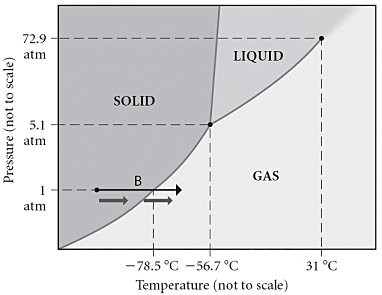
The solid phase of this substance is higher in density than the liquid phase.
Consider the phase diagram shown. Choose the statement below that is TRUE.
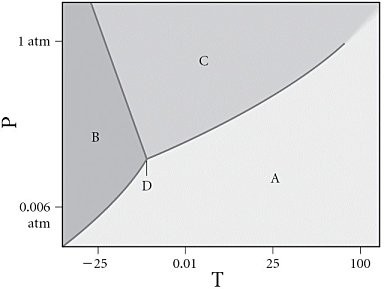
A = gas, B = solid, C = liquid, D = triple point
Assign the appropriate labels to the phase diagram shown below.
carbon
Identify the element with the largest band gap.
edge length = 2r, 52% packing efficiency
Identify the characteristics of a simple cubic cell.
weak dispersion forces
Identify the type of interaction between atoms in a nonbonding atomic solid.
silver iodide
Identify the compound that has the zinc blende structure.
128 ptm
Copper has a face-centered cubic structure and has a density of 8.96 g/cm3. What is its atomic radius?
517 pm
Barium has a radius of 224 pm and crystallizes in a body-centered cubic structure. What is the edge length of the unit cell?
354 pm
Nickel crystallizes in a face-centered cubic structure. What is the edge length of the unit cell if the atomic radius of nickel is 125 pm?
hyposmotic.
Solutions having osmotic pressures less than those of body fluids are called
The solution is considered saturated.
A solution is formed at room temperature by vigorously dissolving enough of the solid solute so that some solid remains at the bottom of the solution. Which statement below is TRUE?
a mixture in which a dispersed substance is finely divided in a dispersing medium
Define colloid.
0.0628 mol/L
The Henry's Law constant of methyl bromide, CH3Br, is k = 0.159 mol/(L ∙ atm) at 25°C. What is the solubility of methyl bromide in water at 25°C and at a partial pressure of 300. mm Hg?
0.36 atm
Determine the partial pressure of oxygen necessary to form an aqueous solution that is 4.7 × 10⁻⁴ M O2 at 25°C. The Henry's law constant for oxygen in water at 25°C is 1.3 × 10⁻³ M/atm.
1.00 kg of solvent.
To make a 0.125 m solution, one could take 0.125 moles of solute and add
0.20 M
Determine the solubility of CO2 in soda water at 25°C if the pressure of CO2 is 6.0 atm. The Henry's law constant for carbon dioxide in water at this temperature is 3.4 × 10⁻² M/atm.
10.1 g
A solution is 2.25% by weight CsF . How many grams of CsF are in 450.0 g of solution?
desorption.
In the hydrogenation of double bonds, a catalyst is needed. In the last step, the reactants must escape from the surface into the gas phase. This step is known as
Rate constants are temperature dependent.
Which of the following statements is TRUE?
2 N2O5 → 4 NO2 + O2
Write a balanced reaction for which the following rate relationships are true.
Rate = - ½ N2O5/ = ¼ NO2 = O2
1/[reactant] vs. time
What data should be plotted to show that experimental concentration data fits a second-order reaction?
8.88 × 10⁻² M/s
Given the following balanced equation, determine the rate of reaction with respect to [Cl2]. If the rate of Cl2 loss is 4.44 × 10⁻² M/s, what is the rate of formation of NOCl?
2 NO(g) + Cl2(g) → 2 NOCl(g)
0.240 mol/min
The decomposition of dinitrogen pentoxide is described by the following chemical equation
2 N2O5(g) → 4 NO2(g) + O2(g)
If the rate of appearance of NO2 is equal to 0.960 mol/min at a particular moment, what is the rate of appearance of O2 at that moment?
2nd order
What is the overall order of the following reaction, given the rate law?
X + 2Y → 4Z Rate = k[X][Y]
depression
Impurities will cause a(n) ___________ in the melting point.
protein
Most enzymes are what type of biological material?
Polarity, pressure, molecular size, physical state of solute, surface area, and temp
Select all that will influence the solubility of a substance.
solute
substance being dissolved
solvent
substance doing the dissolving
solution
mixture of solvent and solute