Lab Methods
 Call Kai
 Learn
Learn Practice Test
 Spaced Repetition
 Match
Match Flashcards
 Knowt Play
1/41

There's no tags or description
Looks like no tags are added yet.
Name | Mastery | Learn | Test | Matching | Spaced | Call with Kai |
|---|
No analytics yet
Send a link to your students to track their progress
42 Terms
Flake Stone tools
chipped or knapped
Sharp edges required for cutting, scraping and piercing
Material requirements: hard, fine grained, homogenous
Ground Stone tools
pecked, ground, polished
Edges required for grinding, smashing, or splitting
Choice of material: dense, crystalline, resilient, homogenous
XRF (X-Ray Fluorescence)
Measures the elemental composition of a material and determines which elements are present
NAA (Neutron Activation Analysis)
Measures trace elements with very high precision
LA-ICP-MS (Laser Ablation Inductively Coupled Plasma Mass Spectrometry)
Measures trace-element concentrations at very low levels
what makes a stone knappable?
Homogeneity- even internal structure
Elasticity- ability to store and release energy when force is applied
Brittleness- breaks rather than deforms
Isotropy- fractures propagate evenly in all directions
Conchoidal fracture
glass like or smooth, curved, shell-like fracture surfaces.
Sub-conchoidal fracture
irregular, smooth on breaks but uneven; step or hinge fractures common.
Granular/crystalline fracture
breaks along grains or crystals; dull, angular fragments.
Anatomy of a flake
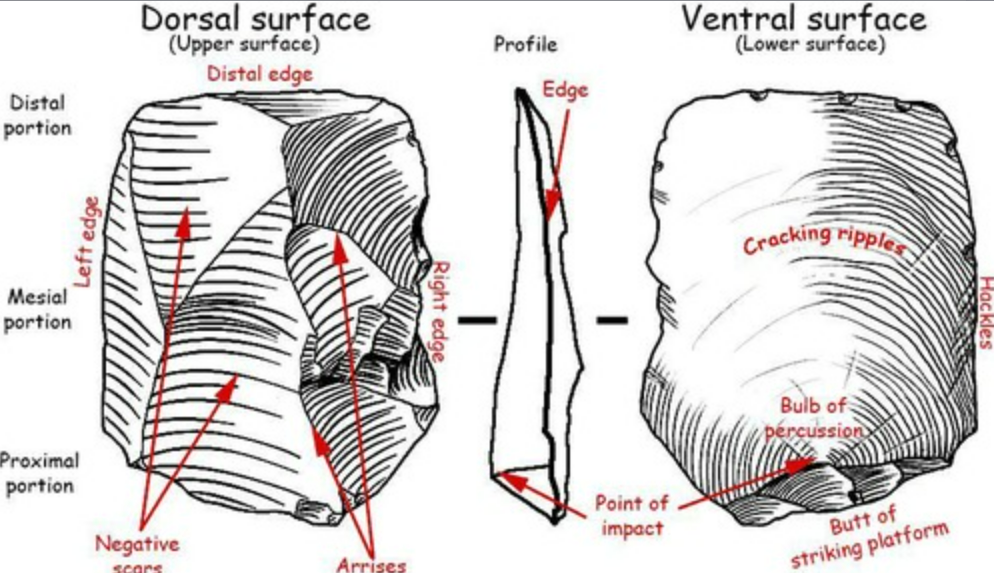
Cortex
outer layer of a rock
can be used as an indicator of the tools reduction stage
links between flake attributes and behaviour?
Economy: control and intent in flake production (efficiency, raw material management)
Process: Stage and structure of reduction (where in the sequence the flake comes from)
Strategy: Reduction strategy and technological tradition (how flakes were removed, not just when)
Ad hoc methods
Opportunistic, unplanned, low predictability in shape and size outcomes, and limited platform management
Bipolar methods
used to make flakes
Planned methods
pre-conceived core reduction methods
ex. Levallois
used to make blades
Biface
a stone artifact that has been intentionally flaked on both faces to shape, thin, and control its overall form.
Halfing module (base)
a set of dimensions and forms that make a biface fit and function within a haft
Approaches to debitage analysis
Attribute-based
type-based
stage-based
mass analysis
Attribute Based
measurable variables used to characterize flakes to identify the reduction processes and technological activities
Type Based
classificatory scheme that organizes variability in debitage.
stage-based
Classifies individual pieces of debitage on the amount of cortex on their dorsal surface
mass analysis
records mass by size gradient at the assemblage level
a pattern-recognition approach that correlates size distributions with particular reduction modes
retouch
removals made by percussion or pressure, with the intention of making, finishing or sharpening tools
Tool Attribute Analysis
Delineation: shape of the retouched edge
Extent: depth of retouch
Angle: formed by retouched edge
Localization: where on the blank
Morphology: of the retouched
Position: which side of the tool
Distribution: characteristics along edge
Use wear analysis
The study of microscopic modifications on a tool’s working edge or surface that result from use
What material was worked (e.g., hide, meat, wood, bone, plant fibres)
What motion was used (e.g., cutting, scraping, drilling, sawing)
Use wear analysis allows us to
Reconstruct specific tasks
Evaluate tool design and hafting
Assess tool use-life and maintenance
Reconstruct site activities and economic behaviour
What is a striking platform?
The specific surface on a stone core where a blow is struck to detach a flake.
What is a core?
A lithic artifact used as a base for which other tools and flakes are made
What is a flake?
A piece of stone removed from a larger piece (the core) via percussion or pressure.
what is the bulb of percussion
The small bump on a stone flake where the rock was hit with another stone to break it.
What does unifacial mean in lithics?
Tools that are only worked on one side.
What does bifacial mean in lithics
Tools that are worked on both sides.
What is the importance of non-local stone sources in lithics?
They indicate travel or trade networks among early humans.
Types of Chipped artifacts
objective pieces- hit, cracked, flakes, modified
detached pieces - removed from objective pieces during modification
Percussion flaking
Removal of flake/chip through striking the objective piece with a hammer or percussor
Pressure flaking
Removal of flake/chip by applying pressure to the objective piece w/o striking
more accuracy
ideal flake types
conchoidal
compression
bending
Igneous
obsidian
quartz
Metamorphic
quartzite
cortial
unimodified cortical surface of the objective piece
Flat
flat surfaces impacted to remove detached piece
complex
rounded or has multiple flake scars
abraded
smoothed by abrasion or rubbing