Introduction to Equity and Trusts
 Call Kai
 Learn
Learn Practice Test
 Spaced Repetition
 Match
Match Flashcards
 Knowt Play
1/7

There's no tags or description
Looks like no tags are added yet.
Name | Mastery | Learn | Test | Matching | Spaced | Call with Kai |
|---|
No analytics yet
Send a link to your students to track their progress
8 Terms
What is Equity?
‘Heavily influenced by the precepts of natural law, equity is chiefly occupied by concerns of conscience - that is, matters invoking fairness and equitable dealing… This is the ultimate ambition of equity: the fusion of the ethical with the legal.’
Michael Levenstein, Maxims of Equity : A Juridical Critique of the Ethics of Chancery Law (Algora Publishing 2013) 44
What Is Equity?
Equity is a system of law based on fairness, conscience, and justice, developed to fill gaps and correct unfairness in the common law. Levin described it as the “fusion of the ethical with the legal.”
Common Law & Equity Analogy
Common law and equity operate together but remain separate systems — like water and oil flowing in the same direction toward justice. This reflects the “fusion fallacy”: they complement rather than merge with one another.
Common Law v Equity
Common law focuses on strict legal rights and usually provides damages, whereas equity focuses on fairness and grants equitable remedies such as injunctions and specific performance. For example, breach of contract at common law leads to damages, while equity may order completion of the contract
Equitable Maxims - part 1
§ Equity will not suffer a wrong without a remedy (e.g. proprietary estoppel – see later in the course)
§ Equity follows the law (FHR European Ventures LLP and others v Cedar Capital Partners LLC [2015] A.C. 250, 269 per Lord Neuberger: ‘two general rules which law students learn early on are that common law legal rights prevail over equitable rights, and that where there are competing equitable rights the first in time prevails; yet, given that equity is far more ready to recognise proprietary rights than common law, the effect of having an equitable right is often to give priority over common law claims - sometimes even those which may have preceded the equitable right.’)
Key Equitable Maxims 1. Equity Will Not Suffer a Wrong Without a Remedy
Where the common law provides no remedy, equity may intervene, e.g. proprietary estoppel where someone relies on a promise to their detriment.
2. Equity Follows the Law
Equity works alongside rather than against common law, supplementing or restraining legal rules where fairness requires.
When Law & Equity Conflict
Generally, common law rights prevail over equitable rights, while competing equitable rights are decided by “first in time.” In FHR European Ventures LLP v Cedar Capital Partners, Lord Neuberger confirmed common law usually takes priority, though equity can sometimes recognise earlier proprietary rights.
3. Those Who Come to Equity Must Come With Clean Hands
A claimant seeking equitable relief must act honestly and fairly; equity will not assist someone acting unconscionably. This principle appeared in cases such as Re Uxey and Wright v Hodgkinson.
4. Equity Regards as Done That Which Ought to Be Done
Equity may treat an act as completed if it should have been completed. In Walsh v Lonsdale, equity recognised an equitable lease despite missing legal formalities.
5. Equity Will Not Perfect an Imperfect Gift
If legal formalities for a gift or trust are incomplete, equity will not complete them. In Milroy v Lord, the transfer failed because the settlor had not properly completed it. This reflects the principle that “equity will not assist a volunteer.
Equitable Maxims - part 2
§ Those who come to equity must come with clean hands (Re Bhusate [2019] EWHC 470 (Ch) at [57]; and Wright v Hodgkinson [2004] EWHC 3091 (Ch))
§ Equity sees as done that which ought to be done (Re Bhusate [2019] at [58]; and Walsh v Lonsdale (1882) 21 Ch. D. 9)
§ Equity will not perfect an imperfect gift (Milroy v Lord (1862) 45 E.R. 1185, 1189 per Bruce LJ – ‘I take the law of this Court to be well settled, that...the settler must have done everything which...was necessary to be done in order to transfer the property and render the settlement binding upon him...for there is no equity in this Court to perfect an imperfect gift.’; and Edwin Teong Ying Keat, ‘Beware the “gifted” Trojan horse: analysing the equitable maxim – “Equity will not prefect an imperfect gift”’ (September 2021) Vol 27(7) Trusts & Trustees 686-700)
‘Ultimately, the maxims of equity are useful to the extent (and perhaps only to the extent) that they guide what would otherwise be an even broader discretion, based upon that most enigmatic of ideas, “unconscionability”.’
What is a Trust?
core concepts of a trust:
A trust divides ownership into legal title, held by the trustee who controls the property, and equitable/beneficial title, held by the beneficiaries who enjoy the benefit of it. A trust is an equitable obligation requiring the trustee to manage property for the beneficiaries. Roles can overlap, so a settlor or trustee may also be a beneficiary.
Roles in a Trust
Role | Function |
|---|---|
Settlor | Creates the trust and transfers property; may also be trustee or beneficiary |
Trustee | Holds legal title and manages the property subject to fiduciary duties |
Beneficiary | Holds equitable title, benefits from the trust, and can enforce trustee duties |
Principles from Westdeutscher Landesbank v Islington
Equity acts on the conscience of the person who holds the legal title to property. However, a person cannot be treated as a trustee unless they are aware of the facts that would affect their conscience.
For a trust to exist, there must be identifiable property that is subject to the trust.
Once a trust is validly established, the beneficiary gains an equitable proprietary interest in that property from that moment. This interest can be enforced against anyone who later acquires the property—whether it is the original asset or something it has been converted into through tracing—except where the property is acquired by a bona fide purchaser for value without notice.
Why Create a Trust?
1) To create multiple interests – to A for life, remainder to B
Trusts allow different people to benefit at different times, e.g. a life tenant benefits during their lifetime while the capital later passes to children or relatives.
2) To hold property on behalf of infants who cannot hold legal title
As minors cannot hold legal title until 18, trustees hold and manage property on their behalf until it vests in them.
3) Tax avoidance (not evasion – illegal)
Trusts may be used for lawful tax planning and asset management, although these arrangements are heavily regulated.
4) Commercial interests – T holds property on trust until transaction between A and B complete
Trusts can temporarily hold property until transactions or conditions are completed, ensuring property is protected during commercial dealings.
5) To keep estates of land whole or within a family (entails)
Trusts can preserve family wealth and prevent land or property from being divided or lost outside the family line.
6) To protect the capital in the long-term for some future interest
Trusts help preserve capital for future beneficiaries or long-term interests, protecting assets from misuse or dissipation.
7) For charitable purposes – a public interest trust (e.g. National Trust)
Charitable trusts operate for public benefit, supporting organisations and assets such as parks, historic buildings, and charities like National Trust.
8) To ensure pets are cared for after the owner’s death – a hybrid trust
Trusts may be created to care for pets after an owner’s death. For example, Karl Lagerfeld famously left money for his cat through a hybrid trust administered by a human trustee.
Types of Trust
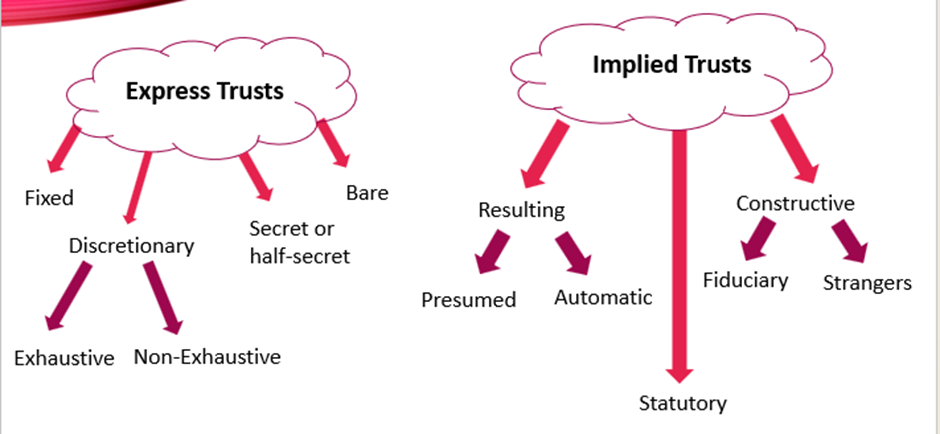
types of trusts detailed
Fixed/Bare Trust | Beneficiaries know what their interests are | Alastair Hudson, Equity and Trusts (10th edn, Routledge 2022) Chapter 3, 67 |
Discretionary Trust | Give trustees discretion - beneficiaries have no interest in the property until the trustees exercise their discretion | Alastair Hudson, Chapter 3, 132 |
Secret/Half-Secret Trust | A quirky trust where one tries to hide something, usually the beneficiary – a trust truly based on trust! | Alastair Hudson, Chapter 6, 262. |
Constructive Trust | Are implied – an equitable remedy? – e.g. mutual wills | Brian Sloan, Borkowski’s Law of Succession (4th edn, OUP 2020) Chapter 10, 369; and Alastair Hudson, Chapter 12, 490. |
Statutory Trust | Practical – e.g. statutory trusts on intestacy | Brian Sloan, Chapter 2, 38; and for an example of statutory trusts in commercial contexts see Alastair Hudson, Chapter 3, 114 |