Microbiology Exam 5
 Call Kai
 Learn
Learn Practice Test
 Spaced Repetition
 Match
Match Flashcards
 Knowt Play
1/55

There's no tags or description
Looks like no tags are added yet.
Name | Mastery | Learn | Test | Matching | Spaced | Call with Kai |
|---|
No analytics yet
Send a link to your students to track their progress
56 Terms
Obligate intracellular parasites
only replicate in host cell
few or no enzymes of own for metabolism (mainly use host cell)
Host range
viruses infect every known organism
most can only infect specific cells of one host species
viruses that infect bacteria are called bacteriophage
phage therapy or phage
determined by receptor specificity
phage therapy
Phage therapy
Use phage to treat bacterial infections
Problem with phage
Immune system attacks it before it can be beneficial
Structure
nucleic acid
protein capsid
may contain an envelope around capsid - made up of lipids, proteins, and carbohydrates
Nucleic acid
Either DNA or RNA
Protein capsid
Protein coat that surrounds the nucleic acid
General characteristics of viruses
obligate intracellular parasites
host range
size
Taxonomy (old system)
based on symptoms (human had) or similar morphologies
may cause more than one disease state
look the same but dramatically different in action
Taxonomy (new system)
nucleic acid
strategy for replication
morphology
classification is “new” and changingT
Taxonomy (viral species)
same genetic information
same host range
no specific epithet - use common name
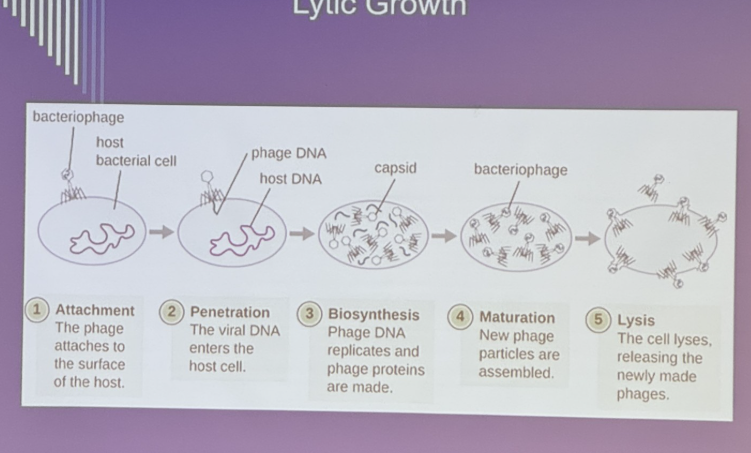
Lytic cycle
attachment - phage attaches to host cell wall
penetration - penetrates cell via phage lysozyme and injects DNA
Biosynthesis - phage DNA directs synthesis of viral components by host cell (eclipse period)
maturation - components assembled into virions
release - cell lyses (phage lysozyme) and virions released
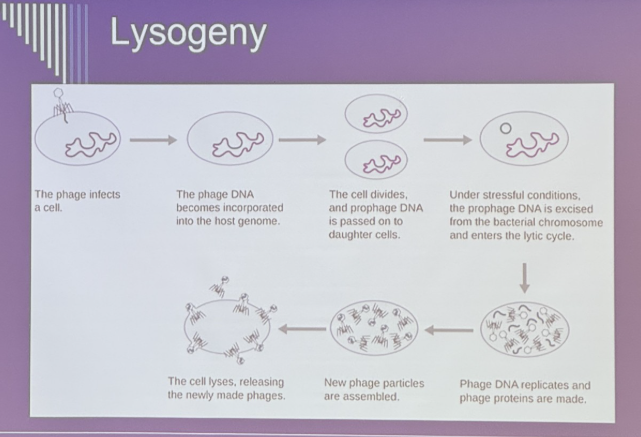
Lysogeny cycle
attachment (cell wall) and penetration (inject)
can continue with lytic cycle or
DNA sometimes integrates with bacterial DNA (prophage)
bacteria can reproduce normally (divide) - prophage genes repressed
phage conversion can happen
occasionally, viral DNA excises from bacterial DNA and then continues with lytic cycle
Prophage
DNA sometimes integrates with bacterial DNA
Life cycles of bacteriophage
lytic cycle
lysogeny cycle
Life cycles of animal viruses
lytic cycles
persistent infections
Persistent infections
not completely cleared
latent
chronic
Latent persistent infections
Virus remains in host for long periods without producing disease (repressed state) - reactivates
Chronic persistent infections
Small amounts of virus always found
Animal virus attachment
use a receptor on plasma membrane of host cell
no tails - attachment sites over whole surface virus
Animal virus penetration
endocytosis
fusion
Endocytosis
Plasma membrane folds inward to form vesicle virus which virus is in - loses the envelope
Fusion
Envelopes fuses with plasma membrane and releases capsid
Animal virus uncoating
Enzymatic removal of capsid proteins
Animal virus biosynthesis/assembly
animal viruses don’t always express genes using the normal flow of genetic information (DNA → RNA → protein)
assembly varies from happening in the nucleus to happening in the cytoplasm
retrovirus - RNA turned into DNA that integrates and follows dogma
Animal virus maturation and release
lysis: nonenveloped
budding: enveloped
Bacteria
plasma membrane
binary fission
possess both DNA and RNA
make ATP
ribosomes
sensitive to antibiotics
Virus
Intracellular parasite
Latent viruses
Vercella-Zoster
Herpes Simplex
Epstein-Barr
Chronic viruses
Hepatitis C
HIV
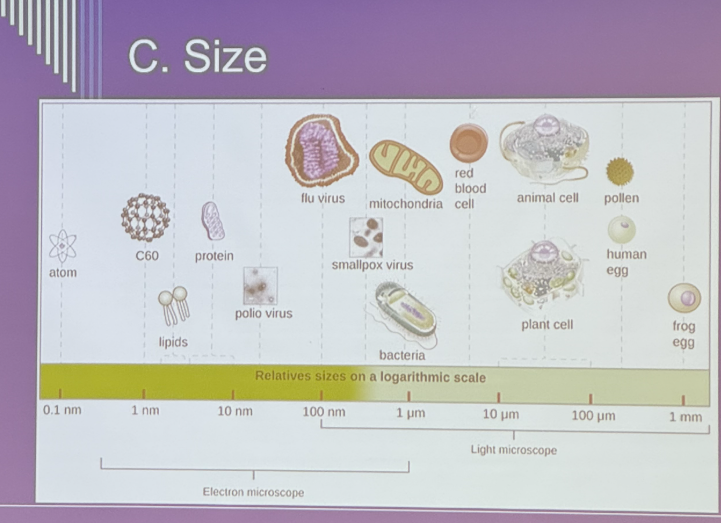
Size of viruses
20-300 nm
Viruses and cancer
hard to diagnose
most do not cause cancer
cancer may not develop immediately
cancers are not contagious
Oncogenes in animal cells
any gene that cause the cell to grow/divide again when mutated causes cancer
causes for activation
-mutagenic chemicals
-UV light
-oncogenic viruses
Oncogenic viruses
10% of all cancers
activated by virus integration into DNA
transformation of the cells (tumors)
Characteristics of tumors
uncontrolled growth
no contact inhibition
decreased cell adhesion
Antiviral drugs
viral disease
nucleoside analogs
enzyme inhibitors
fusion or exit inhibitors
interferon
Viral disease
60% of infectious diseases world-wide are caused by viruses and only 15% is bacterial
90% US population suffers from viral disease/year
very few antiviral therapies
Nucleoside analogs
Interfere with DNA and RNA synthesis
Acyclovir (nucleoside analog)
used for herpesvirus and shingles treatment
activity - virus infected cells use drug in place of normal nucleoside which leads to DNA synthesis issues
administered orally, topically, or injected
Ribavirin (nucleoside analog)
Hepatitis C and respiratory syncytial virus
induces high mutation rate of RNA virus
Zidovudine - AZT (nucleoside analog)
HIV treatment
competitive analog blocks synthesis by reverse transcriptase
fairly toxic
Nevirapine (enzyme inhibitor)
HIV treatment
inactivates reverse transcriptase
Indinavir and saquinavir (enzyme inhibitor)
HIV treatment
protease inhibitor
Raltegravir and elvitegravir (enzyme inhibitor)
Integrase inhibitors
Fusion or exit inhibitors
Enfuvirtide: stops HIV fusion
Oseltamivir (Tamiflu), zanamivir (Relenza), peramivir (Rapivab): prevent influenza virus release
Interferon
natural product of the immune system which stimulates cells to produce antiviral proteins
alpha interferon
Hepatitis C treatment
Prions structure/description
Proteinaceous infectious particle
causes rare neurodegenerative disorders
diseases with long incubation periods
always fatal (progressive)
Prion diseases
Scrapie (sheep)
Mad cow disease
Kuru (humans)
Creutzfeldt-Jakob disease (CJD) (humans)
Gerstmann-Straussler-Scheinker syndrome (humans)
Fatal Familial Insomnia (humans)
Chronic Wasting Disease (deer)
Prion transmission
eating CNS from an infected animal
transplanting nerve tissue
contaminated surgical instruments (hard to degrade via enzyme or heating)
Prion mode of action
can induce abnormal folding of NORMAL cellular prion proteins in the brain
causes large vacuoles in the brain (spongiform encephalopathy)
Viroids structure/description
short pieces of naked circular RNA - 300 to 400 nucleotides long, no protein coat
causes plant disease
Types of influenza
Influenza A
Influenza B
Infleunza C
Influenza A
broken into subtypes: based on glycoprotein present - hemagglutination (H) and neuraminidase (N)
cause for major pandemics
found in many different animals, including ducks, chickens, pigs, whales, horses, seals, cats, and humans
16 H subtypes and 9 N subtypes (available)
Influenza B
infects humans only
Influenza C
no epidemics (mild disease)
infects humans and pigs