Gravity and Vertical
 Call Kai
 Learn
Learn Practice Test
 Spaced Repetition
 Match
Match Flashcards
 Knowt Play
1/95

There's no tags or description
Looks like no tags are added yet.
Name | Mastery | Learn | Test | Matching | Spaced | Call with Kai |
|---|
No analytics yet
Send a link to your students to track their progress
96 Terms
What is the acceleration due to gravity called?
g
What is the value of gravity near Earth’s surface?
9.81 m/s2
In what direction does gravity accelerate objects near Earth?
Toward the center of the Earth
Does gravity accelerate all objects equally
Yes, regardless of mass
What did Galileo demostrate at the Tower of Pisa?
Objects fall with the same acceleration regardless of mass
Who is associated with the Tower of Pisa gravity experiment?
Galileo Galilei
What happens to a falling object’s velocity over time?
It increases constantly due to acceleration
What does “constant acceleration” mean?
Velocity changes by the same amount each second
If an object falls for 1 second, about how fast is it moving downward?
9.81 m/s downward
If an object falls for 2 seconds, about how fast is it moving downward?
19.6 m/s downward
If an object falls for 3 seconds, about how fast is it moving downward?
29.4 m/s downward
What unit is used for acceleration?
Meters per second squared (m/s2)
What does m/s2 mean?
Velocity changes by a certain number of meters per second every second
A bowling ball and tennis ball are dropped at the same time in a vacuum. Which hits first?
They hit at the same time
Why do lighter objects sometimes fall slower in real life?
Air resistance
What force causes objects to fall toward Earth?
Gravity
What symbol represents acceleration due to gravity?
g
Why is gravity considered an acceleration instead of a speed?
Because it changes velocity over time.
If an object’s speed increases by 9.8 m/s every second while falling, what is causing this?
Acceleration due to gravity.
What is the main takeaway from this slide?
All objects near Earth fall with the same constant acceleration: g = 9.81 m/s²
What is free fall?
The motion of an object influenced only by gravity
What force acts on an object in free fall?
Gravity only
What is ignored in ideal free-fall problems?
Air resistance
Why can free-fall motion use constant-acceleration equations?
Because gravitational acceleration near Earth is essentially constant
What is the acceleration in free fall near Earth?
9.81 m/s² downward.
Is gravitational acceleration constant near Earth’s surface?
Yea
What direction does free-fall acceleration point?
Toward Earth’s center
What type of motion equations are used for free-fall problems?
1D constant-acceleration equations
Why are free-fall problems considered one-dimensional?
Motion usually occurs only vertically (up/down)
Does mass affect the acceleration of an object in free fall?
No
If a feather and a hammer fall in a vaccum, what happens?
They fall at the same rate
If gravity is the only force acting on an object, what type of motion is it undergoing?
Free fall
What happens to velocity during free fall?
It changes continuously due to gravity
If an object is dropped, what is its initial velocity?
0 m/s
If an object is thrown upward, is it still in free fall?
Yes, after it leaves the hand
What happens to an object’s upward velocity after it is thrown upward?
Gravity slows it down until it stops momentarily
At the highest point of a tossed object, what is its velocity?
0 m/s.
At the highest point of a tossed object, is acceleration still acting?
Yes, gravity still acts downward
A ball is thrown upward and then falls back down. What acceleration acts during the entire motion?
A constant downward acceleration of 9.81 m/s².
What is the main idea of this slide?
Free-fall motion is motion under only gravity, so it follows constant-acceleration motion rules
What are the two main types of free-fall problems?
Objects falling downward and objects moving upward
What happens to an object falling vertically downward?
It speeds up due to gravity
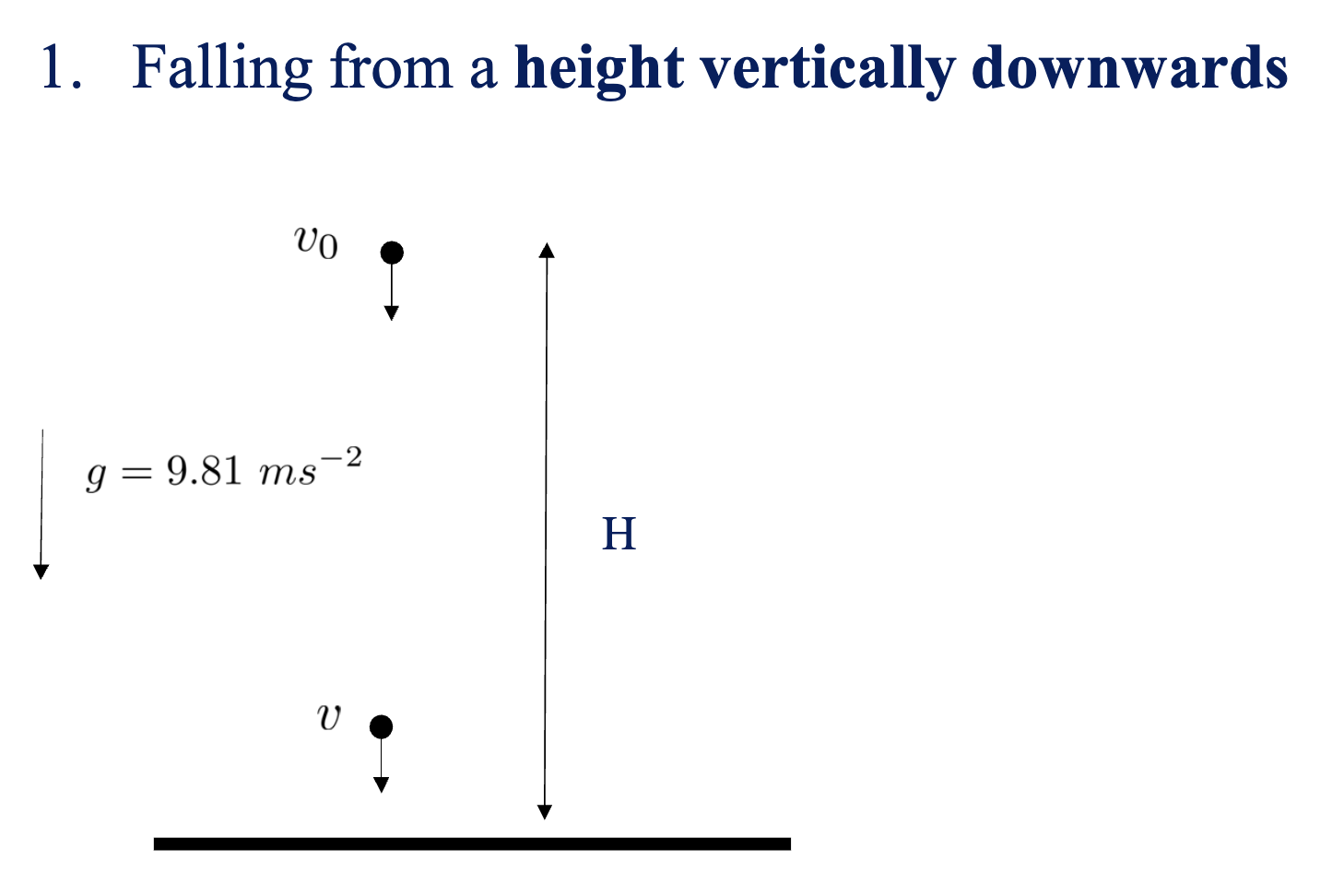
What happens to an object falling upward under gravity?
It slows down as gravity pulls downward.
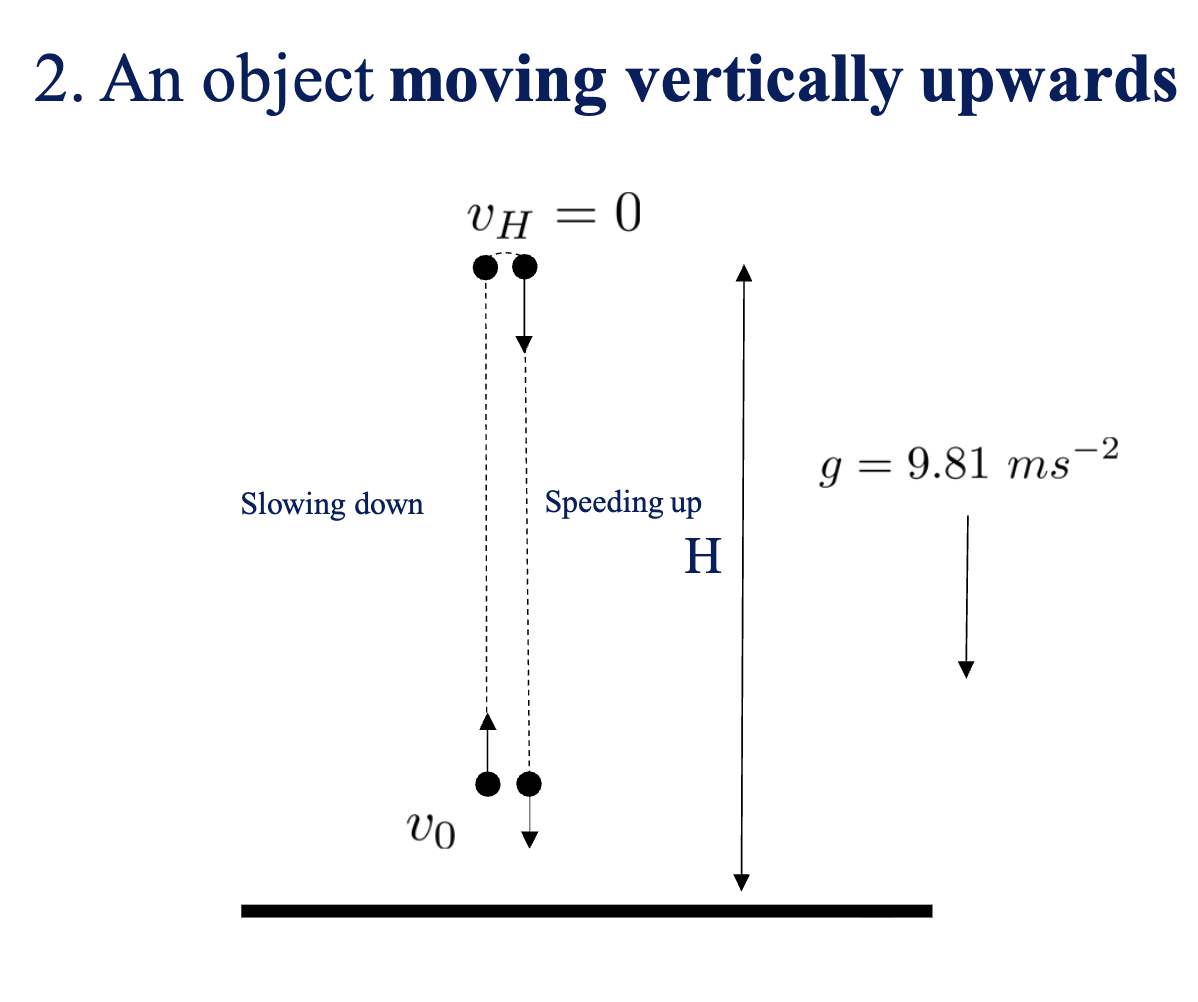
What is the acceleration due to gravity in both upward and downward motion?
9.81 m/s² downward.
In free fall, what direction does gravity always act?
Downward toward Earth
What does H represent in the diagrams?
Height.
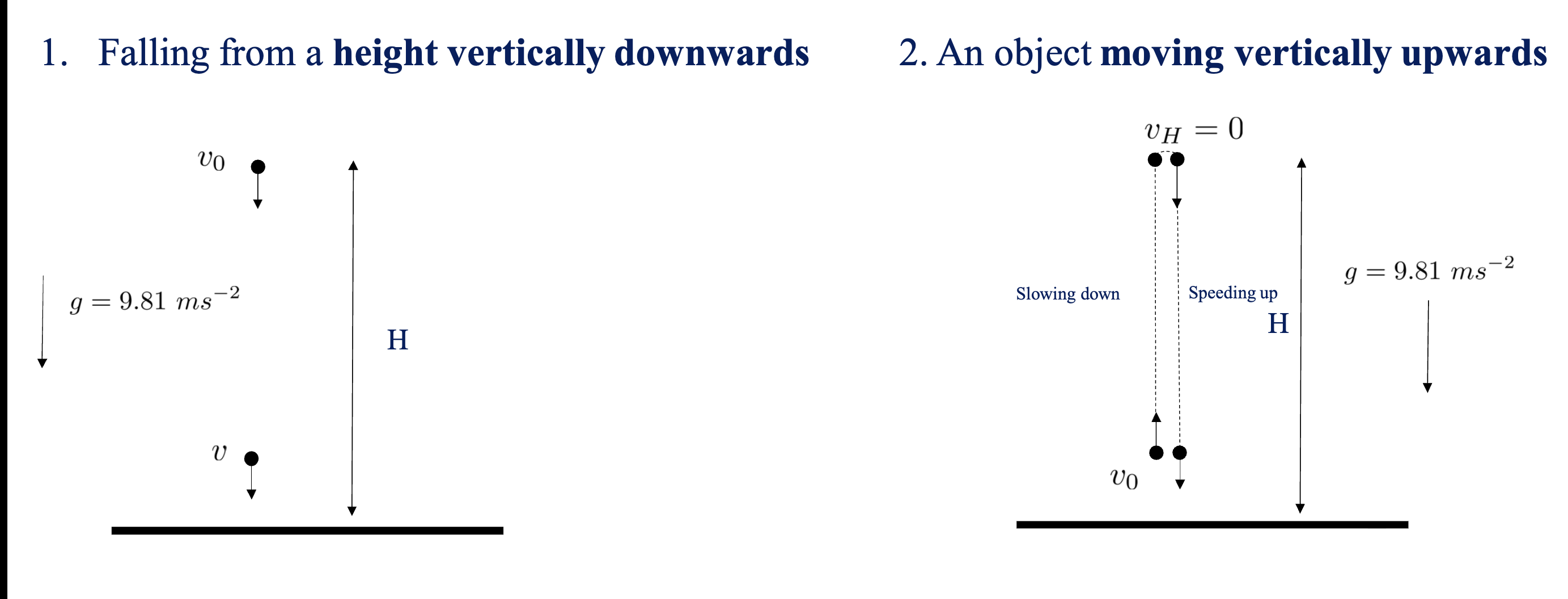
What does v₀ represent?
Initial velocity.
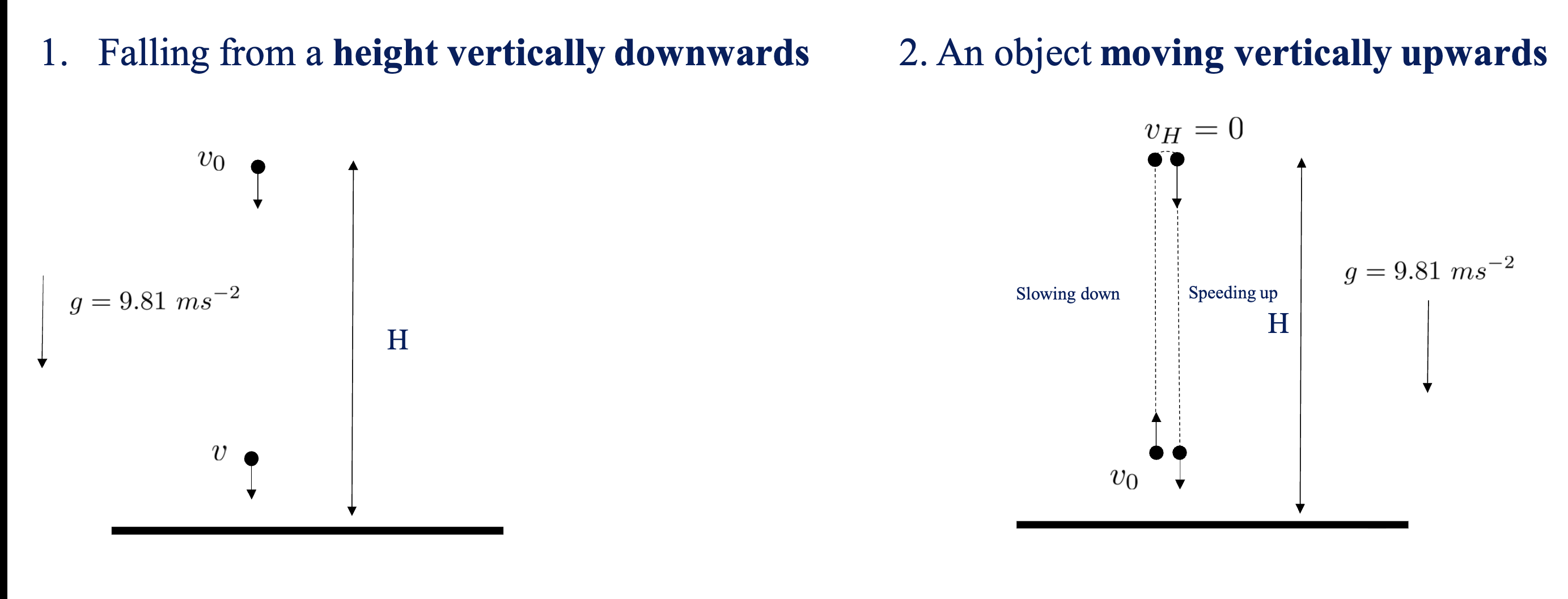
What does v represent in the falling-object diagram?
Final velocity
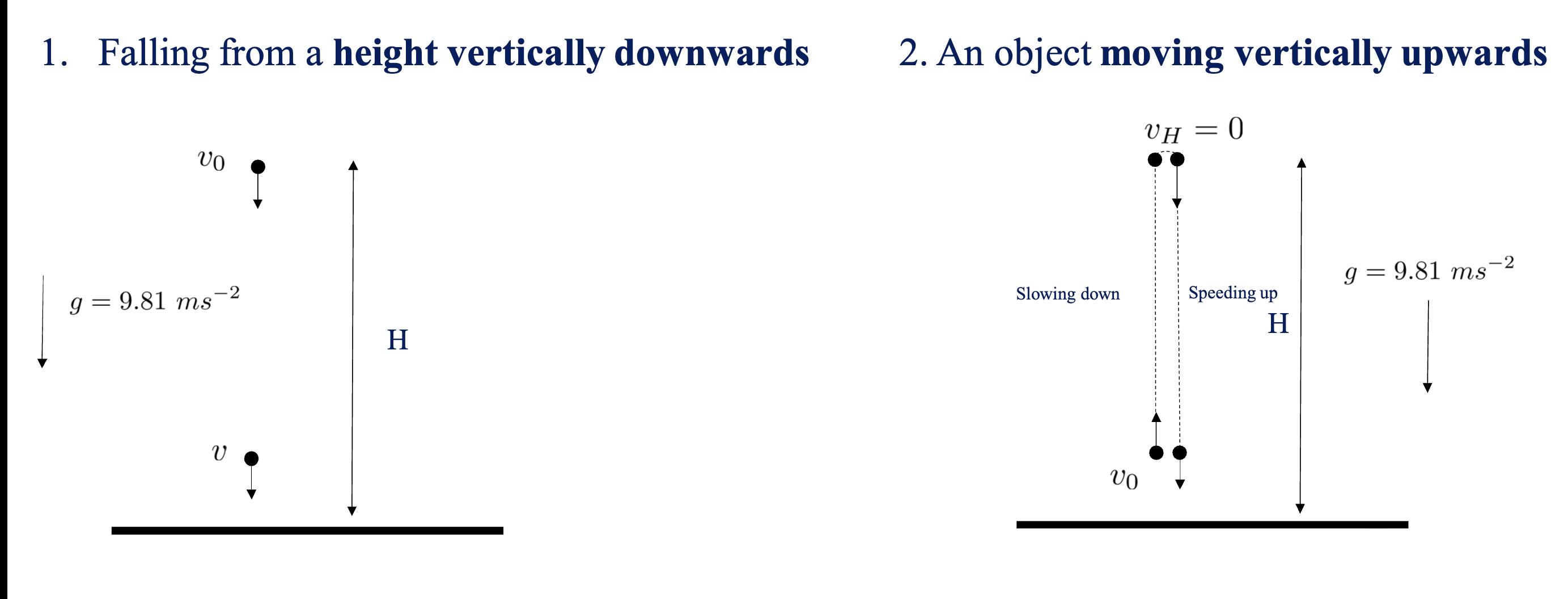
What does v_H=0 mean at the top of upward motion?
The object momentarily stops before falling back down
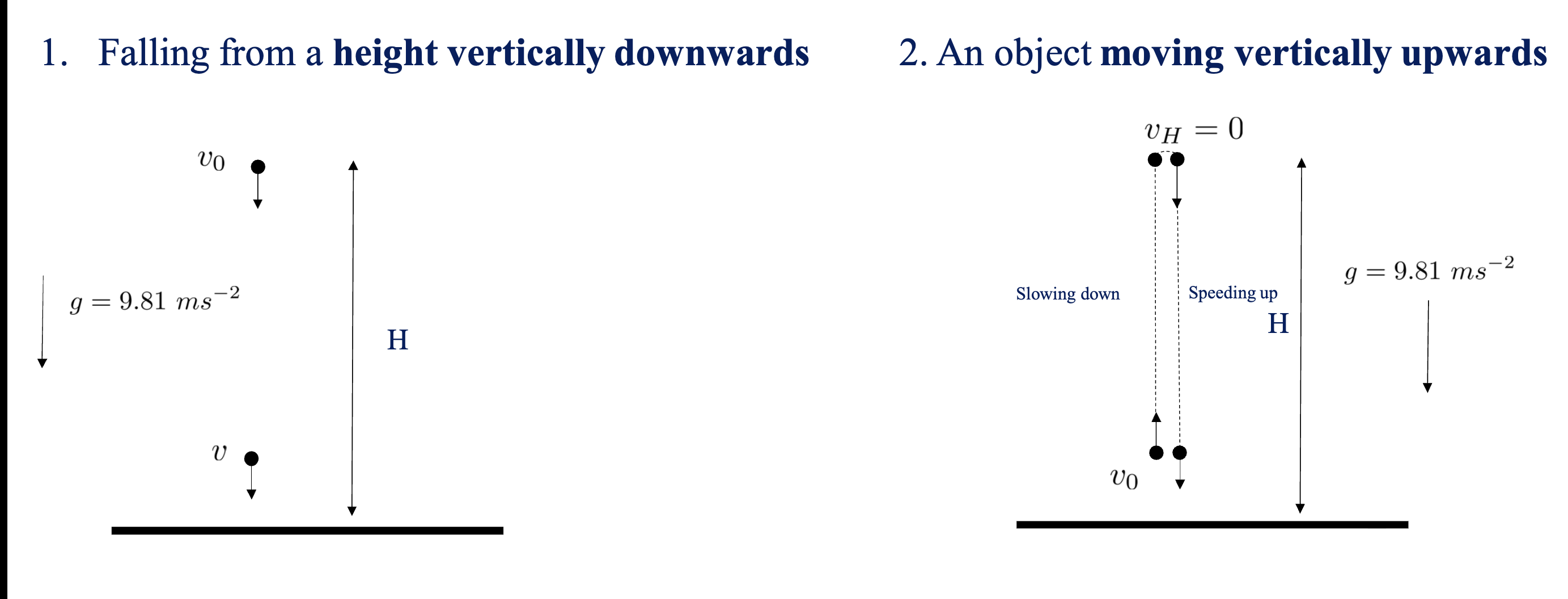
At the highest point of upward motion, is acceleration zero?
No, acceleration is still -9.81 m/s2 downward
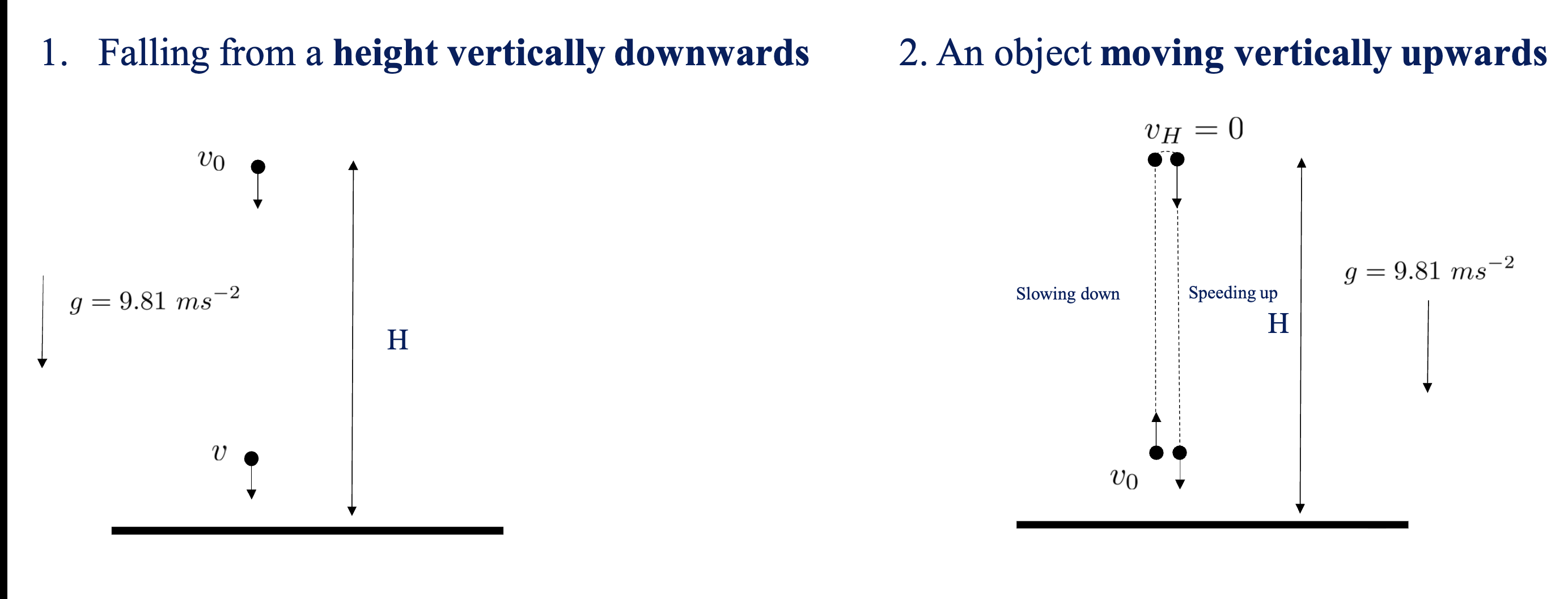
Why does an upward-moving object slow down?
Gravity acts opposite the direction of motion
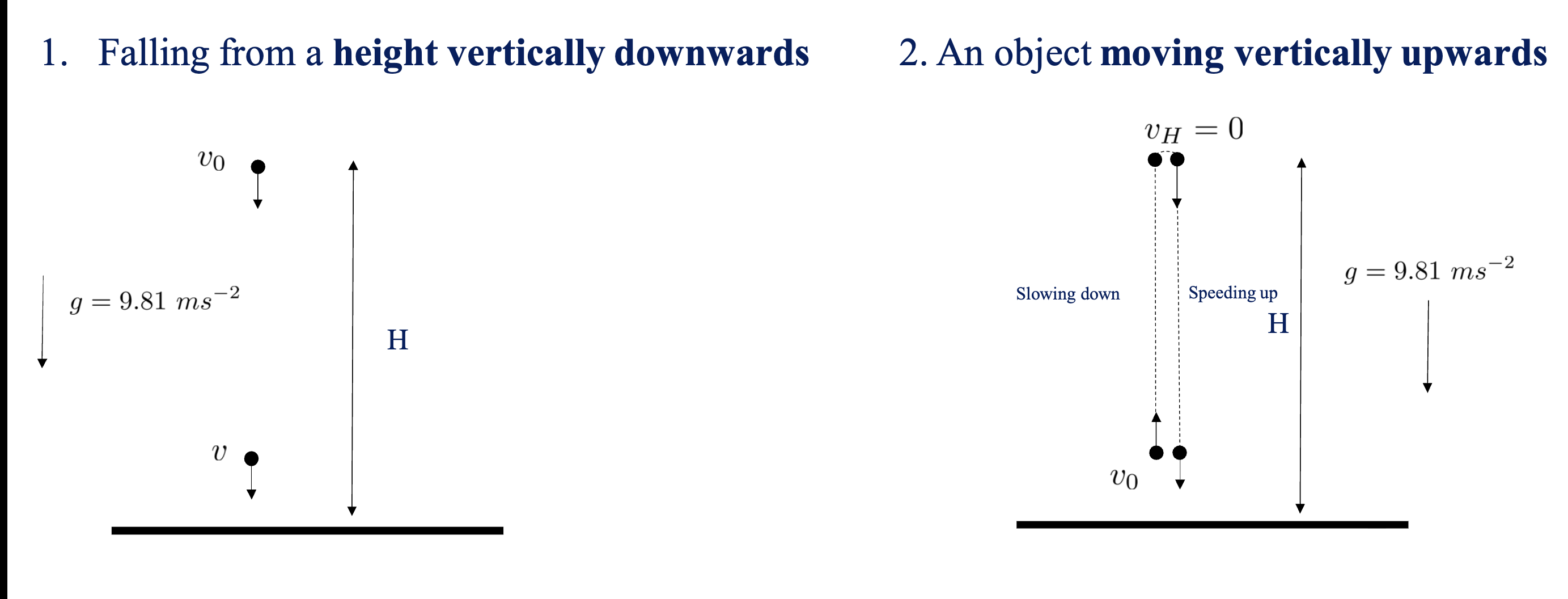
Why does downward-moving object speed up?
Gravity acts in the same direction as motion
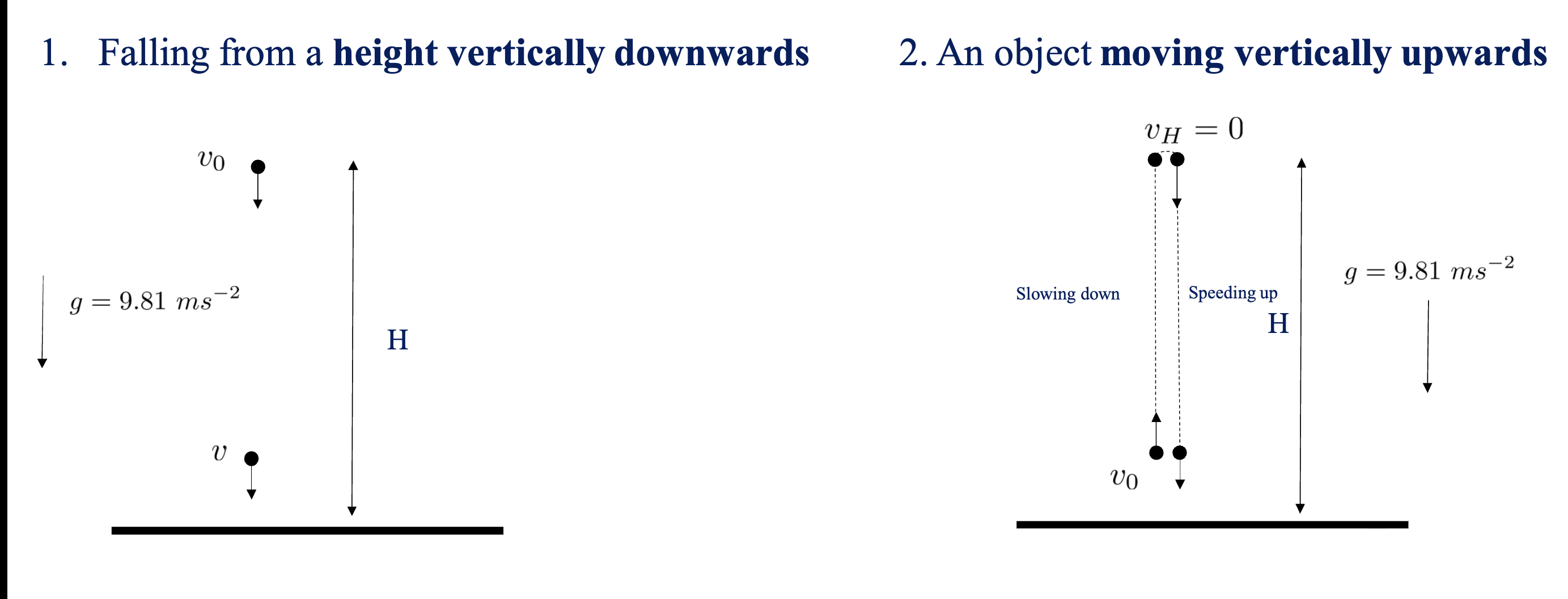
Is gravity different when an object goes up versus down?
No, gravity is always constant and downward
A ball is thrown upward. What eventually happens?
It slows down, stops briefly, then falls back down
What force causes both upward slowing and downward speeding?
Gravity
If an object is dropped from rest, what is its initial velocity?
0 m/s
When an object changes direction at the top of its path, what happens to its velocity?
It changes from upward to downward
If an object is slowing while moving upward, what is the direction of acceleration?
Downward
If an object is speeding up while moving downward, what is the direction of acceleration?
Downward
What is the main idea of this slide?
Gravity causes downward acceleration in all free-fall situations, whether objects move upward or downward.
What direction does gravitational acceleration (g) always act near Earth?
Downward toward Earth.
What is the magnitude of gravitational acceleration near Earth?
9.81 m/s²
What does |g| represent?
The magnitude (size) of gravitational acceleration.
What determines whether acceleration due to gravity is positive or negative?
Your chosen coordinate system.
If downward is chosen as the positive direction, what is acceleration due to gravity?
+9.81 m/s².

If upward is chosen as the positive direction, what is acceleration due to gravity?
−9.81 m/s²
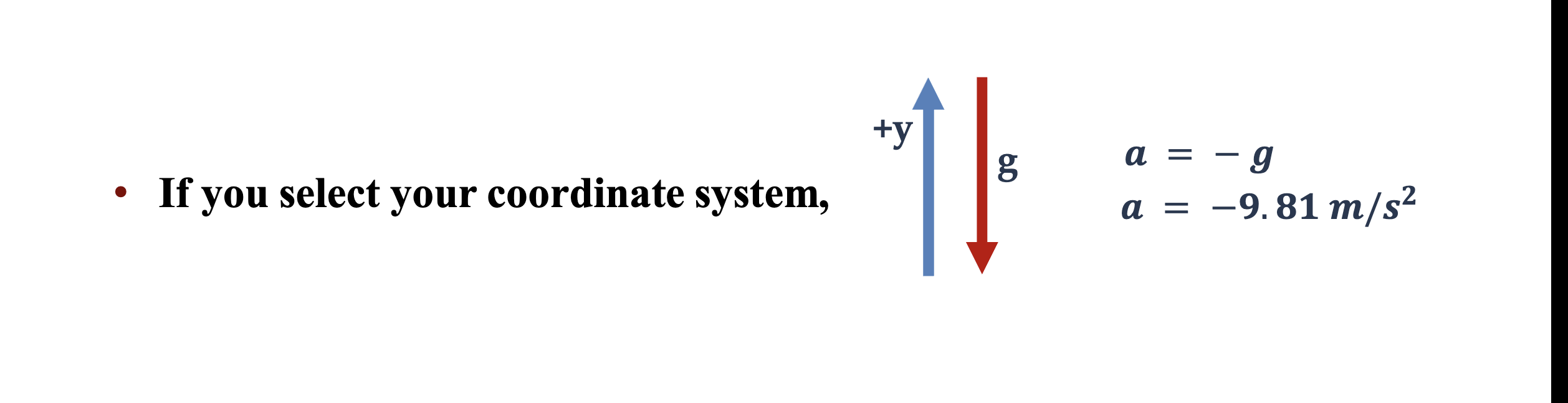
Does gravity itself change direction based on the coordinate system?
No, only the sign changes
Why can g sometimes be positive and sometimes negative in problems?
Because signs depend on the selected axis direction
If +y is upward, what sign does gravity have?
Negative
If +y is downward, what sign does gravity have?
Positive
A problem states a = −9.81 m/s². What direction was likely chosen as positive?
Upward.
A problem states a = +9.81 m/s² in free fall. What direction was likely chosen as positive?
Downward.
Gravity near Earth can point upward depending on the coordinate system.
False.
The magnitude of g is always positive
True
What is more important in free-fall problems: memorizing the sign of g or staying consistent with your coordinate system?
Staying consistent with the coordinate system.
If a ball is thrown upward and upward is positive, what is the acceleration during the entire motion?
−9.81 m/s².
If a rock falls downward and downward is positive, what is the acceleration?
+9.81 m/s²
Why do physics problems define coordinate systems before solving motion equations?
To correctly assign signs to velocity and acceleration
What common mistake do students make with gravity signs?
Changing the sign of g inconsistently during the problem
What is the main takeaway from this slide?
Gravity always points downward, but its sign depends on the chosen coordinate system
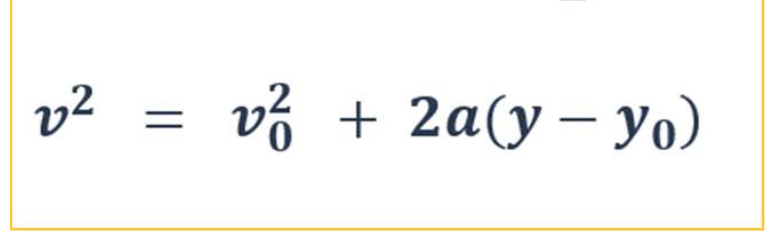
What type of motion equations are used in free-fall problems?
1-D kinematic equations
Why can kinematic equations be used for free fall?
Because acceleration due to gravity is constant.
What variable represents acceleration in the equations of motion?
a
In free-fall problems, what does acceleration equal?
±g depending on the coordinate system.
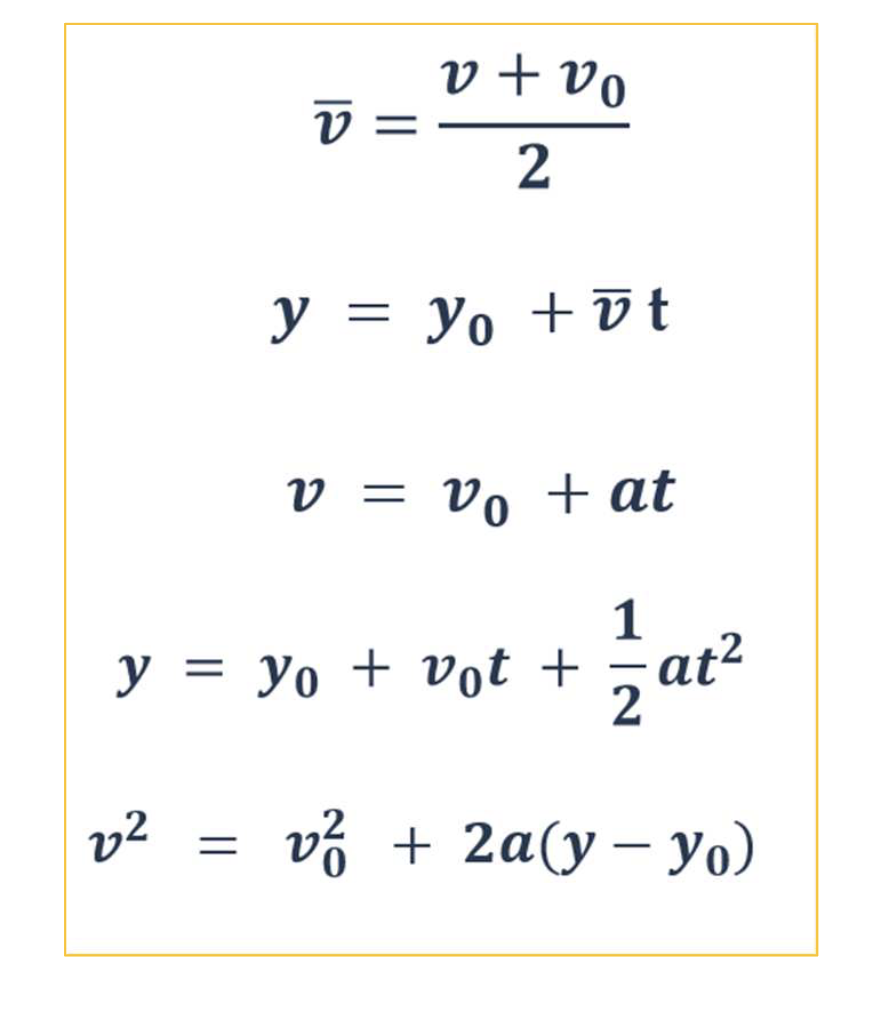
Which equation does NOT require time?
If upward is positive, what sign is acceleration due to gravity?
Negative
If downward is positive, what sign is acceleration due to gravity?
Positive
Why is choosing a coordinate system important in free-fall problems?
It determines the sign of acceleration, velocity, and displacement.
A problem uses a = −9.81 m/s². What direction is probably positive?
Upward
Which kinematics equation is best when time is unknown?
A dropped object starts from rest. What is v₀?
0 m/s
An object thrown upward slows down because what quantity is opposite its motion?
Acceleration due to gravity.
The value of g changes sign because gravity changes direction.
False.
The same kinematics equations work for upward and downward motion.
True.
What is the most common mistake in free-fall kinematics problems?
Using inconsistent signs for acceleration and velocity
What is the main idea of this slide?
Free-fall motion uses standard constant-acceleration kinematics equations with acceleration equal to ±g depending on the coordinate system