Organic chemistry
 Call Kai
 Learn
Learn Practice Test
 Spaced Repetition
 Match
Match Flashcards
 Knowt Play
1/121

There's no tags or description
Looks like no tags are added yet.
Name | Mastery | Learn | Test | Matching | Spaced | Call with Kai |
|---|
No analytics yet
Send a link to your students to track their progress
122 Terms
What are hydrocarbons?
A hydrocarbon is a compound that contains only hydrogen and cabron atoms
The empirical formula shows the ___________________ of the atoms in a molecule
simplest possible ratio
The molecular formula shows the ______________ of atoms in a molecule
actual number
What is a homologous series
A homologous series is a series or family of organic compounds that have similiar features and chemical properties due to them having the same functional group.
All members of a homologous series have:
The same general formula
Same functional group
Similar chemical properties
Gradation in their physical properties
The difference in the molecular formula between one member and the next is CH2
All members of a homologous series have the ____ general formula
same
All members of a homologous series have _____ functional group
same
All members of a homologous series have _________ chemical properties
similiar
All members of a homologous series have __________ in their physical properties
Gradation
In all members of a homologous, the difference in the molecular formula between one member and the next is ____
CH2
What is a functional group?
A group of atoms bonded in a specific arrangement that influences the properties of the homologous series
What are isomers?
Isomers are compounds that have the same molecular formula but different displayed formulae
The reactions of organic compounds can be classified into:-
Substitution
Addition
Combustion
What is a susbtitution reaction?
A substitution reaction takes place when one functional group is replaced by another
What provides the activation energy for subsitution reactions in organic compounds?
Ultraviolet light
What is the purpose of Ultraviolet light in substitution reaction
Ultraviolet light provides the activation energy needed to start the substitution reaction.
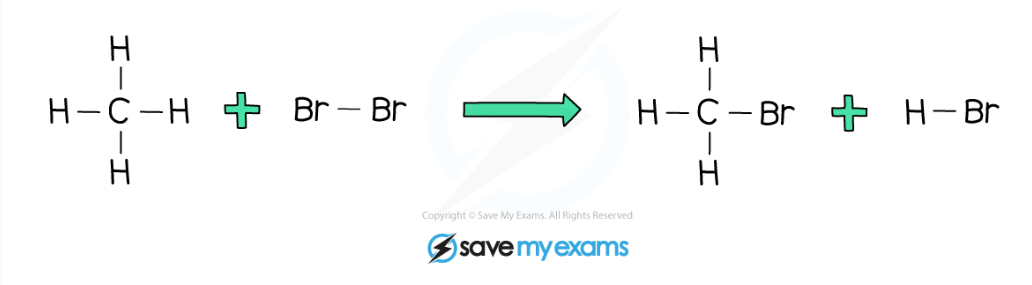
Reaction of methane and bromine
CH4 + Br2 → CH3Br + HBr
methane + bromine → bromomethane + hydrogen bromide
Reaction of ethane and bromine
Ethane + Bromine → Bromoethane + Hydrogen bromide
C₂H₆ + Br₂ → C₂H₅Br + HBr
Reaction of Propane and bromine
Propane + Bromine → Bromopropane + Hydrogen bromide
C₃H₈ + Br₂ → C₃H₇Br + HBr
Reaction of butane and bromine
Butane + Bromine → Bromobutane + Hydrogen bromide
C₄H₁₀ + Br₂ → C₄H₉Br + HBr
Reaction of pentane and bromine
Pentane + Bromine → Bromopentane + Hydrogen bromide
C₅H₁₂ + Br₂ → C₅H₁₁Br + HBr
Reaction of hexane with bromine
Hexane + Bromine → Bromohexane + Hydrogen bromide
C₆H₁₄ + Br₂ → C₆H₁₃Br + HBr
Reaction of methane and chlorine
CH4+Cl2→CH3Cl+HCl
methane + chlorine → chloromethane + hydrogen chloride
When an alkane reacts with a halogen what happens?
a substitution reaction
When an alkene reacts with a halogen what happens?
addition reaction
What is an addition reaction?
An addition reaction takes place when two or more molecules combine to form a larger molecule with no other products
Reaction of ethene and bromine
Ethene + Bromine → 1,2-dibromoethane
C₂H₄ + Br₂ → C₂H₄Br₂
Reaction of propene and bromine
Propene + Bromine → 1,2-dibromopropane
C₃H₆ + Br₂ → C₃H₆Br₂
Reaction of butene with bromine
Butene + Bromine → 1,2-dibromobutane
C₄H₈ + Br₂ → C₄H₈Br₂
Reaction of Pentene with bromine
Pentene + Bromine → 1,2-dibromopentane
C₅H₁₀ + Br₂ → C₅H₁₀Br₂
Reaction of hexene with bromine
Hexene + Bromine → 1,2-dibromohexane
C₆H₁₂ + Br₂ → C₆H₁₂Br₂
Reaction of ethene and chlorine
C₂H₄ + Cl₂ → C₂H₄Cl₂
Ethene + Chlorine → 1,2-dichloroethane
What is the scientific term for burning?
combustion
What is combustion?
In a combustion reaction, an organic substance reacts with oxygen to form carbon dioxide (or carbon monoxide if incomplete combustion) and water.
What is complete combustion?
Complete combustion is when a hydrocarbon burns in an unlimited supply of oxygen.
It produces carbon dioxide and water.
What is incomplete combustion?
Incomplete combustion is when a hydrocarbon burns in a limited supply of oxygen.
It produces carbon monoxide and water.
Reaction in complete combustion
CH4 + 2O2 → CO2 + 2H2O
C3H8 + 5O2 → 3CO2 + 4H2O
Reaction in incomplete combustion
CH4 + 3/2O2 → CO + 2H2O
Each fraction consists of groups of hydrocarbons of ________ chain lengths
similiar
The fractions in petroleum are separated from each other in a process called ____________ ______________
fractional distillation
The molecules in each fraction have similar ____________ and _______________
properties and boiling points
The ____________________ of each hydrocarbon molecule determines in which fraction it will be separated into
size and length
Most fractions contain mainly _______
alkanes
Fractional distillation is carried out in a _______________ _______ which has a temperature gradient
fractionating column
What do you mean by a temperature gradient?
It is very hot at the bottom of the column and cooler at the top
What happens in the process of fractional distillation?
During the process of fractional distillation:
The crude oil is heated and vapourises
The vapours of hydrocarbons enter the column which has a temperature gradient
The vapours of hydrocarbons with high boiling points condense at the bottom of the column
The vapours of hydrocarbons with lower boiling points rise up the column and condense at the top
What is vicoscity?
This refers to the ease of flow of a liquid
How do high viscosity liquids flow
flow less easily
What happens to the viscosity when the number of carbon atoms/ mass increase?
the attraction between the hydrocarbon molecules also increases which results in the liquid becoming more viscous with the increasing length of the hydrocarbon chain
What happens to the colour when the number of carbon atoms/ mass increase?
As carbon chain length increases the colour of the liquid gets darker as it gets thicker and more viscous
What happens to the Melting point/boiling point when the number of carbon atoms/ mass increase?
As the molecules get larger, the intermolecular attraction becomes greater
So more heat is needed to separate the molecules
With increasing molecular size there is an increase in boiling point
What happens to the Volatility when the number of carbon atoms/ mass increase?
Volatility refers to the tendency of a substance to vaporise
With increasing molecular size hydrocarbon liquids become less volatile
This is because the attraction between the molecules increases with increasing molecular size
What is volitality?
Volatility refers to the tendency of a substance to vaporise
What is the use of Liquified petroleum gas?
Domestic heating & cooking
What is the use of Petrol?
Fuel for cars (gasoline)
What is the use of Kerosene?
Jet fuel (paraffin)
What is the use of Diesel?
Diesel engines (gas oil)
What is the use of heavy fuel oil?
Ships & power stations
What is the use of bitumen?
Surfacing roads and roofs
What is a fuel?
A fuel is a substance that, when burned, releases heat energy (exothermic reaction)
What are some fossil fuels>
Fossil fuels include: coal, oil, natural gas, oil shales and tar sands
Non-renewable fossil fuels are obtained from ______ ___ by fractional distillation
What is petrol used for?
Petrol is used as a fuel in cars
Where is coal use?
Coal is used in power stations and also steel production
Natural gas consists mainly of _______, ___
methane, CH4
All these fuels contain ______, _________ and small quantities of ______
carbon, hydrogen and sulfur
The burning of fossil fuels releases the gases :-
carbon dioxide, carbon monoxide, oxides of nitrogen and oxides of sulfur
The burning of fuels also other than gas gives rise to
unburned hydrocarbons and carbon particulates
When the fuel is a hydrocarbon then _____ and _______ _______ are the products formed
water and cabron dioxide
Complete combustion occurs when there is _______ ______
excess oxygen
Incomplete combustion occurs when there is _________ _________ to burn
insufficient oxygen
In which appliance does incomplete combustion occur
It occurs in some appliances such as boilers and stoves as well as in internal combustion engines
What are the products of incomplete combustion?
The products of these reactions are unburnt fuel (soot), carbon monoxide and water
Why is carbon monoxide dangeorus?
Carbon monoxide is a toxic and odourless gas which can cause dizziness, loss of consciousness and eventually death
The CO binds well to haemoglobin which therefore cannot bind oxygen
Oxygen is transported to organs
How are nitrogen oxides formed?
These compounds (NO and NO2) are formed when nitrogen and oxygen react in the high pressure and temperature conditions of internal combustion engines and blast furnaces
Why are catlytic converters fit inside parts of exhaust system?
Catalytic converters reduce harmful gases in car exhausts by using a catalyst to speed up reactions. They convert carbon monoxide and unburned hydrocarbons into less harmful substances, and they also remove nitrogen oxides by breaking them down into nitrogen and oxygen.
What is the function of a catlytic converter?
Their function is to render these exhaust gases harmless
What are effects of nitrogen oxides?
acid rain
photochemical smog breathing
difficulties, in particular for people suffering from asthma.
Fossil fuels are often contaminated with small amounts of _______ __________
sulfur impurities
When these contaminated fossil fuels are combusted, the sulfur in the fuels get ___________ to ______ ______
oxidised to sulfur dioxide
Reaction of sulfur being oxidised
S (s) + O2 (g) → SO2 (g)
What are the effects of sulfur dioxide?
The adverse effects of sulfur dioxide include acid rain:
Acid rain causes corrosion to metal structures, buildings and statues made of carbonate rocks, damage to aquatic organisms
It pollutes crops and water supplies, irritates lungs, throats and eyes
How is acid rain formed from sulfure dioxide?
The sulfur dioxide produced from the combustion of fossil fuels dissolves in rainwater droplets to form sulfuric acid
2SO2 (g) + O2 (g) + 2H2O (l) → 2H2SO4 (aq)
Sulfuric acid is one of the components of acid rain which has several damaging impacts on the environment
How is acid rain formed from nitrogen dioxide
Nitrogen dioxide produced from car engines reacts with rain water to form a mixture of nitrous and nitric acids, which contribute to acid rain:
2NO2 (g) + H2O (l) → HNO2 (aq) + HNO3 (aq)
Lightning strikes can also trigger the formation of nitrogen monoxide and nitrogen dioxides in air
Nitrogen dioxide gas reacts with rain water and more oxygen to form nitric acid
4NO2 (g) + 2H2O (l) + O2 (g)→ 4HNO3 (aq)
When the clouds rise, the temperature decreases, and the droplets get larger
When the droplets containing these acids are heavy enough, they will fall down as acid rain
What is cracking?
Cracking is an industrial process used to break low demand, long chain hydrocarbon molecules into more useful, small chain hydrocarbon molecules
What are the conditions for catlytic cracking?
Catalytic cracking involves heating the hydrocarbon molecules to around 600 – 700 °C to vaporise them
The vapours then pass over a hot powdered catalyst of aluminium oxide
This process breaks covalent bonds in the molecules as they come into contact with the surface of the catalyst, causing thermal decomposition reactions
Alkanes are a group of __________ hydrocarbons
saturated
The general formula of the alkanes is __________
CnH2n+2
Alkanes are generally ___________ compounds
unreactive
What are the alkanes
Methane
Ethane
Propane
Butane
Pentane
What is the empirical and molecular formula of methane?
CH₄, CH₄
What is the molecular and empirical formula of ethane?
Molecular formula:
C₂H₆
Empirical formula:
CH₃
What is the molecular and empirical formula of propane
Molecular formula:
C₃H₈
Empirical formula:
C₃H₈
What is the molecular and empirical formula of butane?
Molecular formula:
C₄H₁₀
Empirical formula:
C₂H₅
What is the molecular and empirical formula of pentane?
Molecular formula:
C₅H₁₂
Empirical formula:
C₅H₁₂
Displayed equation for CH4 + bromine
What are the products of halogen + alkene substitution reaction called?
The products belong to a family called halogenoalkanes or haloalkanes
What are the uses of halogenoalkanes or haloalkanes?
Halogenoalkanes have many uses a solvents, refrigerants, propellants and pharmaceuticals
Alkenes are ___________ hydrocarbons
unsaturated
What is the general formula for alkenes?
The general formula of an alkene is CnH2n