Cell Signaling - IV
 Call Kai
 Learn
Learn Practice Test
 Spaced Repetition
 Match
Match Flashcards
 Knowt Play
1/44

Earn XP
Description and Tags
Chapter 16 - Cell Signaling
Name | Mastery | Learn | Test | Matching | Spaced | Call with Kai | Chat |
|---|
No analytics yet
Send a link to your students to track their progress
45 Terms
extracellular; intracellular
Cells convert ________ signals into an ________ signal.
e.g., like a phone that recieves a signal and has an output
Endocrine
secreted at a distal part (liver) and dispersed throughout the body thru blood
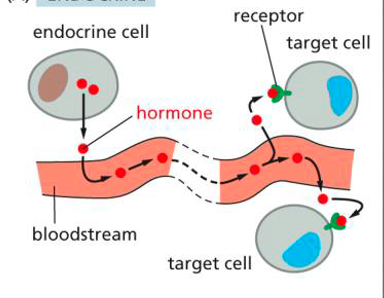
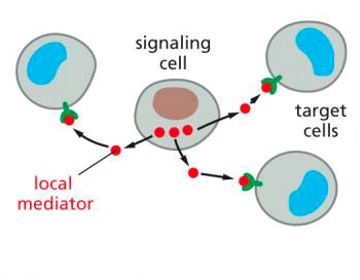
Paracrine
released by a cell to act as a local mediator for nearby cells
Neuronal
electrical signals that travel between two neurons

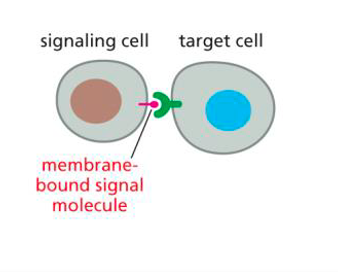
Contact dependent
membrane bound signal molecule between two adjacent cells
Extracellular
Intracellular or extracellular?
the signal is:
large
hydrophilic (charged)
cannot cross the membrane → receptor is outside
Intracellular
Intracellular or extracellular?
the signal is:
small
hydrophobic (uncharged)
cross the membrane → receptor is inside
Small, nonpolar molecules
Which one diffuses more easily?
a.) Small, nonpolar molecules
b.) large, polar molecules
large, polar molecules
Which one crosses very slowly?
a.) Small, nonpolar molecules
b.) large, polar molecules
size; solubility
The rate of solute diffusion across a protein-free artificial lipid bilayer depends on the solute’s _______ and ________.
Cortisol
diffuses across the plasma membrane
binds a cytosolic receptor because it is lipid-soluble
hormone-receptor
The ______-_______ complex translocates to the nucleus through nuclear pores.
in intracellular receptors
transcription
In the nucleus, the activated receptor-cortisol complex binds to the regulatory region of the target gene and activates __________.
acts as a _______ regulator, altering gene expression in response to stress.
Fast responses
Fast or slow cell signaling response?
may not need changes to gene expression
e.g., movement or secretion

Slow responses
Fast or slow cell signaling responses?
require many genes to be expressed and many new proteins to be made
e.g., differentiation, growth or division
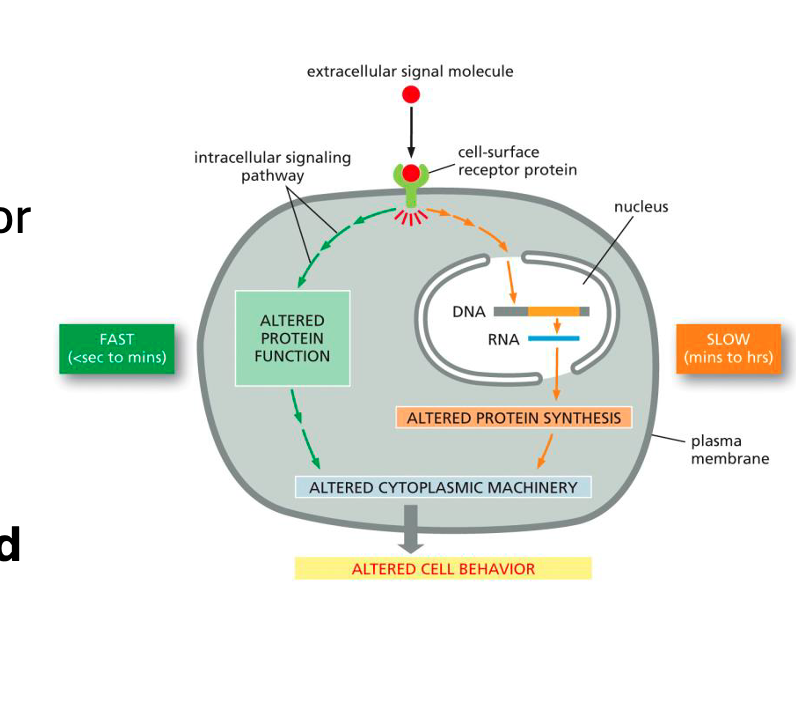
cell-surface
Extracellular signals trigger intracellular signaling pathways by binding ____-________ receptors.
extracellular; intracellular
Cell-surface receptors relay _______ signals via ________ signaling pathways
effector proteins
proteins that are altered to change the cell’s behavior
signaling molecules
Intracellular Signaling pathways involve cascades of ______ _______ (proteins or small messengers) that relay and amplify the signal.
Intracellular
________ signaling proteins relay, amplify, and distribute signals, allowing them to spread and strengthen within the cell.
Cell-surface receptors
transduce extracellular signals into intracellular signals, initiating one or more signaling pathways.
feedback
Intracellular signaling proteins can also integrate multiple signals and modulate responses via ________, fine-tuning the cell’s behavior.
Feedback loops
______ ______ fine-tune cellular responses, ensuring signals are amplified, dampened, or oscillated as needed for proper cell function. There are two kinds
positive feedback
downstream protein (e.g., protein Y) enhances the activity of the protein that activated it, potentially triggering rapid or “explosive” responses like cell division.

negative feedback
downstream protein inhibits the protein that activated it, creating oscillations in activity similar to predator–prey dynamics.

cell memory
What’s an example of positive feedback within the cell?
necessary for a proliferating cell to maintain its identity; must be remembered by each daughter cell
Phosphorylation
a protein kinase may add a phosphate group and a protein phosphatase may remove a phosphate group.
doesn’t necessarily mean activation or deactivation

molecular switch
Some intracellular signaling proteins act as a _______ ______ to turn themselves (or others) on or off.
These activities could be regulated by processes such as phosphorylation.
GTP-binding protein
They toggle between active and inactive state based on whether they have GTP or GDP bound to them.
They also have intrinsic GTPase activity (removing GTP) to stop themselves when needed

GEFs (guanine nucleotide exchange factors)
activate GTPases by promoting GDP → GTP exchange.
GAPs (GTPase-activating proteins)
inactivate GTPases by stimulating GTP → GDP.
GTPases
function as molecular switches
cycling between:
active (GTP-bound) and inactive (GDP-bound) states.

Ion-channel-coupled receptors
opens in response to binding an extracellular signal molecule.
These channels are also called transmitter-gated ion channels.
Change the permeability of the plasma membrane to selected ions
GPCRs
Signal binds → G protein activated → enzyme/ion channel turned on/off
G protein
When a GPCR binds an extracellular signal, it activates a ___ ______ inside the cell.
The G protein then turns an enzyme or ion channel on or off in the cell membrane.
cytosolic
When a G-protein-coupled receptor binds its extracellular signal molecule, the activated receptor signals to a trimeric G protein on the _______ side of the plasma membrane, which then turns on (or off) an enzyme (or an ion channel) in the same membrane.

Enzyme-coupled receptors
Signal binds → enzyme inside cell turns on (built-in or attached)
enzyme; associated
Many enzyme-coupled receptors have their own _____ activity (left), while others rely on an enzyme that becomes _________ with the activated receptor (right).

Covalent modifications
can regulate protein location and interactions, not just activity.
e.g., phosphorylation
Phosphorylation
can create docking sites that allow other proteins to bind and form larger signaling complexes.
Receptor tyrosine kinases
phosphorylate themselves in response to extracellular signals, recruiting intracellular signaling proteins that transmit signals and alter cell behavior.
kinase
a type of enzyme that catalyzes phosphorylation
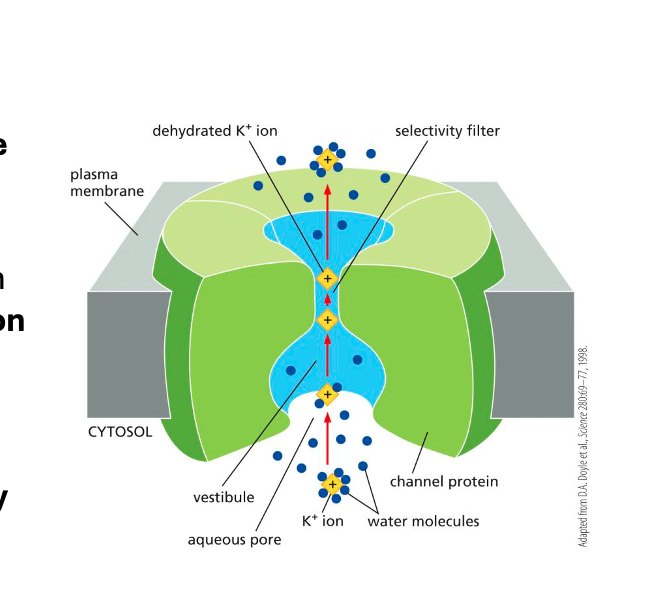
ion channels
channels that are gated and are opened or closed briefly
are ion-selective
diameter; shape; distribution
Ion selectivity is achieved by the _______ and _____ of the ion channel and on the ______ of the charged amino acids that line it.
Lock and key model
The same signal molecule can induce different responses in different target cells.
Different cell types are configured to respond to the neurotransmitter acetylcholine in different ways