UIowa management Exam 2
 Call Kai
 Learn
Learn Practice Test
 Spaced Repetition
 Match
Match Flashcards
 Knowt Play
1/156

There's no tags or description
Looks like no tags are added yet.
Name | Mastery | Learn | Test | Matching | Spaced | Call with Kai |
|---|
No analytics yet
Send a link to your students to track their progress
157 Terms
Forces for Internationalization
Globalization - tendency of firms to expand sales, manufacturing, and ownership to new markets in other countries
-modern communication technology
-air travel
-corporate globalism
Pros and Cons of gobalization
Pros:
-productivity grows
-living standards increase
-inflation is less likely (cheap)
-innovation (new ideas)
-access to new markets and new customers
-export jobs pay more
Cons:
-Americans lose jobs
-fear losing jobs
-competition for american companies
-pay cut
-service and white collar job in danger
Internationalization Process - 5 big options
Stage 1: Exporting - selling domestically produced products to customers in foreign countries
Stage 2: Cooperative contracts - an agreement in which a foreign business owner pays a company a fee for the right to conduct that business in his or her country
Stage 3: Strategic alliances - an agreement in which companies combine key resources, costs, risks, technology, and people
Stage 4: Wholly owned affiliates - foreign offices, facilities, and manufacturing plants that are 100% owned by the parent company
New Global Ventures - new companies that are founded with an active global strategy and have sales, employees, and financing in different countries
2 types of cooperative contracts
Licensing - an agreement in which a domestic company, the licencor, receives royalty payments for allowing another company, the licensee to produce the licencor's product, sell its service, or use its brand name in a specified foreign market
Franchising - a collection of networked firms in which the manufacturer or marketer of a product or service, the franchiser, licenses the entire business to another person or organization, the franchisee
Problem at Mustang Jeans
deals with international business, does business the "american way", which turns off foreign business leaders
-the cultural imperative
-culture barriers and norms prevented american man and Japanese man from doing business together
High context cultures
Cultures in which nonverbal and situational messages convey meaning
-relationship more important than terms
Low context cultures
Cultures in which words convey primary meaning
-nonverbal messages are secondary
-the terms of the deal are more important than building a business relationship
Hofstede's dimensions
-long-term vs. short-term orientation
-uncertainty avoidance
-masculinity vs. femininity
-individualism vs. collectivism
-power distance
long-term vs. short-term orientation
addresses whether cultures are oriented to the present and seek immediate gratification or to the future and defer gratification
uncertainty avoidance
the degree to which people in a country are uncomfortable with unstructured, ambiguous, unpredictable situations
masculinity vs. femininity
the difference between highly assertive and highly nurturing cultures
individualism vs. collectivism
the degree to which societies believe that individuals should be self-sufficient
power distance
the extent to which people in a country accept that power is unequally distributed in organizations and society
indulgence vs. restraint
addresses the degree to which a society allows relatively free gratification of basic drives related to enjoying life and having fun vs. struct social norms that regulate and suppress gratification of needs and wants
Tariff
a direct tax on imported goods; increase cost of imported goods relative to that of domestic goods
Non-tariff trade barriers
non tax methods of increasing the cost or reducing volume of imported goods; 5 types:
1. quotas - a limit on the number or volume of imported products
2. voluntary export restraints - imposed limits on number or volume of products exported to a particular country; exporting country imposes
3. government import standard - a standard ostensibly established to protect the health and safety of citizens but in reality is often used to restraint imports
4. subsidies - government loans, grants and tax deferments given to domestic companies to protect them from foreign competition
5. customs classification - assigned to imported products by government officials that affects the size of the tariff and the imposition of import quotas
why do managers need to know about tariffs and trade?
free trade agreements create new business opportunities, they also intensify competition and addressing that competition is the managers job
Characteristics of attractive
""me bitch"- nikole george"- anna clough
Characteristics of attractive foreign business climate
access to a growing market; 2 factors:
-purchasing power (high is favorable) - relative cost of a standard set of goods and services in different countries
-foreign competitors (determined by the number and quality of companies that already compete in foreign market)
preparing for an international assignment
language and cross-cultural training; 3 methods:
1. documentary training - focuses on identifying specific critical differences between cultures
2. cultural simulations - practice adapting to cultural differences
3. field experiences - places trainees in ethnic neighborhood for 3-4 hours to talk to residents about cultural differences
what is a mongrel and why is it a good thing (zachary article)
a person confident in multiple cultures
effective missions
Briefly define the organization's purpose for stakeholders in a way that is enduring, inspirational, clear, and consistent with company values
getting into business
•Family-owned
•Starting new
•Buy existing
•Buy franchise
getting funding
•Equity - investors give funds in exchange for shares
•Debt - go to bank and take out loan - repay with interest
•Awards from competitions
types of ownership (and their differences)
•Proprietorship/Partnership
•Corporation
•Subchapter S-Corporation
•Limited Liability Company (LLC)
Main Differences: how/when earnings are taxed; liability for debts
key ideas behind "burn your business plan"
-Great oral presentation
-Compelling written story
-Effective web site
-Hard-hitting financial projections
how to make a plan that works
1. set goals
2. develop commitment
3. develop an effective plan
4. track progress toward goal achievement
5. maintain flexibility
Strategic plans
overall company plans that clarify how the company will serve customers and position itself against competitors over the next 2-5 years
-purpose statement - statement of company's purpose or reason for existing
-strategic objective - a more specific goal that unifies company-wide efforts, stretches and challenges the organization, and possesses a finish line and time frame
Tactical plans
plans created and implemented by middle managers that directs behavior, efforts and attention over the next six months to 2 years
-management by objectives - 4 step process in which managers and employees discuss and select goals, develop tactical plans and meet regularly to review progress toward goal accomplishment
Organizational plans
day-to-day plans, developed and implemented by lower-level managers, for producing or delivering the organization's products and services over a 30 day to 6 month period
Single use plans
plans that cover unique, one-time-only events
Standing plans
plans used repeatedly to handle frequently recurring events
policies and procedures
policies - standing plans that indicate the general course of action that should be taken in response to a particular event or situation
procedures - standing plans that indicate the specific steps that should be taken in response to a particular event
Rules and regulations
standing plans that describe how a particular action should be performed or what must happen or not happen in response to a particular event
steps in rational decision making
systematic process of defining problems, evaluating alternatives & choosing optimal solutions
1. define the problem
2. identify decision criteria
3. weigh the criteria
4. generate alternative courses of action
5. evaluate each alternative
6. compute the optimal decision
nominal group technique
a decision making method that begins and ends by having group members quietly write down and evaluate ideas to be shared with the group
delphi techniques
a decision making method in which members of a panel of experts respond to questions and to each other until reaching agreement on an issue
creating a sustainable competitive advantage
what you do must be
-valuable
-rare
-imperfectly imitated
-non substitutable
SWOT analysis
situational analysis: strengths, weaknesses, (internal), opportunities, threats (external)
-an assessment of the strengths & weaknesses in an organization's internal environment & the opportunities and threats in its external environment
corporate strategies
the overall organizational strategy that addresses the question "what business or businesses ar wein or should we be in?" - 2 approaches
1. portfolio strategy
2. grand strategy
Portfolio strategy
a corporate level strategy that minimizes risk by diversifying investment among various businesses or product lines (diversifying)
BCG matrix
a portfolio strategy developed by the Boston Consulting Group that categorizes a corporation's business by growth rate & relative market share & helps managers decide how to invest corporate funds
grand strategy
a broad corporate level strategic plan used to achieve strategic goals and guide the strategic alternatives that managers of individual businesses or subunits may use; 3 kinds:
-growth - focuses on increasing profits, revenues, market share, or the number of places in which he company does business
-Stability - focuses on improving the way in which the company sells the same products or services to the same customers
-retrenchment - focuses on turning around very poor company performance by shrinking the size or scope of the business
Industry strategies
-cost leadership - lower cost, broad target
-cost focus - lower cost, narrow target
-differentiation - differentiation, broad target
-focused differentiation - differentiation, narrow target
firm-level strategies (attack/response and blue ocean)
-strategic moves in direct competition, goal is to attack (a competitive move designed to reduce a rival's market share or profits)
-entrepreneurship, find a place where nobody is competing, niche market
-starting your business in afield without competition
value curves
-brainstorm factors of competition
-identify competitors
control process
Set standards --> Measure performance --> compare with standards --> identify deviations --> analyze deviations --> take corrective action
characteristics of service provision
1.Customers participate
2.Services are consumed immediately
3.Services are provided where and when the customer desires
4.Services tend to be labor intensive
5.Services are intangible
quality in service provision (RATER)
1.Reliability (most important)
2.Assurance
3.Tangibles
4.Empathy
5.Responsiveness
PERT
-if prior data is available then use it
-for new tasks, use expert judgement and this formula
Te = (To + 4Tm + Tp)/ (6)
Te= estimated time
To= optimistic time
Tm= most likely time
Tp= pestimistic time
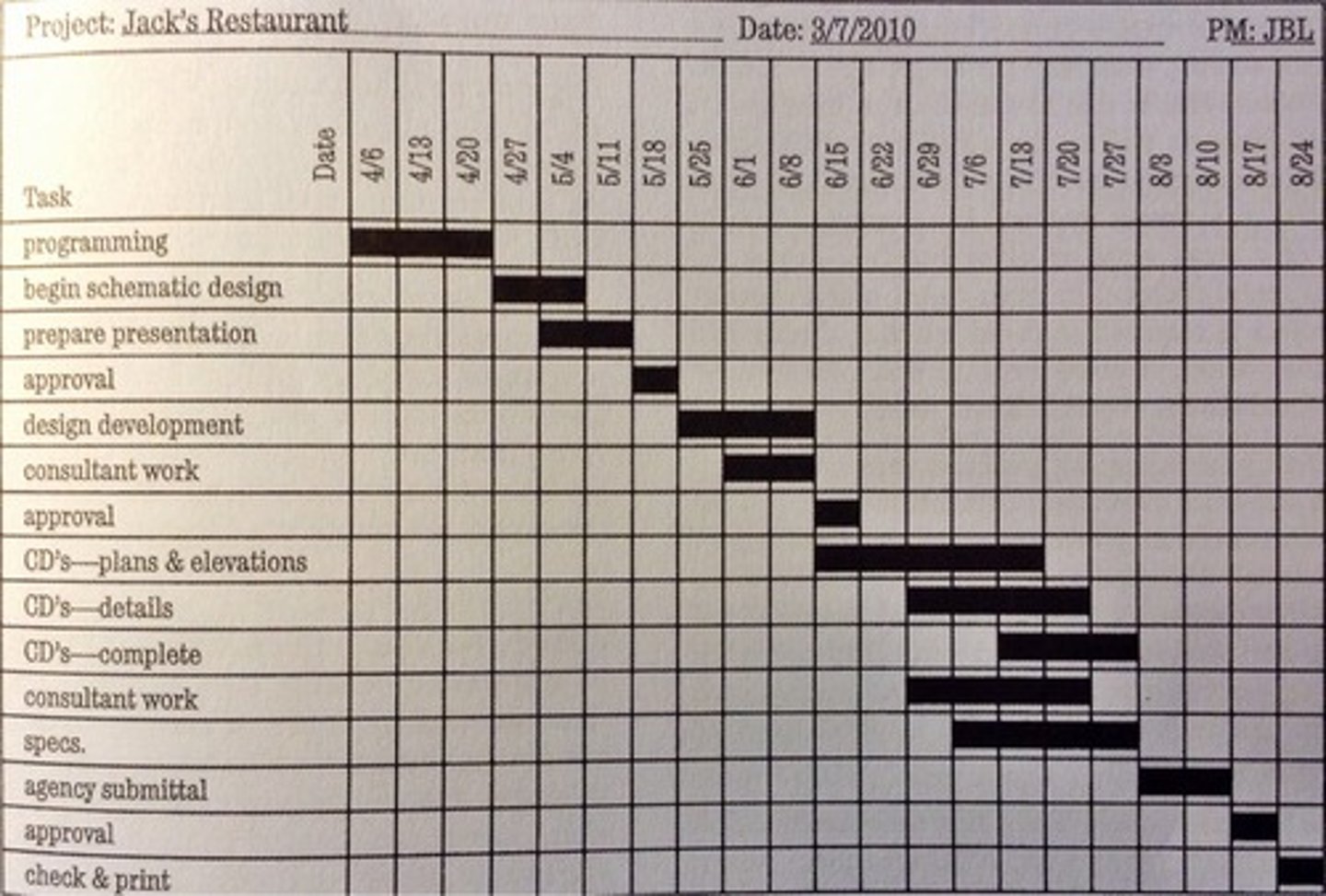
Gnatt chart
balanced scorecard (4 main)
measurement of organizational performance in 4 equally important areas: finances, customers, internal operations, & innovation and learning
-focuses managers at each level of the company to set specific goals & measure performance in each of the 4 areas
-minimizes sub optimization
economic value added
the amount by which company profits (rev - exp) exceed the cost of capital in a given year
-forces managers to set specific goals & measure performance
-reduces sub optimization
3 types of control
Feedforward Control
-monitoring inputs
-anticipating and preventing problems
-inputs
Concurrent Control
-monitoring processes
-adjusting ongoing activities
-productive processes and activities
Feedback Control
-monitoring products
-learning from past mistakes
-outputs
methods of control
1. bureaucratic control
2. objective control
3. normative control
4. concertive control
5. self-control (self management)
bureaucratic control
the use of hierarchical authority to influence employee behavior by rewarding or punishing employees for compliance or noncompliance w/ organizational policies, rules & procedures
objective control
the use of observable measures of worker behavior or outputs to assess performance & influence behavior
-behavior control - the regulation of the behaviors and actions that workers perform on the job
-output control - the regulation of workers results or outputs through rewards and incentives
normative control
the regulation of workers' behavior & decisions through widely shared organizational values and beliefs
-very careful about who to hire
-learn what they should do and not do by observing experienced employees & listening to their stories (driven by organizational culture)
concertive control
the regulation of workers' behavior & decisions through work group values & beliefs
-shaped & negotiated by work groups
-groups are autonomous
self-control (self-management)
a control system in which managers & workers control their own behavior by setting their own goals, monitoring their own progress & rewarding themselves for goal achievement
budgets
quantitative planning through which managers decide how to allocate available money to best accomplish company goals
variance analysis
the comparison of planned project results with actual project results.
technology cycles
a cycle that begins with the birth of a new technology & ends when that technology reaches its limits & is replaced by a newer, substantially better technology
experiential approach to innovation
an approach to innovation that assumes a highly uncertain environment & uses intuition, flexible options & hands-on experience to reduce uncertainty & accelerate learning & understanding
-goal: new product/service
-can be planned through deliberate creation of creative work environments, & testing
-5 aspects: design iterations, product prototype, testing, milestones, multifunctional teams
compression approach to innovation
an approach to innovation that assumes that incremental innovation can be planned using a series of steps & that compressing those steps can speed innovation
-certain environments
-series of steps
-Goal: faster & cheaper
-managed primarily through tradional planning & control processes
-based on idea of gernerational change
-5 aspects: planning, supplier involvement, shortening the time of individual steps, overlapping steps, multifunctional teams
creative work environment components
workplace cultures in which workers perceive that new ideas are welcomed, valued and encouraged; 6 components:
1. challenging work
2. organizational encouragemetn
3. freedom
4. lack of organizational impediments
5. expertise and positive moods
resistance to change
opposition to change resulting from self-interest, misunderstanding & distrust & a general intolerance for change
Lewin's change model
unfreeze--> (driving forces overpower restraining forces) --> change --> (new restraining forces created to establish new status quo) --> freeze
unfreeze--> (share reasons, empathize, communicate) --> change --> (explain, champion, opp for feedback, offer security, educate, dont rush) --> freeze
errors managers make (what not to do when leading change)
-not establishing a great enough urgency
-not creating a powerful enough coalition
-lacking a vision
-undercommunicating the vision by a factor of 10 (managers just old 1 meeting about it)
-not removing obstacles to the new vision
-not systematically planning for & creating short term wins
-declaring victory too soon
-not anchoring changes in the corporations culture
3 Organization development interventions (and examples)
a philosophy & collection of planned change interventions designed to improve an organization's long term health & performance ; 3 types:
-large system interventions - to change the character and performance of an organization, business unit or department
-small group interventions - focuses on assessing how a group functions and helping it work more effectively to accomplish its goals
-person focused intervention - intended to increase interpersonal effectiveness by helping people become aware of their attitudes and behaviors and to acquire new skills and knowledge
basic departmentalization structures
subdividing work & workers into separate organizational units responsible for completing particular tasks
1. functional departmentalization
2. product departmentalization
3. customer departmentalization
4. geographic departmentalization
5. mixed departmentalization
functional departmentalization
organizing work & workers into separate units responsible for particular business functions or areas of expertise (accounting, sales, marketing, HR)
-Advantages: work is done by highly qualified specialists, lowers cost by reducing duplication, good communication & coordination
-Disadvantages: cross department coordination can be hard, slow decision making
product departmentalization
organizing work & workers into separate units responsible for producing particular products or services
-Advantages: allows manager & workers to specialize in 1 area, easier access to work-unit performance, faster decision making
-Disadvantages: duplication, challenge of coordinating across the different product departments
customer departmentalization
organizing work & workers into separate units responsible for particular kinds of customers
-Advantages: focuses the organization on customer needs rather than on products or business functions
-Disadvantages: leads to duplication of resources, lead workers to make decisions that please customers but hurt the businesses
geographic departmentalization
organizing work & workers into separate units responsible for doing business in particular geographic areas
-Advantage: helps companies respond to demands of different markets, reduce cost by locating unique organizational resources closer to customers
-Disadvantage: can lead to duplication of resources, difficult to coordinate departments b/c they are so far from each other, redundancy
mixed departmentalization
a hybrid organizaional structure in which 2 or more forms of departmentalization (most often product & functional) are used together
-Advantages: allows companies to manage in an efficient manner, large complex tasks such as R&D & marketing or carrying out complex global businesses
-Disadvantage: high level of coordination needed, confusion & conflict, disagreements, misunderstandings
span of control
the number of people who report to a manager
-narrow: create tall organizations, only managing a few people, oversight is high, low autonomy and freedom, low workload for manager
-wide spans of control: create flat organizations, managing many people, very responsive to company needs and trends, cut out layers of managements, high autonomy and freedom, high workload for manager
logic of contingency design
-there is no single best design for all companies & situations
-mechanistic vs organic
-burns & stalker: must determine the degree of environmental uncertainty & adapt the organization & its subunits to that situation
mechanistic organization
an organization characterized by specialized jobs and responsibilities; precisely defined, unchanging roles; & a rigid chain of command based on centralized authority & vertical communication
-very clear chain of command
-vertical communication
-centralized authority
-low delegation
-high specialization
organic organization
an organization characterized by broadly defined jobs & responsibilities; loosely defined, frequently changing roles; decentralized authority & horizontal communication based on task knowledge
-think broadly about who you report to
-lateral communication
-decentralized authority
-high delegation
-high generalization
chain of command
the vertical line of authority that clarifies who reports to whom throughout the organization
line/staff authority
line - the right to command immediate subordinates in the chain of command
staff - the right to advise, but not command, others who are not subordinates in the change of command
delegation, how to do well (3 transfers)
the assignment of direct authority & responsibility to a subordinate to complete tasks for which the manager is normally responsible
-3 transfers
1. manager transfers full responsibility for the assignment to the subordinate
2. manager gives subordinate full authority over the budget, resources, & personnel needed to do the job
3. transfer of accountability, delegate their managerial authority & responsibility to subordinates in exchange for results
decentralization
the location of a significant amount of authority in the lower levels of the organization
centralization
the location of most authority at the upper levels of the organization
Correlation between missed classes and final points
Negative (r=-.41)
management
Getting work done through others
How do I get help
1. Do Your Homework= Search For Your Answer First
2. Think Strategically about Who to Ask
3. Prepare a Good Question
4. Be Patient, Kind, and Professional
"Life Lessons"
1. The most effective and most respected people show initiative and look for answers before relying on other people
2. Sometimes the person sitting next to you is the best source of information
3. Even if your boss really likes you, do not bother him or her with questions that you should be able to answer yourself
4. Do your homework, and let people know you've done your homework, otherwise they just might ask you, "Did you do your homework"?
5. Make other people feel that their work is important, even if you are not sure whether it is
6. Gratitude gains you a great deal of good will from others; adopting an attitude of entitlement and being a jerk irritates others and may mean you don't get the answers you need
7. Sometimes a short face-to-face meeting is the best way to get questions answered, and to get to know someone
8. Your time is valuable. So is theirs. People who schedule ahead of time will get attention. People who don't may be ignored
9. Asking the right person, the right way, is the best way to get the right answer and gain respect in the process
Types of managers
-top managers
-middle management
-first line management
-non-supervisory employees
Models
Useful simplification of reality
Four Functions
Planning
Organizing
Leading
Controlling
Managerial Skills
-Conceptual: more important as you go up management
-Human: needed (50%) for all levels of management
-Technical: less important as you go up management
Gaining management skills
-Sources of learning: reading, reflection, relationships, real experience
-Skills gained though: combining multiple sources, self management
Team leader role and responsibilities
Responsible for facilitating team activities toward goal accomplishment
Motivation to manage
An assessment of how enthusiastic employees are about managing the work of others
Top 3 mistakes managers make
1. insensitive
2. cold, aloof, arrogant
3. betrays trust
Transition to management
-Initial expectations: be the boss, formal authority, manage tasks, job is not managing people
-After 6 months: wrong initial expectations, fast pace, heavy workload, job is to problem solve
-After 1 year: communication, listening, positive reinforcement, learning to adapt, people development
Each stage of self-management process, including tips & mistakes
1. self-assessment and planning
2. goal setting
3. self and environmental control
4. evaluating and rewarding progress
1. self-assessment and planning
Tips:
- who am I now and who do I want to be?
-what are my strengths and what do I want them to be?
-what am I doing now and what do I want to be doing?
-where am I now and where do I want to go?
Common mistakes:
-no standards
-ignoring important parts of our identities