Lecture 47: Lung Cancer
 Call Kai
 Learn
Learn Practice Test
 Spaced Repetition
 Match
Match Flashcards
 Knowt Play
1/36

There's no tags or description
Looks like no tags are added yet.
Name | Mastery | Learn | Test | Matching | Spaced | Call with Kai |
|---|
No analytics yet
Send a link to your students to track their progress
37 Terms
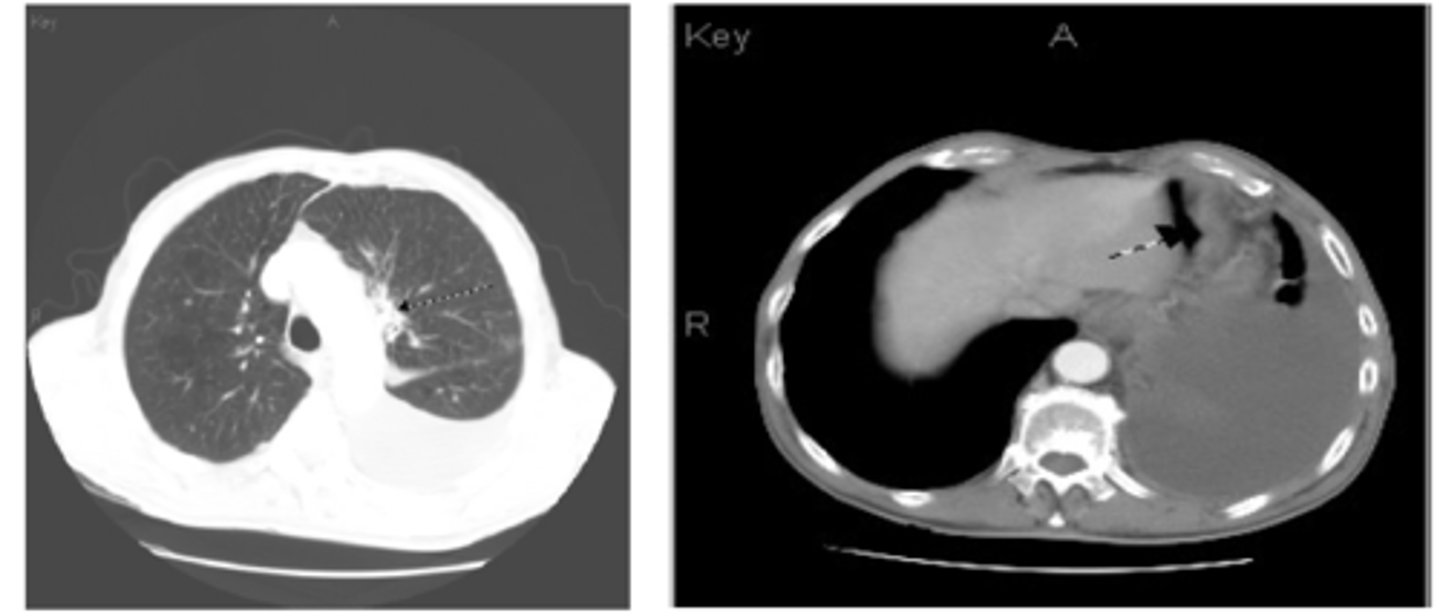
Left-sided Pleural Effusion
1. Smoking
2. Second hand smoke
3. Radon
4. Industrial pollution
5. Radiation (asbestos, radon, radiation, silicosis, beryllosis, arsenic)
top risk factors for lung cancer
Men
rates of lung cancer has rapidly gone up in ___________, but the rate is now decling
Female
____________ mortality by lung cancer began to rise in 1960
higher
The later you quit smoking, the _____________ the chance of getting lung cancer
NO
is screening diagnostic?
No
if pt doesnt want treatment, should you screen for lung cancer?
Yes
Should you offer CT screening for lung cancer?
-smokers and former smokers, age 55-74, with more than a 30 pack years of smoking
No
Should you offer CT screening for lung cancer?
-pt is younger than 55
-pt is older than 74
-pt has a smoking history of less than 30-pack years
No
Should you offer CT screening for lung cancer?
-pt has a severe comorbidity that would preclude potentially curative treatment or limit life expectancy
ages 55-80 with 30 pack year smoking history and currently smokes or has quit within past 15 years
CT lung cancer screening recommendations according to the USPSTF
15 years
according to the USPSTF, lung cancer screening should be discontinued after the pt has not smoked for ______________ or develops a health problem that substantially limits life expectancy
Solitary Pulmonary Nodule
Single lesion, surrounded by lung parenchyma, size 3-4cm
Group 2
What group for lung cancer screening?
High risk
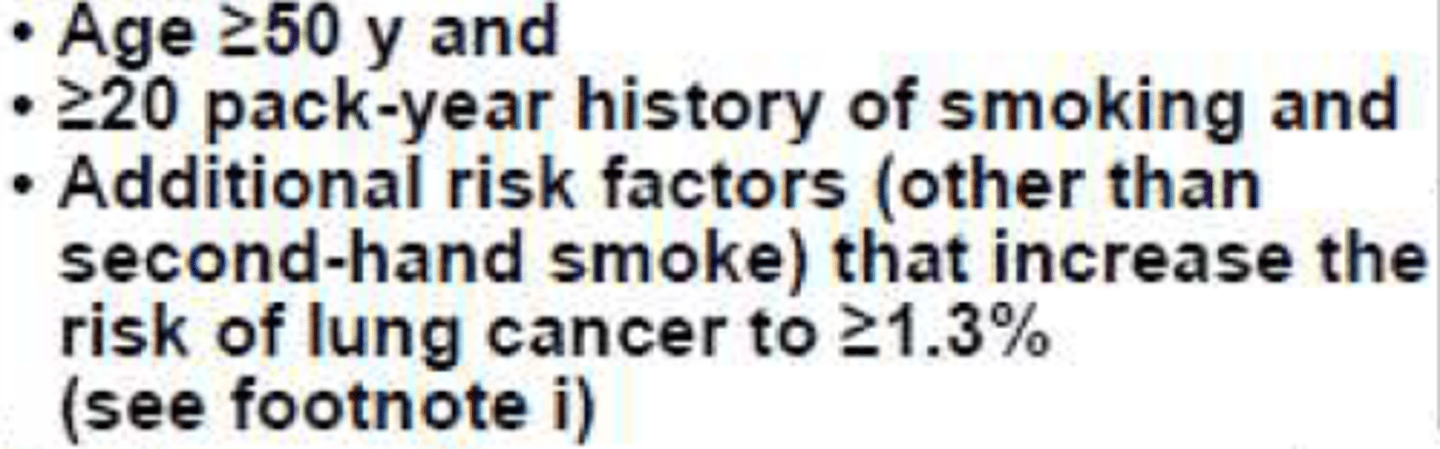
Group 1
What group for lung cancer screening?
High risk

High
according to NCCN guidelines, lung cancer screening is only recommended for ___________ risk status pts
50%
At an age >60, the risk of a solitary pulmonary nodule being malignant is greater than ___________
• Large airway obstruction
• Obstructive pneumonitis or atelectasis
• Dyspnea out of proportion to mass
• Pleural or pericardial effusion
• Hemoptysis
• Weight loss
Common Symptoms of lung cancer
Obstructive Pneumonitis
-results form compression of airway whereby bacteria or pathogens are trapped behing resulting in infection
Cough
most common symptom of lung cancer
Bronchitis
Although it is also a common symptom in lung cancer, the most common cause of hemoptysis is __________________
Recurrent Laryngeal Nerve
nerve associated with Hoarseness
Lung Cancer
• constricted pupil, partial ptosis, and loss of hemifacial sweating
-Superior Vena Cava Syndrome
-Brachial Plexus Involvement (horners syndrome, rib destruciton, upper extremity pain and weakness)
Heptatic
____________ metastases is assoc with weakness and weight loss
Brain
______________ metastases is assoc with headache, nausea and vomiting, focal neurologic symptoms, seizures, confusion, and personality changes
Leptomeningeal
________________ spread is assoc with pain, visual disturbance, and headache
Hypercalcemia
-paraneoplastic syndrome of lung cancer
-parathyroid hormone rp
-squamous cell, associated increase WBC, Not related to metastases, not prognostic of
stage or survival
HCG production
-paraneoplastic syndrome of lung cancer
-Gynecomastia, milky nipple discharge
-Hypercalcemia
-Digital Clubbing
-Syndrome Inappropriate ADH
-Hormone (SCC)
-Ectopic ACTH (SCC)
-HCG Production
-Eaton-Lambert Syndrome, Peripheral Neuropathy, CNS Syndromes
paraneoplastic syndromes of lung cancer
Syndrome of Inappropriate ADH (SIADH)
-Paraneoplastic syndrome
-hyponatremia
Ectopic ACTH
-Paraneoplastic syndrome
-cushing syndrome
Eaton-Lambert Syndrome
-Paraneoplastic syndrome
-power increases with repetition
-decreased reflexes
SVC Syndrome
-Paraneoplastic syndrome
-SVC obstruction
-dyspnea
-increased JVP
-facial swelling
Adenocarcinoma
most common type of lung cancer in US
Adenocarcinoma
-malignant epithelial tumor
-glandular differentiation or mucin production, showing acinar, papillary, bronchoalveolar, or solid with mucin growth patterns or a mix of these patterns
Large Cell Carcinoma
an undifferentiated non-small cell carcinoma that lacks the cytologic and architectural features of small cell carcinoma and glandular or squamous differentiation
Squamous Cell Carcinoma
-a malignant
epithelial tumor showing keratinization
and/or intercellular bridges that arise
from bronchial epithelium.
-These features vary with degree of differentiation, being prominent in
well-differentiated tumors and focal in poorly differentiated tumors.