Forces and Motion Study Guide
 Call Kai
 Learn
Learn Practice Test
 Spaced Repetition
 Match
Match Flashcards
 Knowt Play
1/21

Earn XP
Description and Tags
A series of flashcards covering terminology and concepts related to forces and motion.
Name | Mastery | Learn | Test | Matching | Spaced | Call with Kai |
|---|
No analytics yet
Send a link to your students to track their progress
22 Terms
What is a force?
A push or pull.
What two things do all forces have?
Strength and Direction.
What causes objects to fall to the ground?
Gravity.
What two forces cause a rolling ball to eventually come to a stop?
Gravity and friction.
What is inertia?
The tendency of an object to resist a change in motion. (resist a change in motion)
How is mass related to inertia?
More mass means more inertia.
What happens when the net force is 0N?
The forces are balanced and the motion remains the same.
What happens to velocity when a force is applied in the same direction as the motion?
The velocity will increase.
What is an unbalanced force?
When the net force is more than 0, causing a change in motion.
What is velocity?
Speed in a specific direction.
What is acceleration?
A change in velocity.
What is friction?
An opposing force when two objects rub against one another. ( when objects rub against each other)
How can you increase friction?
Make the surface rough or bumpy.
What happens to motion when you increase friction?
The object will move slower.
What happens to motion when you decrease friction?
The object will move faster.
What is the equation related to force, mass, and acceleration?
F = ma.
Which law states that for every action there is an equal and opposite reaction?
Newton's Third Law. (3rd law of motion)
Which law states that an object in motion stays in motion?
Newton's First Law.
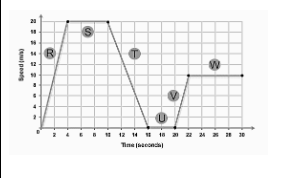
What is positive acceleration shown as?
Line segments R, V.
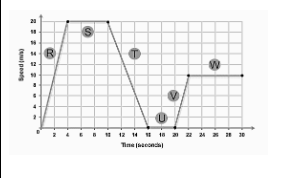
What is negative acceleration shown as?
Line segment T.
What is a steady speed shown as?
Line segments S, W.
What situation describes an object at rest according to Newton's First Law?
An object at rest stays at rest.