w+w detailed
 Call Kai
 Learn
Learn Practice Test
 Spaced Repetition
 Match
Match Flashcards
 Knowt Play
1/51

There's no tags or description
Looks like no tags are added yet.
Name | Mastery | Learn | Test | Matching | Spaced | Call with Kai |
|---|
No analytics yet
Send a link to your students to track their progress
52 Terms
spartan citizens
-live off the income of their land and could dedicate their time to training and warfare
-they were not professional soldiers
-they ate their daily meal with the men who made up their military unit
-when young men came of age they had to be selected by companies in order to become a full citizen
-both your father and mother had to be citizens to gain citizenship
perioci
-communities that governed themselves but recogized spartas over control
-these people were landowners, crfatsmen and traders
-no participiation in politics
helots
-enslaved people but greek speaking
-land assigned to spartan citizens but the native people worked the land for them (helots)
-they were obliged to hand over a proprtion or fixed amount of their produce to their spartan masters
-helots presented a danger to spartan society due to their size (perhaps seven to one)
-460 BC major slave revolt
kings
two kings jointly ruled sparta, apparently descended from heracles
-one was a military leader, one was a religious leader
taxiarch
a senior commander in the Spartan army, was directly responible for the kings
enomotia
a 'sworn-band,' the smallest unit of the Spartan army, consisted of 40 men, linked to the ssysteion, took an oath to stay with eachother
roles of perioci and helots
-were used on campaign
-battle of platea - 5000 perioci and 35000 helots
-used as fighters but also craftsmen
-fought alongside spartans
-carried equipment and supplies
-served as light armoured troops
roman legionary fortress
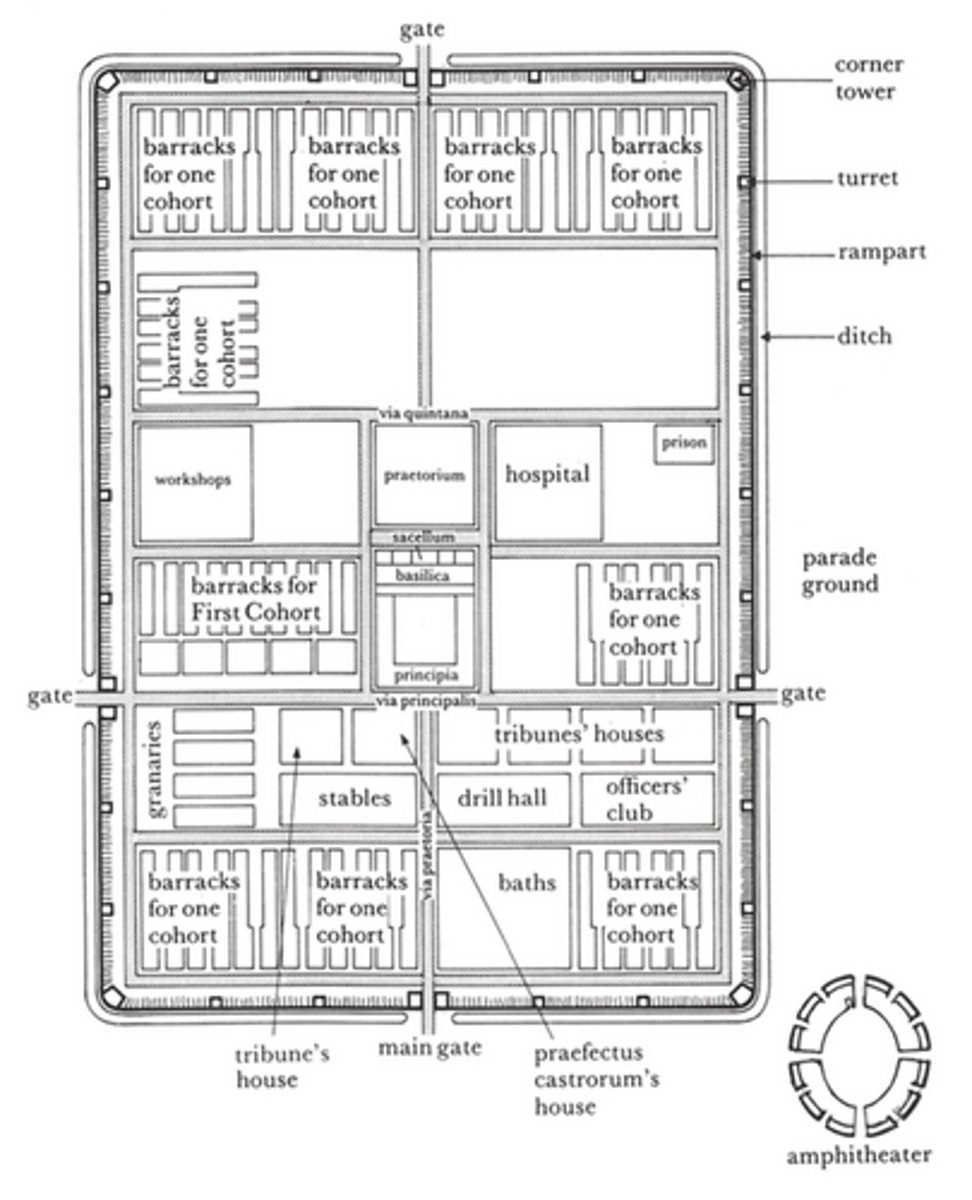
what was the principia in a fortress
-held strong rooms for the legions money
-shrine that housed the aquilla and the century standards
-small offices used for administration
-bascilica - open space for commanders to adress troops
roman tactics
tortoise formation, balista (large crossbow), catapult, battering rams, seige tower
roman recruitment
-had to be a roman citizen
-had to bring a letter of reccomendation and appear before a board of examining officers
-carpenters, hunters and butchers were the most desirebale trade for a legionary
-period of probation after the interview where the applicant underwent careful medical examniation
roman training
-upon arriving he would have to take the military oath, this was renewed at the beginning of every year
-then displatcched for a period of intense training:
-marcching a legionary had to march for 20 miled in five hours
-fitness - swimming, riding, running and jumping
-weapons training
-riding - how to jump off a horse in full armour
- how to constrcut a camp
auxiliaries
-recruited from non-citizens in the empire
-upon retirement after 25 years of service an auxiliary would gain citizenship
-formerdd into smaller regiments seperate from the legionaries
-commanded by romans of equestrian rank
main duties of the navy
-transport troops and support land campaigns
-protect costal settlements
-supress piracy and support merchant shipping
-repel barbarian incursions
who commanded naval fleets?
a prefect, a man of senetorial rank
after being in navy
they were rquired to serve for 26 years, they gained roman citizenship, honourable discharge and a cash payment after this time
training for the roman fleets
-learning to row in time and change pace
-follow instructions and engage in naval manovers
-required body strength to row
types of ships the romans had
trireme, quadrieme, quinquereme, hexareme, libruna
estimated amount of men for the army
300,000men
army before augustus rule
no professional standing army, instead legions were raised for a campaign and then later disbanded
how many centurions
59
how many men in a century
80
how many men in the first cohort 150
contubernium
8 men who shared a tent and mess arrangments
cohort
six centuries except for the first five cohort
legion
ten cohorts, over 5000 soldiers plus 120 hoursmen who acted as scouts
centurion
in command
signifier
standard-bearer and in charge of the pay and centurys savings
optio
deputy, responsible for training
tesseraius
organsised guards and communicated passwords
cornicen
horn blower who sounds orders
primi ordines
those of the first rank - the five centurions of the first cohort
primi pilus
the first spear man - the most senior of the five centurions, post held for a year and siginifcant importance within the legion
cleopatra
the pharoh of egypt, egpyt was not a roman province yet and was only a client state . Cleopatra had an affair with Ceaser and bore him a son Caeserion. From 41 BC she and Anthony were in a relationship and had three children
who was mark anthony
Julius Caesar's right hand man and deputy, he was well loved by the people and their legions
who was Marcus Agrippa
Octavians childhood friend and an amazing military commander
Octavian
Caesers heir and nephew, 18 years old when Caeser was assasinated
tensions before the war
assasins of Caeser had been defeated, Octavian and Anthony were ruling together. O had the west, A had the east. 32 BC Anthony divorced Octavia, Octavians sister. Octavian portrayed Anthiny as under the spell of cleopatra and a deserter, he publicly read out his will than named cleopatra as his main heir and beneficiary. Anthony's soldiers deserted and Octaviamn declared war on Cleopatra.
the battle of Actium
-Agrippa set up a blockade on the supply lines of Anthony's resources and the island of Leukas, allowing him to set up a naval blockade
-A and C's forces suffered starvation and disease, many deserted
-A decided to fight at sea in an attempt to secure the West coast of Greece for himself
-in preperation A and C ordered for their chests of treasure to be loaded onto their boats
size of Octavians fleet
250 ships
size of ANthony's fleet
230 + 60 Egyptian ships
A and C trying to escape
Agrippa tried to outflank A +C's fleet and broke through and raced soutth due to the centre of Agrippa's line training
Anthony saw this and moved his flagship to a smaller quiereme and ordered them to flee as well
the aftermath of the battle
Cleopatra escaped the battle and Anthony followed, the survivors of his fleet eventually withdrew and many joined Octavians army
the aftermath - what did Anthony do?
he was beaten in Alexandria the next summer, he heard a flase rumor of Cleopatra being killed and captured, so he took his life. It took Anthony days to die and he eventually died in Cleopatra's arms
the aftermath - what did Cleopatra do?
she offered Octavian an allince, he refused and she pleaded for Caesrions life, but Octavian had him killed. Cleopatra then killed herself
the aftermath - what did Octavian do?
he spent the winter in Greece before sailing to Egypt the next summer
Trajan
the first emperor born from outside of Italy, he was from Southern Spain and came from a high ranking Roman family.
Trajan making his name in the army
-he served in Syria, his father was the goverener of Syria
-he was a tribune in the army and later became a Legatus of VII Germina
-became a consul to Rome
-married into Roman old money
Trajan becoming emperor
Nerva became emperor, he was childless and not popular with the army. Nerva adopted Trajan and made him his successor. Nerva died in 98 AD and Trajan becomes emperor
Trajan as a military leader
-conquest of Dacia, Parthia
-loved by soldiers and formed two legions
-marched on foot with his men to campaign
Trajan as a civic leader
-positive relations with the senate and upper classes
-built new projects such as new forums and new roads
-introduced welfare for the poor and orphaned children
-he extended the corn dole