Exam 4 Zoology Prep
 Call Kai
 Learn
Learn Practice Test
 Spaced Repetition
 Match
Match Flashcards
 Knowt Play
1/64

Earn XP
Description and Tags
Creator, help us all
Name | Mastery | Learn | Test | Matching | Spaced | Call with Kai |
|---|
No analytics yet
Send a link to your students to track their progress
65 Terms
What are the 5 main classes of Echinodermata?
Holothuroidea (sea pickle), Asteroidea (sea stars), Echinoidea (sea urchin), Ophiuroidea (brittle stars/snake-like), Crinoidea (sea lilies/feathered stars)
What are the characteristics of Asteroidea?
Sea stars
Multiple arms radiating from a central disc
Shorter Arms
a water vascular system used for movement and feeding
Active predator with gut that comes out
What are the characteristics of Ophiuroidea?
Brittle star
Long, slender, flexible arms that are sharply marked off from central disk (No rounded edges, just shoots from central disc/center)
Ambulacral grooves closed off by ossicle plates (No divot/dent like a sea star, but instead flat)
What are the characteristics of Echinoidea?
Sea Urchins
Test (interlocking armor under spikes/spines)
Aristotle’s Lantern (Teeth-like structure used for eating)
Eat anything with hard crust
Live on sea floor
What the characteristics of Holothuridea
Sea pickles
Live on sea floor/bottom feeders
No cephalization (No concentration of nerves to head/no head)
Anus opens into large cloaca (chamber), to bring in water to bring in oxygen and remove nitrogenous waste
Ossicles reduced to small plates/spicules (They’re smooth)
Water vascular system is closed (they have their own blood/coelomic fluid)
What are the characteristics of Crinoidea
Sea lilies
Most ancient of all classes
Suspension feeders (They’re sessile and catch prey with their pinnules/ feathery arm thing)
Believed that they lost their stock throughout evolution due to ocean acidification & climate change which caused calcium to be hard to come by
What are the characteristics of the Phylum Hemichordata
Acorn worms & colonial animals
Pharyngeal gill slits/pouches (Holes/slits in the neck to push water through and out), also exchange oxygen, not all organisms will use it
Dorsal hallow nerve chord
What are the two main classes of Hemichordata ?
Class Enteropneusta (Acorn worms)
Class Pterobrancia (small colonial animals)
What are the main traits of Chordata?
Pharyngeal slits/pouches
Dorsal Hallow nerve chord
Notochord
Post-anal tai
Endostyle
What is a Pharyngeal Slit?
Initially used for filter feeding
turns into jaws
Can turn into gills
Can turn into part of ear
Dorsal Hallow Nerve Chord
Turns into nerve chord
Connects/turns into part of your brain
Notochord
Sits below dorsal hallow nerve cord
Develops by wrapping itself around the DNC to then become the vertebrae (spine)
Provides support (will turn into bones/cartilage)
Postanal Tail
used for locomotion
Vestigial in humans (Develops into tailbone which is later lost in humans)
Endostyle
On ventral wall of pharynx, produces mucus to gather food particles
In humans, turns into thyroid gland which regulates metabolism
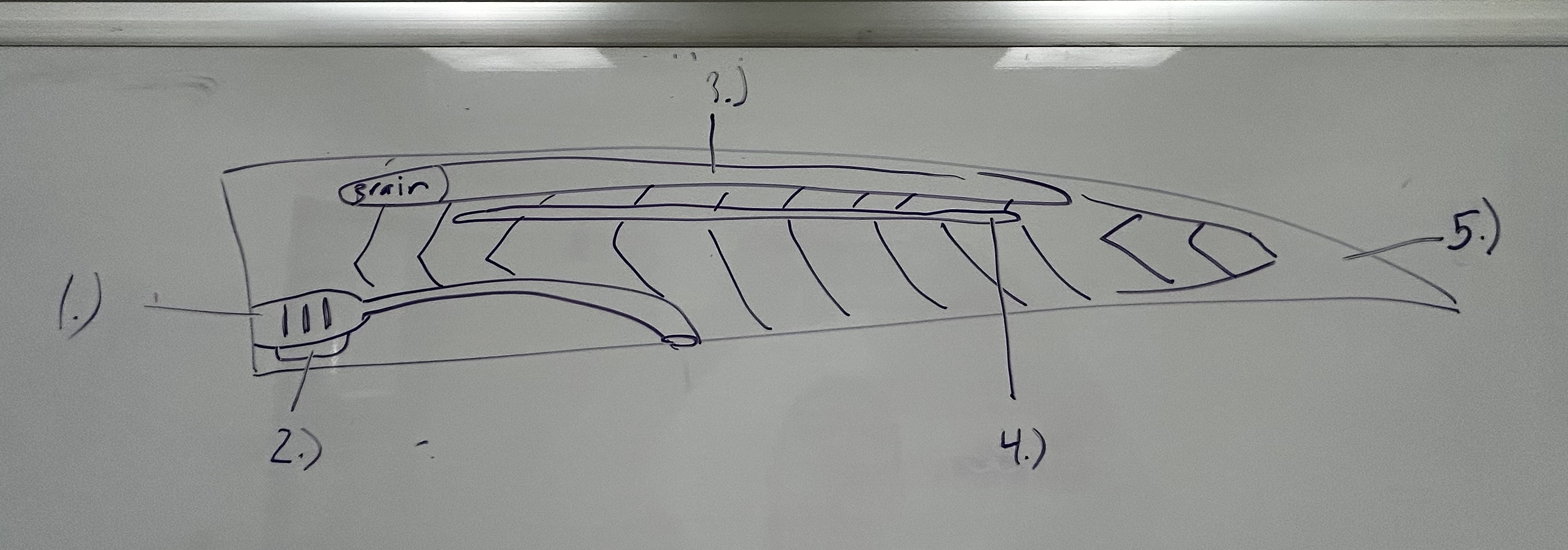
#1
Pharyngeal Slit/Pouch (picture)
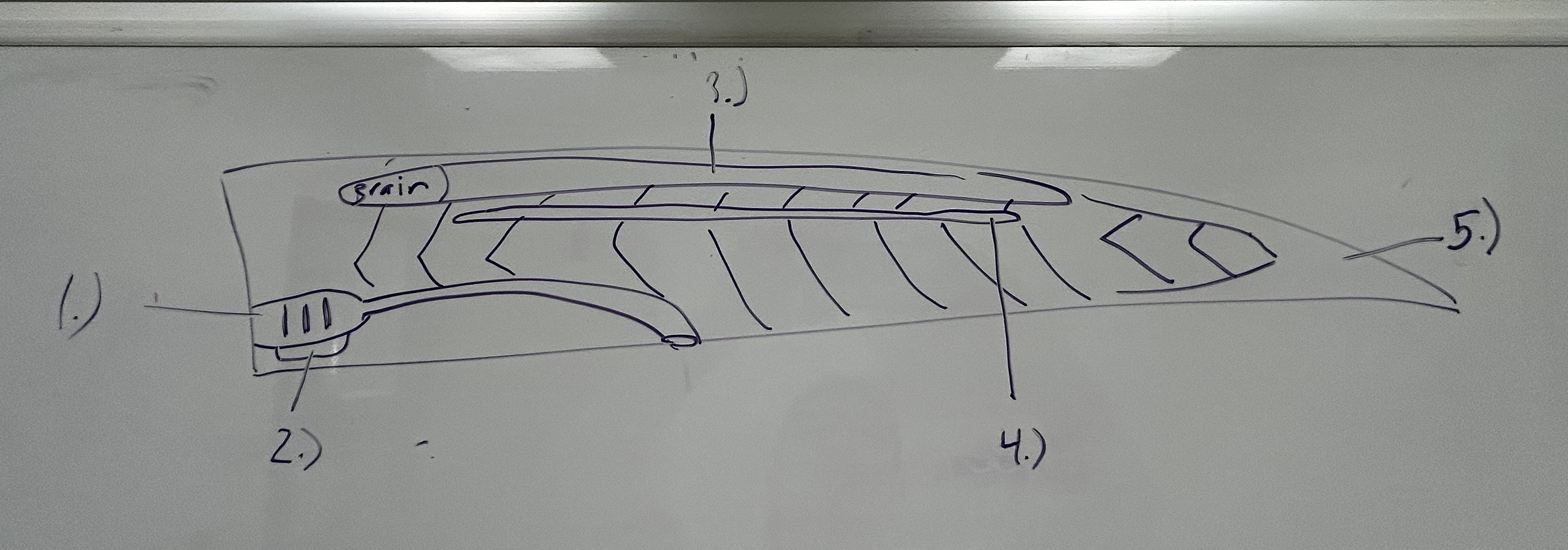
#2
Endostyle (picture)
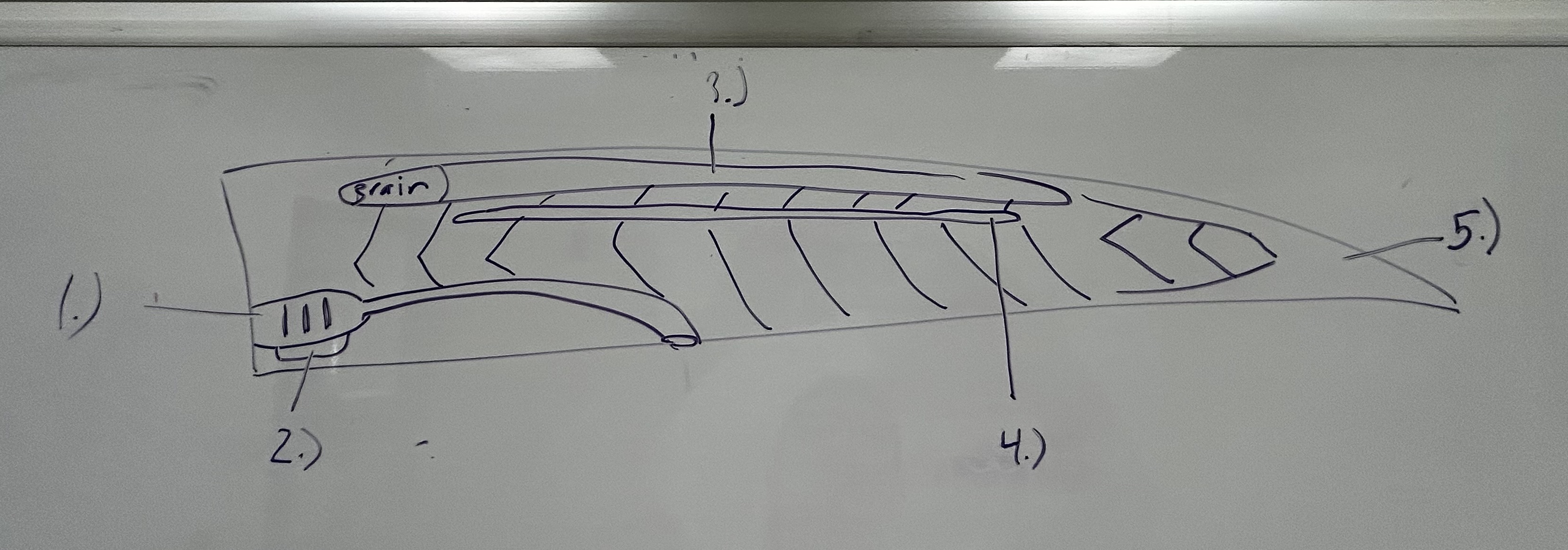
#3
Dorsal Hallow Nerve Chord (picture)
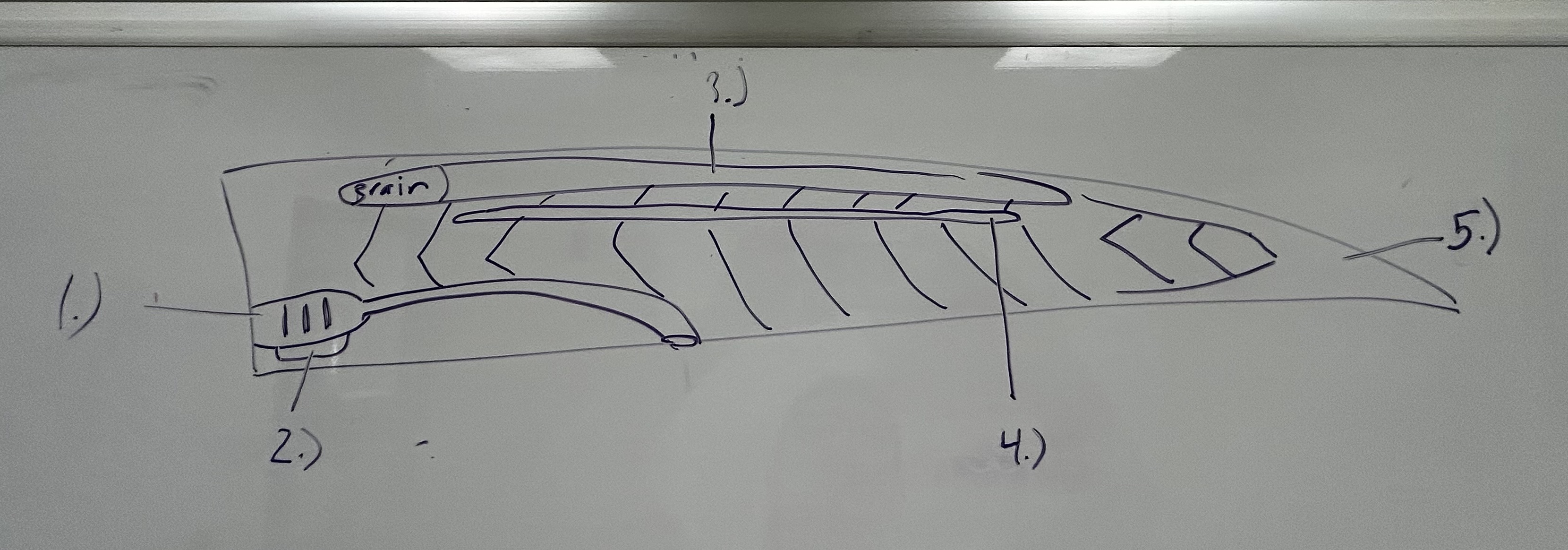
#4
Notochord (picture)
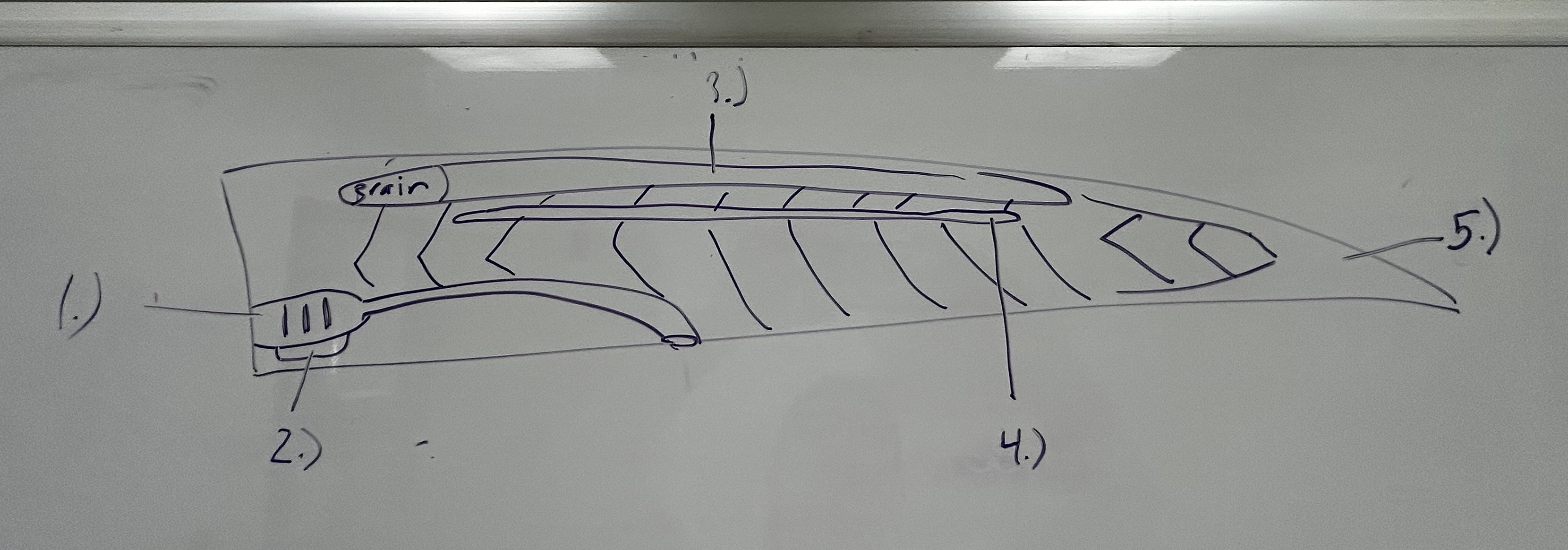
#5
Post Anal Tail (picture)
What are the three main subphyla of the Phylum Chordata?
Cephalochordata (lancelet/fish-like most common ancestor)
Urochordata (Seasquirt)
Vertebrata (Human)
What is the main characteristic of the subphylum Urochordata?
Sessile/Stick to something usually as an adult (not all)
Move around in larval stage
Surrounded by nonliving cellulose test called a Tunic
Only when it’s in larval form, it’ll have all chordate (lanclet) features, then as adult, stick to something
What is the main class of Subphylum Urochordata?
Class Ascidiacea (sea squirts)
What are the characteristics of the class Ascidiacea?
Solitary & colonial species
Sessile as adults
during metamorphosis, notochord and tail disappear & dorsal nerve cord is greatly reduced.
What tunicate/Chordate is used for medicine and what medicine?
Ecteinascidia turbinata/Mangrove tunicate
Trabectedin (anti-tumor drug)
What are the main characteristics of Subphylum Cephalochordates?
Lancelets
Has five shared Chordata characteristics
is a model species that represents an old ancestor (not common ancestor, just similar)
What are the main characteristics of Subphylum Vertebrata?
Known as clade Craniata (has skull-like thing)
How are the early vertebrate characteristics different form other subphyla in chordata?
Large size & active lifestyle
(Notochord Turns into endo skeleton) allows greater speed and mobility
Well developed cranium
Tripartite brain (three regions)
Various sensory organs
What are protochordates?
Hemichordata, Urochordata, cepholochordata
What are the different parts of the brain in an early vertebrate character?
Forebrain
Midbrain
Hindbrain
Brain Stem
What does the Forebrain do?
Coordinates movement & sensory info (smell)
Emotions, problem solving
learning
(Cerebrum)
What does the Midbrain do?
Visual & auditory processing
Movement of eye
motor movement
(Optic lobe)
What does the Hindbrain do?
Autonomic functions; relay info
coordinate voluntary muscle movement
balance and equilibrium
(Cerebellum)
What does the Brain Stem do?
Regulate involuntary actions (sneezing, vomiting, heart rate swallowing & breathing)
Sleep cycle
Conduct messages between brain and spinal cord
(Medulla oblongata)
What are some characteristics of early Vertebrae?
Endoskeleton (cartilage → bone)
Bone’s original function was mineral storage
What resulted of increased metabolic demand?
(Increased need for food/energy production/way to get oxygen)
Muscular pharynx (muscle in throat to help push food down)
Vascularized gills (allows for increased ability to take oxygen from water and then use it in the blood)
Multi-chambered heart
What are Ostraderms?
A clade → Armored Extinct Jawless fish
Agnatha meaning?
Jawless
What are the two main classes of Agnathans?
Myxini (Hagfishes)
Pteromyzontida (lamprays)
What are the characteristics of Agnathans?
Lack: Jaws, internal ossification (development of bone from other connective tissue), scales and paired fins
Have: Pore-like gill openings & eel-like bodies
Characteristics of Class Myxini?
(Hagfish)
All marine
Predators & scavengers (bore into carcasses)
Nearly blind but have acute sense of smell
Characteristics Class Pteromyzontida?
(lampreys)
Parasitic species that attach to fish with sucker-like oral disk & sharp teeth rasp through flesh
Non-parasitic species don’t feed as adults, digestive track degenerates, spawn and die
What is the Sea Lamprey Invasion of the Great Lakes Region?
Initially, no lampreys were ever in the U.S Great lakes,
then in 1913-1918, the Welland Ship Canal was deepened allowing sea lampreys to invade lakes
Destroyed lake trout fisheries & depleted stock of most other fishes by 1951
What is Gnathostomata?
A clade → HAS Jaws
Characteristics of Gnathostomata?
Has an ostracoderm ancestor (originally jawless ancestor)
Jaws are modified gill arches (A gill moved down to become jaw)
What is a placoderm?
Extinct class or armored jawless fishes
Characteristics of Class Chondrichthyes?
(Sharks, sawfish, Rays, Skates, and Chimaeras) (Cartilaginous Fishes)
Mostly Marine
Has cartilage → No bones
Descended from a bony ancestor
Well-developed sense organs
Powerful Jaws
Well-developed sense organs
Powerful Jaws
Heavier than water → most must move or sink
Body hydrodynamic (well adapted to moving in water, doesn’t require a lot of energy)
What are the two main Subclasses of Class Chondrichthyes?
Elasmobranchii (sharks & rays)
Holocephali (chimaeras)
What are characteristics of Subclass Elasmobrancii?
5-7 pairs of gill slits
Tough leathery skin with tooth-like placoid scales
Asymmetrical heterocercal tail → provides thrust and lift
Can sense low frequency vibrations with lateral line system (neuromasts) → (mechanoreceptors)
What are characteristics of (Rays) Subclass Elasmobranchii?
Dorsoventrally flattened bodies with enlarged pectoral fins
Teeth adapted to crush prey
Modified dorsal respiratory spiracle & ventral gill slits
What is the main Superclass of the Phylum Chordata?
Osteichthyes (Bony Fishes)
What are characteristics of Superclass Osteichthyes?
Paraphyletic (tetrapods share ancestor with lobe-finned fishes)
Bone replaces cartilage during development
Swim bladder for neutral buoyancy → derived from gut
The bony operculum over gills increases respiratory efficiency
What are the two main classes of Superclass Osteichthyes?
Actinopterygii (Most common) (ray-finned fish/fins look like delicate fans)
Sarcopterygii (Rarer) (lobe-finned fish)
What are characteristics of Class Actinoptergii?
Ancestral forms from Devonian period
Heavily armored with ganoid scales (don’t overlap)
Modern teleost fish comprise almost half of all vertebrates
Dermal armor replaced by light, thin, flexible cycloid (smooth & round) and ctenoid (has tiny teeth-like edges) scales
Jaw is modified to protrude & suction food
What are the characteristics of Class Sarcopterygii?
(Lobe-finned fish)
8 extinct species
Pectoral & pelvic fins supported by stout bones & strong muscles
Has gills AND lungs
Have Ambulatory fins (“walking fins”/ can use them for locomotion along bottom of ocean)
The Coelacanths (believed to be extinct) was re-discovered in 1938 off the coast of Africa and is unchanged
In early evolution of terrestrial vertebrates, what happened?
Aquatic features were repurposed in early verts to explore terrestrial habitats
→ Air filled cavities connected to pharynx once worked as a swim bladder
Bony fins originally were then modified for support & underwater locomotion
What were some adaptions to living on land?
(important event in metazoan evolution)
Access to unoccupied niches & resources → vascular plants, pulm snails and tracheate arthropods were already well established on land
Lower predation pressure
More opportunities for adaptation
What were the new physiological requirements of the adaptions to living on land?
Oxygen 20x richer than air in water (Increase vascularization & double circulation)
Air is 1000x less dense than water (skeleton and muscles develope to support more weight)
Temp fluctuate more rapidly in air (behavioral strategies evolve)
What are some characteristics of the early terrestrial vertebrates?
Transition bwtn lobe-fin fishes and tetrapods
Had lungs and well muscular limbs & skeletal support system
What taxonomy is Amphibia?
Class
What is the Amphibia Crisis?
1/3 of all species threatened
Chytridiomycosis (disease that affect’s skin → death) responsible for killing frogs)
Climate change affects it too
What is the Subclass of Class Amphibia?
Subclass Lissamphibia
(has three orders of modern amphibians)
What are the three Orders of Modern Amphibians?
Gymnophiona (Caecilians/worm-like)
Urodela (Salamanders & Newts)
Anura (Frogs & Toads)
What are the main characteristics of Modern Amphibians?
Forelimbs with four digits
Cutaneous respiration (skin is thin & prone to desiccation)
Three chambered heart w. double circulation
Ecto & poikilo thermic (body temp varies on environment)
What are the main characteristics of the Order Gymnophiona?