International Trade Theory and Policy: Foundations, Advantages, and Barriers
 Call Kai
 Learn
Learn Practice Test
 Spaced Repetition
 Match
Match Flashcards
 Knowt Play
1/46

There's no tags or description
Looks like no tags are added yet.
Name | Mastery | Learn | Test | Matching | Spaced | Call with Kai |
|---|
No analytics yet
Send a link to your students to track their progress
47 Terms
What is the primary purpose of the United Nations?
Collective security
What is the function of the UN General Assembly?
To serve as a forum for all member states to discuss international issues
What are the three main responsibilities of the UN Security Council regarding international peace?
Identifying threats to peace, peace enforcement, and peacekeeping
What are the requirements for enacting a substantive resolution in the UN Security Council?
A 'yes' vote from at least 9 of the 15 members and no negative vote from any P5 member
How is international trade defined?
The transfer of goods and services from one entity to another, often in exchange for money
What are the two primary benefits of trade for producers?
Selling to new markets and increasing efficiency
What is the primary benefit of trade for consumers?
Access to cheaper goods
What is the term for a policy of complete self-sufficiency where a state does not trade?
Autarky
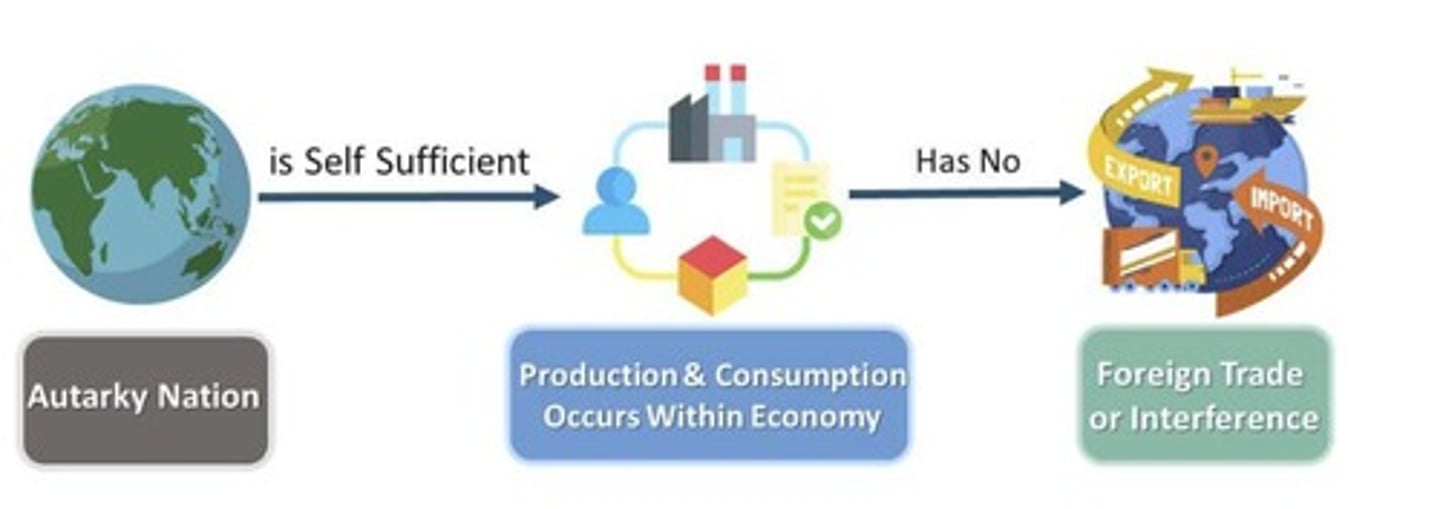
What is the purpose of specialization or the division of labor in an economy?
It allows diverse segments of society to focus on different economic activities in ways that benefit society as a whole
Define absolute advantage.
The ability of a country or firm to produce more of a particular good or service than others using the same amount of resources

Define opportunity cost.
The value of the next best alternative that must be given up to produce one more unit of a particular good
Define comparative advantage.
The ability of a country or firm to produce a good or service more efficiently at a lower opportunity cost than another
Is it necessary for a country to have an absolute advantage to profitably export a good?
No, it only requires a comparative advantage
What is the core focus of the Heckscher-Ohlin trade theory?
Explaining a country's comparative advantage and its trade patterns based on factor abundance
According to the Heckscher-Ohlin theory, what does comparative advantage depend on?
A country's abundant factor of production
What is the primary role of the UN Security Council?
To facilitate swifter and more efficient decision-making in dealing with threats to international peace and security
What does 'peace enforcement' entail in the context of the UN?
Restoring peace
What does 'peacekeeping' entail in the context of the UN?
Maintaining peace
Who are the P5 members of the UN Security Council?
The five permanent members who hold veto power
How does specialization affect the production of sophisticated products versus labor-intensive products?
Sophisticated products are typically made in developed regions, while unskilled, labor-intensive products are made in developing countries
If Alice can produce 10 sandwiches or 20 lemonades in an hour, what is the opportunity cost of one sandwich for her?
2 glasses of lemonade
If Bob can produce 5 sandwiches or 5 lemonades in an hour, what is the opportunity cost of one sandwich for him?
1 glass of lemonade
In a scenario where Alice has an absolute advantage in both sandwiches and lemonade, how is it determined who should produce what?
By comparing the opportunity costs; each party should specialize in the good for which they have a lower opportunity cost
What are factors of production?
Resources essential for economic activity, including land, labor, and capital.
What does 'land' represent as a factor of production?
Agriculture and natural resources.
What is included in the factor of production known as 'capital'?
Human capital (skills, knowledge, experience) and investment capital (money, equipment).
What is the core premise of the Heckscher-Ohlin trade theory?
Countries export goods that use their abundant resources intensively and import goods that use their scarce resources intensively.
According to Heckscher-Ohlin, what should a country with abundant capital and scarce labor export?
Capital-intensive products.
How did U.S. exports change from the nineteenth century to today?
It shifted from exporting raw materials and farm goods (land-abundant) to exporting goods requiring capital and skilled labor.
Define trade barriers.
Government-imposed limitations on the international exchange of goods.
What is a tariff?
A tax imposed on imported goods.
What is a quota in the context of trade?
A quantitative restriction that limits the volume of a specific good allowed to be imported.
What are subsidies in international trade?
Government payments provided to domestic producers to help them compete.
What is the purpose of trade prohibitions?
Laws banning the export of specific items, such as sensitive military technology.
Who typically benefits from trade barriers?
Owners of scarce factors of production who are protected from global competition.
Who typically benefits from free trade?
Owners of abundant factors of production who can produce goods more cheaply than international competitors.
Why do politicians often support trade barriers?
To protect specific domestic sectors from foreign competition in response to domestic political preferences.
What was the result of the U.S. forcing 'voluntary export restraints' on Japanese cars in the 1980s?
The retail price of Japanese cars in the U.S. rose by 41 percent between 1981 and 1984.
Why might a government impose trade barriers for national security?
To protect industries deemed critical to the nation's defense or technological independence.
Why did the U.S. impose restrictions on AI chip exports to China?
To restrain the Chinese military and economy and block China's development in AI and quantum computing.
How can tariffs be used as a diplomatic tool?
They can be used as bargaining leverage to gain negotiating power in international trade deals.
What is 'human capital'?
The skills, knowledge, and experience possessed by individuals.
What is the primary reason labor-intensive industries in the U.S. often seek trade protection?
Because cheap labor is a scarce factor in the U.S., these industries cannot compete globally without protection.
What is the main motivation for tech companies in the U.S. to support free trade?
The U.S. has an abundance of capital, allowing these companies to produce goods more cheaply and expand their market share through exports.
What is a nontariff barrier?
Any trade restriction that is not a tax, such as quotas or subsidies.
What is the relationship between factor endowments and trade patterns?
A country's specific mix of land, labor, and capital determines its comparative advantage and what it trades internationally.
Still learning (14)
You've started learning these terms. Keep it up!