bio 2 exam 2?
 Call Kai
 Learn
Learn Practice Test
 Spaced Repetition
 Match
Match Flashcards
 Knowt Play
1/104

There's no tags or description
Looks like no tags are added yet.
Name | Mastery | Learn | Test | Matching | Spaced | Call with Kai |
|---|
No analytics yet
Send a link to your students to track their progress
105 Terms
What is an Animal
multicellular heterotrophic, eukaryotic organism
cells lacking in cell wall, held by proteins and contain nervous and muscle tissue most reproduce sexually but have a dominant diploid stage
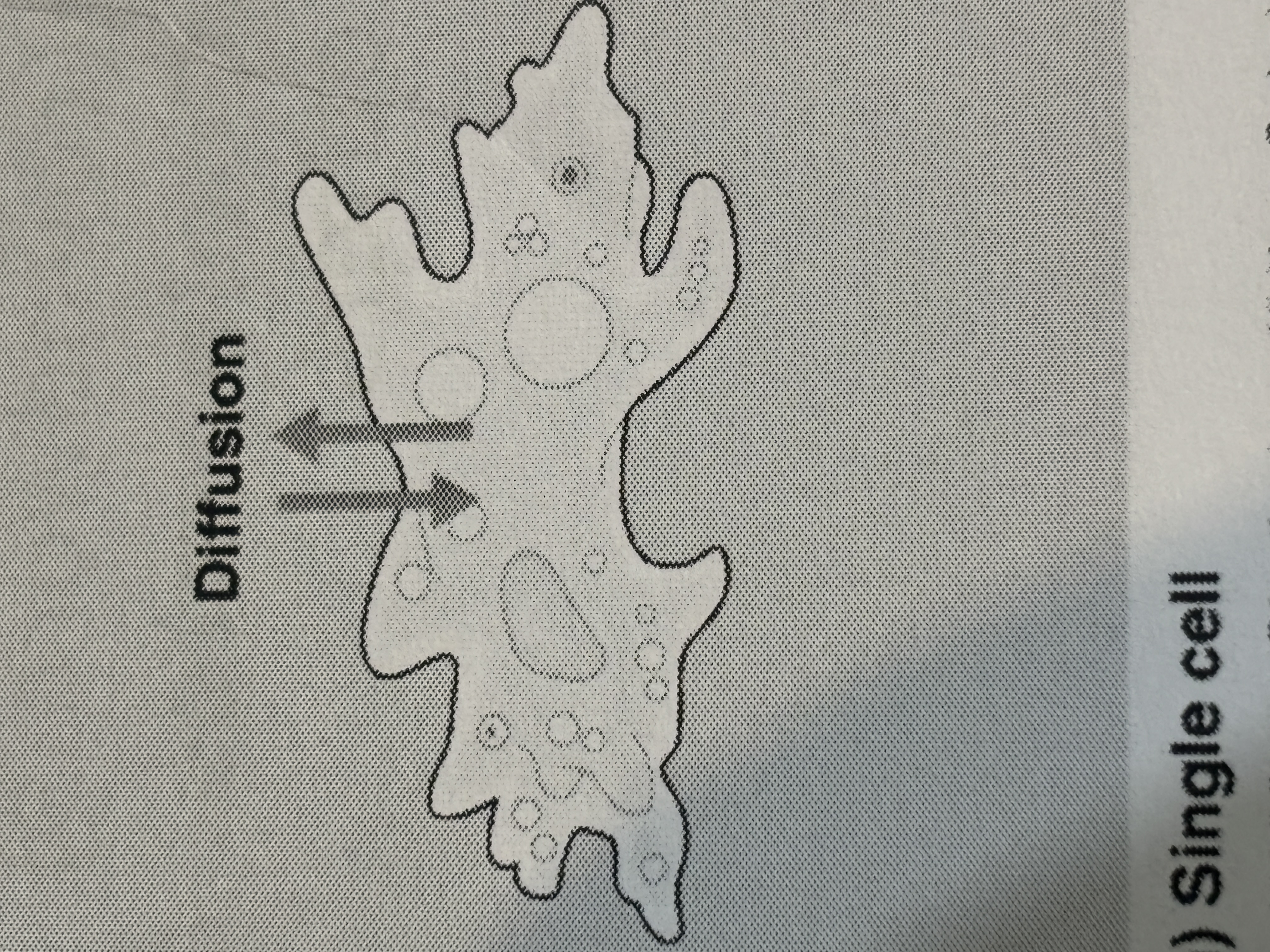
porifera organization level
cellular
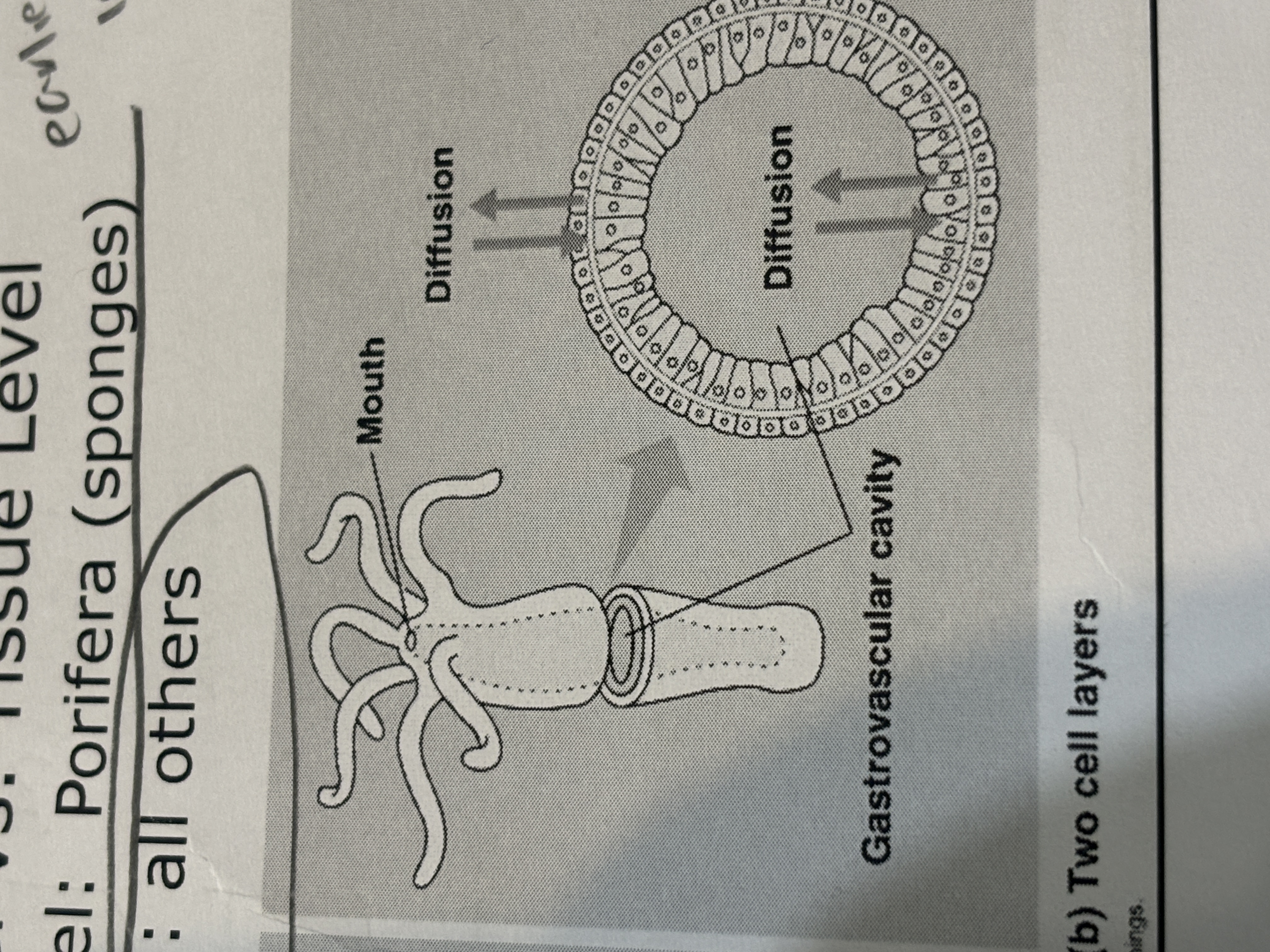
organization of everything else
tissue
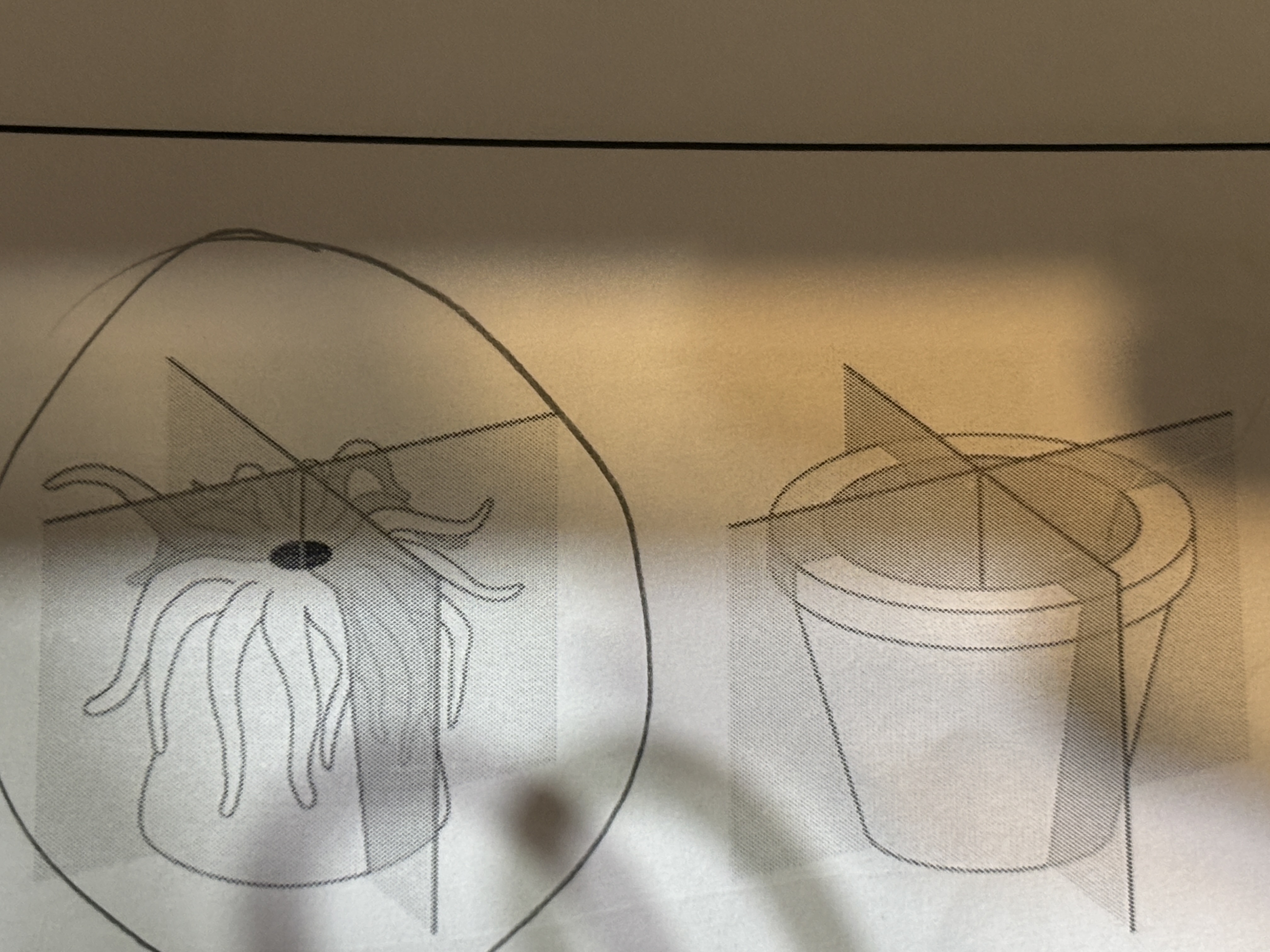
Radial symmetry
Cnidaria and Ctenophora
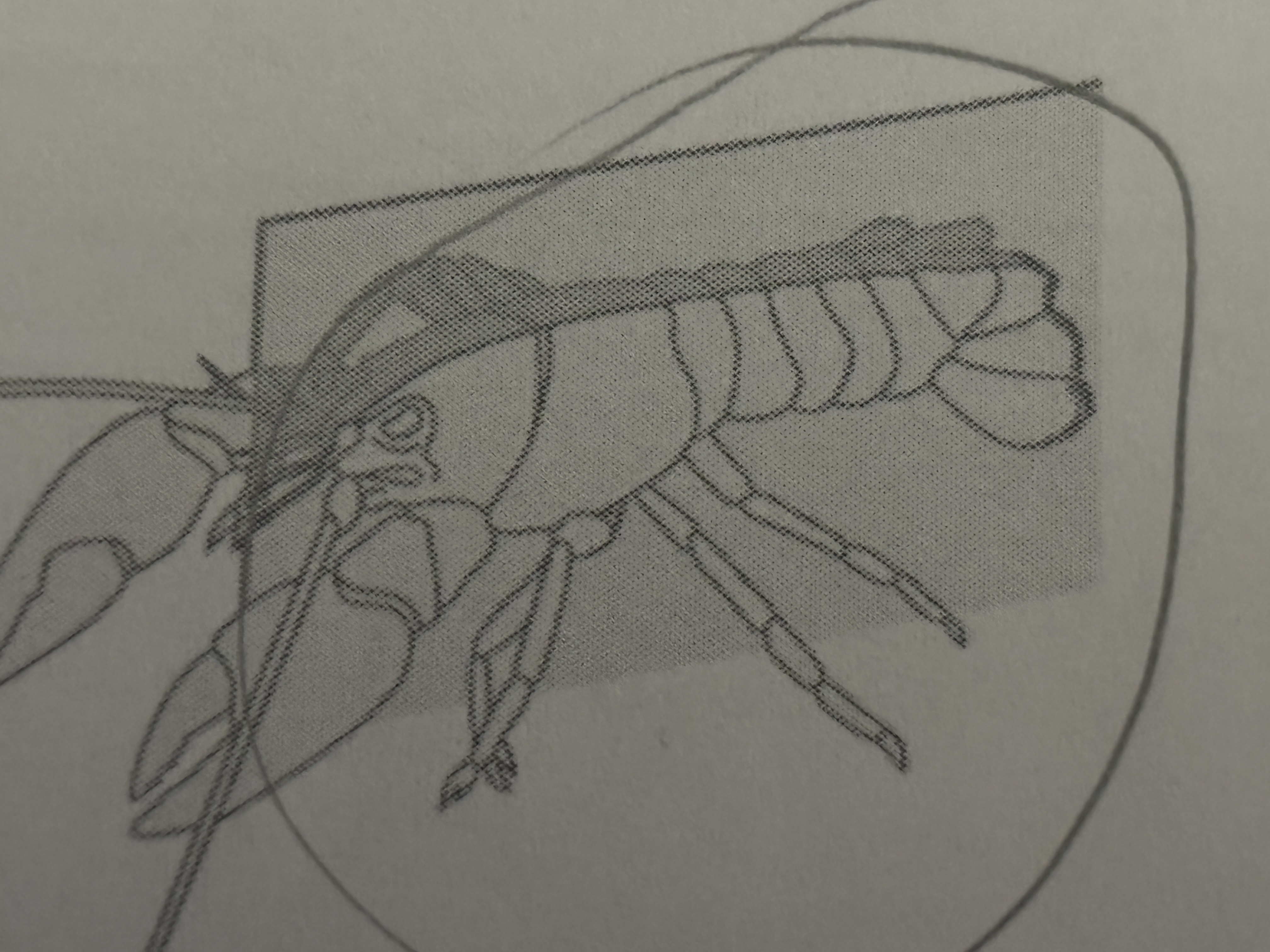
Bilateral symmetry
Everything else/ us
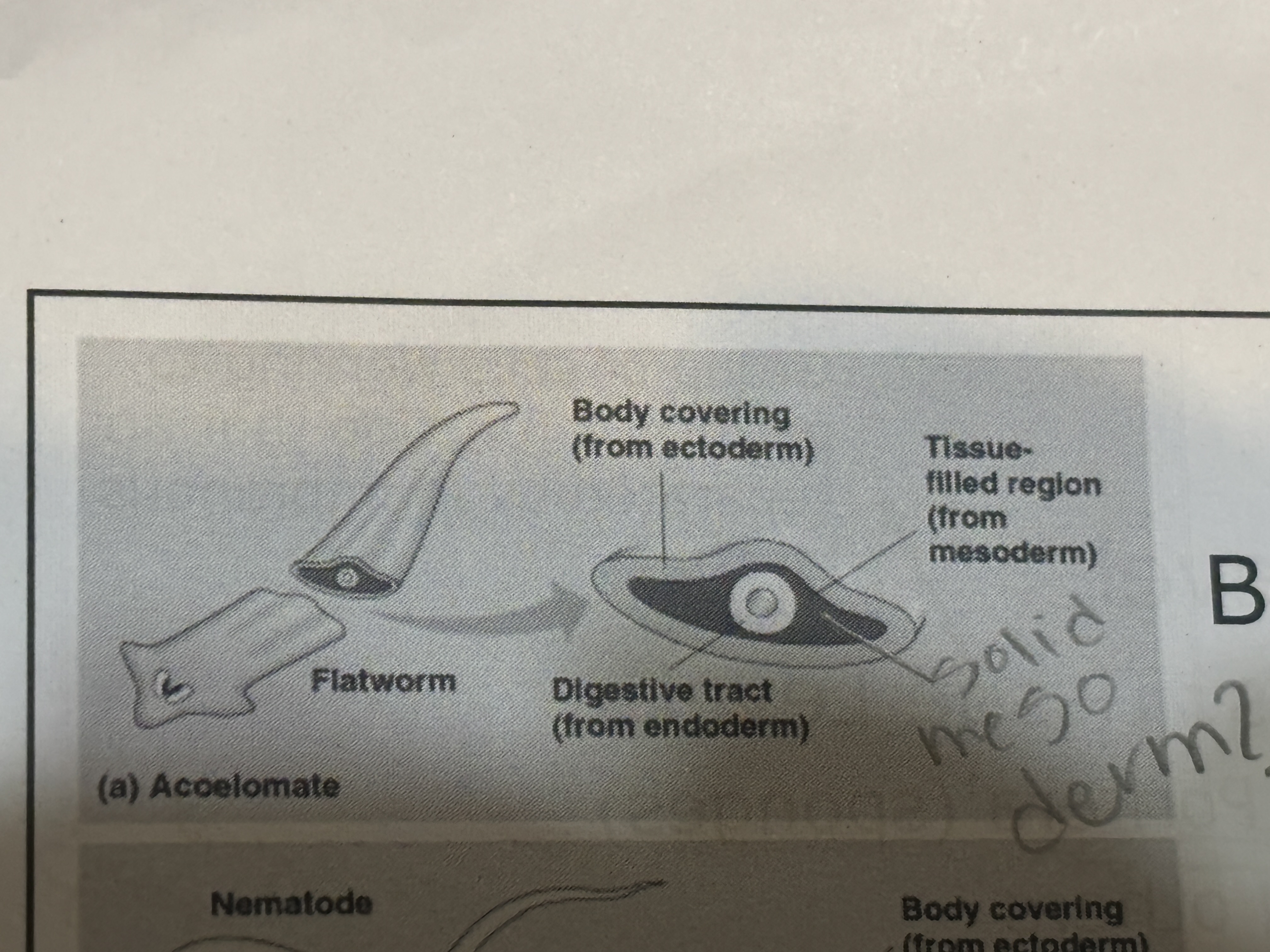
Body cavities
Acoelomates
Playhelminthes (flatworms)
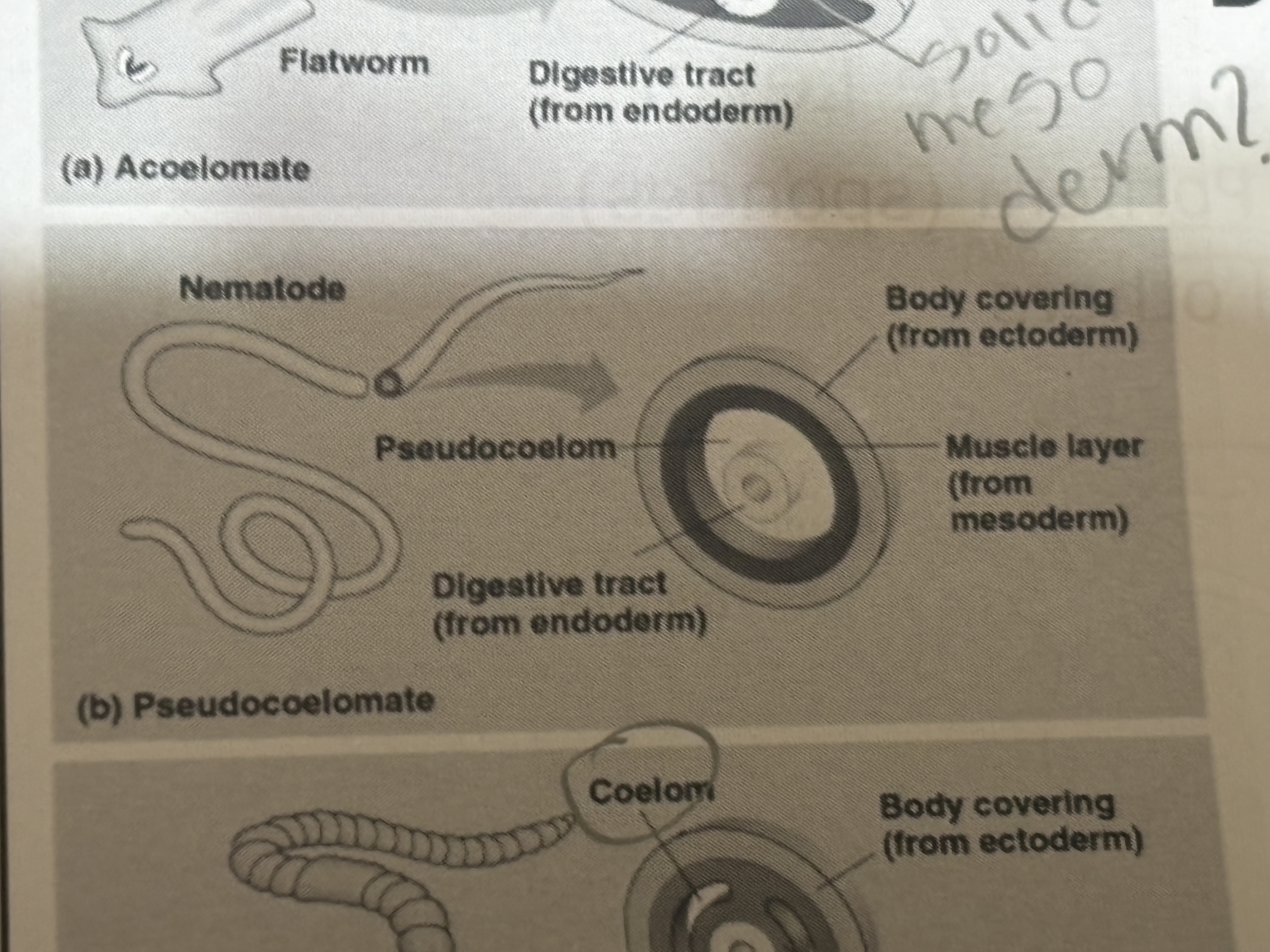
Body cavities
Pseudocoelomates
Nematoda (roundworms)
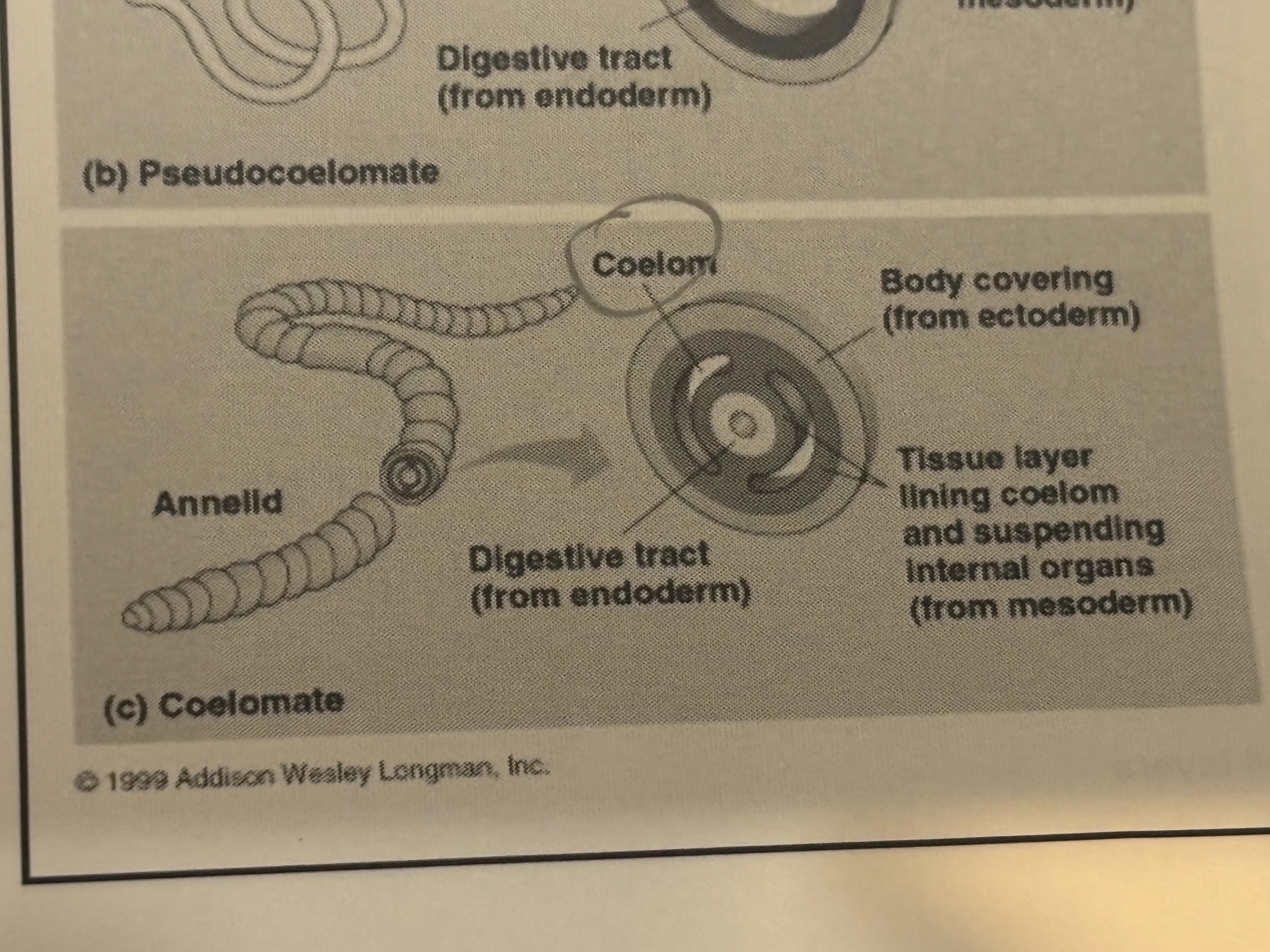
Body cavities
Coelomates
All others
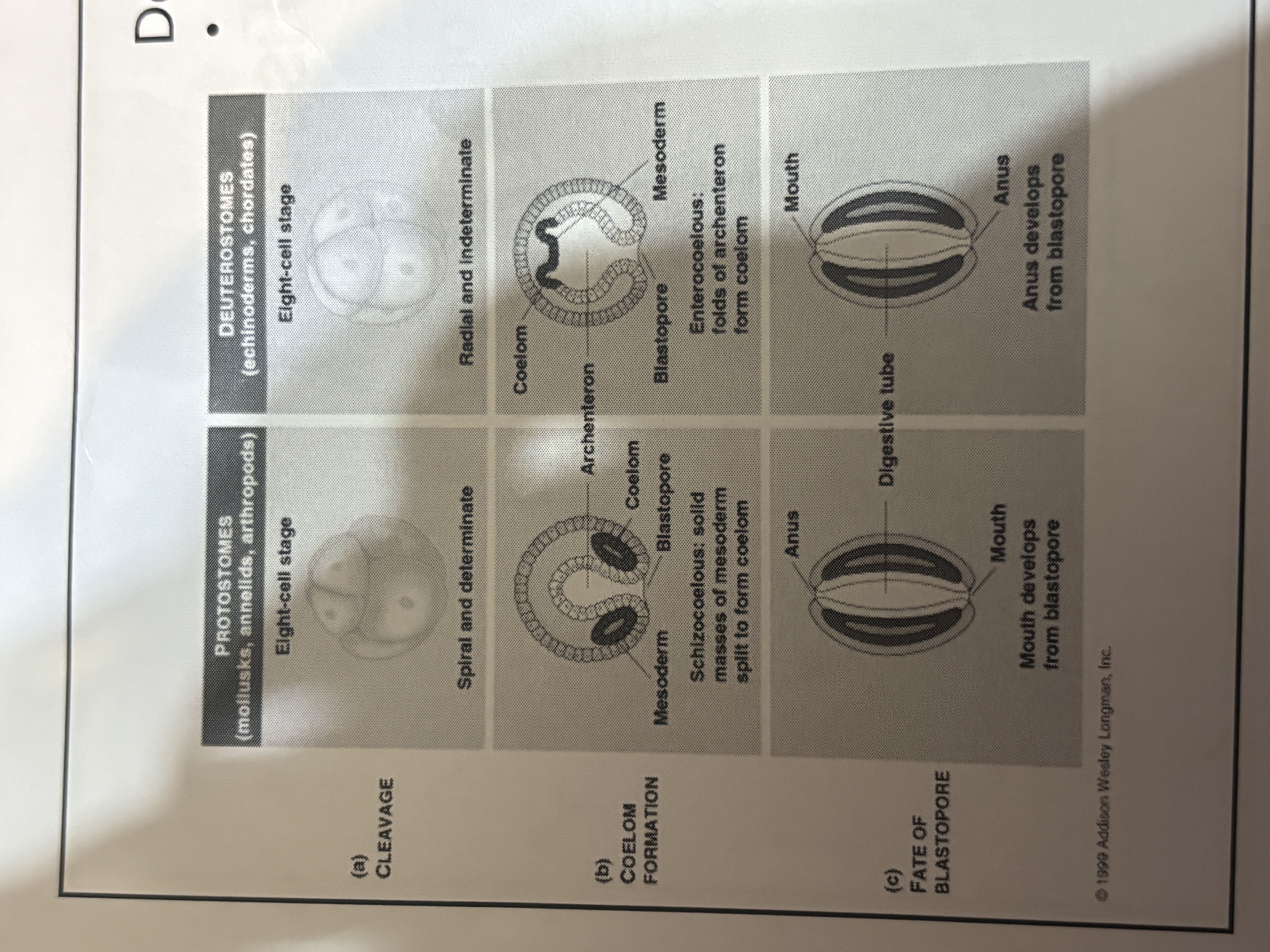
Protostome development
Cleavage - spiral and determinate
Coelom formation - schizocoelous
Fate of blastopore - mouth
Deuterostomes
Cleavage - radial and indeterminate
Coelom formation - enterocoelous
Fate of blastopore - anus
Protostomes- molusca (claims snails)
Annelids- (segmented worms)
Arthropods - (crustaceans, insects)
Deuterostomes - echinodermata (sea stars)
Chordates ( vertebrates)
segmentation
Mollusca - soft undersegmented
Annelids - soft segmented
Arthropoda- hard segmented
Chordata - segmented
Epithelial tissue
Tightly packed cells used for lining
Stratified squamous, simple columnar
Connective tissue
Cells scattered thru an extra cellular matrix (bone , blood , cartilage)
Nervous tissue
Transmits signals (neurons)
Muscles tissues
Fibers for contraction ( smooth, skeletal, cardiac)
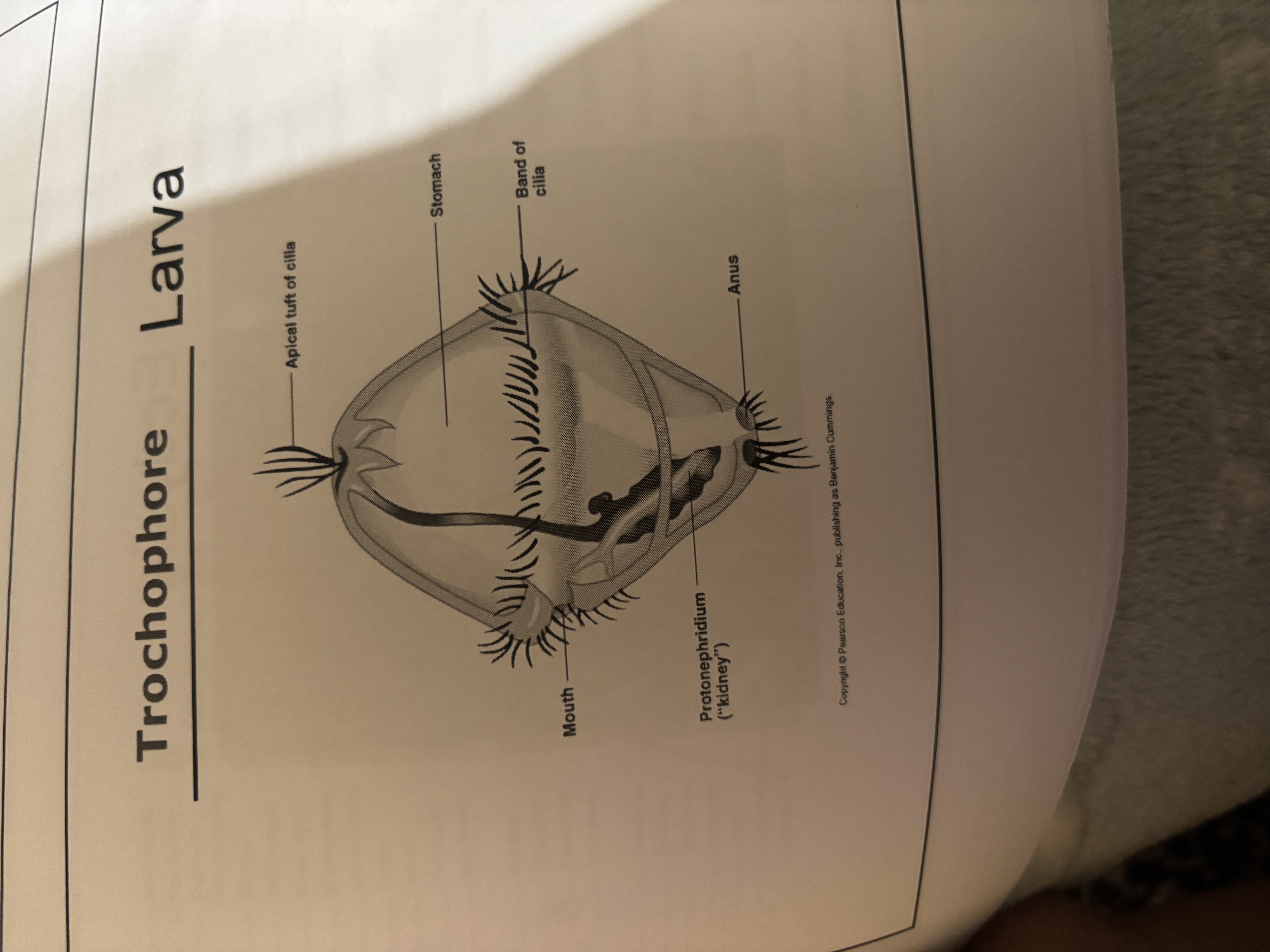
Trochophore larva
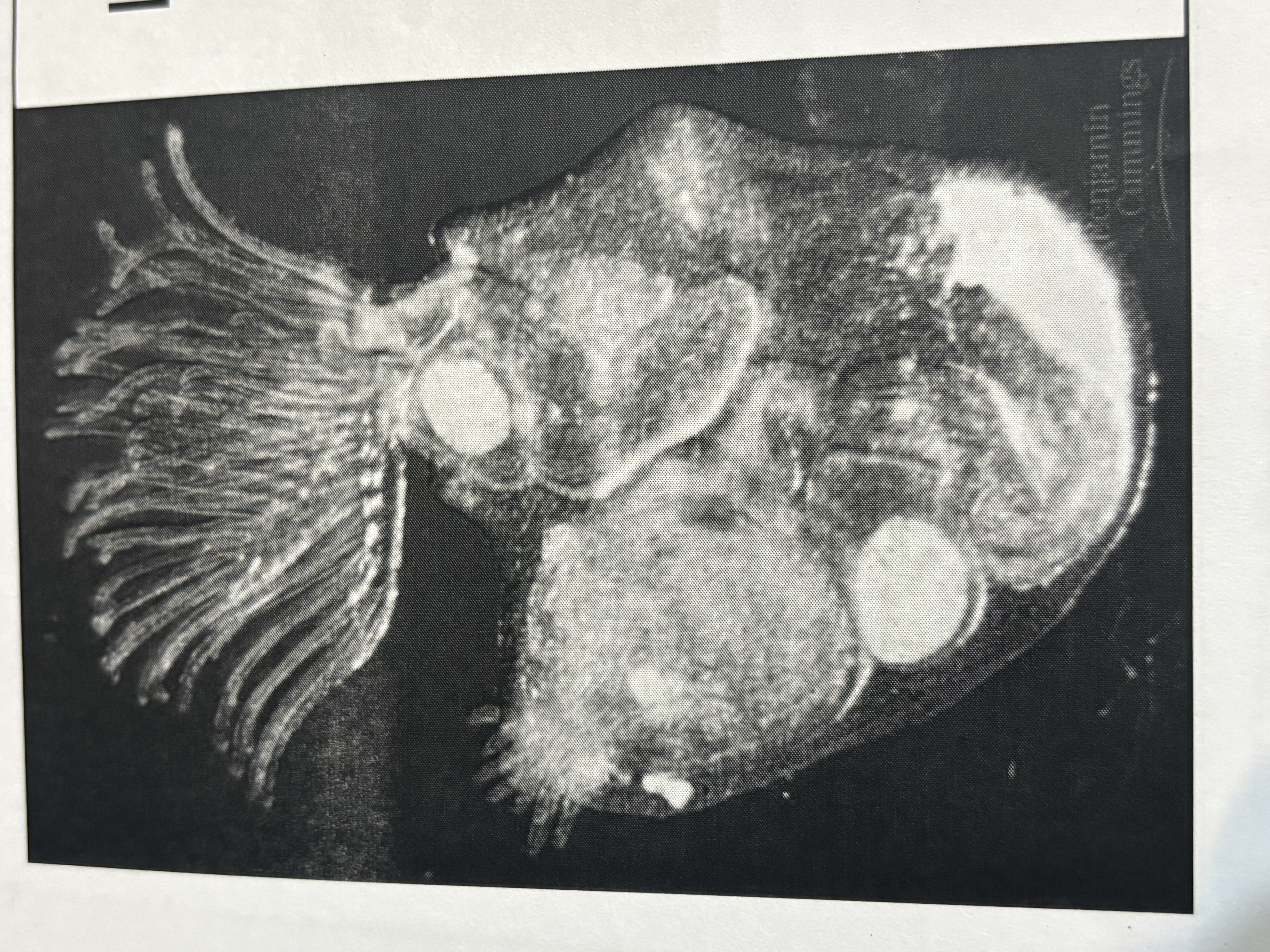
Lophophorate
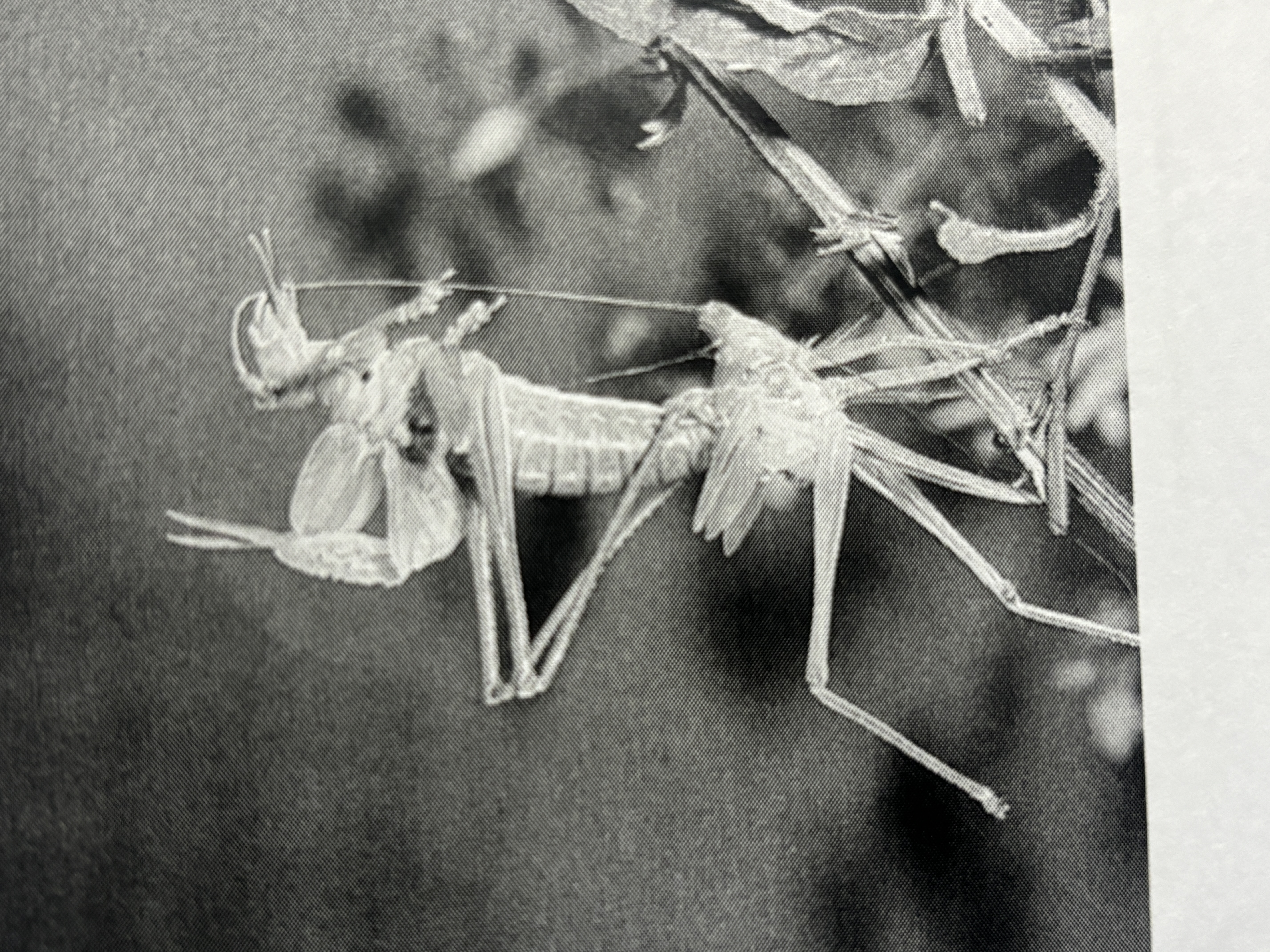
Ecdysis
Porifera
Cellular level of organization
Mostly marine 9000 species only 100 freshwater sponges
Asymmetrical and sessile
Hermaphrodites
Often live in groups called a sleeze
Porifera
Choanocyte
Flagellated cells
Porifera
Ameobocyte
Pseudopodia
Porifera skeleton
Spicules( calcium carbonate or silica)
Spongin (protein)
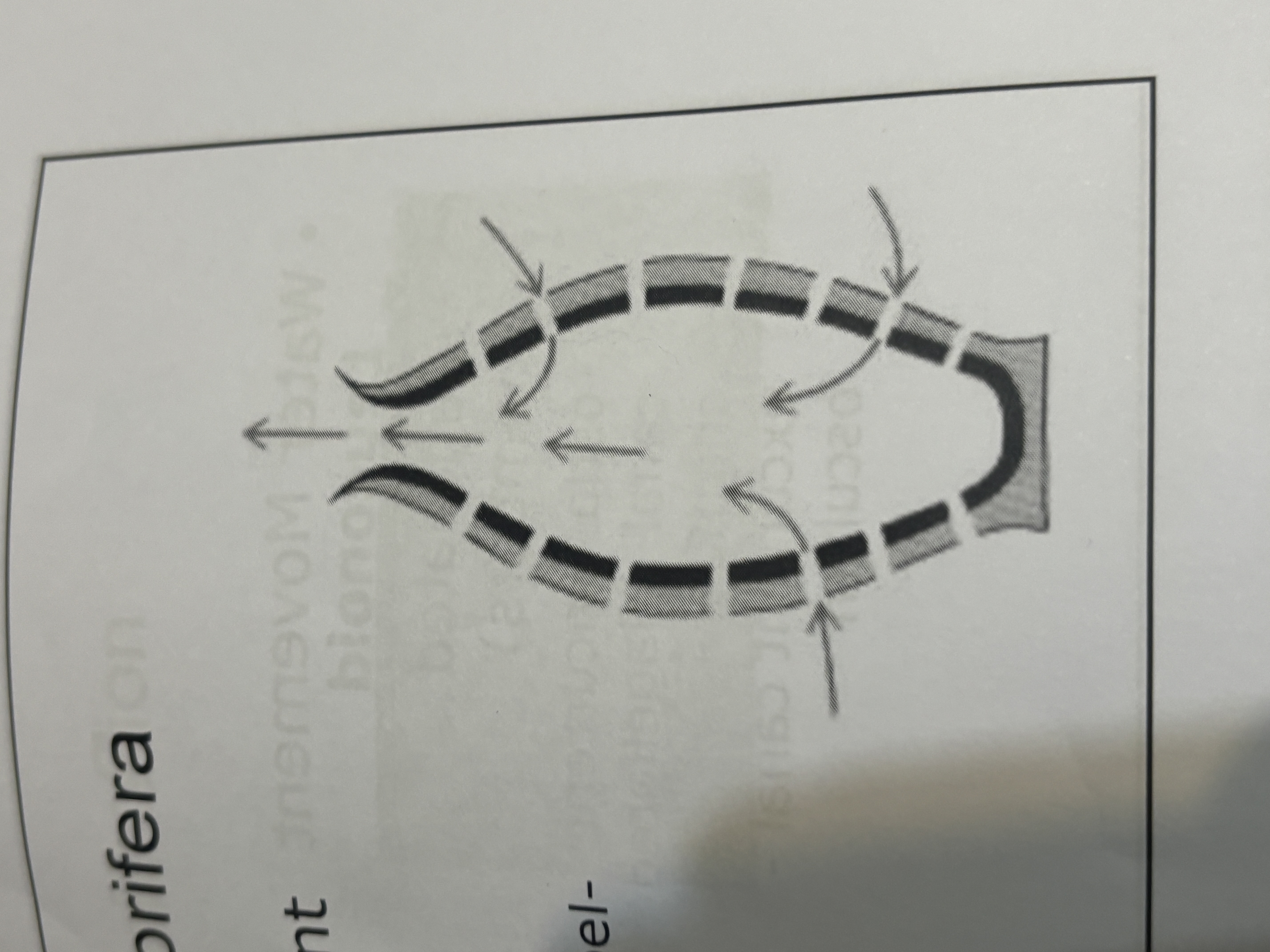
Porifera water movement
Asconoid
Flagellated spongocoel
Ostia - spongeocoel- osculum
Porifera water movement
Syconoid
Flagellated canal
Ostia- incurrent canal -prosopyle- radial canal- apopyle- spongocoel- osculum
Classification
Calcarea
Calcium spicules
Asconoid
Syconoid
Leuconoid
Class hexactinellidae
Silica spicules
Syconoid, Leuconoid
Class demospongiae
Silica spicules and or spongin
Leuconoid
Radial symmetry includes
Cnidaria - hydras, jellies, sea anemones and coral
Creniphora - comb jellies
Tissue system level of organization diploblastic - endosperm - ectoderm
Cnidaria two body forms
Polyp and Medusa
Cnidocytes
Nematocyst thread with barbs
Cnidocil triggers sting
Cnidaria
Classes
Class Hydrozoa - man or war, hydra, obelia
Class Scyphozoa - jellies
Class Anthozoa - sea anemones, corals, sea fans, sea pansies
Class cubozoa
Hydrozoa
Most marine
Have polyp and Medusa
asexual (budding and sexual (zygotes snd larva) reproduction
Scyphozoa
All are marine
Pelo stage reduce or absent
Medusa stage free living
Common same sea jellies
Anthozoa
All marine
Polyp stage dominant
no Medusa stage
Cubozoa
Box jellies
Complex eyes embedded in Medusa stage dominant
Sea wasp - can kill 60 ppl
phylum Ctenophora
Comb jellies
Contain comb plates with cilia
Largest animal to move with cilia
Tentacles with Colloblasts
(Adhesive cells)
Phylum platyhelminthes
Flat worm
Acoelomates- no body cavity
Gastrovasular cavities - opening where food comes in and out
Organ system level of organization
Triploblastic
Platyhelminthes
Class turbellaria - planarians
Class monogenea- monogenes - one host)
Class trematoda - fluke
Class cestoidea ( tapeworm)
Class trematoda
endoparasitic flukes
Two hosts
Females fits into groove on male body
Class trematoda
Genus schistosoma
In water larva burrows into foot
Goes to skin moves to blood and ends up in intestines
invert host - snail
(Africa, South America, west India)
Blood fluke
Symptoms : pain anemia dysentery
Clonorchis
Enters by eating raw fish and moves to bile ducts
Liver fluke
Invert host snail ( China Asia Japan)
Symptoms : cirrhosis of liver and death
Class Trematoda
Swimmers dermatitis
Larva enters skin
Larva in skin can’t complete life cycle in humans
Class cestoidea
Endoparasitc tapeworm
Body part proglottids
Scolex with hooks and suckers
Genus Taenia
Beef tapeworms
undercooked beef
Taenia solium
Pork tapeworms
Undercook pork
Diphyllobothrium Latum
Fish tapeworm
Undercook fish
Dipylidium caninum
Dogtape worm
Undercook dog
Genus Echinococcus
Unilocular hydatid (cyst)
Associate with dogs and ruminants
Tape worm found in canine host
Eggs passed in hosts feces
If u eat larva it forms in spleen or heart and forms cysts and damage organs but cannot finish its life cycle
Pseudocoelomates
Includes phyla rotifera and nematoda
False cavity
store nutrients
movement
Hydrostatic skeleton
Space for organ development
Phylum rotifera
Mostly freshwater
Ring of cilia around mouth
Jaws with complete alimentary canals (mouth and anus on opposite ends)
Parthenogenesis - virgin birth
Phylum nemertea
Proboscis worms
Closed circulatory system
Complete digestive tract
Proboscis -jaws that can stick out
Phylum nematoda
Unsegmented, round with tapered ends
Complete alimentary canals
Decomposers, agricultural pests, parasites
Genus Ancylostoma
Nematoda
Hookworm
burrows into skin and moves to intestine
Genus enterobius
Nematoda
Pinworm
Pick up eggs from anus or dusts with eggs
Nematoda
Genus ascaris
Human roundworms (pick up eggs in food)
Nematoda
Trichinella
Trichina worm pick up from infected muscle in uncooked pork
Wuchereria
Blocs lymph channels
Pick up from mosquitos
Causes elephantiasis
Phylum mollusca
Most marine some freshwater and terrestrial
Most protected by shell (calcium carbonate)
Most contain radios
Most have open circulatory systems
Open circulatory systems
Arthropoda , mollusks
hemolymph (no blood or interstitial fluids)
Closed circulatory systems
Mollusca , Nematoda, annelids, vertebrates
Blood
Interstitial fluid
Body parts of HAM
FOOT
MANTLE
VISCERAL MASS
RADULA
Phylum Mollusca
Class monoplacophora( neopilina)
Class polyplacophora (chitons)
Class Gastropoda (snails and slugs)
Class scaphopoda (tooth or tusk shells)
Class bivalvia ( clams mussels oysters scallops)
Class cephalopoda (squid octopuses)
Class monoplacophora
Single shelled
Segmented
Deep marine
Reduced head
Foot for locomotion
Radula
Class polyplacophora
Marine
Shell with 8 overlapping plates
Foot used for locomotion
Head reduced
Radula
Class Gastropoda
Marine freshwater terrestrial
Asymmetrical due to torsion
Shell coiled
(Reduced or absent in some)
Dextral vs sinistral
Foot for locomotion
Radula
Class scaphopoda
Benthic marine
Filter feeders
Foot to burrow in sand
Radula used to move food into gizzard
Class bivalvia
Marine and freshwater
Flattened shell with two valves
Head reduced
Filter feeders( siphons )
NO RADULA
Class cephalopoda
All marine
Head surrounded by tentacles
Shell external internal or absent
Mouth with radula
Locomotion by siphon
Closed circulatory system
Phylum annelid
Repeated segments
Specialized segment
Connections
Phylum Annelids
Classifications
Class oligochaeata - earthworms
Class polychaeta - marine worms
Class hirudinea- leeches
Class oligochaeta
Reduced head
No parapodia
Few setae per segment
Class polychaeta
Well developed head
Parapodia with setae
Tube dwelling and free living
Class hirudinea
Body flattened
Reduced segments and coelom
Setae absent
Suckers at both ends
Parasites, predators, scavengers
Phylum onychophora
Velvet worm
Walking worm
Link between annelids and arthropods
Unjointed appendages but segmented
Phylum tardigrada
Water bears
Can survive -300F to over 300F
name means slow stepper
Cryptobiosis?
Phylum Arthropoda
Hard exoskeleton
Segments carry paired appendages
Open circulatory system
nervous system similar to annelids
Contains 80% of all identified species (1 mil currently)
Arthropod diversity
Versatile exoskeleton
Segmentation and appendages
Highly complex sense organs
Complex behavior patterns
Metamorphosis
Athropod clasificación
Subphylum trilobita
Subphylum cheliceraformes
Class merostomsta ( horseshoe crabs)
Class pycnogonida( scorpions spiders ticks mites)
subphylum Crustacea
Class lobster crabs shrimps
Subphylum myriapoda
Class chilopoda (centipedes)
Class diplopoda ( millipedes)
Subphylum: Hexapoda
Class insecta
Subphylum trilobita
All extinct
Permian era 250 Mya
segmented without specialization
Paired appendages
Subphylum cheliceraformes
6 pair of appendages
One pair of chelicera
One pair of pedipalps (not in horseshoe crabs)
Four pair of walking legs
No mandibles or antennae
Class merostomata
6 pair of appendages
One pair of chelicerae
Five pair of walking legs
Unchanged since TRIASSIC period
Swallow coastal waters
Larvae similar to trilobites
Class pyconogonida
Called sea spiders (not true spiders)
May have extra legs
Duplicate segments
Polar oceans
Class arachnida
Scorpions are fish terrestrial invertebrates
Pedipalps with modified pinchers
Tail modified with stinger
Ticks and mites are parasitic
Spiders contain modified chelicera
Used as fangs to inject poison
Produce silk used for webs eggs escape and courtship
Subphylum Crustacea
Contain two pair of anteannae
Each appendage is bivamous
Mandibles
Body of two or theee parts
Mostly marine
Subphylum myriapoda
Contain one pair of antennae
Each appendage is uniramous
Mandibles
Classes chilopoda and diplopoda
Chilopoda - centipede
1 pair of jointed legs per segment
Position claws
Predators
Diplopoda Millipede
2 pair of jointed legs per segment fused
Herbivores
Subphylum Hexapoda
Class insecta
Most diverse of all arthropods
May has been cause of angiosperm diversity
Metamorphosis
Order blattodea
German roaches
Order Coleoptera
Beetles r coole
2 pair of wings front
Thickened elytra
Order Hemiptera
True bugs
Two pairs of wings ½ have hard outer shell sucking mouth parts
order demapretera
Earwigs are dermatologists
Order Diptera
Flies (1 pair of wings ; back from knobs called halteres)
order Hymenoptera
Bees wasps ants
Winged/ less 2 pairs membrane wings - thin waist
Order Isoptera
Termite
Order Lepidoptera
Butterflies and moths
Two sets of wings covered with scales
Odonata
Dragonflies and damselflies
Two sets of membrane wings large compound eyes and long abdomen
Phylum echinodermata
Deurostomes
Radial and indeterminate cleavage
Enterocoelous
Anus from blastopore
Phylum echinodermata
Radial symmetry
Water vascular system
Ambulcral groove
Madreporite
All marine
Phylum Echinodermata
Classification
class asteroidea ( seastars)
Class opiuroidea (brittle stars)
Class echinoidea (sea urchins, san dollars)
Class crinoidea (sea Lillie’s)
Class holothuroidea(sea cucumbers)