LBBBYIO3 (1st Exam)
 Call Kai
 Learn
Learn Practice Test
 Spaced Repetition
 Match
Match Flashcards
 Knowt Play
1/164

There's no tags or description
Looks like no tags are added yet.
Name | Mastery | Learn | Test | Matching | Spaced | Call with Kai | Chat |
|---|
No analytics yet
Send a link to your students to track their progress
165 Terms
Dorsal
towards the back or upper side
Ventral
towards the under side
Lateral
towards the sides, right and left.
Anterior/Cephalic/Cranial
towards the head end of the animal
Posterior/Caudal
Towards the tail end
Medial
Towards the middle
Central
near the center of the body or organ
Peripheral
the part nearest the surface.
Proximal
near the main mass of the body, as the thigh.
Distal
away from the main mass of the body, as the toes.
Superficial
on or near the surface.
Deep
some distance below the surface.
Superior
Above
Inferior
Below
Planes and axes
The structures of most animals are arranged symmetrically with reference to certain imaginary planes and axes.
Sagittal plane
divides body into left and right
Parasagittal plane
divides the body into unequal left and right halves
Midsagittal plane
divides the body equally into left and right
Coronal / Frontal plane
divides body into dorsal and ventral parts
Transverse / Cross plane
divides body into anterior and posterior parts
Oblique plane
Any plane that is not perfectly sagittal, frontal, or transverse is described as an ________. Combination of two or all three cardinal planes
Anatomical axis
An imaginary straight line that passes through the body. Provides reference points for describing the orientation and movement of body parts.
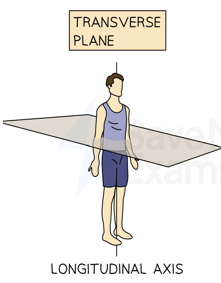
Longitudinal (Anteroposterior) axis
runs from head to tail; associated with the transverse plane (movement around this axis includes rotation, like twisting).
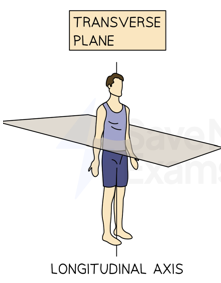
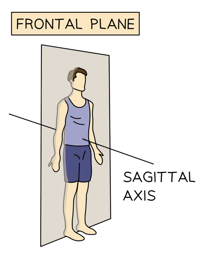
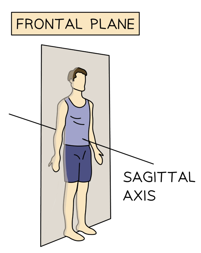
Sagittal (Dorsoventral) axis
runs from back to belly; associated with the frontal plane (movement around this axis includes abduction/adduction).
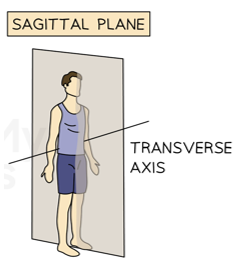
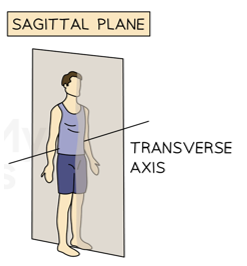
Transverse (Mediolateral) axis
runs from side to side (left → right); associated with the sagittal plane (movement around this axis includes flexion/extension).
Symmetry
refers to the balanced arrangement of body parts on opposite sides of a dividing plane or around a central point
Asymmetry
No pattern in body parts.
Sponges, corals
Examples of asymmetry
Radial Symmetry
body parts arranged around a central axis (e.g., cnidarians)
Jellyfish, sea anemones, adult sea urchins
Examples of radial symmetry
Bilateral
right and left halves that mirror each other
Humans, frogs, insects, cats, dogs, fish
Examples of bilateral symmetries
Biradial
Radial with slight bilateral features
Metamerism (Segmentation)
Repetition of similar structural units (segments or metameres) along the longitudinal axis of the body
metamere, segment, or somite
Each such division of the body is termed a
vertebrae, ribs, spinal nerves, body muscles (myotomes).
Examples of metamerism
Homonomous Metamerism
all segments are structurally similar, showing little or no specialization.
Earthworms/Annelids
Examples of Homonomous Metamerism
Heteronomous Metamerism
Segments are dissimilar and specialized for different functions
vertebrates, Insects, and other arthropods
Examples of heteronomous segmentation
Yes, humans do exhibit segmentation both heteronomous and Homonomous
Do humans exhibit metamerism or segmentation
The vertebral column (Spine) is made up of repeating bone units (vertebrae), ribs and associated muscles also show a segmented pattern, and during early development, humans form somites.
Reasons why humans exhibit metamerism or segmentation
Cephalization
Evolutionary trend toward the concentration of sensory and nervous tissues in the head region.
Formation of a head region containing the brain
Clustering of sensory organs (eyes, ears, nose, antennae)
Development of feeding structures near the mouth
Key features of Cephalization
heteronomous condition
In segmented animals the advance in cephalization is correlated with the progression of the
Heteronomy
appears first in the head region and gradually progresses posteriorly.
bilateral symmetry, internal and markedly heteronomous segmentation, and a high degree of cephalization
The vertebrates are, then, animals characterized by the possession of
Evolution
Change in the characteristics of a species over several generations and relies on the process of natural selection
Natural selection
Individuals having more useful traits survive better and produce more progeny than individuals with less-favorable traits
Convergent evolution
Occurs when organisms that aren’t closely related evolve similar traits as they both adapt to similar environments (Ex. Birds, Bats, and Butterflies are different but have the same characteristics of having wings and flying.
Divergent evolution
occurs when groups from the same common ancestor split into two groups by a geographic barrier (for instance, a body of water or a migration to a new area), causing each group to develop different traits (Ex. Wolf → Fox and Domestic Dog)
Phylogeny
The relationship between all the organisms on Earth that have descended from a common ancestor
Phylogenetic tree
The relationships are backed by molecular evidence.
Should have access to DNA or other molecular data
Cladogram
The relationships are hypothetical
You can easily make it on your own
Taxonomy
Science of naming, describing, and classifying organisms
Domain (Most inclusive)
Kingdom
Phylum
Class
Order
Family
Genus
Species (Least inclusive)
Taxonomic Ranking system
Carolus Linnaeus
adopted a system of binomial nomenclature
A scientific name is always italicized or underlined
A genus name begins with Uppercase, while a species name is lowercase, e.g., Homo sapiens, Boa constrictor
Conventions of Linnaean taxonomy:
Genus, Species
Scientific name structure
italicized or underlined
A scientific name is always
Analogous structures
are features of different species that are SIMILAR in
function, but not necessarily in structure, and do not
derive from a common ancestral feature.
Homologous structures
Similar physical features in organisms that share a common ancestor, but the features serve completely different functions.
the Pharyngeal gill slits
The wall of the pharynx of the embryo or adult is pierced by openings,____________, originally probably a food-catching device. Modified in tetrapods
Notochord
is a rod lying dorsal to the intestine, extending from anterior to posterior end, and serving as a skeletal support. flexible rod for support; replaced by vertebral column in most vertebrates
Notochord
Pharyngeal gill slits
Dorsal hollow nerve cord
Post-anal tail
Endostyle/Thyroid gland
Characteristics of the chordata
Hollow central nervous system
containing a single continuous cavity, and is situated entirely on the dorsal side of the body.
Dorsal hollow nerve cord
develops into the central nervous system.
Post-anal tail
extends posterior to anus; may regress (human coccyx).
Endostyle/Thyroid gland
secretes mucus for filter-feeding; in vertebrates becomes
thyroid gland.
Gill arches in body fish and into the jaw and inner ear in terrestrial animals
Pharyngeal pouches becomes
Thyroid gland
Endostyle becomes
central nervous system
Dorsal tubular nerve cord becomes
vertebrae/backbone
Notochord becomes
absent in humans and apes
Postanal tail becomes
Shrinks or restricts
If a body part no longer serves a purpose or function then it
Protostome
When the mouth is first formed is called
Deurostome
When the anus is first formed is called
Phylum Chordata
all members share the four main features (notochord,
dorsal hollow nerve cord, pharyngeal slits, and post-anal
tail) at some stage in their development
Cephalochordata, Urochordata (Tunicata), Vertebrata (Craniata)
3 Subphylum of Chordata
Sac-like, soft-bodied, filter-feeding through a pharyngeal basket
The notochord and nerve cord are present only in the larval stage
Lacks a vertebral column/backbone
Characteristics of Urochordata/Tunicata
Small, filter-feeding has a fish-like body
Retains the notochord and nerve cord throughout life
Lacks a vertebral column/backbone
Characteristics of CEPHALOCHORDATA
Highly varied, complex body systems
Notochord present in embryo only (becomes vertebrae), nerve cord develops into brain and spinal cord
Has a vertebral column/backbone
Characteristics of Vertebrata
Tunicata
Cephalochordata
Which of the subphylum chordata are invertebrates
Cirri - finger-like projections
Subphylum Cephalochordata
Oral hood with ___________ that filter food and keep large particles out
Myotomes
Subphylum Cephalochordata
_______ are V-Shaped muscle blocks for swimming
Fins
Subphylum Cephalochordata
________ are dorsal, ventral, and caudal fins for stabilization
Atriopore
Subphylum Cephalochordata
________ are the opening where water exits the body
Anus
Subphylum Cephalochordata
____ is located near the tail end
Sessile (Immovable), Motile
Subphylum Urochordata (Tunicata)
Adult are ____, but larvae are ___ and show all chordate features
Tunic made of tunicin (cellulose-like material)
Subphylum Urochordata (Tunicata)
Body covered by a ____ made of ______
oral (incurrent) and atrial (excurrent)
Subphylum Urochordata (Tunicata)
They have______ and ________ siphons for water flow
Large pharynx with gill slits
Subphylum Urochordata (Tunicata)
______ Used for filter feeding
Larvae
Subphylum Urochordata (Tunicata)
Chordate traits (notochord, post-anal tail, dorsal nerve cord) are present only in _____
Retrogressive metamorphosis
Subphylum Urochordata (Tunicata)
Undergo __________, where the adult is simpler than the larva
Humans have tails when we were embryos. The embryonic tail usually grows into the coccyx or the tailbone
Why people don’t have tails
Vertebrae (Plural form = Vertebra)
Animals with backbone or spinal column, also called _____
•Have a backbone (vertebral column)
•Have a skull (cranium) to protect the brain
•Internal skeleton (cartilage or bone)
•Well-developed brain and nervous system
•Closed circulatory system with a heart
•Complete digestive system
•Paired fins or limbs (in most)
•Gills or lungs for breathing
•Kidneys for excretion and water balance
•Hormones to control body functions
•Separate sexes (mostly)
•Sense organs concentrated in the head (eyes, ears, etc.)
Main characteristics for vertebrates
Superclass Agnatha (jawless vertebrates)
First vertebrates
•do not have true jaws like other fish
•have a circular, toothed mouth
•have a cartilaginous skeleton rather than made of bone
•lack scales on their bodies
•have long, eel-like bodies
•often parasitic
•include jawless fishes like hagfishes (Class Myxini) and lampreys (Class Petromyzontida)
Characteristics of superclass Agnatha
Class Myxini
Class Petromyzontida
Two classes of Superclass Agnatha (jawless vertebrates)