BV EM1
 Call Kai
 Learn
Learn Practice Test
 Spaced Repetition
 Match
Match Flashcards
 Knowt Play
1/73

Earn XP
Description and Tags
introduction to eye movements: this deck does not focus on units.
Name | Mastery | Learn | Test | Matching | Spaced | Call with Kai |
|---|
No analytics yet
Send a link to your students to track their progress
74 Terms
What are the 4 main categories of eye movements?
Fixational
Gaze-Holding (VOR)
Gaze-Shifting (Saccades/Pursuits/Vergence)
Accommodation
what is the purpose of fixational eye movements
occur when attempting to hold gaze steady on a stationary object. debated whether or not these have a purpose
What ocular condition can be considered an abnormality of fixational eye movements?
Nystagmus
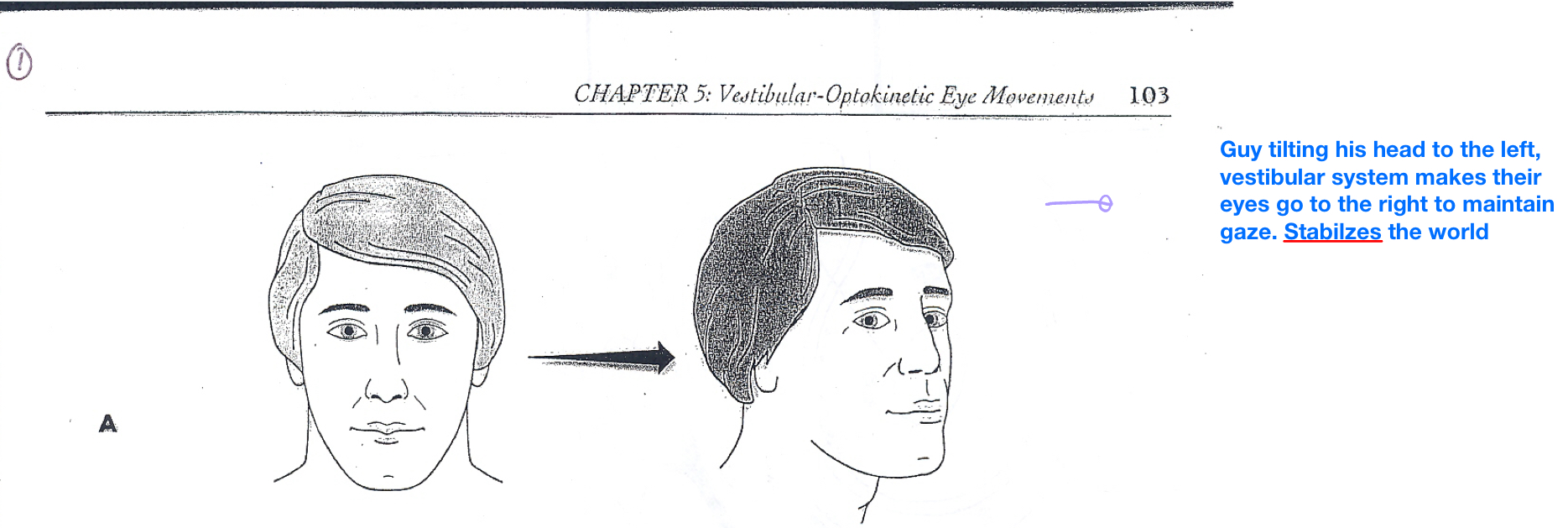
What is the Vestibulo-Ocular Reflex (VOR) and why does it exist?
A gaze-holding movement controlled by the inner ear that counteracts "retinal slip" (the blurring that occurs when head motion causes images to shift across the retina). An inner ear infection can disrupt it.
Why did gaze-shifting movements (saccades/pursuits) develop?
Because of the development of the fovea. Vision is best at the foveola (it subtends 70 min of arc!), so the eye must shift accurately to bring objects of interest onto it.
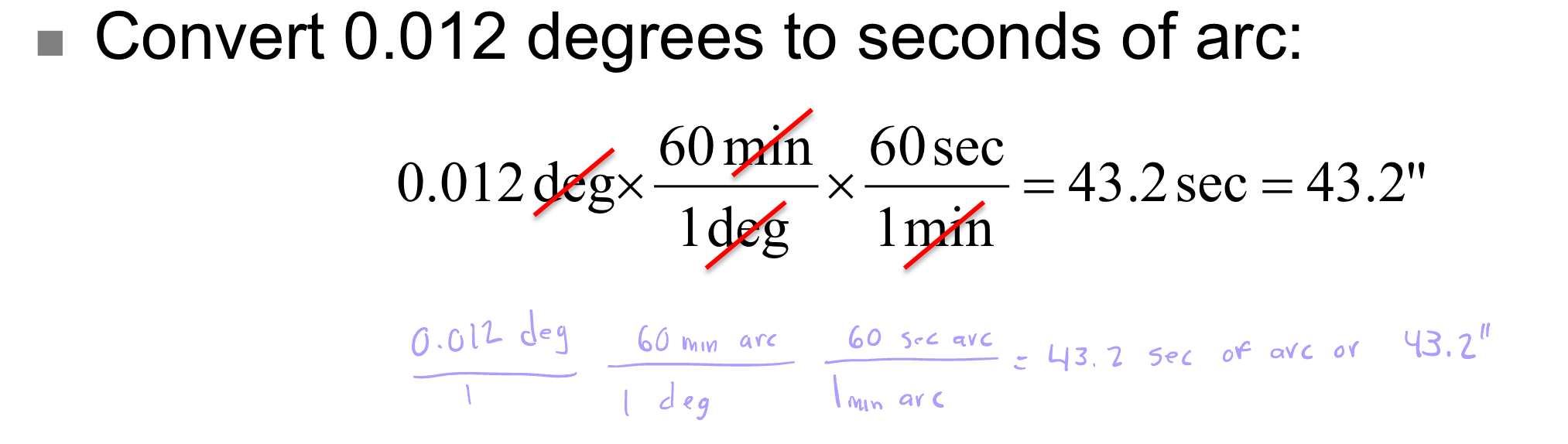
be able to convert degrees to seconds of arc
1 degree = 60 mins of arc = 60’
1 min of arc = 60 seconds of arc = 60’’
see image for example
what is the formula for circumference of a circle?
c= 2πr
2π(rad)=? degrees
360 deg
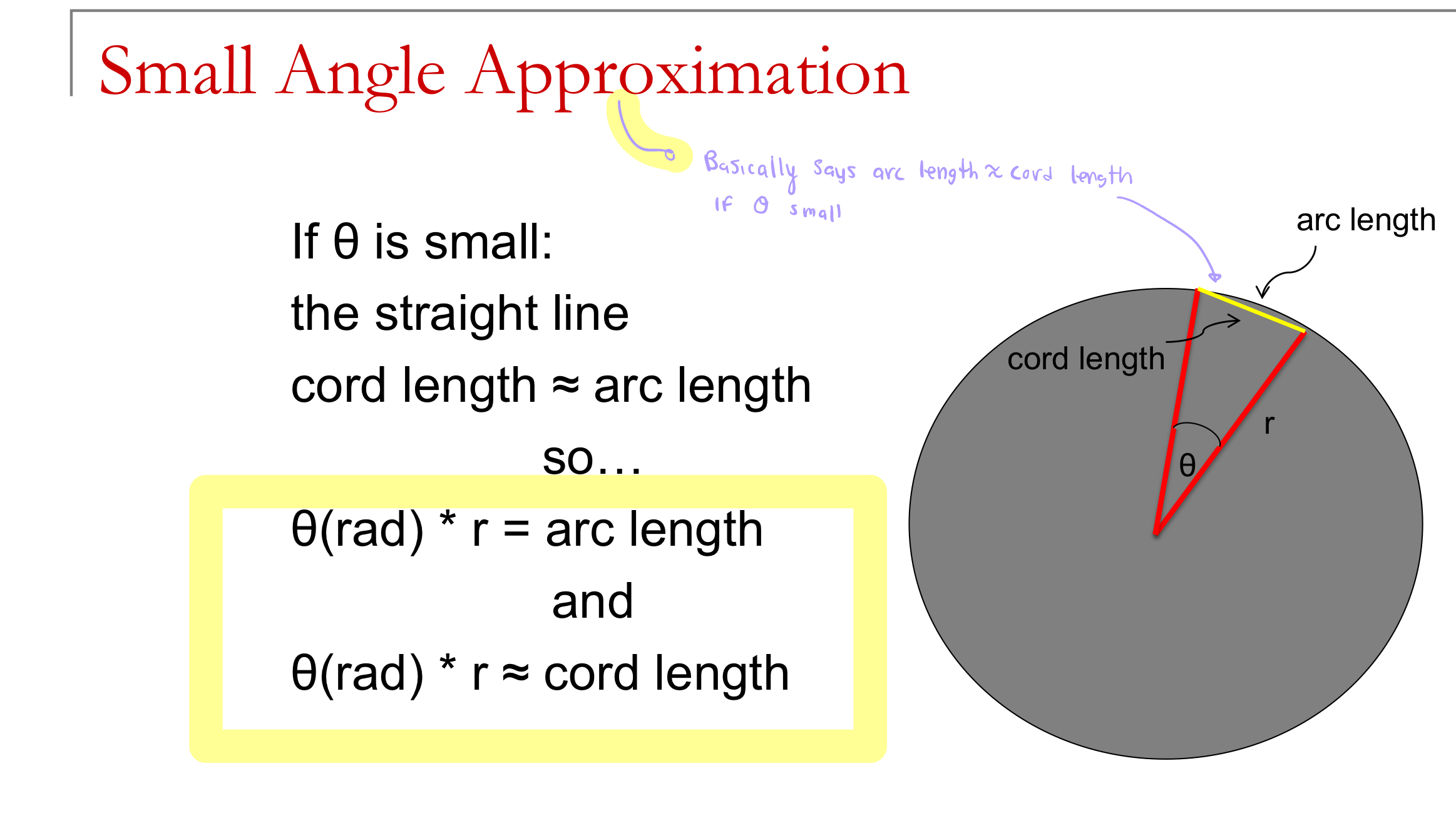
small angle approximation
1 (rad) = ? seconds of arc
206,000 seconds of arc
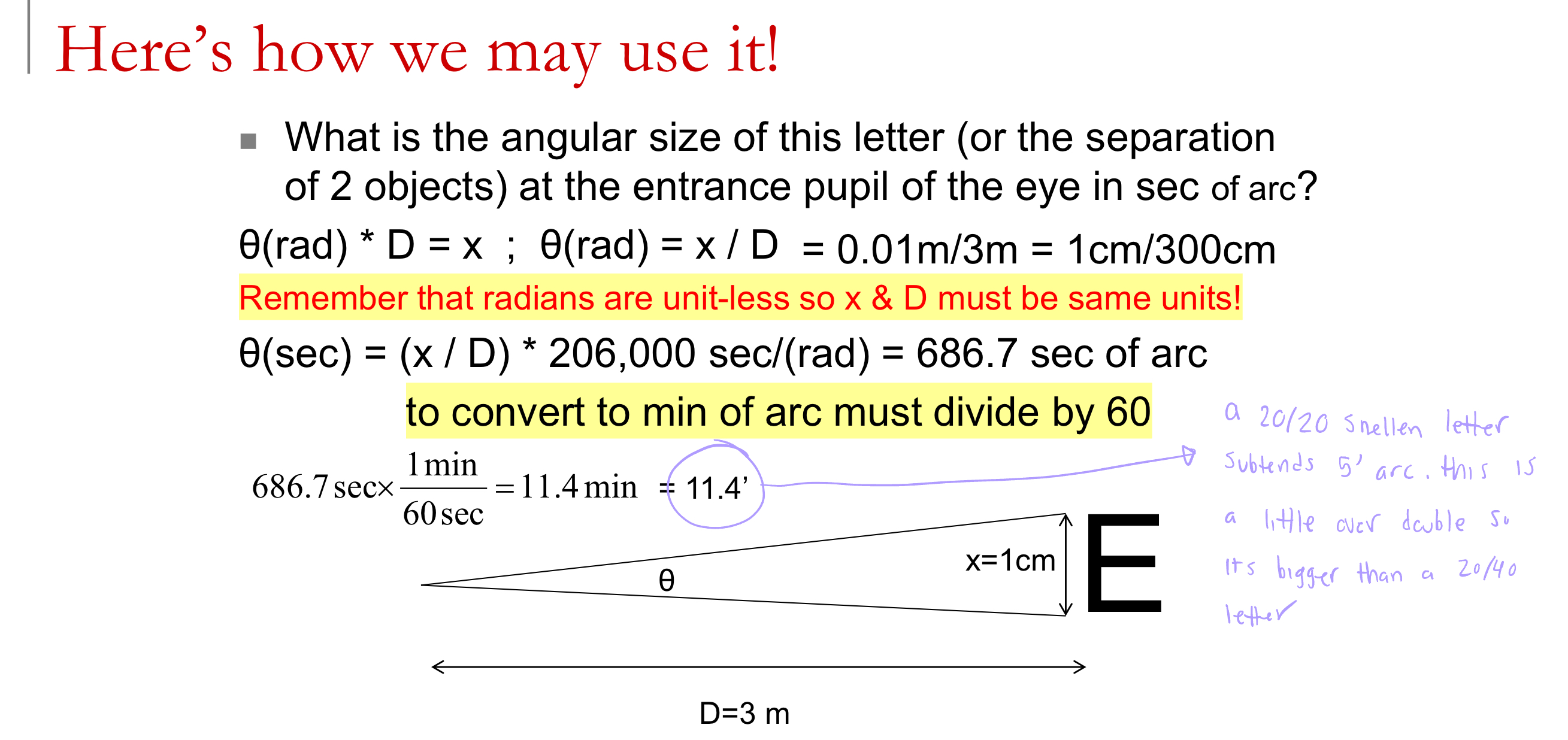
go over how to calculate angular size of letters
What is vergence (in terms of gaze shifting) and why is it useful?
A disjunctive (eyes move in opposite directions) eye movement that changes gaze for different distances, placing the object of interest on both foveas simultaneously. It enables depth perception and better low-light object detection.
What is the formula for expected amplitude of accommodation (AA)?
AA = 18.5 D – (0.3 D/year)(age). Around age 40, accommodative ability begins to noticeably limit near tasks (presbyopia)
why would a 45 year old patient be symptomatic for strain at near if their age expected accommodation is 5 and the near accommodative demand is only 2.5?
it is challenging for them to do for an extended period of time. Think of sheard’s criterion
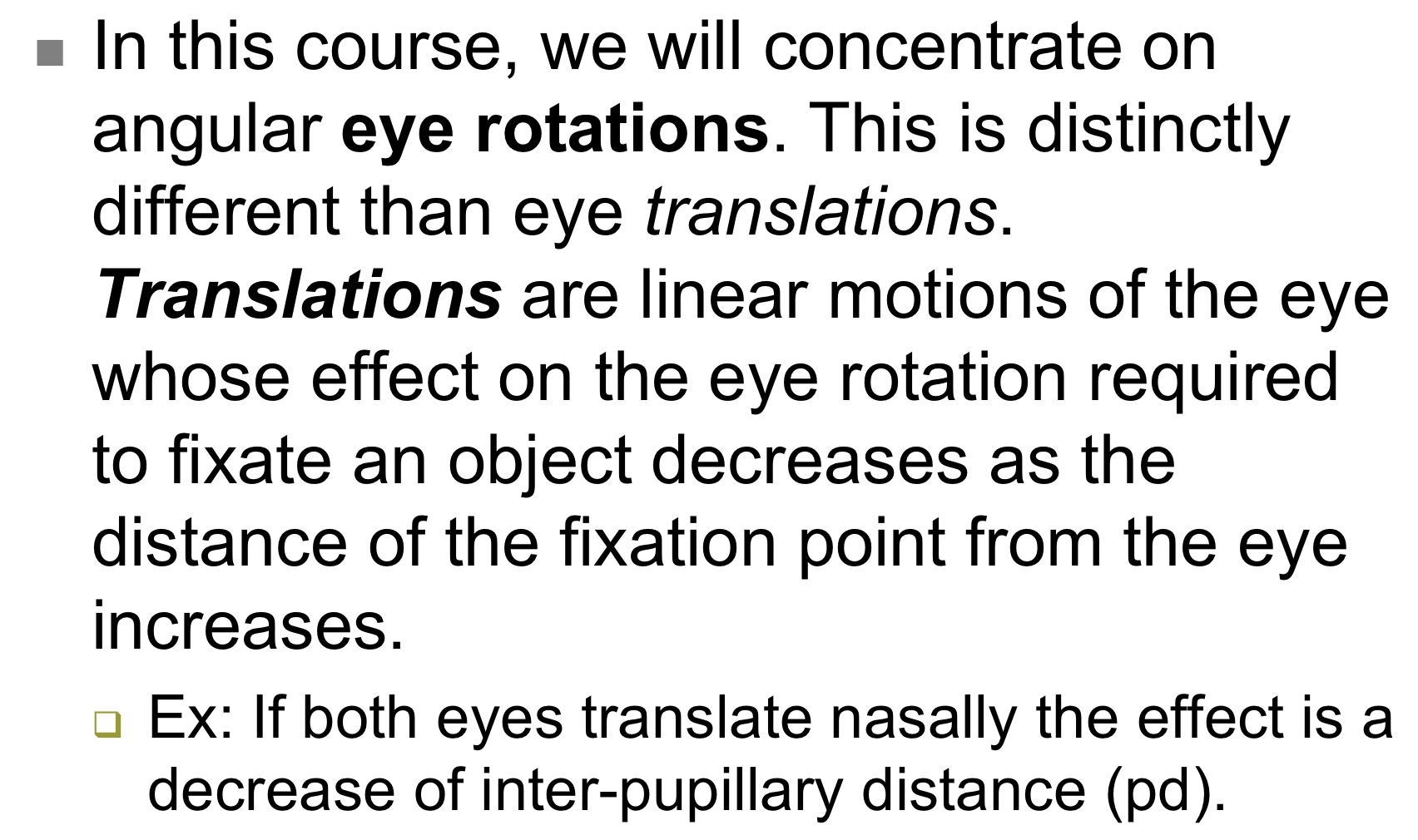
what is the difference between an eye rotations and translations
translation is when the eye literally shifts in orbit (if you put it in a cup and pushed it sideways)
an example could be orbital trauma causing globe displacement, or eye moving slightly backward during a blink
rotation is when the eye rotates around its center without changing its position in the orbit. (basketball sitting in cup and spinning in place)
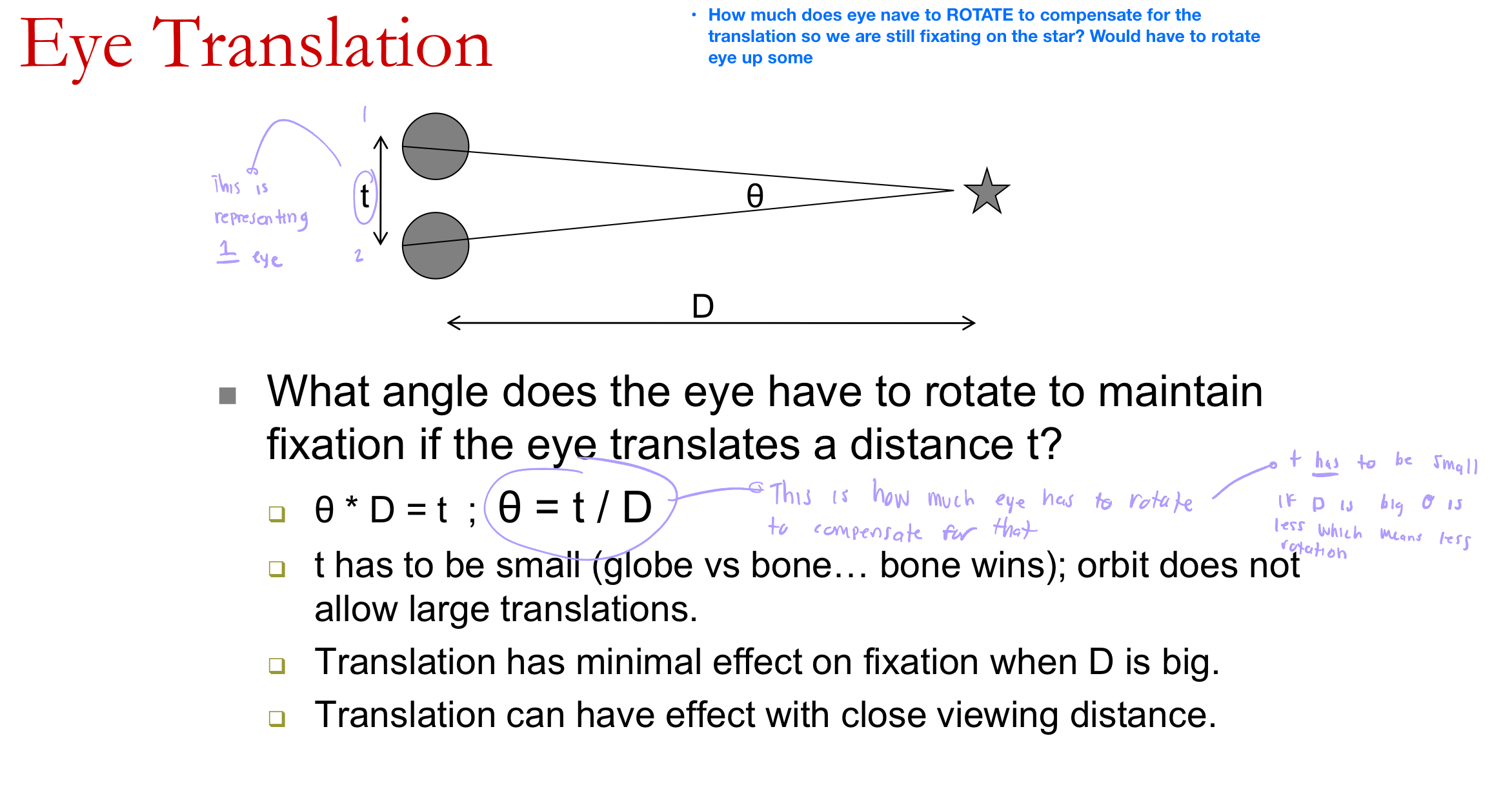
understand how much eye has to rotate to maintain fixation if the eye translated a distance (t)
What are ductions?
monocular eye movements
what is the difference between ABduction and ADduction
Abduction = temporal (outward) rotation, limit around 45° (fyi)
Adduction = nasal (inward) rotation, limit around 50°(fyi)
what is the difference between sursumduction vs. deorsumduction
Sursumduction = upward rotation, limit
Deorsumduction = downward rotation
what is the difference between intorsion and extorsion
Intorsion = 12 o'clock position of the eye rotates toward the nose.
Extorsion = 12 o'clock position rotates away from the nose.
Versions vs. Vergences
Versions are conjugate (both eyes move in the same direction). Vergences are disjunctive (eyes move in opposite directions).
Define dextroversion and levoversion.
Dextroversion = rightward conjugate eye movement.
Levoversion = leftward conjugate eye movement.
Define sersumversion and deorsumversion.
Sursumversion = upward conjugate eye movement
Derosumversion = downward conjugate eye movement
Define hypervergence and hypovergence
Both describe a vertical vergence
if the right eye goes up and left eye goes down, it can be called a right hypervergence OR a left hypovergence.
Define Dextrocycloversion and Levocycloversions
Dextrocycloversion: 12 o’clock position of both eyes rotating to the right
Levocycloversions: 12 o’clock position of both eyes rotating to the left
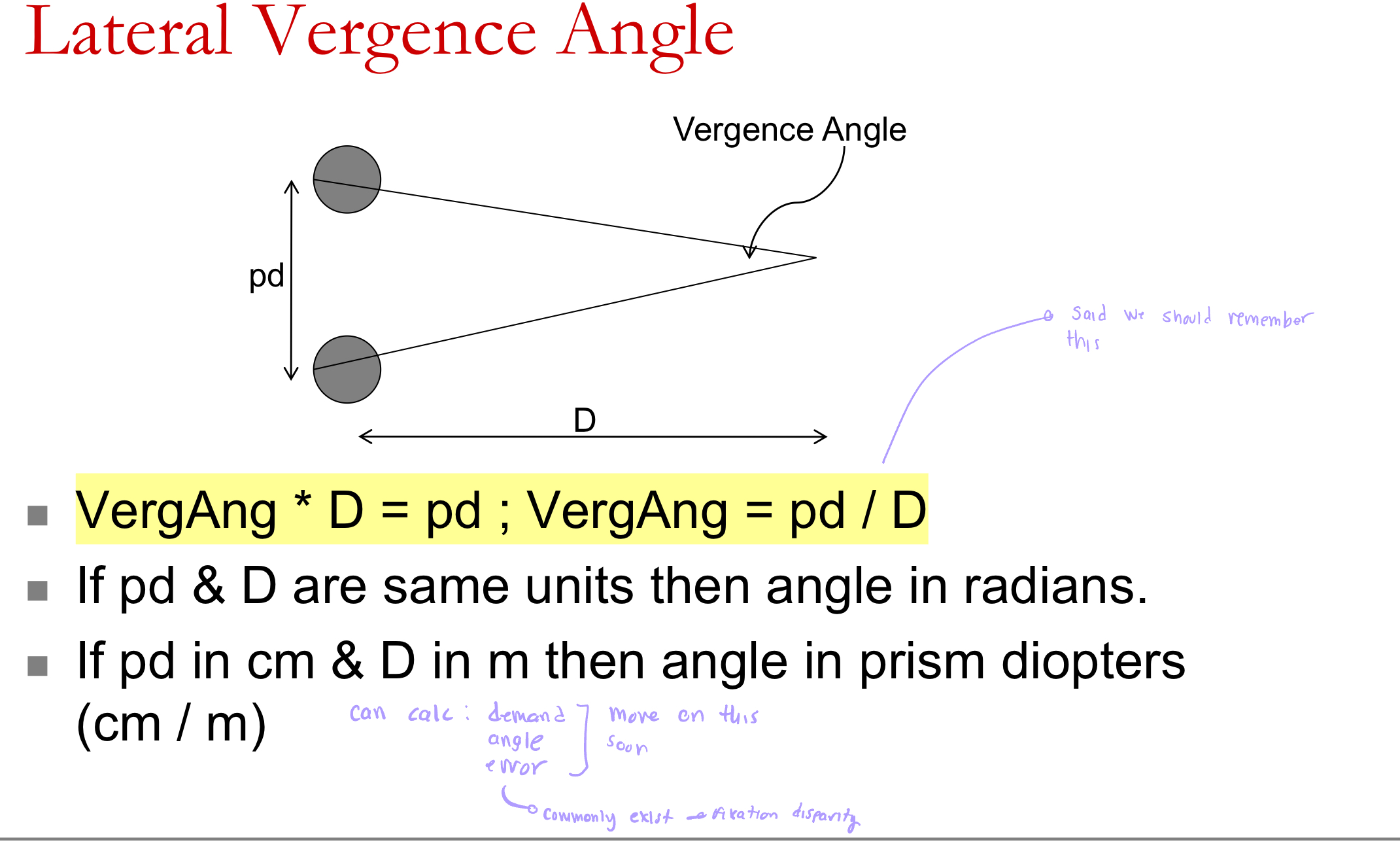
What is the formula for lateral vergence angle?
VergAng = pd / D.
If pd and D are in the same units, the angle is in radians.
If pd is in cm and D is in meters, the angle is in prism diopters (cm/m).
conceptually, it is the angle between two lines of sight
What is zero lateral vergence posture?
When the lines of sight are parallel, as when viewing an object at optical infinity.
What is Herring’s Law of Equal Innervation
In the execution of any eye movement, the ocular innervation is equal in magnitude to both eyes. This applies to both conjugate (versions) and disjunctive (vergences) movements. In health, all eye movements obey this law (with rare exceptions).
he was very confusing about this in lecture when speaking about breaking the law
What is the anatomical axis and why is it not useful for describing fixation?
The line joining the corneal and scleral poles.
The fovea is not at the scleral pole, so it does not indicate the point of fixation.
What is the pupillary axis and why is it limited?
A line through the center of the pupil, normal to the cornea (perpendicular to the surface), passing through the center of curvature of the cornea (~7.8 mm behind the corneal pole).
It is close to the anatomical axis and also does not intersect the fovea.
What is the center of curvature of the cornea?
The center of the globe is the center of curvature, sitting about 7.8 mm behind the corneal pole (the very front tip of the cornea).
What is the optic axis?
A line joining the centers of curvature of the cornea and lens (all optical elements)
It is close to both the anatomical and pupillary axes and is not clinically useful for describing fixation direction
What is the visual axis and what limits its usefulness?
The line from the fixation point through the primary nodal point (7.11 mm from cornea) to the secondary nodal point (7.39 mm from cornea) and then to the fovea.
It is limited because nodal point positions shift with accommodation, making it unreliable when focus changes.
What is the line of sight?
where the visual axis uses nodal points (unreliable because accommodation changes), the line of sight solves this problem by using the center of the pupil as its reference instead
center of pupil —> center of exit pupil —> fovea
What is the line of fixation?
The line from the fixation point to the center of rotation (COR) of the eye. It stops at the COR and does not continue through the eye.
What are the four angles defined from the axes, and what does each describe?
pretty sure this is fyi
λ (lambda) = angle between line of sight and pupillary axis. α (alpha) = angle between optic axis and visual axis. κ (kappa) = angle between visual axis and pupillary axis. γ (gamma) = angle between optic axis and line of fixation. None are typically used clinically.
What is the center of rotation of the eye?
A point within the eye that has zero velocity relative to the orbit during an eye movement.
What was Mueller's reasoning about the COR?
He reasoned the eye was a ball-and-socket joint, so the COR must be at the center of the globe.
What did Volkmann find and what did he call it?
He aligned lines of sight at multiple gaze angles and extended them back, finding they intersected ~13.5 mm behind the corneal pole.
He called this the sighting center, but it is NOT the true COR.
Why was the Volkmann/Park & Park assumption wrong?
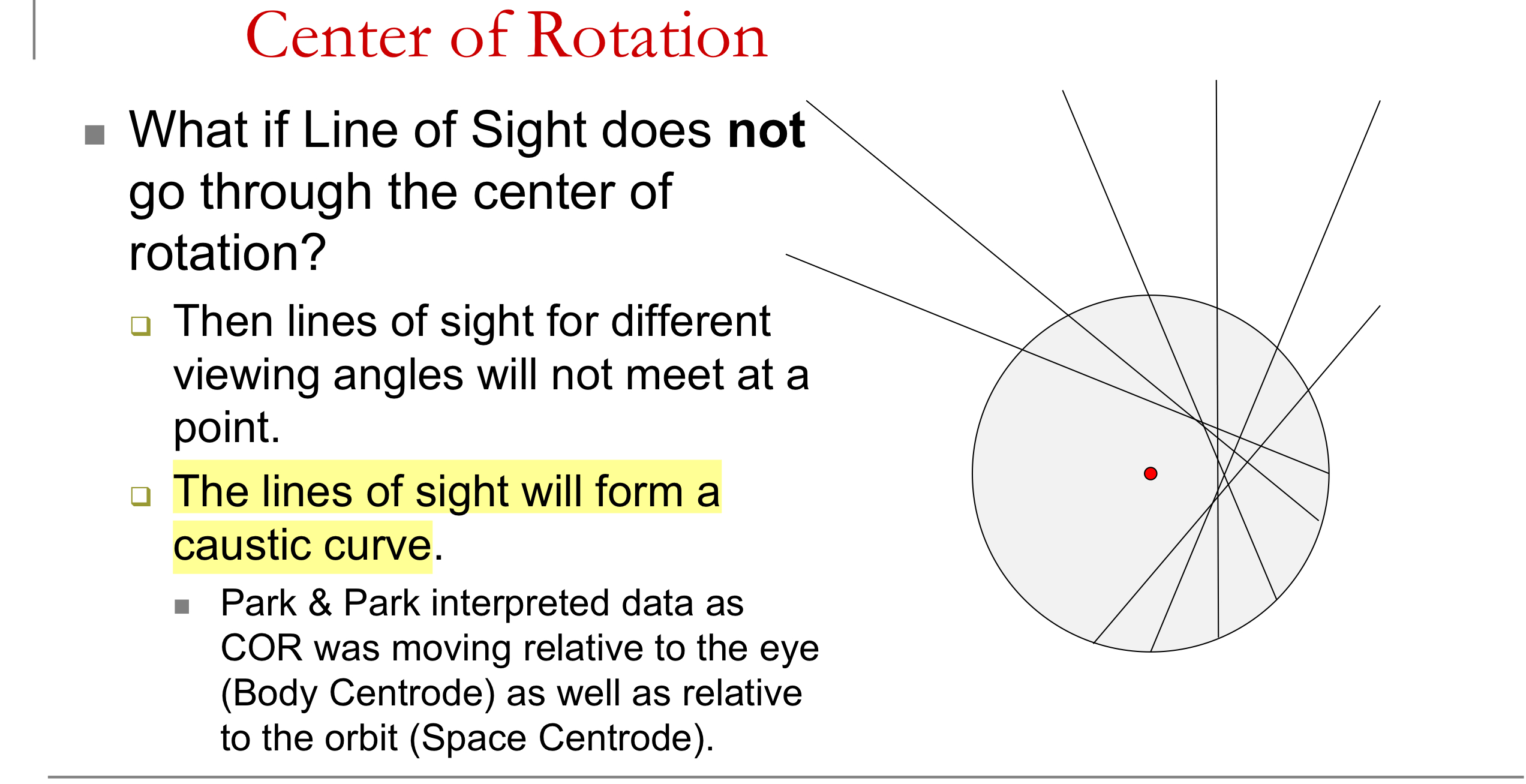
They assumed the line of sight passes through the COR. It does not. Because the line of sight is offset from the COR, extending lines of sight back does not yield the COR
They form a caustic curve instead of a single intersection point.
What did Park & Park (1933) conclude and why were they incorrect?
They concluded there was no single fixed COR — that it moved within the eye (body centrode) and within the orbit (space centrode). This was because they incorrectly assumed lines of sight would intersect at the COR.
What is a caustic curve in this context in terms of COR?
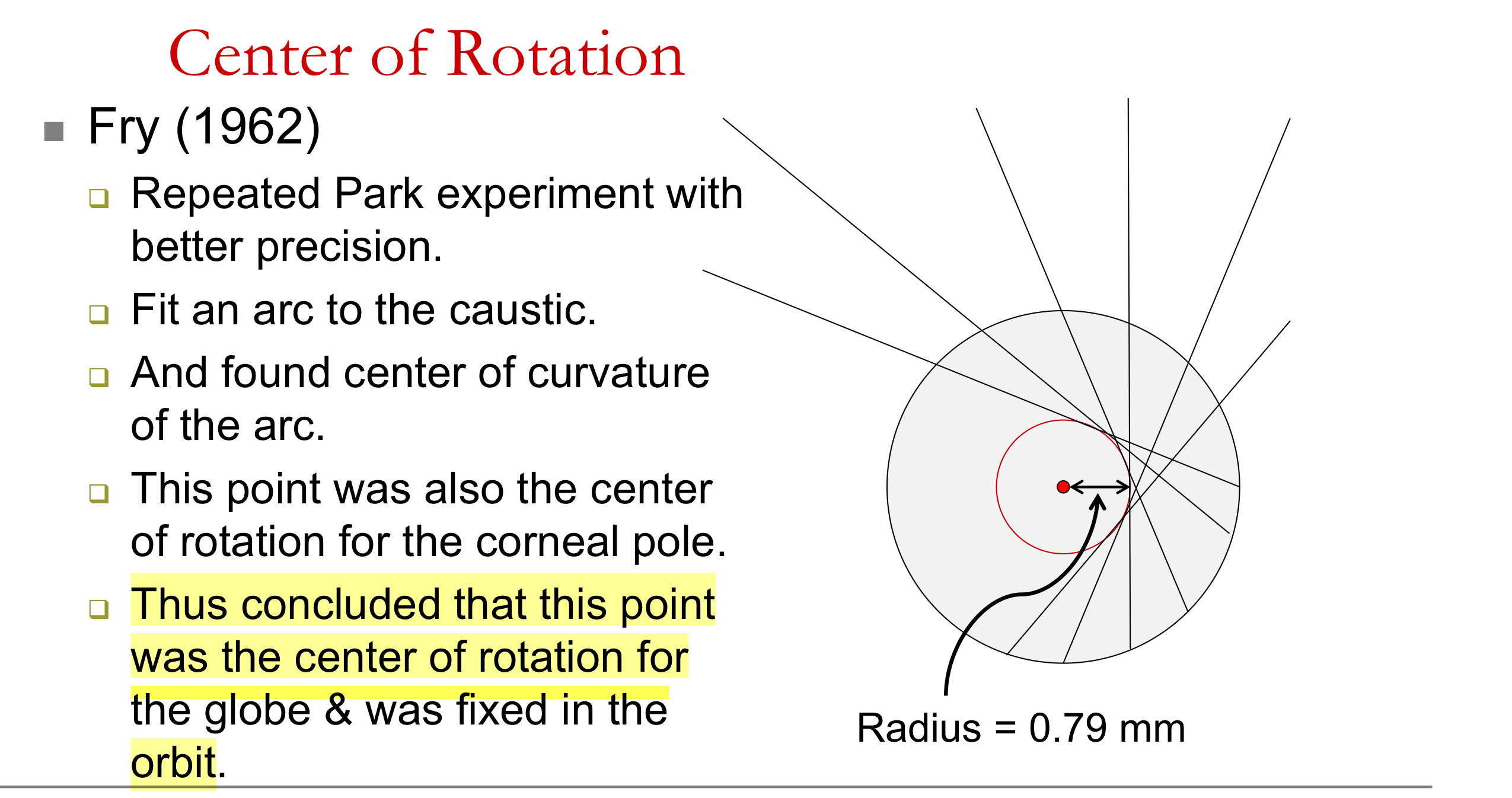
The curved envelope formed when lines of sight at different gaze angles are extended back — they do not meet at a single point because the line of sight does not pass through the COR.
What did Fry (1962) conclude and how?
By repeating Park & Park's experiment with greater precision, Fry recognized the lines of sight formed a caustic curve. He fit an arc to the caustic, found its center of curvature, and showed this point was also the COR for the corneal pole — concluding there is a single, fixed COR in the orbit.
Where is the COR located according to Fry?
prob fyi
Approximately 14.8 mm behind the corneal pole for horizontal movements, and 0.79 mm nasal to the lines of sight. For vertical movements, approximately 12.2 mm behind the corneal pole, roughly at the eye's equator.
Define primary, secondary, and tertiary positions of gaze.
Primary = straight ahead.
Secondary = positions along the pure horizontal or vertical axes from primary (up, down, left, right).
Tertiary = all other positions (any combination of horizontal and vertical).
What is a tangent screen / Frontal Parallel Plane?
A flat screen used as an objective reference to specify where a person is looking.
Eye position is mapped onto it using one of the three coordinate systems.
T/F: The coordinate system describes the path the eye takes to reach a tertiary gaze position, first moving vertically, then horizontally.
The coordinate system only describes where the eye ends up, not how it got there
What are the defining features of the Fick coordinate system?
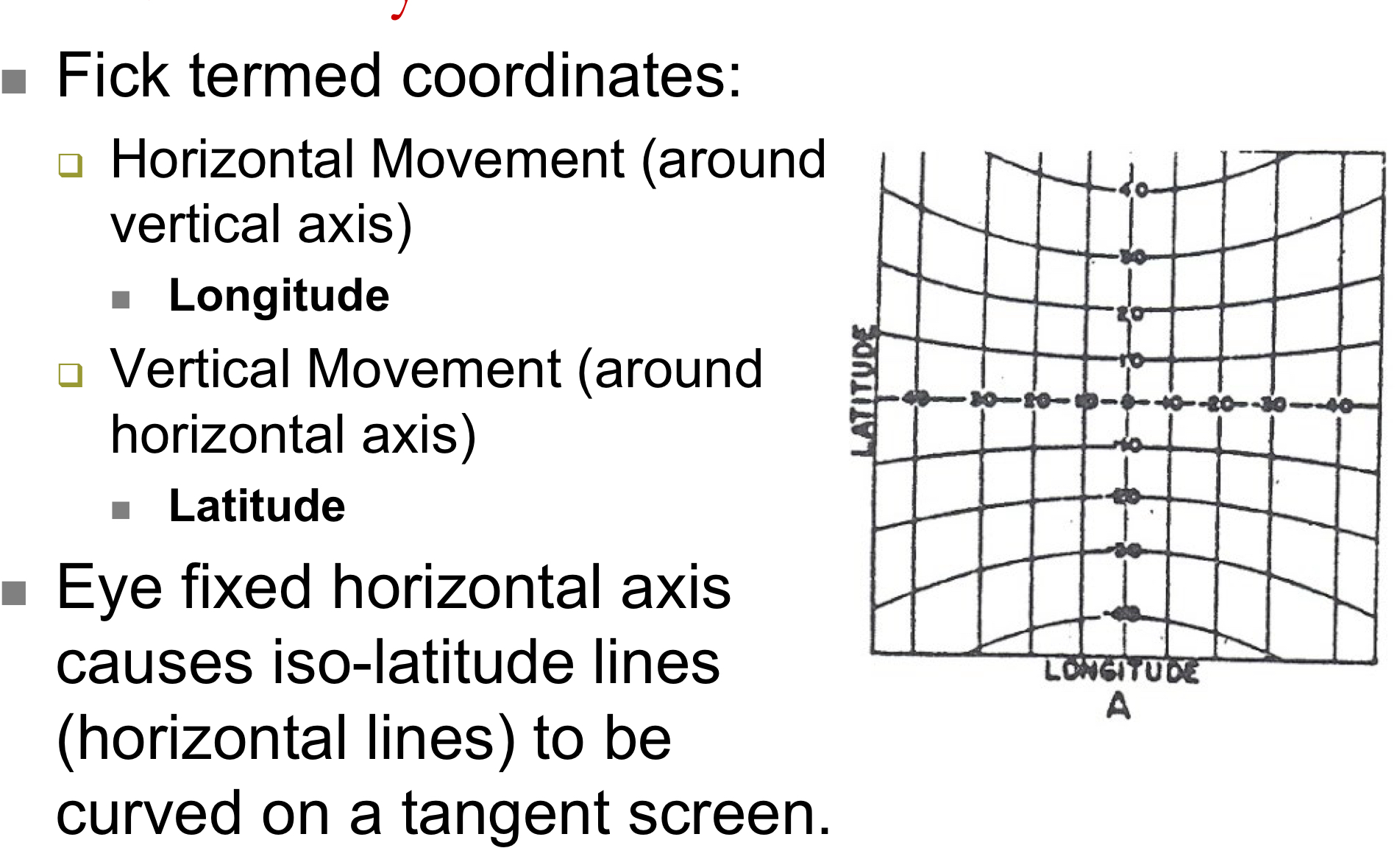
Horizontal movement is primary (around a head-fixed vertical axis). Vertical movement is secondary (around an eye-fixed horizontal axis). Because the horizontal axis is eye-fixed, it moves with the eye during lateral movements.
What are Fick's coordinate terms?
Horizontal movement = Longitude
Vertical movement = Latitude
What real-world devices use Fick coordinates?
telescope and camera tripods, the human head, and the troposcope
What is a visual consequence of the Fick system on a tangent screen?
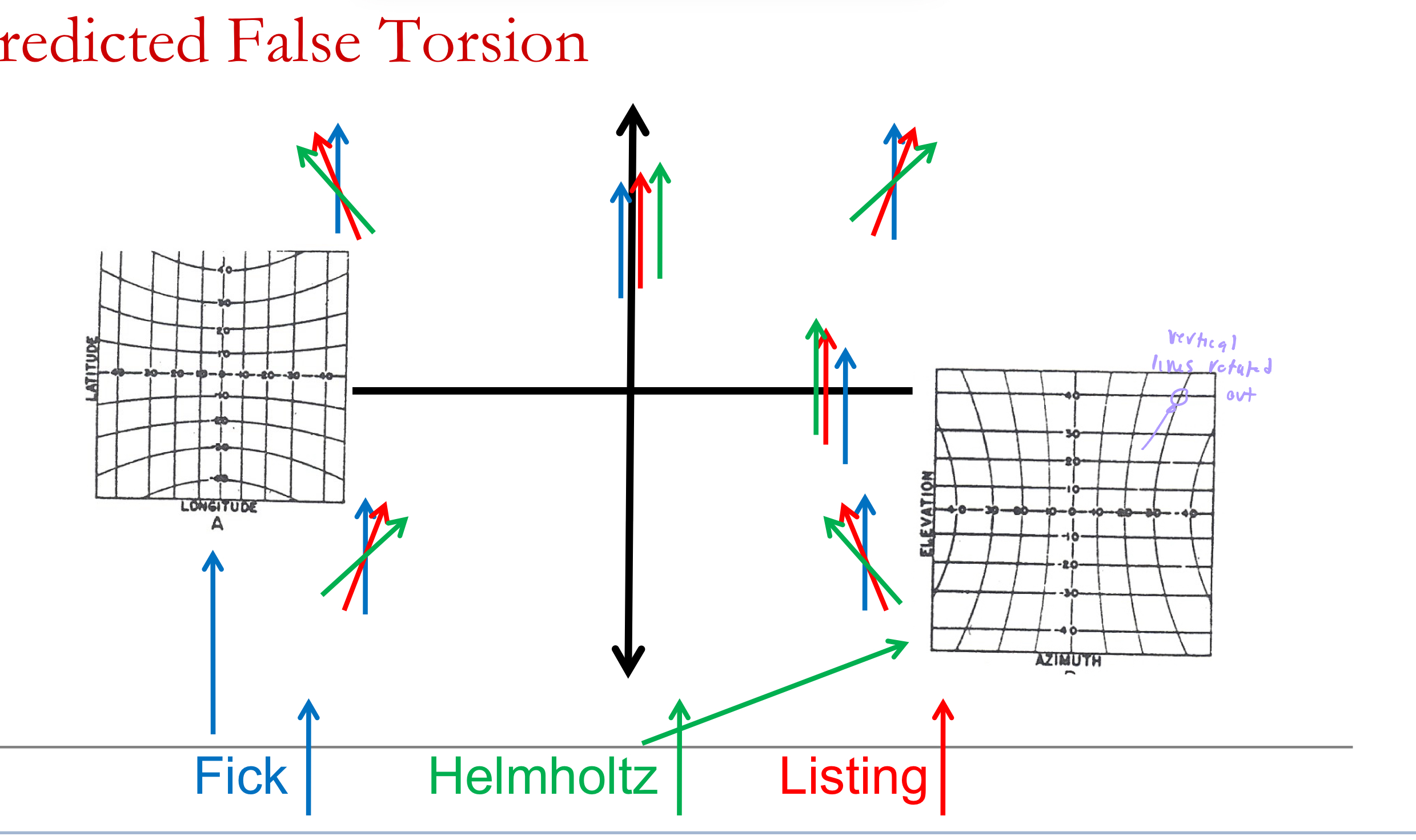
Because the horizontal axis is eye-fixed, iso-latitude lines (horizontal lines) appear curved on a tangent screen.
How much false torsion does the Fick system predict?
Zero false torsion
What are the defining features of the Helmholtz coordinate system?
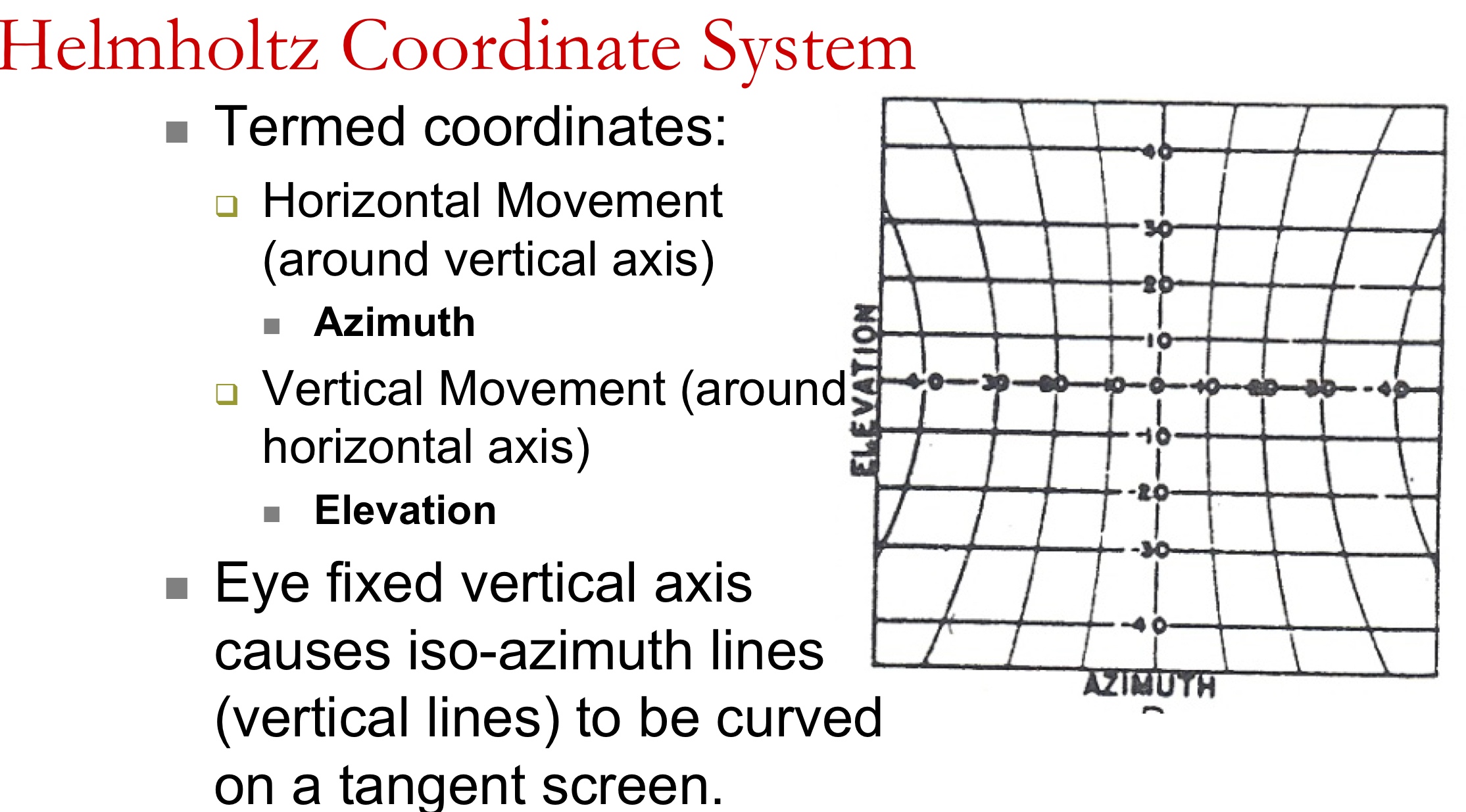
Vertical movement is primary (around a head-fixed horizontal axis). Horizontal movement is secondary (around an eye-fixed vertical axis). The vertical axis is eye-fixed and moves with vertical eye movements.
What are Helmholtz's coordinate terms?
Vertical movement = Elevation
Horizontal movement = Azimuth.
What is a visual consequence of the Helmholtz system on a tangent screen?
Because the vertical axis is eye-fixed, iso-azimuth lines (vertical lines) appear curved on a tangent screen.
How much false torsion does the Helmholtz system predict?
The most of the three coordinate systems
What type of coordinate system is Listing's?
A polar coordinate system
What are the two coordinates in the Listing system?
Meridian (the angle/direction of the axis of rotation)
Eccentricity (the angle between primary gaze and the final eye position).
Why is the Listing system considered the most physiologically accurate?
Because it closely matches how the eye actually travels to reach tertiary positions, and its predicted false torsion most closely matches real eye data.
Where is the Listing coordinate system used clinically?
In perimetry (e.g., Goldmann perimeter, tangent screen).
How much false torsion does the Listing system predict relative to the others?
An intermediate amount
More than Fick
Less than Helmholtz
It most closely matches actual measured eye torsion.
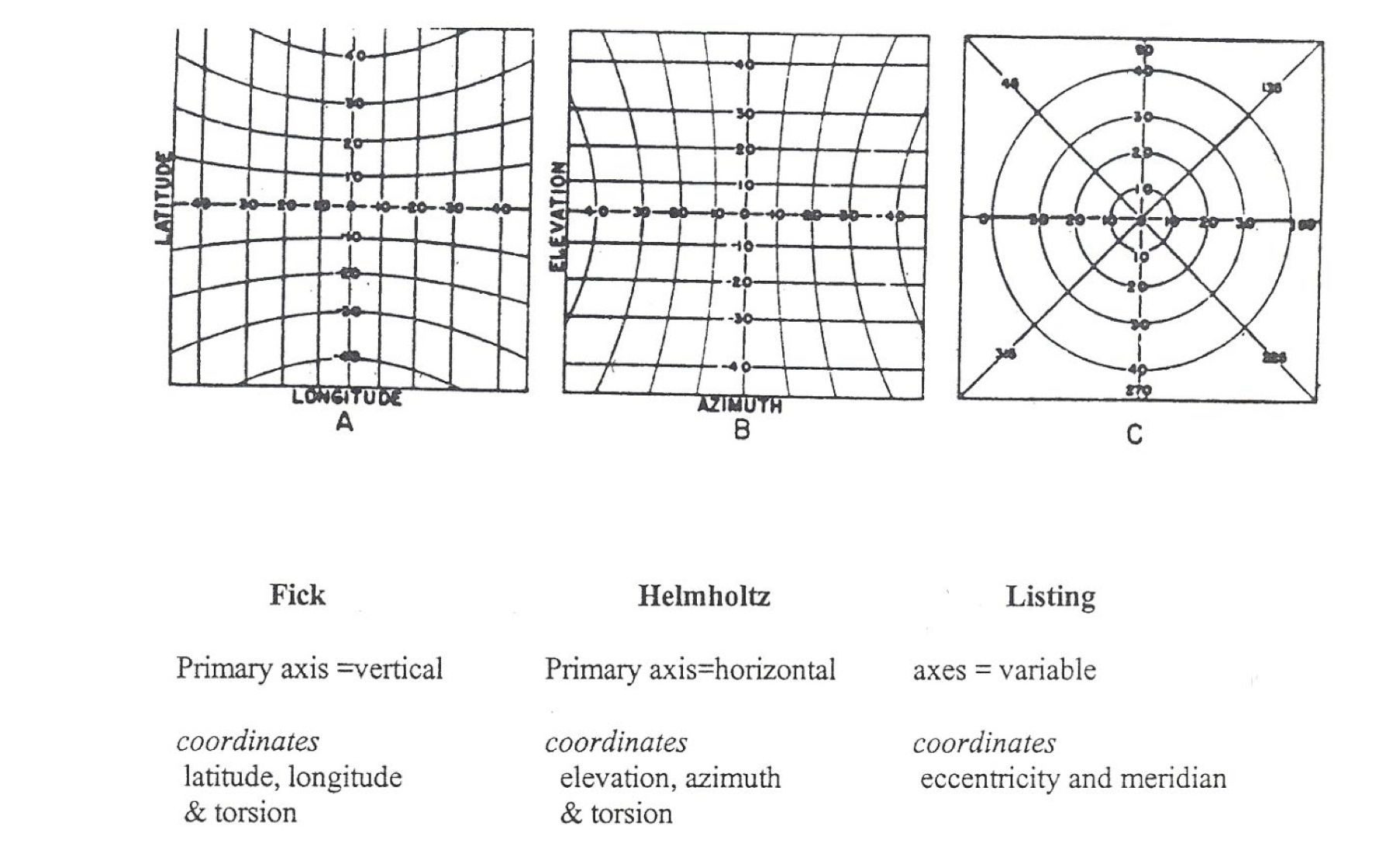
Compare Fick, Helmholtz, and Listing in terms of primary axis and coordinate names.
Can different coordinate systems describe the same gaze position?
Yes
For example, a point 20 cm right and 35 cm up at 50 cm distance is described as 21.8° right / 33.0° up in Fick, and 18.1° right / 35.0° up in Helmholtz
Both refer to the exact same eye position
What is true torsion?
Torsion that results from actual rotation of the eye around the anterior-posterior axis (the line of sight).
What is false torsion?
Torsion that occurs simply because the eye is in a tertiary position
The vertical meridian tilts relative to gravitational vertical without any rotation around the line of sight.
i.e: looking up and to the right, torsion is not occurring because of a rotation of ant/post axis
predicted false torsion of the three coordinate systems
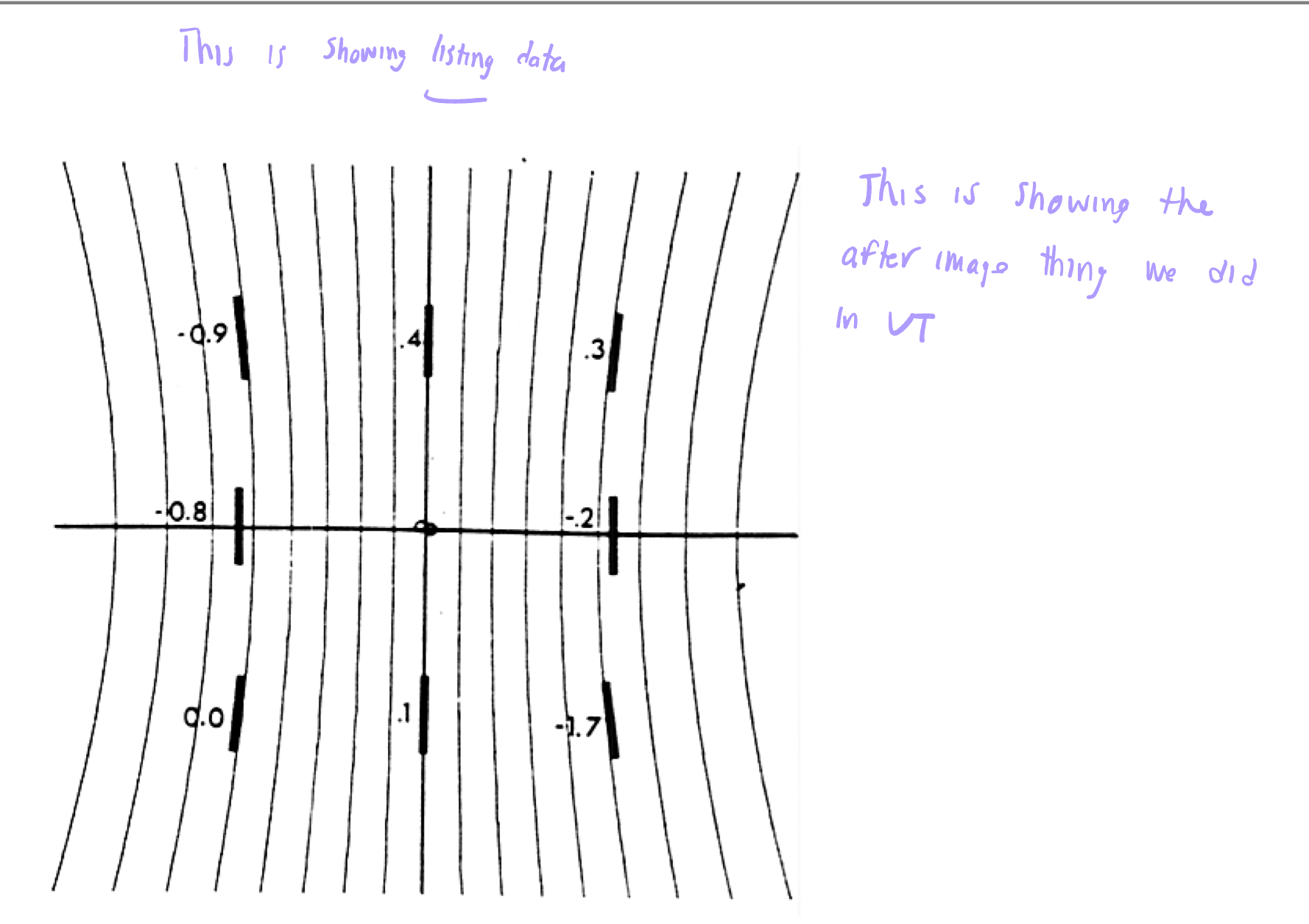
How is torsion (true or false) classically measured?
Using afterimages
Since an afterimage is fixed to the retina, any torsion causes the perceived afterimage to appear tilted relative to the world.
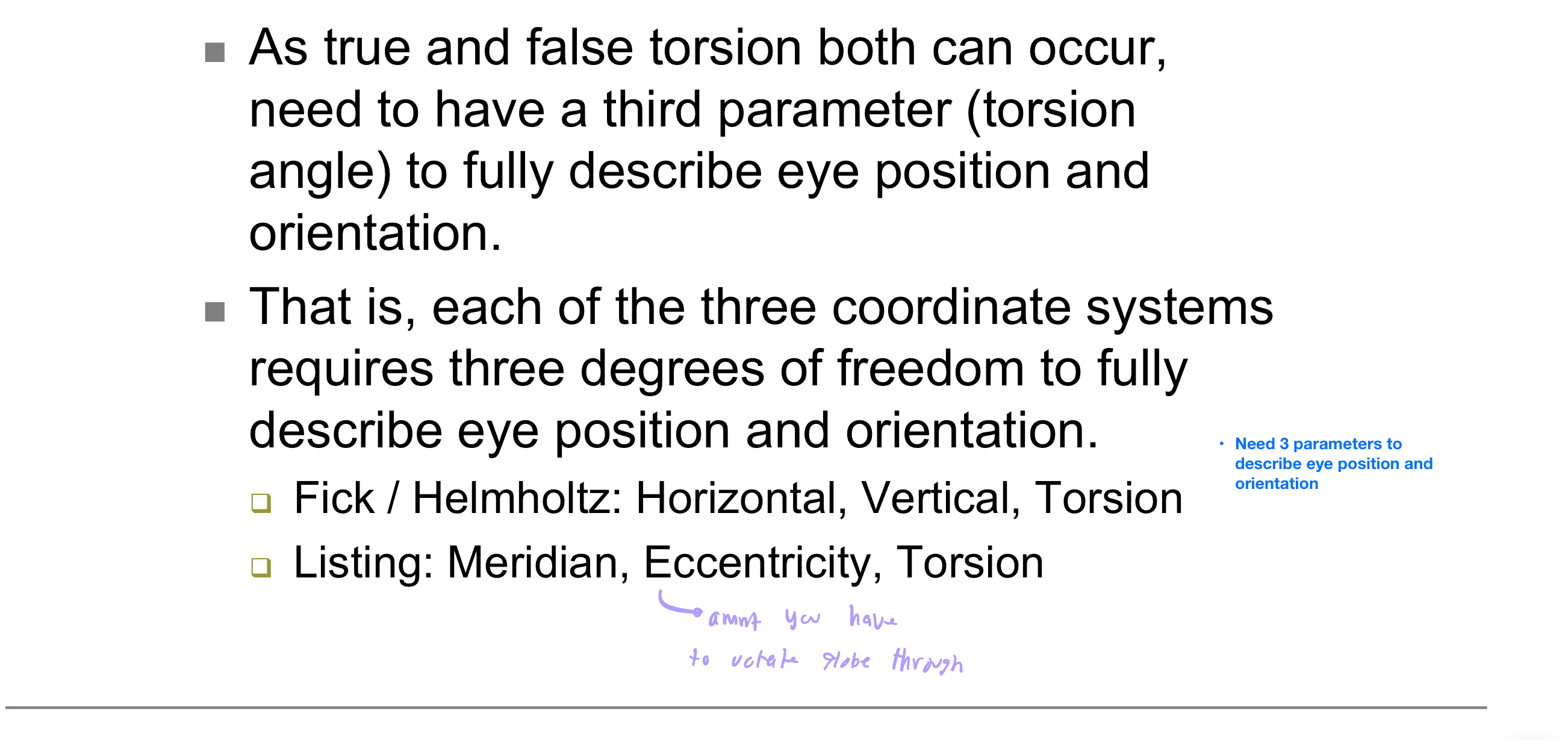
How many degrees of freedom are needed to fully describe eye position and orientation, and what are they?
Three degrees of freedom.
For Fick/Helmholtz: horizontal, vertical, and torsion.
For Listing: meridian, eccentricity, and torsion.
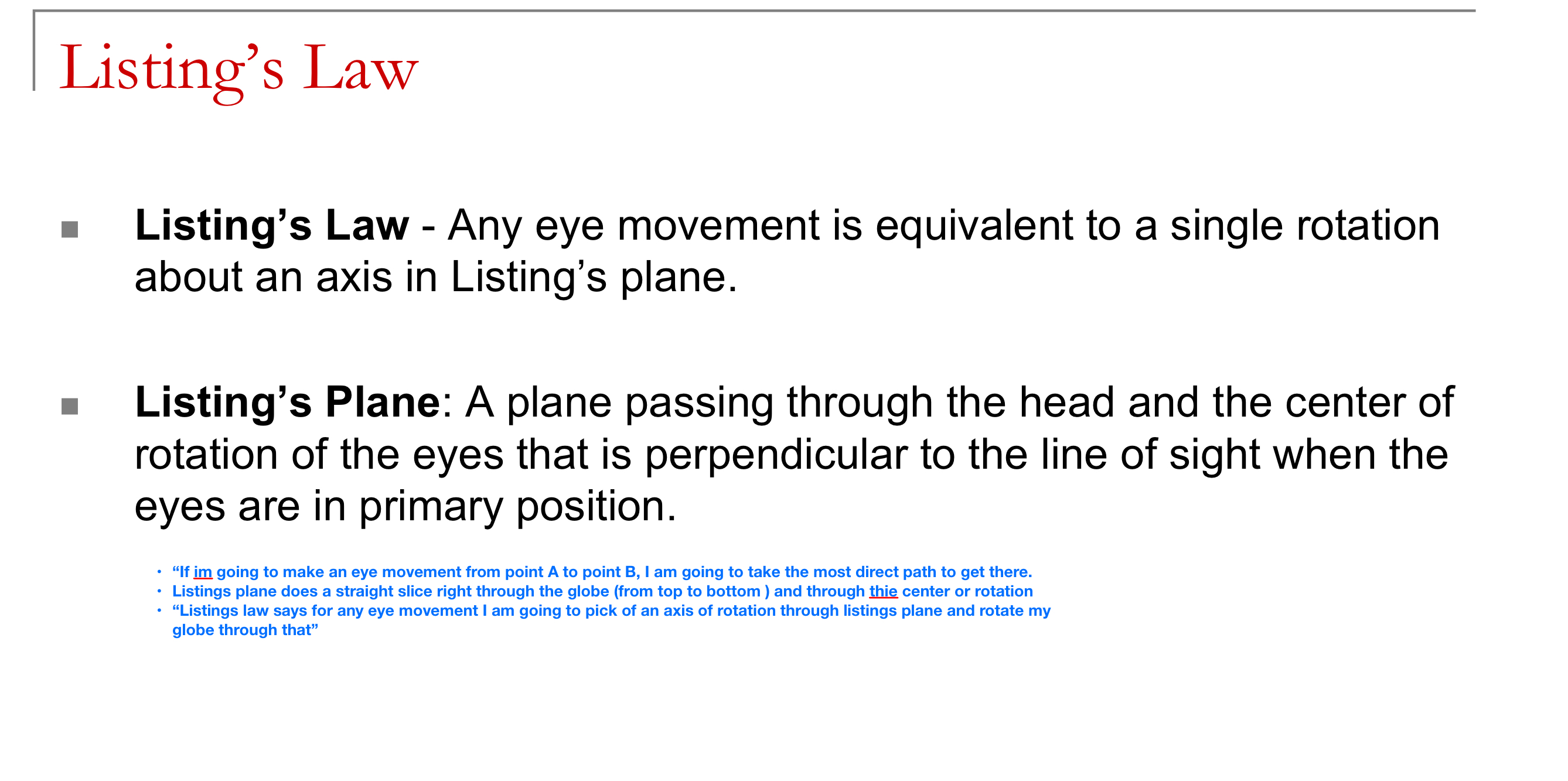
State Listing's Law.
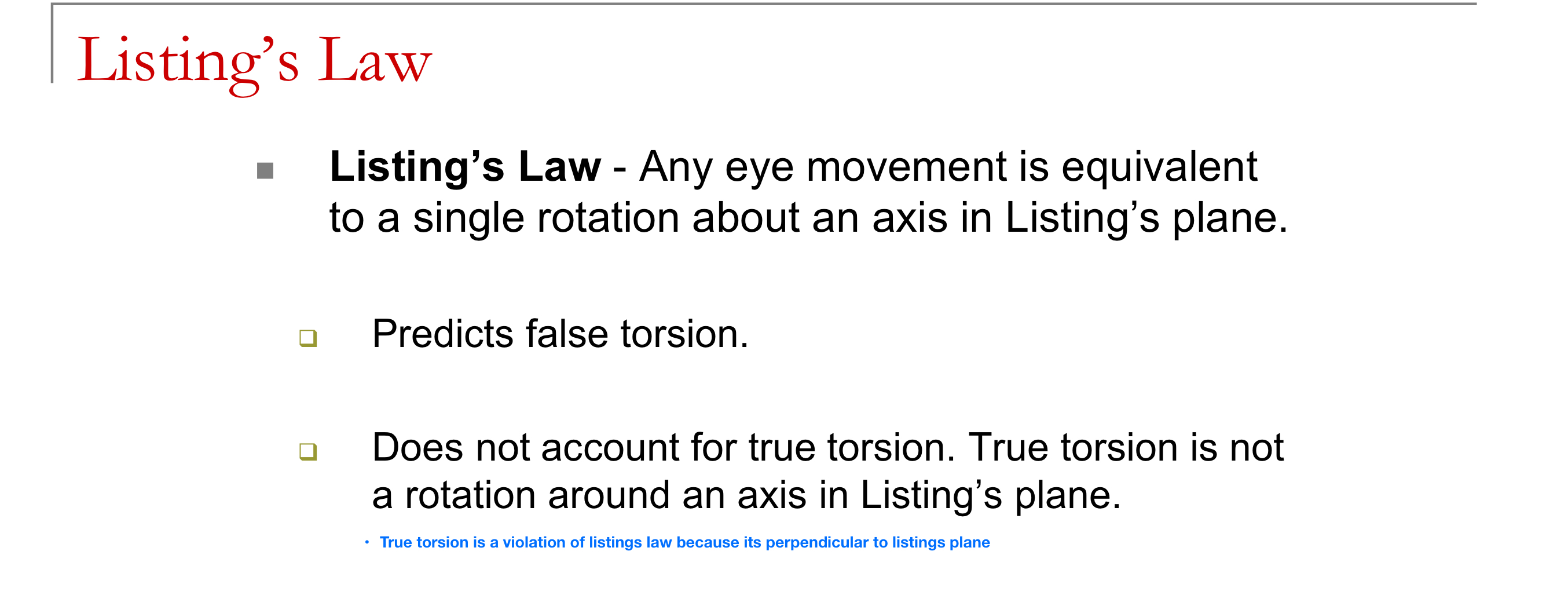
Any eye movement is equivalent to a single rotation about an axis lying within Listing's Plane.
It predicts false torsion but does not account for true torsion (which involves rotation outside Listing's Plane).
What is Listing's Plane?
A plane that passes through the center of rotation of the eye, is fixed to the head, and is perpendicular to the line of sight when the eyes are in primary position
What does it mean that true torsion violates Listing's Law?
True torsion involves rotation around the line of sight (anterior-posterior axis), which is perpendicular to Listing's Plane — meaning its axis of rotation does not lie within Listing's Plane, so it cannot be described by Listing's Law.
State Donder's Law.
For any given direction of gaze, the orientation of the eye (i.e., the amount of torsion present) is always the same, regardless of the path the eye took to reach that position.
What is the relationship between Listing's Law and Donder's Law?
Donder's Law states that eye orientation is unique for each gaze position. Listing's Law is more specific
it tells you exactly how much false torsion will be present at any given tertiary position. Listing's Law is essentially the mechanistic explanation for Donder's Law.
What is the alternative definition of primary gaze based on torsion principles?
Primary gaze is the ocular position from which a pure vertical or horizontal rotation can occur with zero false torsion, because false torsion only arises in tertiary positions.