PSYC2040 WEEK 4
 Call Kai
 Learn
Learn Practice Test
 Spaced Repetition
 Match
Match Flashcards
 Knowt Play
1/25

There's no tags or description
Looks like no tags are added yet.
Name | Mastery | Learn | Test | Matching | Spaced | Call with Kai |
|---|
No analytics yet
Send a link to your students to track their progress
26 Terms
ATTITUDES
A psychological tendency that is expressed by evaluating a particular entity with some degree of favour or disfavour
Can be towards an concrete or abstract object
INSTRUMENTAL CONDITIONING
Forming attitudes based on rewards and punishments. Linked to utilitarian function.
GOSSIP
Influences impressions regardless of reliability.
ATTITUDES TYPE - CLASSIC UNIDIMENSIONAL APPROACH
Valence = positive, negative, neutral
Strength = weak -> strong
Differ from person to person
Measured using bipolar scales
Assumes attitude can be +ve or –ve, not both
ATTITUDES TYPE - ATTITUDINAL AMBIVALENCE
Simultaneously holding an attitude of mixed valence towards an attitude object
ATTITUDE TYPE - BIDIMENSIONAL APPROACH
People evaluate attitude objects on a separate positive dimension and negative dimension
+ve and –ve measured using unipolar scales
Can separate true neutral from ambivalent attitudes
ATTITUDE STRENGTH
Greater stability/duration over time
Better at predicting behaviour
More resistant to persuasion
INDICATORS OF ATTITUDE STRENGTH
Attitude extremity
How much an attitudes deviates from normality
Attitude certainty
How sure a person is of their attitude
Attitude importance
How important/relevant an attitude is to a person
Attitude accessibility
How easily an attitude comes to mind
MORALISATION OF ATTITUDES
Some attitudes are linked to deeply entrenched beliefs that certain things are 'right' vs 'wrong'
Belief attitude is universal and objectively true
Intolerance of dissimilar people
Greater resistance to compromise, authority
MORAL MANDATE HYPOTHESIS
Attitudes tied to moral convictions are more powerful influences of behaviour than those that aren't
TRIPARTITE MODEL OF ATTITUDES
Positive cognitions + affect + behavioural tendencies = positive attitude
Negative cognitions + affect + behavioural tendencies = negative attitude

SOCIAL ADJUSTIVE FUNCTION
Help us gain social acceptance and connection, and fit into social groups
VALUE EXPRESSIVE FUNCTION
Allows us to express values important to our self-concepts
EGO DEFENSIVE FUNCTION
Helps us protect our self-esteem
UTILIARIAN FUNCTION
Helps us maximise reward and minimise punishment
ATTITUDE FORMATION - DIRECT BEHAVIOURAL EXPERIENCE
Attitude formation from direct experience with attitude object
Positive experience = positive attitude
Positive experiences are rewarding, negative are punishing.
Attitudes formed through direct experience are more predictive of behaviour than not
ATTITUDE FORMATION - MERE EXPOSURE EFFECT
Exposure, even without interaction, can elicit a positive attitude towards a novel stimulus.
We like things we're exposed to more frequently
Effect is only positive when initial attitude is +ve
If –ve, attitude gets worse with exposure.
ATTITUDE FORMATION - EVALUATIVE CONDITIONING
Attitudes formed by association
Pair novel attitude object with an object you already have +ve/-ve attitude for
Celebrity/brand endorsements
Ex. Hard to separate between music and musician
Spreading attitude effect
Dislike/liked objects may affect attitude of object directly associated to novel object and so forth.
ATTITUDE FORMATION - OBSERVATIONAL LEARNING
Adopt the attitudes we see others have towards an object
Emerges when very young
ADDITUDE FORMATION - SOCIAL IDENTITY AND GROUP NORMS
Social groups often defined by shared attitudes
We may be drawn to groups that share our attitudes
ATTITUDE FORMATION - GENETICS
Right environmental factors need to be in place for genetic predisposition to manifest
Similarities in attitudes more in identical twins
ATTITUDE FORMATION - DISPOSITIONAL ATTITUDES
Individual difference in general tendency to like/dislike attitude objects
Positive dispositional attitude associated with openness, extraversion, optimism
ATTITUDES → BEHAVIOUR
Attitudes are powerful predictor of behaviour
Products -> purchase
People -> interactions
Jobs -> performance
Politicians -> voting
Sometimes attitudes don’t predict behaviour
Attitudinal ambivalence
Social norms
Lack of control
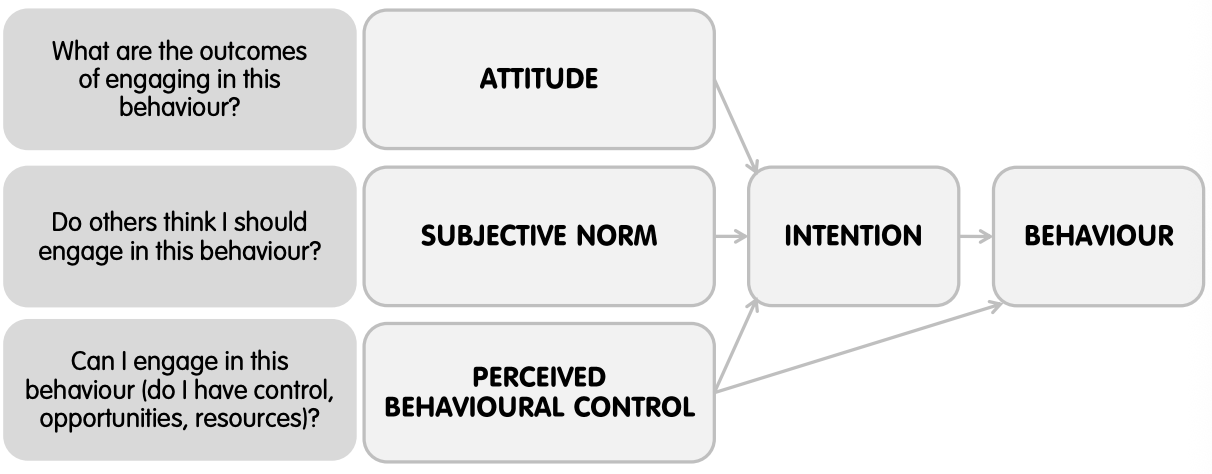
THEORY OF PLANNED BEHAVIOUR
Behaviour is predicted by behavioural intention
Behavioural intention predicted by:
Attitude (behavioural beliefs)
Subjective norms (normative beliefs)
Perceived behavioural control (control beliefs)
JOB ATTITUDES
Behaviour linked to motivation
Work motivation linked to attitudes
SELF DETERMINATION THEORY
Intrinsic motivation
Doing something because it's interesting/enjoyable
Extrinsic motivation
Doing something because it leads to a separable outcome