Dispute Resolution
 Call Kai
 Learn
Learn Practice Test
 Spaced Repetition
 Match
Match Flashcards
 Knowt Play
 Podcast
1/67

There's no tags or description
Looks like no tags are added yet.
Name | Mastery | Learn | Test | Matching | Spaced | Call with Kai |
|---|
No analytics yet
Send a link to your students to track their progress
68 Terms
If parties don’t attempt ADR - consequences?
circumstances where reasonable to refuse ADR?
court can issue penalties to parties who unreasonably refuse to either comply with a court order requiring ADR/accept an offer by the other side to attempt ADR: Adverse costs orders - interest on damages / award of costs
Criteria to determine if refusal to consider ADR is justified:
(a) the nature of the dispute;
(b) the merits of the case;
(c) the extent to which other settlement methods have been attempted;
(d) whether the costs of the ADR would be disproportionately high;
(e) whether any delay in setting up and attending the ADR would have been prejudicial; (that unfairly harmed one party)
(f) whether the ADR had a reasonable prospect of success.
Arbitration governed by…?
Arbitration is largely governed by statute - but Arbitration Act 1996 only applies if the agreement to arbitrate is in writing.
Section 68 (2) Arbitration Act 1996 provides that a challenge to a decision will only be successful where the applicant can prove that there is a serious irregularity in the proceedings, the tribunal or the award which caused substantial injustice to the applicant. The application must be made within 28 days of the award being made. The criteria are therefore very narrow. A serious irregularity can include where the arbitrator has erred on the particular point of law.
Is there scope to challenge an arbitration decision? timing?
A challenge to a decision will only be successful where the applicant can prove that:
there is a serious irregularity in the proceedings, the tribunal or the award which caused substantial injustice to the applicant.
The application must be made within 28 days of the award being made.
The criteria are therefore very narrow. A serious irregularity can include where the arbitrator has erred on the particular point of law.
Section 68 (2) Arbitration Act 1996
Civil claim — 5-stage overview
1. Pre-commencement: limitation, parties, merits, pre-action, ADR.
2. Commencement: claim form, particulars, service, response.
3. Interim/case management: applications, directions, disclosure, evidence, costs.
4. Trial: evidence, judgment, costs.
5. Post-trial: appeal / enforcement.
Limitation period to commence proceedings
contract/tort - claimant has 6 years from the date of the cause of action to commence proceedings
limitation period for personal injury matters is 3 years -
except children, from 18th bday.
negligence where the damage is latent (hidden) -
6 years from damage or 3 years from the date of knowledge of the damage (but within 15 years from the negligent act)
Applicable law: mechanisms to determine which country’s laws apply? contractual disputes within EU
context:
Jurisdiction = where can/should you sue?
Applicable law = which law governs the merits once the court hears it?
_
Applicable law: If no governing law chosen by parties - contract governed by law most closely connected
contractual disputes within EU:
• if no specific rule applies → where 'characteristic performer' has habitual residence ( party to a contract who provides the core, non-monetary obligation)
• sale of goods → seller’s habitual residence
• supply of services → supplier’s habitual residence
• rights in land / tenancies → where property is situated
__
Tort within EU:
• if no agreement between parties → law of country where damage occurs / likely to occur
• exception: tort manifestly more closely connected with another country
overriding objective of the CPR
in exercising powers to manage cases, must comply with overriding objective:
aim is to enable the court to deal with cases justly and at proportionate cost.
Objectives the court should seek to achieve when dealing with cases:
(a) ensuring that the parties are on an equal footing;
(b) saving expense;
(c) dealing with the case in ways that are proportionate to:
— the amount of money involved
— the importance of the case
— the complexity of the issues and
— the financial position of each party;
(d) ensuring that the case is dealt with expeditiously and fairly;
(e) allotting to it an appropriate share of the court’s resources, whilst taking into account the need to allot resources to other cases;
(f) promoting/using ADR; and
(g) enforcing compliance with rules, practice directions and orders.
Pre-Action protocols - specific guidance from 13 causes of actions:
• personal injury;
• resolution of clinical disputes;
• construction and engineering;
• defamation;
• professional negligence;
• judicial review;
disease and illness;
• housing disrepair;
• possession claims by social landlords;
• possession claims for mortgage arrears;
• dilapidation of commercial property;
• low-value personal injury road traffic accident claims;
• low-value personal injury employers liability and public liability claims.
Objectives of pre-action conduct
(a) Understand each other's position.
(b) Make decisions about how to proceed.
(c) Try to settle the issues without proceedings.
(d) Consider a form of alternative dispute resolution (ADR) to assist with settlement.
(e) Support the efficient management of proceedings.
(f) Reduce the costs of resolving the dispute.
PD on pre-action conduct and protocol (PDPACP)
key principles/requirements
after C’s pre-action letter, what is timeframe for D to respond?
D should respond within 14 days (straightforward case) / no more than 3 months (very complex case)
Key requirements
Exchange of key information: disclose any evidence that allows them to achieve the objectives of pre-action conduct
Consideration of ADR: provide evidence that consideration has been given to resolving with ADR
Instruction of experts: look to instruct a single joint expert to save time and costs.
Proportionality: Only reasonable and proportionate steps should be taken by the parties to try resolve; costs should be proportionate to the dispute
In detail:
(1) Litigation should be a last resort. The parties should consider whether negotiation or some other form of alternative dispute resolution (ADR) might enable them to settle their dispute without commencing proceedings.
(2) The parties should exchange sufficient information in order to:
(a) understand each other’s position;
(b) make decisions about how to proceed;
(c) try to settle the issues without proceedings;
(d) consider a form of ADR to assist with settlement;
(e) support the efficient management of those proceedings; and
(f) reduce the costs of resolving the dispute.
(3) The steps taken should usually include:
(a) the claimant writing to the defendant with concise details of the claim;
(b) the defendant responding within a reasonable time; and
(c) the parties disclosing key documents relevant to the issues in dispute.
(4) Only reasonable and proportionate steps should be taken by the parties to identify, narrow and resolve the legal, factual and/or expert issues.
(5) Where a dispute has not been resolved after the parties have followed the Practice Direction, they should review their respective positions to see if proceedings can be avoided and at least seek to narrow the issues in dispute before the claimant issues proceedings.
(6) If a dispute proceeds to litigation, the court will expect the parties to have complied with the Practice Direction. A party may be sanctioned for failing to do so.
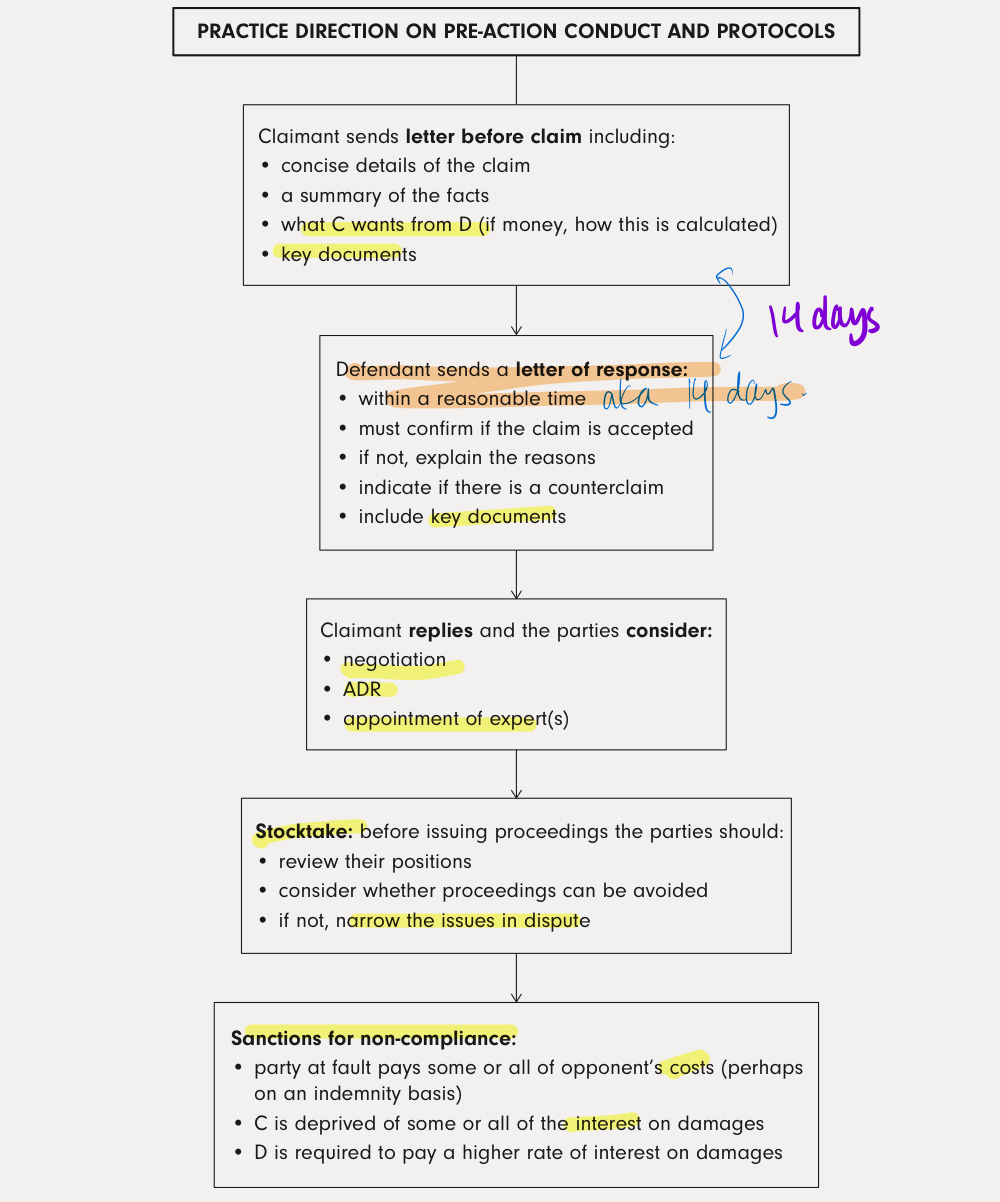
Consequences for failure to follow the terms of PD on pre-action conduct and protocol (PDPACP)
Where non-compliance led to proceedings that might otherwise not have been commenced/unnecessary costs being incurred, the court may impose penalties, e.g. an order:
(a) that the party at fault pays some or all of their opponent’s costs (perhaps on the penalty, indemnity basis);
(b) depriving a claimant who is at fault of some or all of the interest they may subsequently be awarded on any damages recovered; or
(c) requiring D at fault to pay interest on any damages awarded to the claimant at a rate of up to 10% per annum above the base rate.
Preliminary considerations for the use of the Welsh language in civil proceedings
must inform the court if a document is going to be placed before the court in Welsh.
In the directions questionnaire. Parties must indicate at this early stage whether it is likely that any documents disclosed or oral evidence given will be in Welsh.
At the case management hearing. A party or their representative should draw the courfs attention at this point to whether Welsh will need to be used at any part of the proceedings.
In the pre-trial checklist, or listing questionnaire
Pre-Action Protocol for Debt Claims (PPDC)
response timeframe
debtor has 30 days to respond.
Pre-Action Protocol for Debt Claims (PPDC).
applies to any business including sole traders and public bodies (the creditor) that brings a claim against a debtor who is either an individual or a sole trader (the debtor).
It does not apply to B2B debts (unless the debtor is a sole trader).
Because the PPDC is specifically aimed at debt claims, the focus is slightly different. The potential claimant must give
full information on the debt owed, including an up-to-date statement of account with details of interest and charges, and how the debt can be paid.
The standard Reply Form, Information Sheet and Financial Statement forms that are annexed to the protocol should also be included. This is to encourage settlement, perhaps by way of agreeing repayment plans.
Recognising that most debtors will be individuals, they are given a little longer to respond – 30 days – and court proceedings cannot be issued before this deadline. The creditor should also allow extra time if necessary for the debtor to seek legal or debt advice or in order to pay.
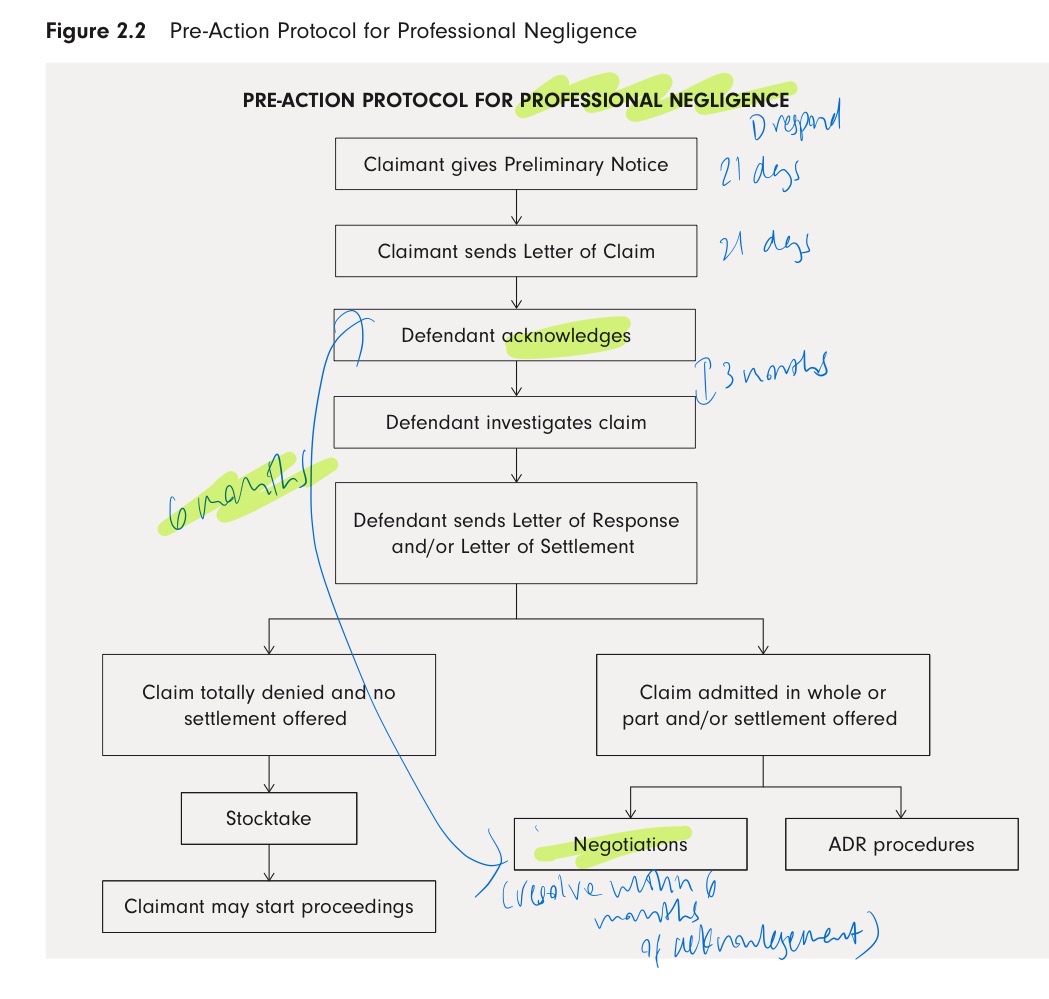
Pre-Action Protocol for Professional Negligence
response timeframe
professional should acknowledge within 21 days
3 months to investigate & respond to letter of claim
when C wishes to claim against most types of professionals as a result of alleged negligence
additional requirements
party encouraged to notify the professional in writing of any intended claim. This letter (the Preliminary Notice) contains information about the claimant, a brief outline of the claimant’s grievance against the professional and, if possible, a general indication of the financial value of the potential claim.
The professional should be instructed to inform their insurers immediately and to acknowledge the notice in writing within 21 days of receipt.
Next, the claimant should write a Letter of Claim giving full details of the issues and attaching key documents. The professional must acknowledge this in writing within 21 days of receipt. Thereafter, they have 3 months to investigate and to respond.
The Letter of Response sets out whether the professional admits the allegations and if not why not, with accompanying documents. Alternatively, or as well as the Letter of Response, a Letter of Settlement may be sent if the professional intends to make proposals for settlement of all or part of the claim.
If the Letter of Response denies the claim in its entirety and there is no Letter of Settlement, it is open to the claimant to start court proceedings.
In any other circumstance, the professional and the claimant should instigate negotiations with the aim of resolving the claim within 6 months of the date of the Letter of Acknowledgment. If matters cannot be resolved, there must be a final Stocktake in which the parties review their positions, or at least narrow down the issues, before court action is taken.
Jurisdiction - commencing proceedings if D is located in EU:
If D is in EU:
Basic rule - D will be sued/proceedings will be issued in the local court to
where the defendant is domiciled, if they are an individual, or
where the registered office is located, if they are a company.
Alternatively, contract/tort cases: C can elect that the case is heard…
where contract was due to be performed
where seller/supplier has their habitual residence
where the damages from the tort were incurred
_
context:
Jurisdiction = where can/should you sue?
Applicable law = which law governs the merits once the court hears it?
Jurisdiction - when can courts in England/Wales hear proceedings?
Service within England and Wales
courts can hear any proceedings if the claim form was served on the defendant while they were present in England&Wales (no matter how briefly).
service of court papers itself establishes the English courts’ jurisdiction over the defendant.
How the value of a claim is calculated
value of a claim is its financial worth disregarding the following:
• interest accumulated;
• the legal costs in pursuing the claim;
• the costs involved in pursuing any counterclaim;
• any amount that may be claimed for contributory negligence.
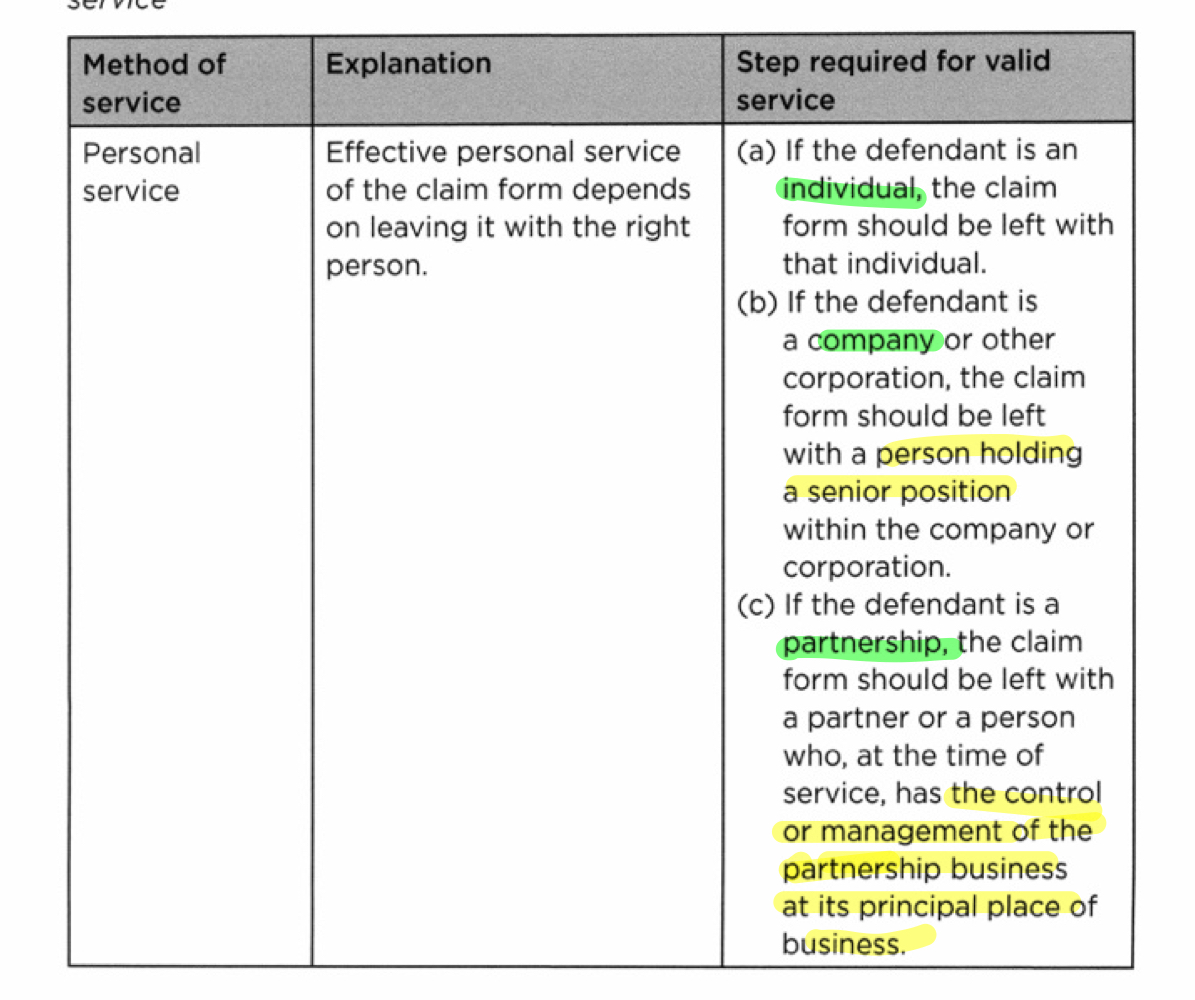
Personal service - what is required for valid service?
Serving claim form outside jurisdiction
time limit?
claim form must be served within 6 months of issue
permission from court must be sought to serve outside England & Wales
Then, service itself needs to be carried out in accordance with the procedures under the law of the country concerned.
The claimant should provide the claim form, and other documentation to the authorities in England and Wales, who then submit that to the authorities in the country in which the defendant is to be served.
The foreign authorities will then serve the document and provide a certificate of service.
Deemed service
time limits for serving proceedings (claim form)
time limit for filing certificate of service
Deemed service
claim form is deemed served on the second business day after the relevant step has taken place (Friday>tues)
all other docs -
personal service, fax, email , delivery - if before 430pm, same day
first class post or doc exchange - second day after it is posted (Wednesday>Fri)
Time limit: Claim form is to be served…
within 4 months (AKA CLAIM FORM VALID FOR 4 MONTHS)
(outside England, within 6 months of the date of issue)
File certificate of service with the court within 21 days of the date C serves particulars of claim on D.
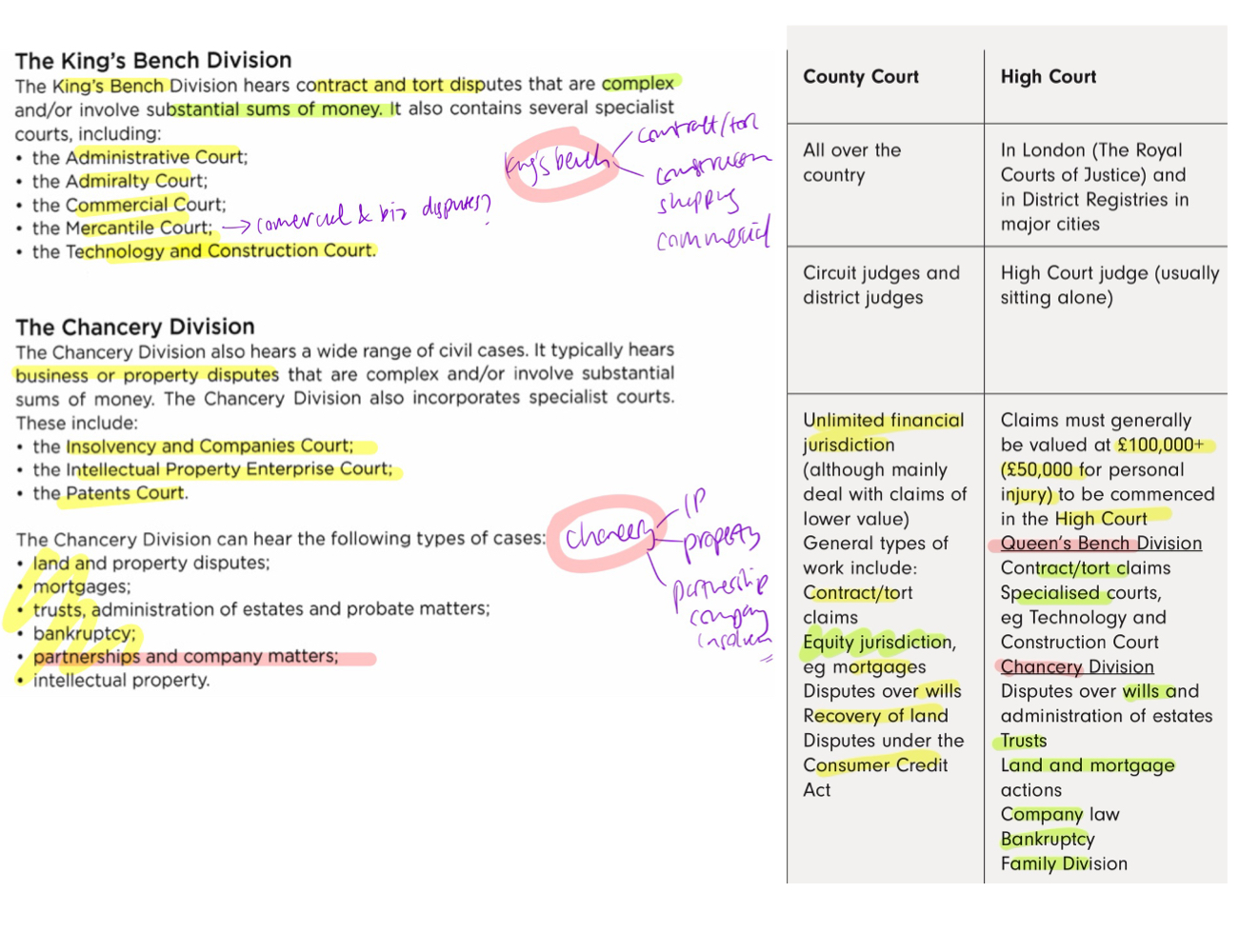
Jurisdiction of specialist courts
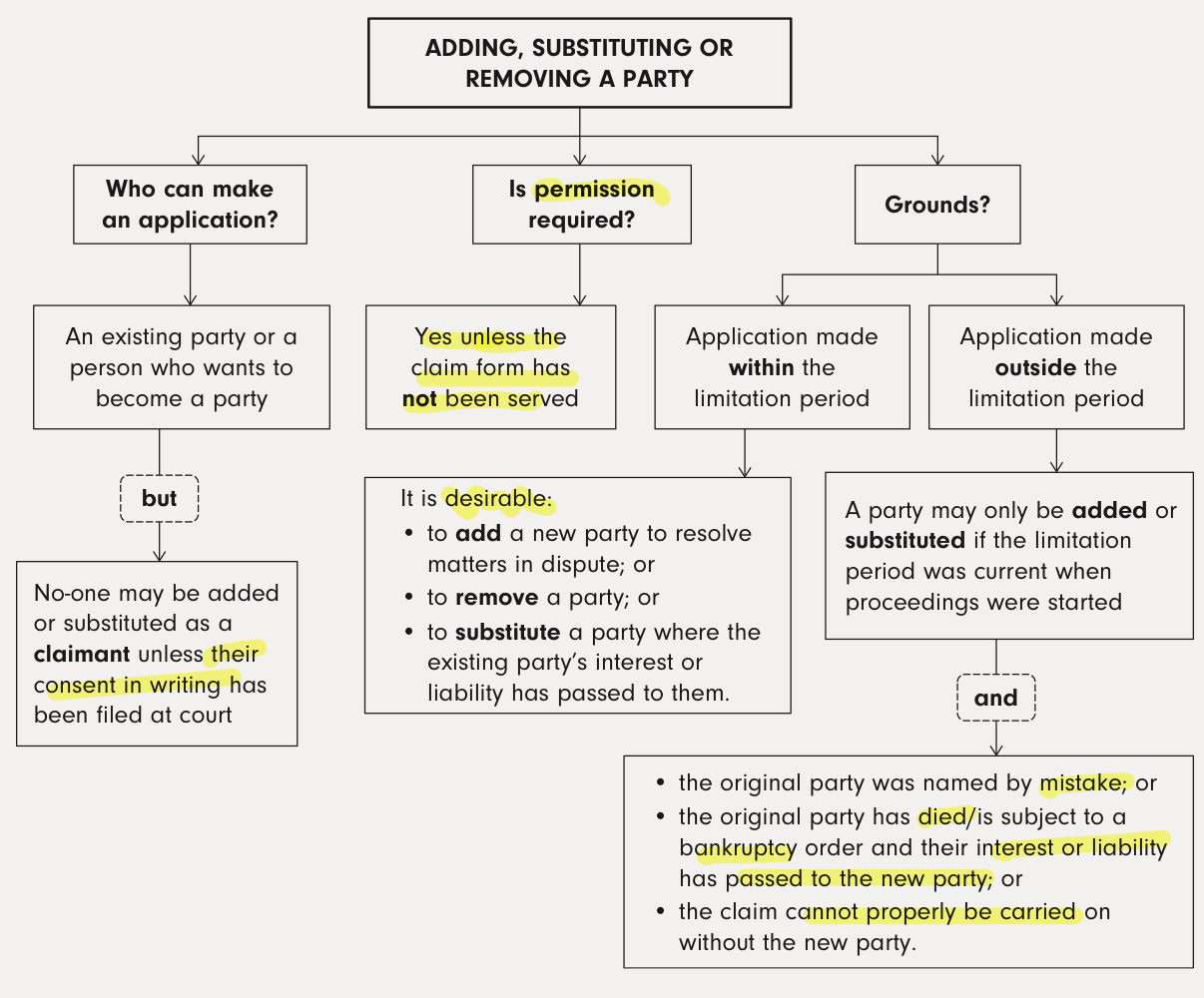
Adding, removing or substituting parties to proceedings - need permission? criteria?
no need permission if claim form not yet served
if made within the limitation period - criteria: it is desirable to resolve matters to add new party to resolve all connected matters etc.
if not - must be mistakenly named / original party died etc. / claim cannot properly be carried on against og party unless new party is added/subbed
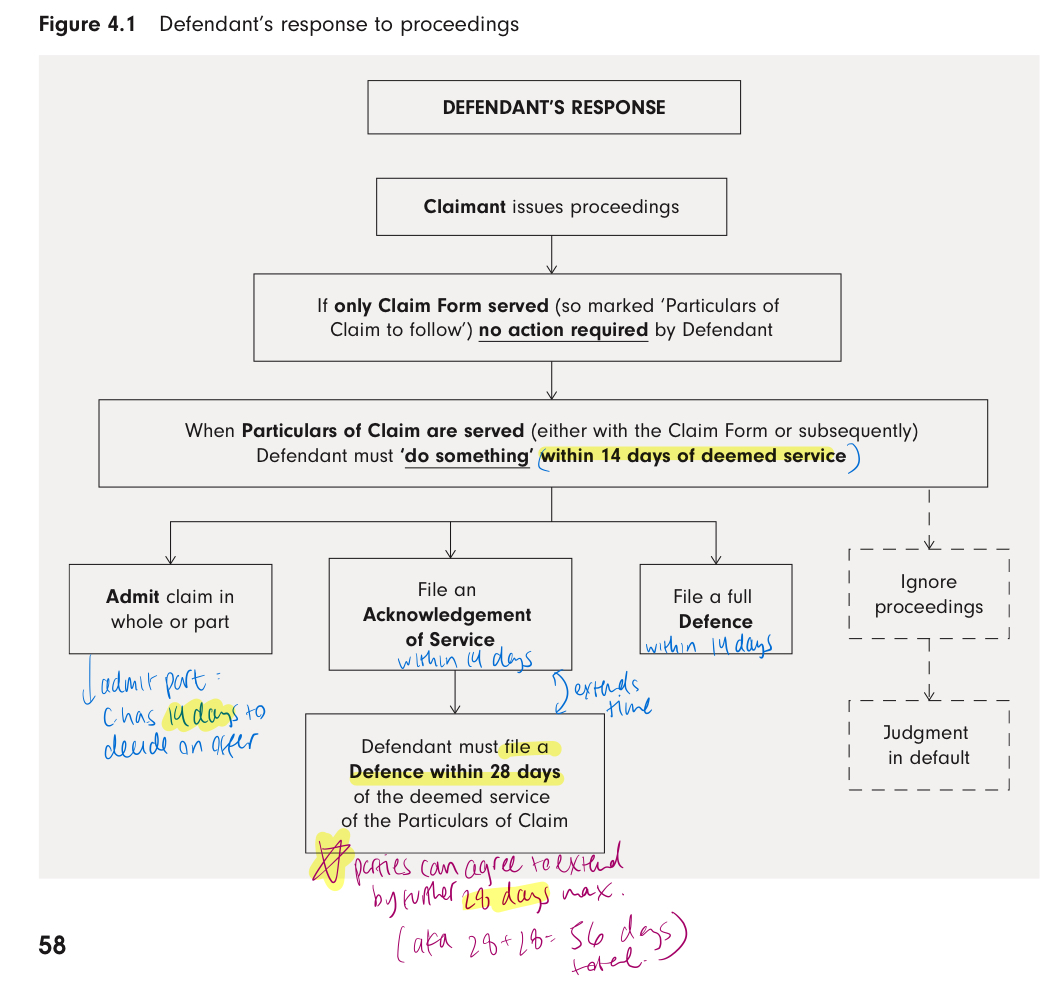
D’s response to a claim (and timescales)
Disputing court’s jurisdiction to hear the claim
what should D do? timing?
If the defendant does not believe that the court of England and Wales has jurisdiction to hear the claim…
D must indicate this on the acknowledgment of service (AOS) form
D then has 14 days from the date of filing the AOS to make application disputing jurisdiction
When can C enter default judgment?
After:
the particulars of claim have been validly served on the defendant; and
the defendant has not filed an acknowledgment of service or defence within the relevant time period.
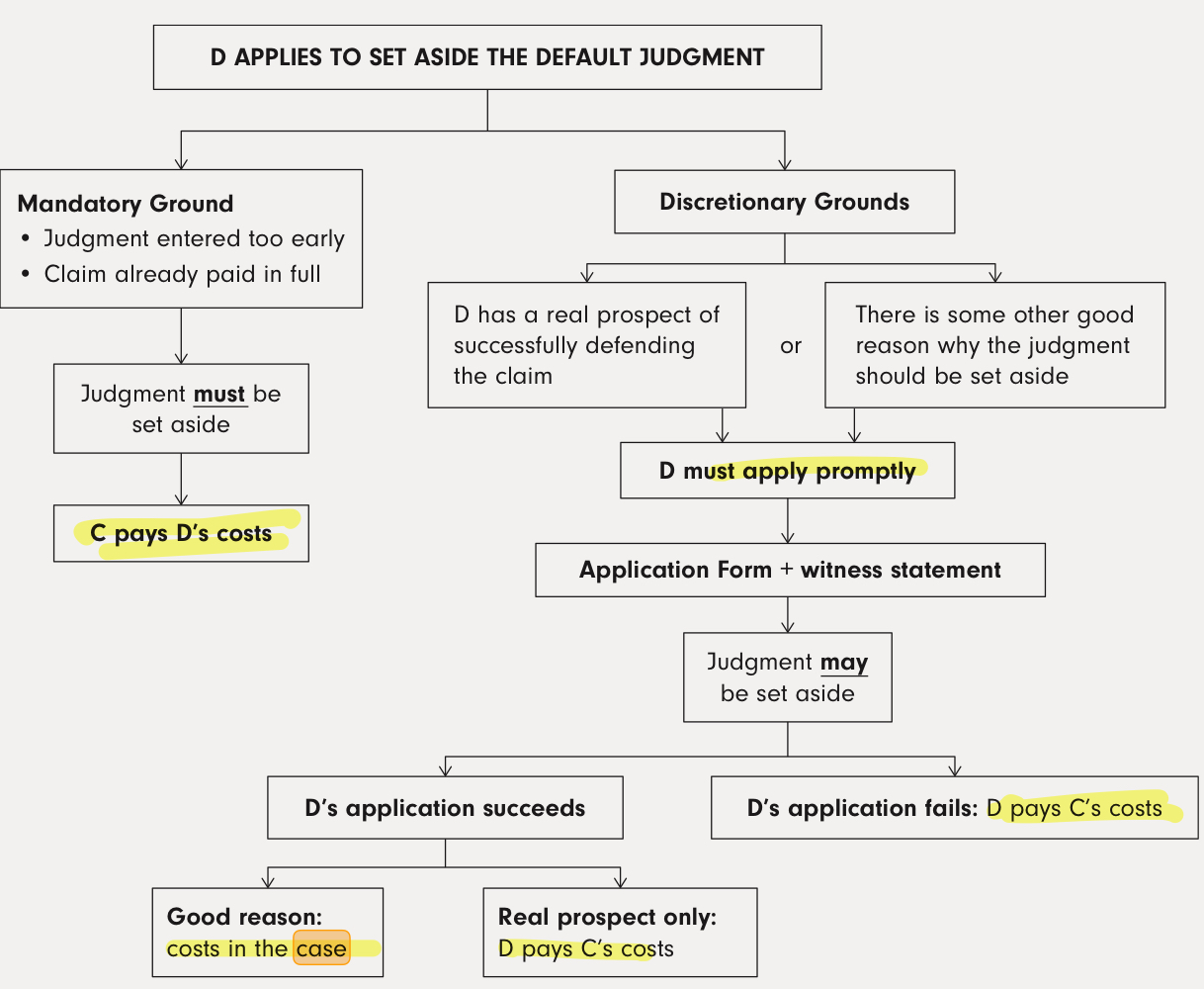
setting aside judgment in default - grounds on which D can apply?
mandatory ground:
D shows they did file the document before the relevant deadline, or that
D settled and paid the claim prior to judgment in default being entered
_
discretionary ground:
real prospect of defending the claim, or
there is some other good reason why they should be allowed to defend the claim
court can order:
successful/unsuccessful; or
successful + condition that D pay money into court as security by a deadline
procedure for C to discontinue proceedings & consequences
C must file and serve a notice of discontinuance on the parties to the proceedings. If consent (of other Cs) is required, a copy of this must be attached to the notice.
Consequence:
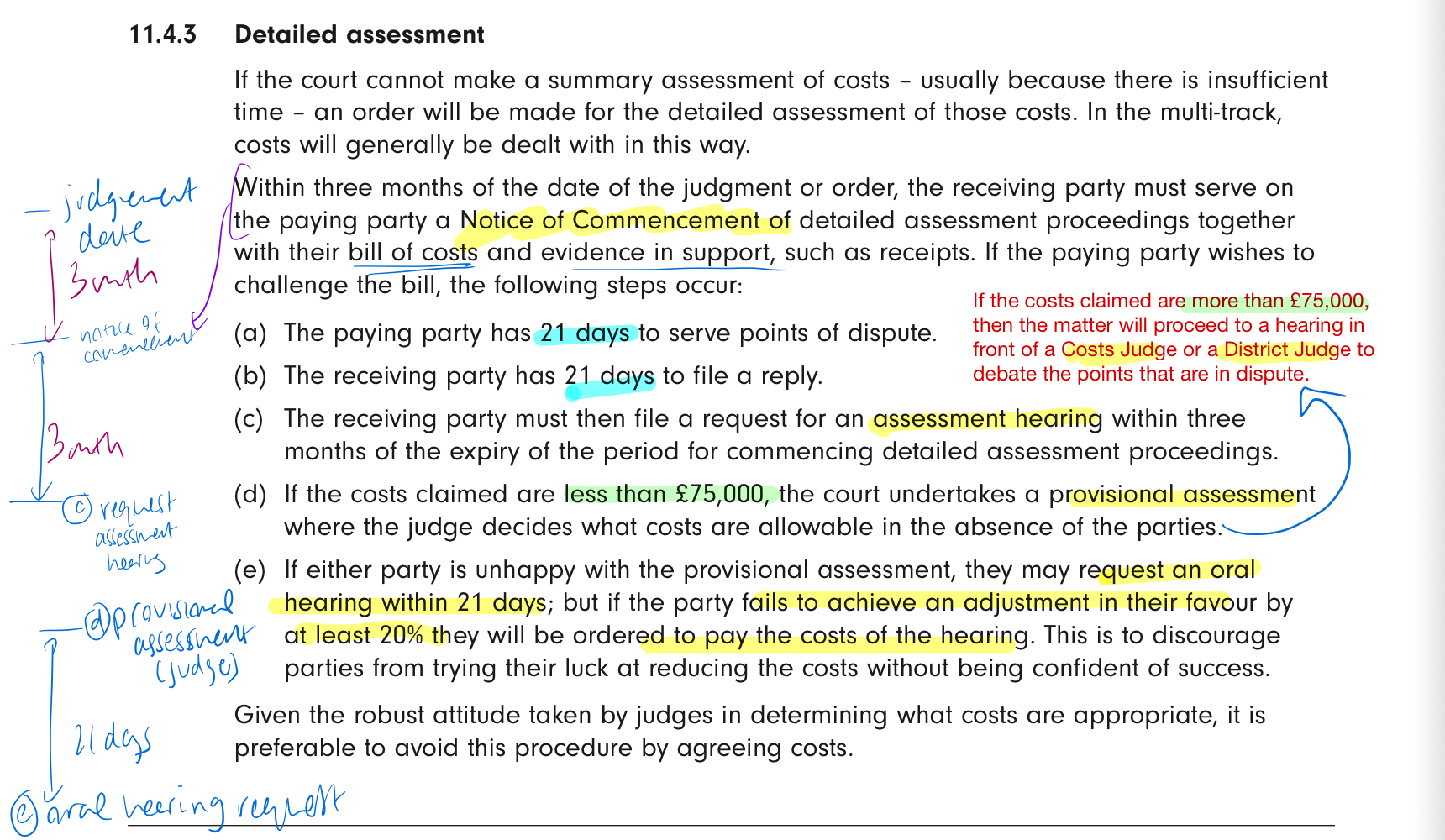
The claimant will be liable for the costs of the proceedings on standard basis unless the court orders otherwise (solicitor must explain this to the client)
_
NB standard basis: costs, fees and expenses associated with the legal action and claimed from the opposition must have been reasonably incurred and must be proportionate to the issues that the court has been asked to resolve.
if parties agree to settle…
parties to agree on terms of consent order
(a contract by which the claimant agrees to terminate the proceedings in exchange for a settlement sum.)
If D breaches any of the terms of a consent order, C must issue a new set of proceedings (based on breach of contract) to enforce the terms of that order.
To prevent this hassle:
Tomlin order: where a claim is stayed or paused on agreed terms that are attached to the order in the form of a confidential schedule.
avoids the need for having to issue fresh proceedings if term is breached
contract particulars of claim
need to claim interest? (principle)
at what rate?
Court may award interest only if claimed.
_
For Damages/ Unspecified claims:
Only set out basis of [party’s] entitlement to interest (no need to calculate sum owed)
_
For Specified claim / debt:
Must precisely plead:
→ accrued interest to issue date; and
→ continuing daily rate.
_
WHAT IS THE INTEREST RATE?
_
1. see contractual rate - contract may specify the interest rate. if not:
_
2. Commercial debts (not consumer debt)
→ 8% p.a. above Bank of England base rate (currently 3.75%) + fixed statutory compensation (for inconvenience of having to recover the debt)
_
3. Other claims - Court has discretion to award interest at whatever it thinks fit - usually 8% p.a.
(under SCA 1981 s35A / CCA 1984 s69)
![<p>Court may award interest <strong>only if claimed</strong>.<br>_</p><p><strong><u>For Damages/ Unspecified claims:</u></strong><br>Only set out <strong>basis of </strong>[party’s] <strong>entitlement</strong> to interest (no need to calculate sum owed)<br>_<br><strong><u>For Specified claim / debt:</u></strong><br>Must precisely plead:<br>→ accrued interest to issue date; and<br>→ continuing <strong>daily rate</strong>.</p><p><em>_<br></em><strong><em>WHAT IS THE INTEREST RATE?</em></strong><em><br></em>_<em><br>1. see </em><strong><em>contractual rate</em></strong><em> - contract may specify the interest rate. if not:<br>_<br>2. Commercial debts (not consumer debt)<br><u>→ </u></em><strong><em><u>8% p.a. </u></em></strong><em><u>above</u></em><strong><em><u> </u></em></strong><em><u>Bank of England</u></em><strong><em><u> base rate (currently 3.75%) </u></em></strong><em><u>+ fixed statutory compensation </u>(for inconvenience of having to recover the debt)<br></em>_</p><p>3. Other claims - Court has <strong>discretion</strong> to award interest at whatever it thinks fit <strong>- usually 8% p.a.</strong><br>(under SCA 1981 s35A / CCA 1984 s69)</p>](https://assets.knowt.com/user-attachments/bb395c0a-c2a0-496c-bdc5-957ba7cdcff3.jpg)
Part 20 claims
Part 20 claims = Counterclaims and other additional claims
counterclaim
this is an additional claim that is brought by D to proceedings after they have been served particulars of claim etc.
allows D to bring cause of action for losses suffered
most commonly a counterclaim (claim by D against C) considered part of same overall proceedings
essentially new cause of action; burden of proof is on D
can be based on entirely different set of facts - generally raised to save cost/time/inconvenience of issuing separate claim
can enter counterclaim w/o permission provided submitted at same time as defence
other additional claims
e.g. adding party not named in original proceedings in contract action
D1 seeking contribution from D2
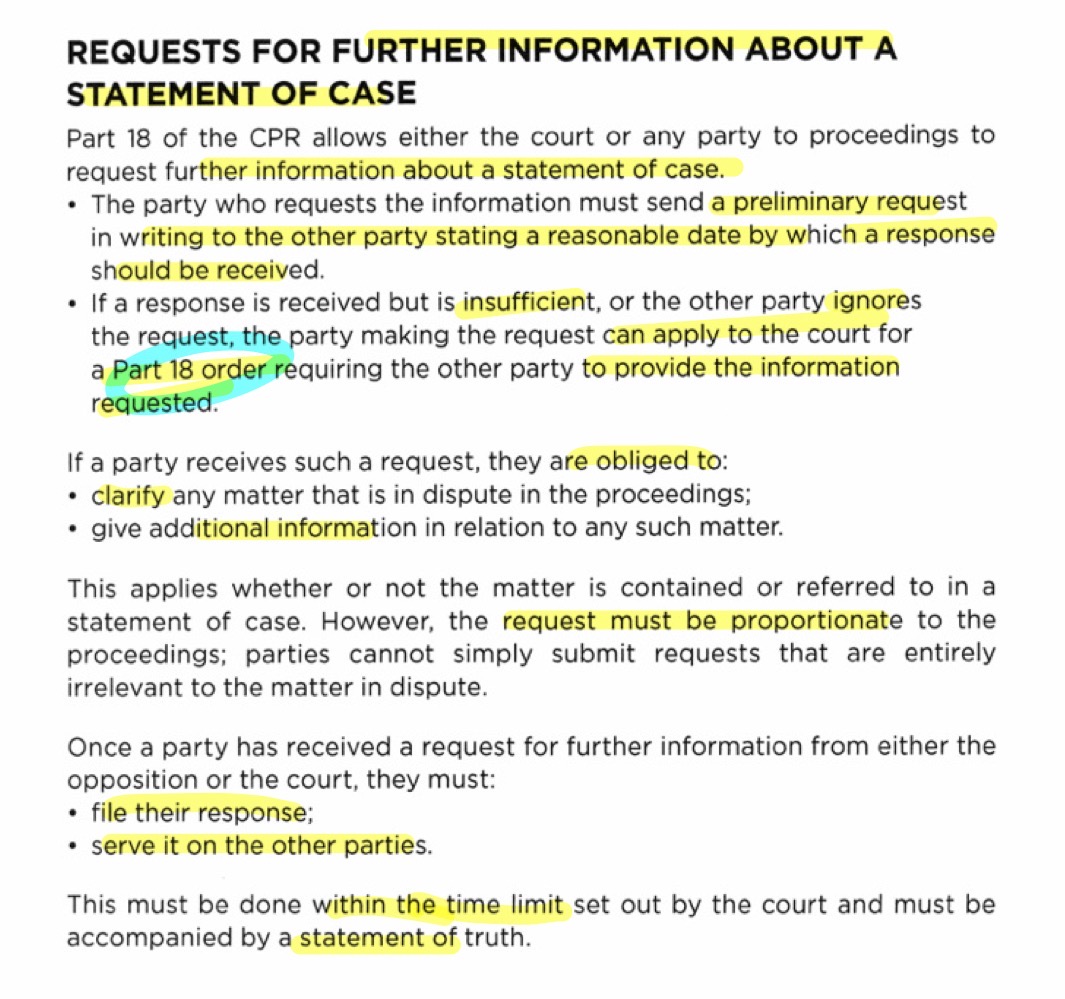
request for further information about statements of case
part 18 order
request must be proportionate to proceedings
amending statement of case - permission
can amend any time before served on other party
if alr served, need consent of all or permission of court
court will have due consideration to prejudice caused to other party
remove/add/substiute party - always need court permission
for substantial amendment - must demonstrate:
have substantive case (based on amendment) which is better than merely arguable
reverified statement of truth if amendments substantial
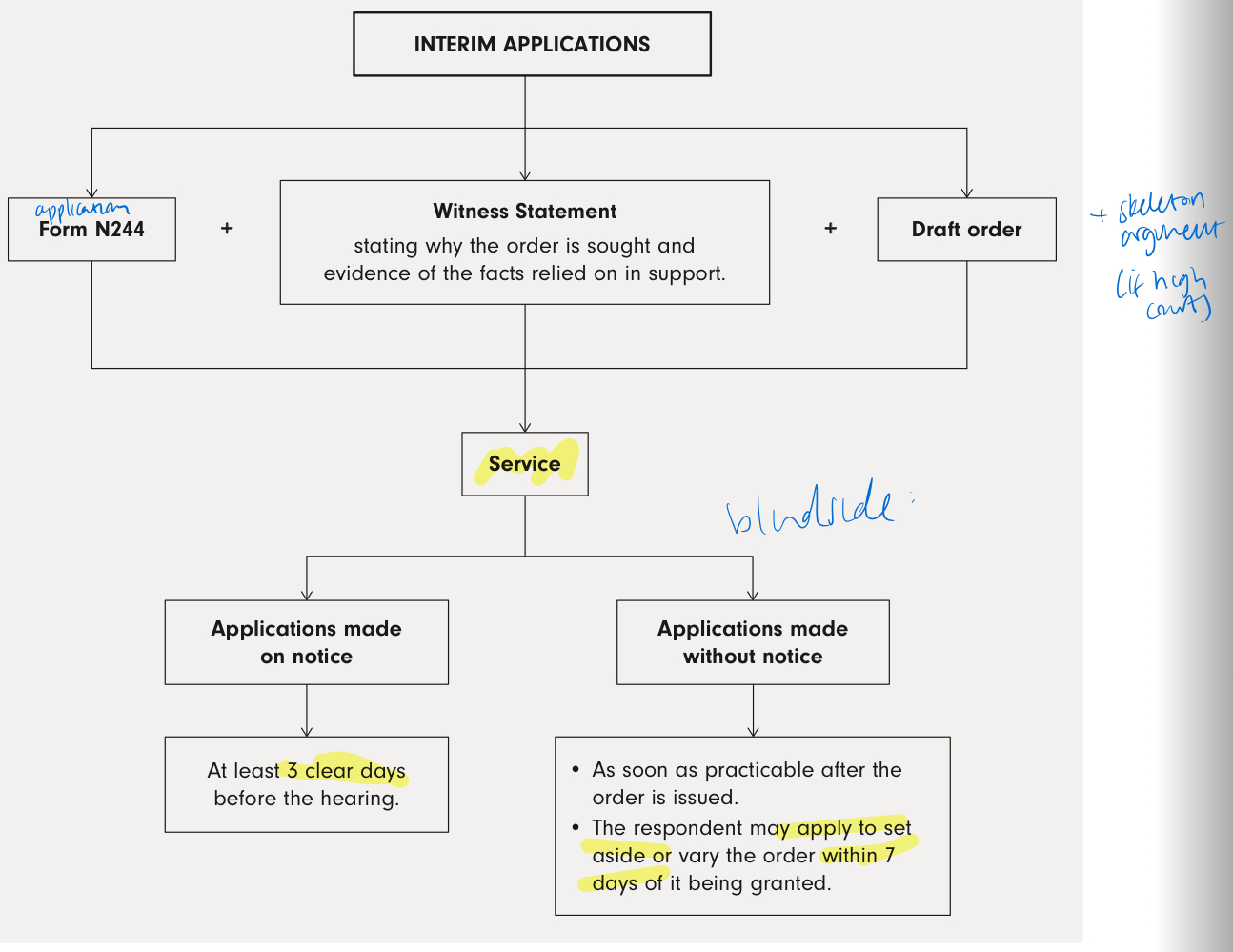
interim application
examples?
procedure + service timing?
see image.
_
timing:
3 days before hearing (if on notice)
no notice: as soon as practicable after order
_
examples of interim applications:
summary judgment
interim payments (D pays early before final decision made)
interim injunctions.
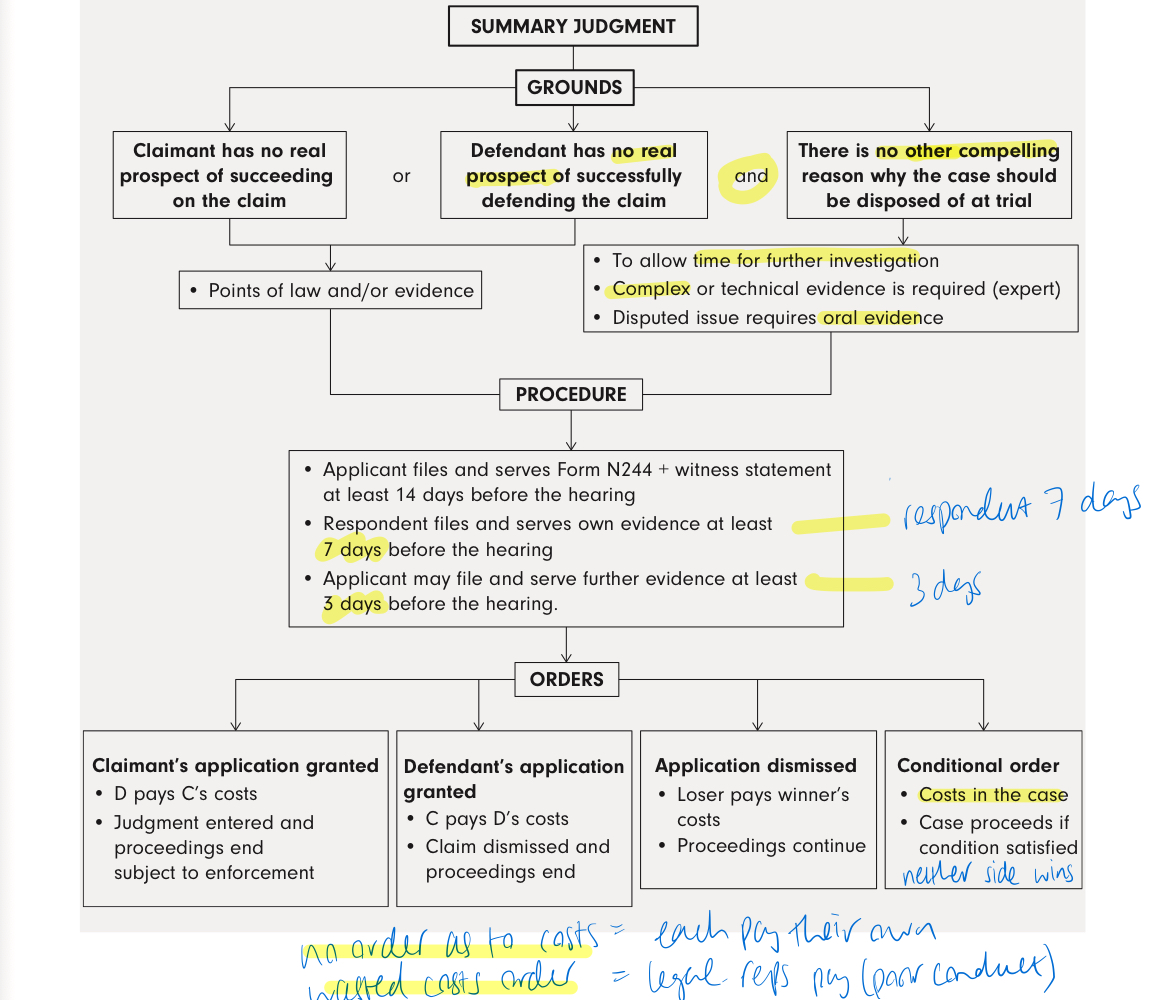
summary judgment - grounds, procedure, timing, order
Grounds:
The respondent has no real prospect of succeeding with the claim or defence, and;
there must be no other compelling reason why the claim should proceed to trial
_
Timing:
14 days before hearing: applicant files and serves
7 days before: respondent evidence
3 days before: applicant further evidence
compelling reason examples:
complex facts
D requires more time to investigate
expert/further witness evidence required to make proper determination on the claim
interim payment application - grounds, timing, procedure
C must prove ONE of the grounds:
D has admitted liability to pay damages or some other sum; or
alr liable; claimant has obtained judgment against that defendant for damages/a sum of money to be assessed; or
The court is satisfied that if the claim went to trial, the claimant would obtain judgment for a substantial amount of money (other than costs) against D
_
Timing: can only seek after the time for acknowledging service has expired
_
procedure:
C files application notice + witness statement re grounds
applicant must give respondent 14 days’ notice of the hearing date
respondent: written evidence - must serve 7 days’ notice before hearing
applicant - further written evidence - 3 days before hearing
interim injunction -
guidelines applied by court re whether to grant? (4)
when can apply?
2 types
cross undertaking?
whether:
(a) there is a serious question to be tried;
(b) damages are an adequate remedy for either side;
(c) the balance of convenience lies in favour of granting or refusing the injunction; and
(d) whether there are any special factors.
_
timing: at any time after proceedings commence (and exceptionally even before) - matter must be urgent
_
2 types of injunction:
freezing injunction - prevents respondent from disposing of assets before trial (must show real risk of D dissipating their assets)
search order - enter premises to search for and take copies of evidence required
_
cross-undertaking:
applicant must undertake to pay any damages that the respondent sustains by reason of the injunction, if it transpires the injunction ought not to have been granted
track allocation criteria, procedure
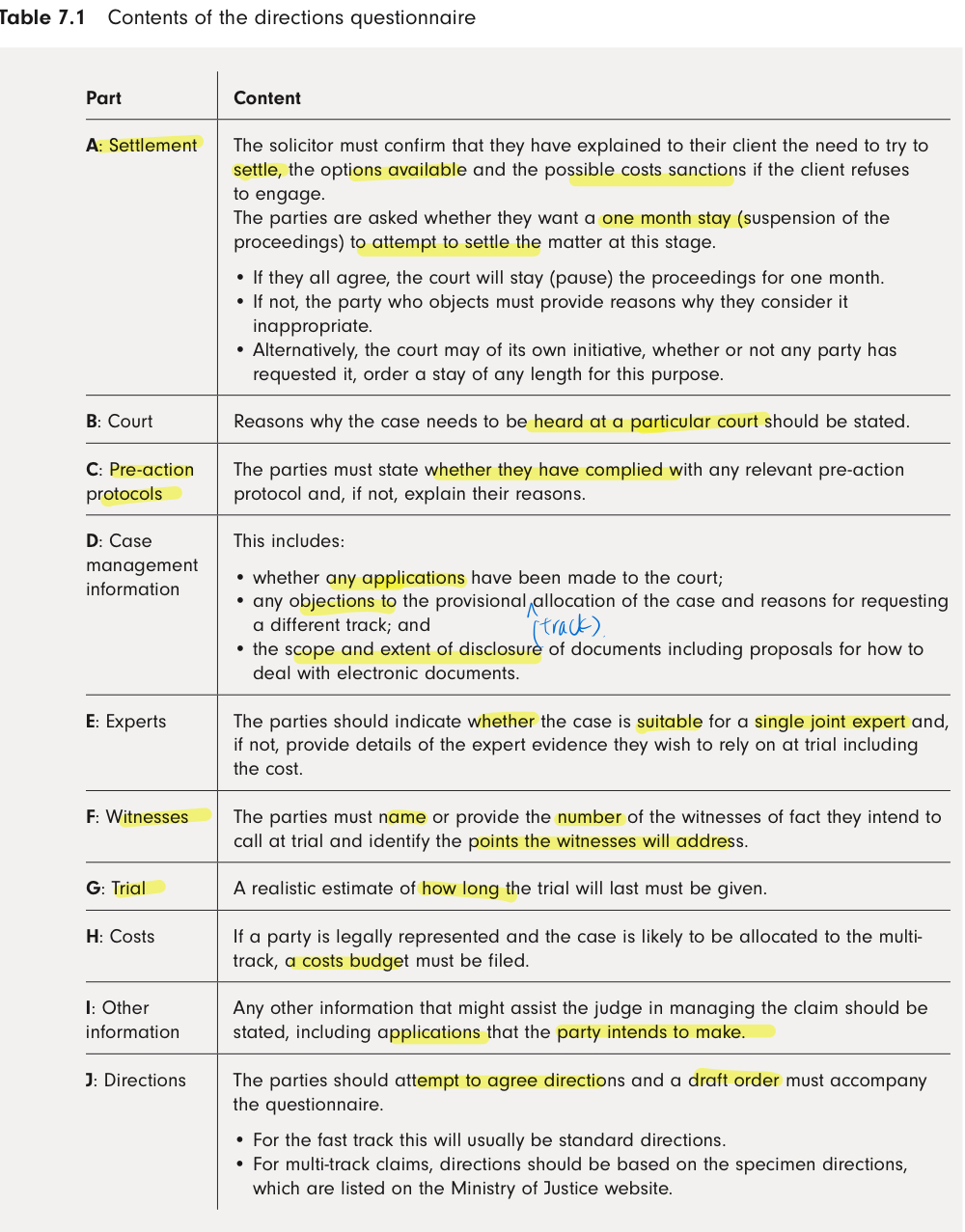
directions questionnaire - contents, consequences if not filed?
4 tracks:
small claims, (claim value <10k / PI / tenant damages <1k)
fast track, (10k-25k)
1 day trial
only 1 expert per party, only 2 expert fields
intermediate track, (25k-100k)
trial 3 days max
only 2 experts per party
standard directions - expedited procedure:
statement of case max 10 pgs
witness statements max 30 pgs
expert report max 20 pgs (1-2 expert witness per party)
oral evidence time limited
multi-track (> 25k - wide range)
_
Criteria:
(a) the financial value of claim (most important factor)
(b) the nature of the remedy sought;
(c) the likely complexity of the facts, law or evidence;
(d) the number of parties or likely parties;
(e) the value of any counterclaim or additional claim and the complexity
of any matters relating to it;
(f) the amount of oral evidence which may be required;
(g) the importance of the claim to persons who are not parties to the
proceedings;
(h) the views expressed by the parties; and
(i) the circumstances of the parties.
_
procedure for filing directions questionnaire:
court serves a notice of proposed allocation, requiring parties to
complete directions questionnaire + draft order for directions (attempt to agree proposed directions)
if provisionally multi-track, must also prepare:
(a) a case summary
(b) a disclosure report
(c) a costs budget and budget discussion report* (for claims < £50k)
if claim > £50k, deadline for filing:
costs budget: ≥ 21 days before first CMC;
budget discussion report: ≥ 7 days before first CMC
_
Failure to file directions questionnaire:
• court makes appropriate order, e.g. directions order; strike out statement of case; list for CMC.
• (special for Money claim in County Court) -
court serves notice requiring compliance within 7 days;
if still not filed → statement of case automatically struck out
_
*budget discussion report - figures that are & aren’t agreed for each liti phase
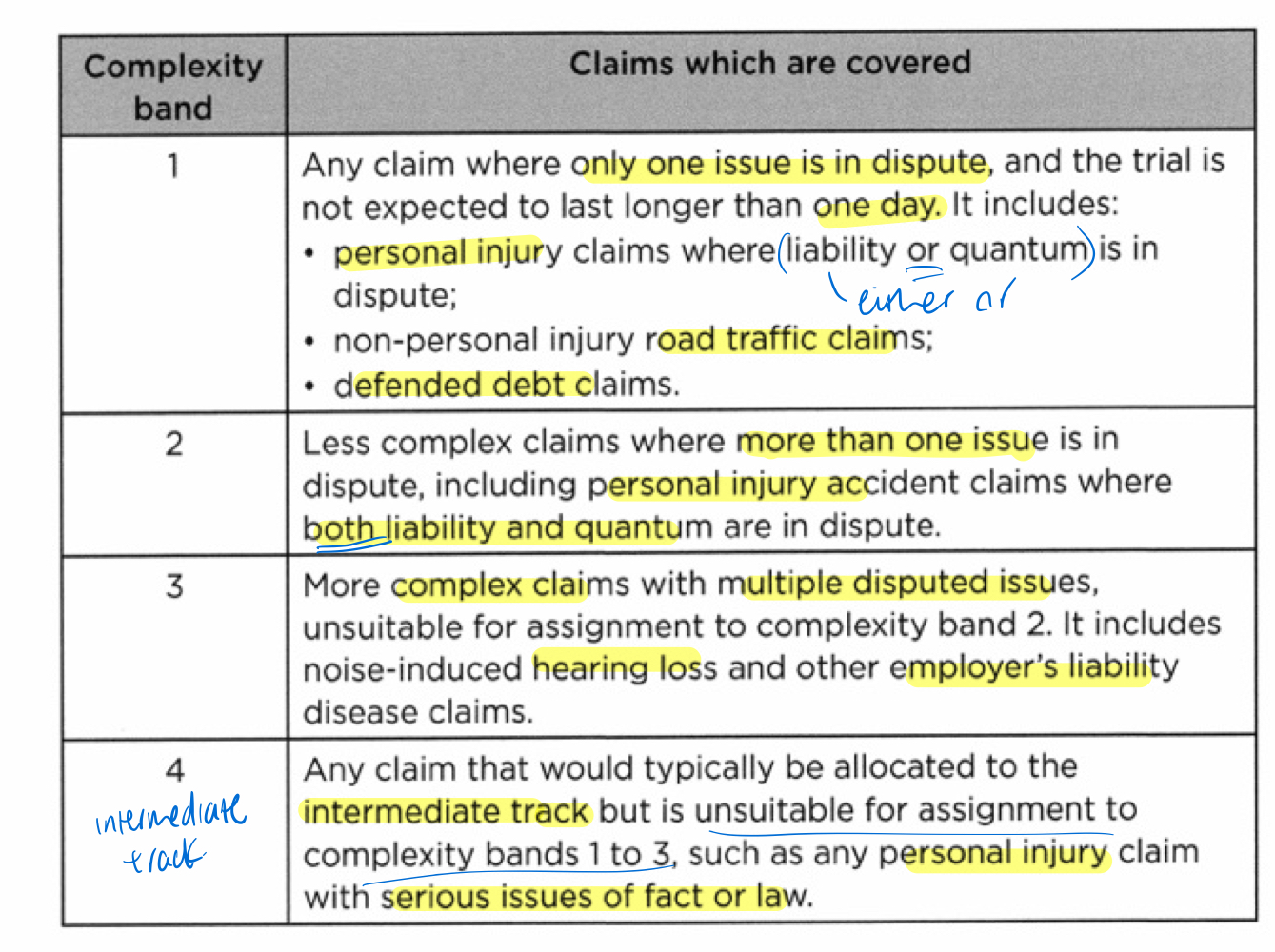
assigning a complexity band (within a track) - factors
parties free to agree on a band prior to any allocation hearing; but court retains discretion
level of fixed recoverable costs - depends on complexity band + stage the claim has reached
factors considered:
• the nature of the claim;
• the amount of money in dispute;
• the complexity of the legal issues involved;
• the number of parties involved; and
• the likely length of the litigation process.
case management directions:
fast track - suggested timetable for proposed directions (base on PD 28)
timing:
within X weeks of filing directions questionnaire:
• Disclosure - to take place within 4 weeks
• Inspection - 6 weeks
• Exchange of witness statements - 10 weeks
• Exchange of experts’ reports - 14 weeks
• Court sends pre-trial checklists - 20 weeks
• Filing of pre-trial checklist - 22 weeks
• Trial - 30 weeks
case management directions:
intermediate track - proposed directions must deal with:
(a) disclosure of documents;
(b) service of witness statements;
(c) expert evidence;
(d) whether to fix a pre-trial review; and
(e) listing the case for trial.
case management directions:
multi-track - CMC
court will fix either a case management conference (CMC) or a pre-trial review (if trial approaching - similar in substance/purpose to CMC)
7 days before CMC - submit own proposals/agreed directions
at CMC, court will consider:
is C’s claim made clear, esp amount (does D understand the case they have to meet)
any amendments required?
what disclosure of docs necessary?
what expert evidence required? how and when obtained/disclosed?
what factual evidence disclosed (witnesses)
arrangements re further information / putting Qs to experts
whether just/save costs to order a split trial (liability and quantum) or trial of one or more preliminary issues
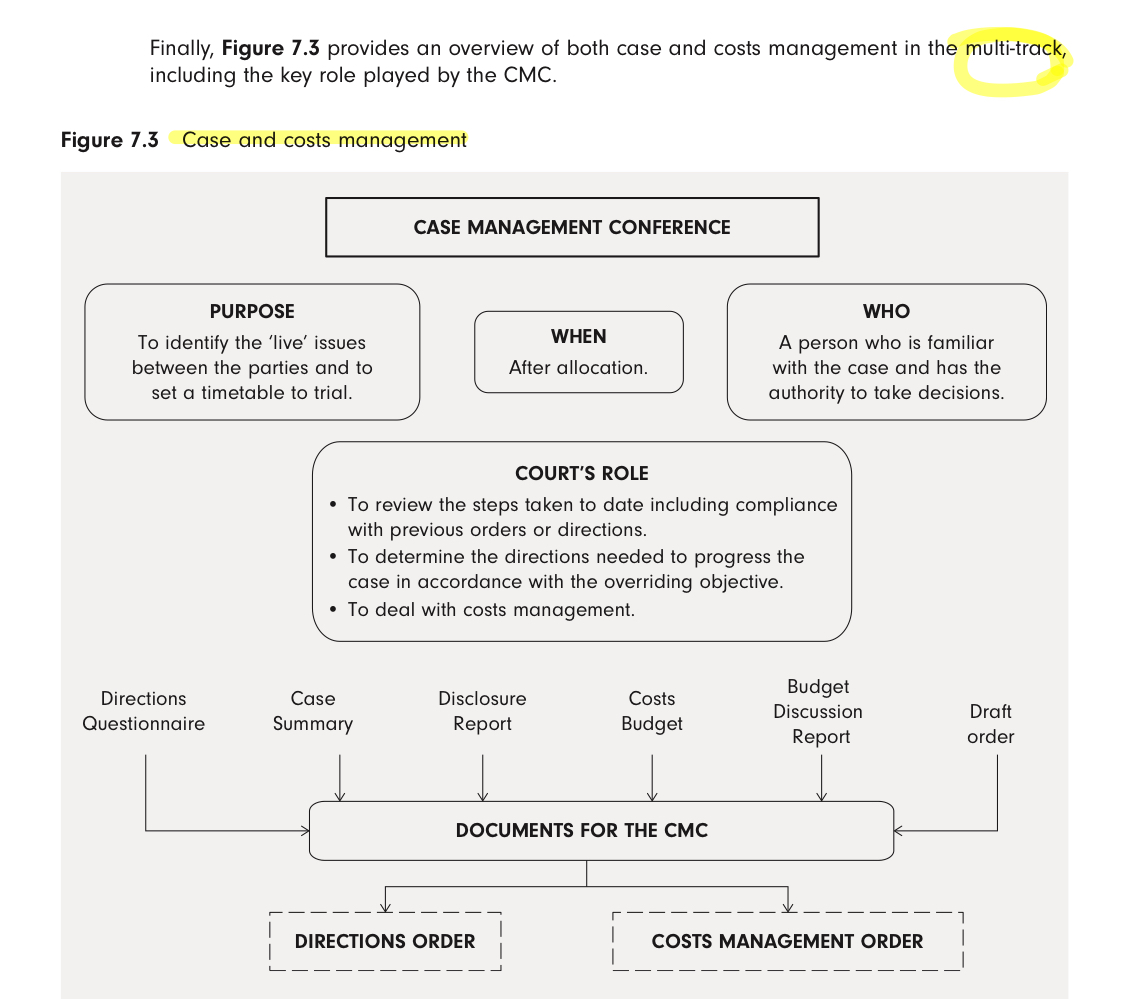
Costs management + costs budget
in multi-track cases, court controls future costs to keep costs reasonable/proportionate (only claims ≥ £10m are excluded from process)
must file costs budget, i.e. statement of:
incurred costs (costs alr incurred at pre-action, issue of proceedings, statements of case) +
budgeted costs - estimated future costs (CMC, disclosure, evidence, pre-trial review, trial prep, trial stages, ADR, settlement discussions)
must be dated + verified by statement of truth
_
costs budget - Filing deadlines
for claims < £50k: with directions questionnaire
all others: ≥ 21 days before first CMC
budget discussion report*: filed ≥ 7 days before first CMC
Judge reviews disputed costs and approves/revises budget at CCMC - costs & case management conference
_
Approved/agreed budget is hard to change — only if agreed or significant developments
Oppressive conduct: if opponent is forcing disproportionate costs party can apply for court to grant appropriate relief
Failure to file budget on time: treated as filed budget w court fees only unless relief granted (will not be able to recover any future legal costs from other party, other than court fees)
_
costs management order (CMO) likely to be made by court - records agreed costs + court-approved budgeted costs
Effect of CMO: if awarded costs on standard basis, party will recover its last approved/agreed budget unless good reason to depart (i.e. parties tied to their costs budget figures)
costs awarded on indemnity basis & incurred costs are assessed the usual way
If no CMO: if costs claimed differ from budget by ≥20%, receiving party must explain difference (court to decide if additional amount can be recovered)
_
*budget discussion report - figures that are & aren’t agreed for each liti phase
Non-compliance with directions/orders — sanctions + relief
e.g. if defaulting party misses case management direction:
First try to agree extension with other side (up to 28 days, only if no hearing date put at risk)
If no agreement → apply to court for relief from sanctions (rule is that sanction applies automatically unless party obtains relief from sanctions)
sanctions for failing to comply with directions:unless order
gives the defaulting party a final deadline to comply + states sanction that will take effect automatically
interest (cannot recover interest on damages at trial or recover enhanced damages)
payment in court (held by court funds until conclusion of case)
costs (pay innocent party’s costs relating to the application; or reduce any fixed recoverable costs)
disallowing evidence
striking out (in whole or part - rare as hands victory on technicality)
Opinion evidence - when is it admissible?
General rule: inadmissible
Exception:
admissible if opinion conveys facts personally perceived by witness
Key distinction: giving perception on a fact / perceived factual impression; cf. conclusion for court
hearsay evidence
• a statement made outside court;
• which is repeated in court (by someone who didn’t originally make statement);
• to prove the truth of the matter stated.
• must be a relevant fact or an admissible opinion
• Can be oral or written
• Key test = purpose: is court being asked to rely on the statement as true?.
_
test - evidence will be admissible where it:
• relates to a relevant fact;
• is not repetition of an opinion that is not a perception of the facts.
_
notice requirements depends on whether witness will be called to give oral evidence
If witness will not be called to give oral evidence, whole witness statement becomes hearsay.
party must serve separate formal notice which:
identifies hearsay evidence
confirm reliance on it at trial
explain why witness will not be called
other side may:
ask court to order witness to attend for cross-examination
serve notice to attack credibility within 14 days of hearsay notice (unreliable/untrustworthy/biased)
Failure to serve notice: evidence still admissible but may affect weight court gives it at trial
expert evidence
Unfavourable single joint expert report - what options?
If party disagrees with single joint expert report, options:
• Instruct own expert — but need court permission to rely on report
• Cross-examine expert at trial to expose weaknesses/inconsistencies
• Obtain second report and send to expert before trial to invite reconsideration - but second report cannot itself be produced to court unless permission granted
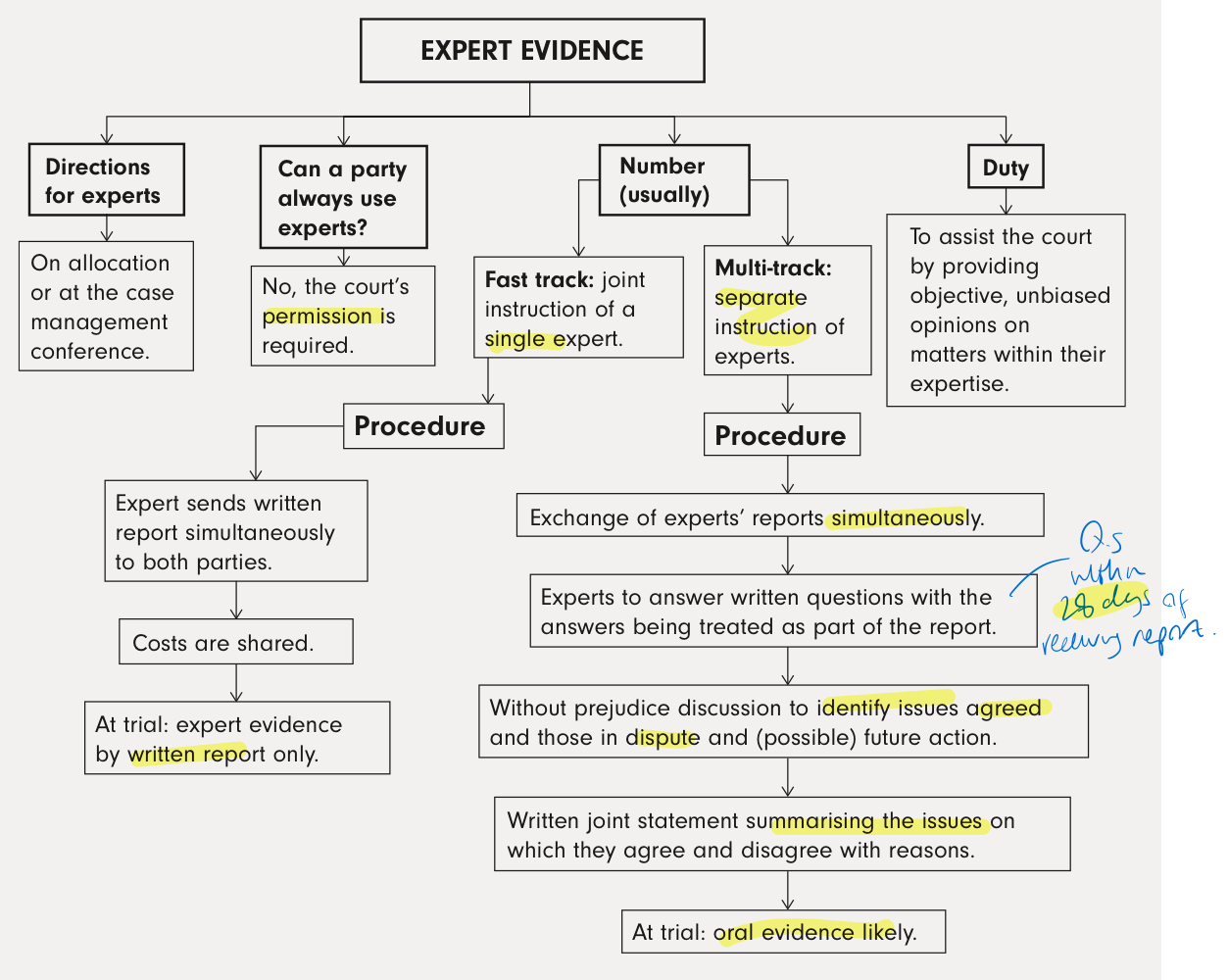
Disclosure —
Standard disclosure
Court’s approach to disclosure in each track
Specific disclosure
Standard disclosure -
disclose documents in party’s control (are/were in physical possession; or had/have right to possess/inspect), that:
• party relies on
• adversely affect own/another party’s case (aka issues in dispute)
• support another party’s case
• required by a relevant PD;
Only disclose documents relevant to matters in dispute (no need to disclose on agreed issues)
_
Court’s approach to disclosure in each track (standard direction)
_
Small claims:
• ≥14 days before final hearing: file & serve all documents relied on, including expert reports
Fast / intermediate:
• usually standard disclosure (see above)
Multi-track:
• ≥14 days before first CMC: parties notify of their requirements for disclosure by filing + serving disclosure report (existence, location, and storage methods)
• ≥7 days before first CMC: parties discuss + seek to agree disclosure proposal; any agreed proposal filed at court
Possible multi-track orders:
• standard disclosure
• no disclosure (order dispensing with disclosure)
• specific disclosure, aka application (w accompanying witness statement) to seek court order for specific docs/classes of docs (where opponent's disclosure/search inadequate)
• party discloses documents relied on + requests specific disclosure from other side
• issue-by-issue disclosure
Disclosure - List of Documents - Part 1-3?
Disclosure list – 3 parts
Part 1: Docs within the party’s control which they do not object to the other side inspecting.
Part 2: Docs in control + inspection refused (e.g. privileged)
Part 3: Docs not privileged but no longer in control
→ must state what happened, e.g. lost / destroyed / posted.
Example:
A solicitor’s file copy of a posted letter may be listed in Part 1, while the original letter, no longer in the party’s control after posting, may be listed in Part 3.
Pre-action disclosure
• Before claim issued: no standard disclosure duty
• Used where opponent may be withholding key docs affecting settlement / whether claim should be issued
• Apply for order requiring disclosure of specific document/class before proceedings
_
Application form + witness statement, which must show:
• applicant + respondent likely parties to future proceedings
• document/class sought
• respondent would have to disclose it if proceedings had started
• early disclosure desirable to save costs / help settlement / fairly dispose of anticipated claim - emphasis is docs capable of assisting parties to avoid court
how are costs dealt with on each track?
small claims: legal costs not recoverable, only disbursements
fast track + intermediate track claims up to £100k:
pre oct 2023: legal costs + disbursements recoverable from other side, usually summarily assessed
Proceedings issued on/after Oct 2023 (or PI - where cause of action accrue after Oct 2023):
“Fixed recoverable costs”(FRC):
recoverable costs fixed by
stage reached +
% of claim value; value depends on complexity band (1-4)
Does not apply to:
• housing claims
• mesothelioma/asbestos lung disease
• clinical negligence, unless breach + causation admitted
• harm/abuse/neglect involving children or vulnerable adults
• jury trials
• certain police claims: intentional/reckless torts or HRA remedies
_
multi-track: detailed assessment (see image for timing)
_
summary assessment:
file and serve statement of costs (breakdown) at least 24 hours before trial/hearing
court determines amount payable immediately at end of hearing
_
Part 36 offer + FRC
recovery of FRC for
fast track + intermediate track,
noise induced hearing loss claims:
If D rejects C’s part 36 offer, and C equals/beats offer at trial: C recovers FRC plus additional 35%
• court discretion to penalise unreasonable behaviour → FRC can be reduced/increased by 50%
non-party costs order
costs order made against/in favour of someone not party to proceedings. rare.
where third party is:
• substantially controlling the course of the litigation;
• stands to benefit from the successful outcome of proceedings.
security for costs order
where there’s risk D cannot recover costs from C if D wins due to C’s circumstances/actions (transferring property etc.)
• Application by D to protect against risk C cannot pay D’s future costs
• If granted: C pays specified sum into court / to D’s solicitor
• If no costs order later: money returned to C
D must show:
• just in circumstances to make order; and
• one condition:
C resident outside E&W or
C is company likely unable to pay D’s costs or
C has taken steps to make enforcement harder e.g. transfer property
_
• focus = risk D cannot recover costs from C if D wins
_
Procedure:
• D file and serve application notice + WS setting out grounds & evidence
• court has complete discretion on whether to grant
inter-partes costs (final)
assessed on what bases ?
factors in assessing amount of costs
process courts apply:
indemnity or standard basis?
any other factors to take into consideration? i.e.:
(a) the conduct of the parties and the efforts made to try and resolve the dispute;
(b) the value of any money or property involved;
(c) the importance of the matter to the parties;
(d) the complexity of the matter;
(e) the skill, effort, specialised knowledge and responsibility involved;
(f) the time spent on the case;
(g) the place and circumstances in which the work was done; and
(h) the receiving party’s last approved or agreed budget.
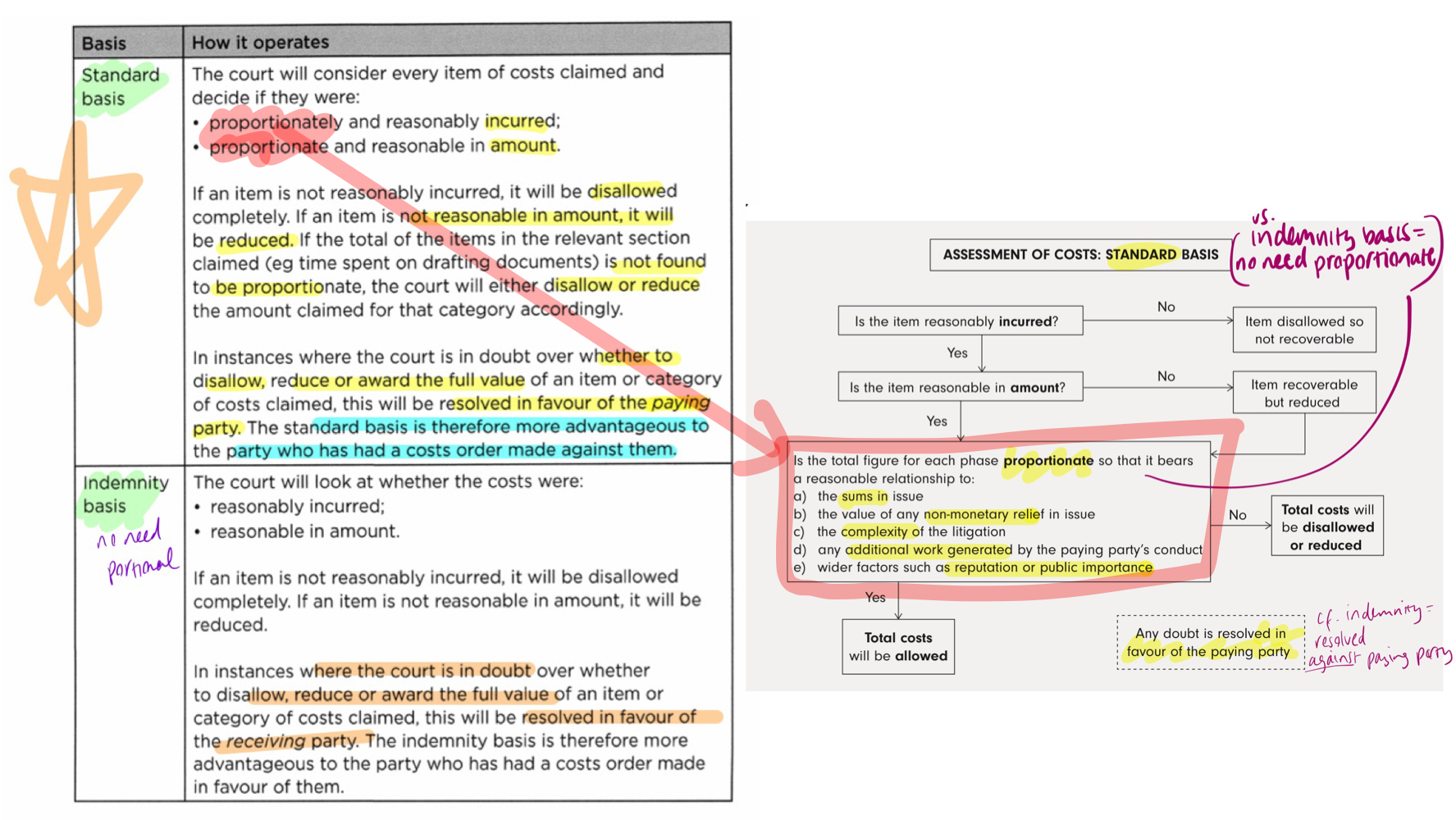
Part 36 offer - criteria, consequence, withdrawal
valid Part 36 offer criteria:
offer in writing;
clear it is made pursuant to Part 36;
it must state: whether it relates to the whole or part of the claim;
whether it includes any counterclaim;
a relevant period (min 21 days)
if accept, sum must be paid within 14 days
_
_
where C / D makes offer, and accepts within relevant period:
D pays C's costs of proceedings on standard basis to the date of acceptance
_
where C accepts D’s offer LATE:
up to expiry of relevant period: D pays C's costs (of proceedings) on standard basis
after expiry to date of acceptance: C pays D’s costs on standard basis
_
where C’s offer not accepted before trial &
C wins and equals/beats own offer,
additional damages: +10% of sum awarded for first £500k + 5% of excess (capped at £75k)
up to expiry of relevant period: usual interest on damages + C’s costs on standard basis
after expiry:
interests on damages up to 10% higher than base rate +
C’s costs on indemnity basis +
interest on costs
C loses / does not beat offer: no penalty on either party
_
where D’s offer not accepted &
C does not beat offer:
up to expiry of relevant period: D pays C's costs on standard basis
after expiry: C pays D’s costs on standard basis + C pays interest on costs
C loses:
C pays: D’s costs on standard basis + interest on costs
_
If both parties make offer, whose offer takes effect?
Where C wins and beats own offer: C’s offer takes effect
Where C loses / C does not beat offer: D’s offer takes effect
_
_
Withdrawing/amending offer before relevant period expires
• Only possible if offer not already accepted
• Offeror must serve notice of withdrawal/amendment
If amendment makes offer more advantageous:
• allowed; new relevant period starts
If withdrawal / less advantageous amendment:
• if offeree accepts original offer before relevant period expires → offeror needs court permission
• if offeree does not accept before relevant period expires → withdrawal/amendment takes effect at end of original relevant period
_
_
Part 36 + fixed recoverable costs (FRC)
recovery of fixed recoverable costs for: fast track, intermediate track, noise induced hearing loss claims:
• If C makes Part 36 offer, D rejects, and C equals/beats offer at trial: C recovers FRC + additional 35% uplift
• court discretion to penalise unreasonable behaviour → FRC can be reduced/increased by 50%
funding options
funding options that may be available to a client to pay for litigation:
• conditional fee agreements;
• damages-based agreements;
• fixed fees;
• third-party funding.
revise SQE legal system chapter 8
Witness summons
Requires witness to attend court / produce documents to court
If court issues summons, it must be served with offer to pay:
travel/attendance expenses
compensation for loss of time
summons invalid if no offer for expenses/lost time
Must be served ≥7 days before hearing unless court orders otherwise
Failure to attend/comply may lead to fine or contempt of court
listing questionnaire, pre-trial review
pre-trial checklist / ‘listing questionnaire’:
filed by parties 8 weeks before trial date
Required in fast track + multi-track trials
Gives court overview of:
whether parties complied with directions
whether additional last-minute directions needed
who will give oral / witness / expert evidence
whether expert evidence relied on + number of experts
who will present case at trial: party / solicitor / barrister
whether trial time estimate is still accurate
After court reviews checklist:
• judge decides whether further directions needed
• judge may list matter for pre-trial review
Pre-trial review:
• hearing around 10 weeks before trial in multi-track trials listed for several days
• court checks compliance with orders/directions
• directs parties to file trial bundle
• sets trial timetable
Trial timetable:
• detailed trial schedule
• sets time limits for each party’s case + examination/cross-examination of witnesses
trial bundle - timing for filing
must be filed 3-7 days before trial
contains all docs to be referred to by any party at trial
claimant to prepare + make sufficient copies for court, parties and witnesses/experts
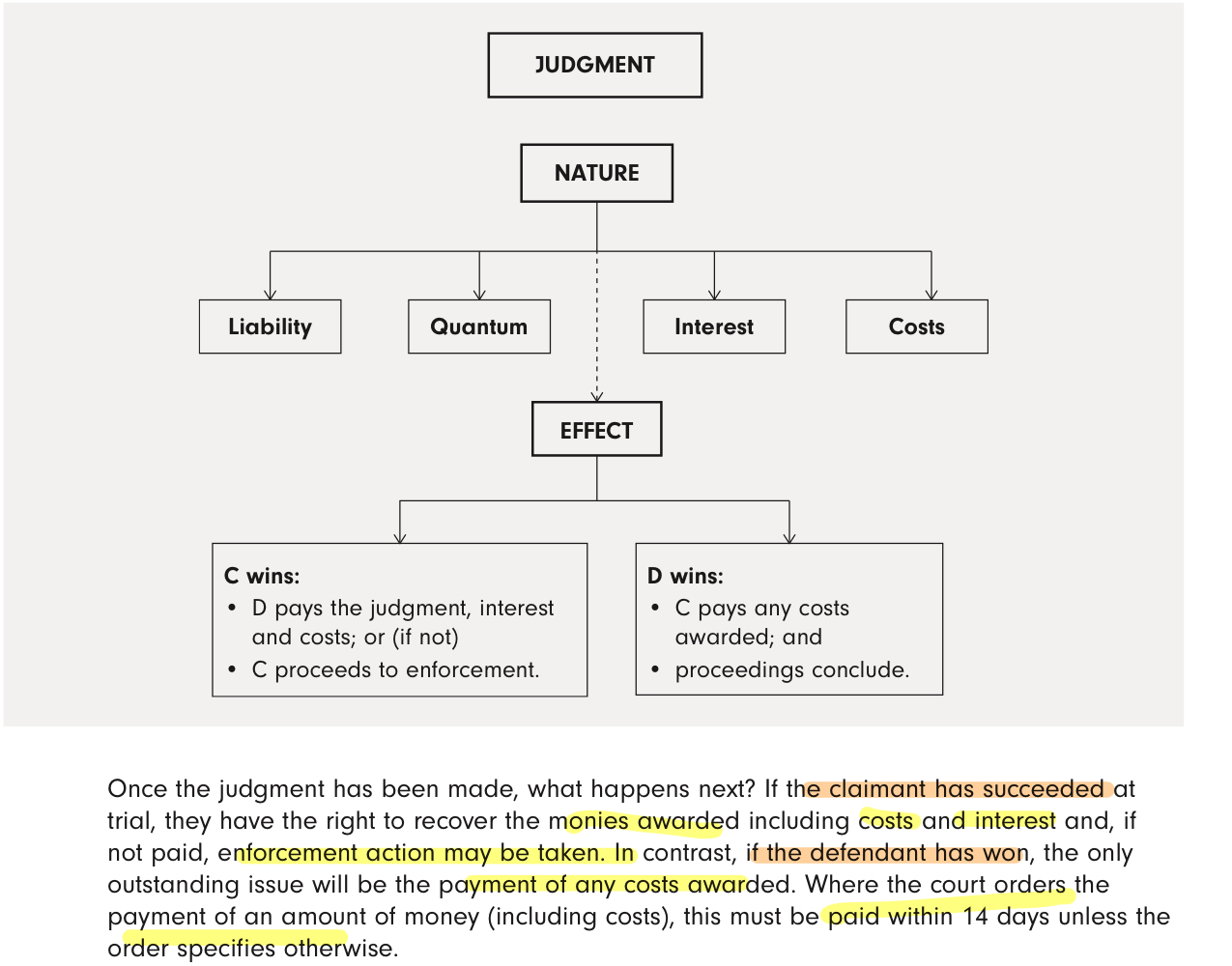
judgment award - timing of payment ?
where court orders the payment of an amount of money (including costs), this must be paid within 14 days unless the order specifies otherwise
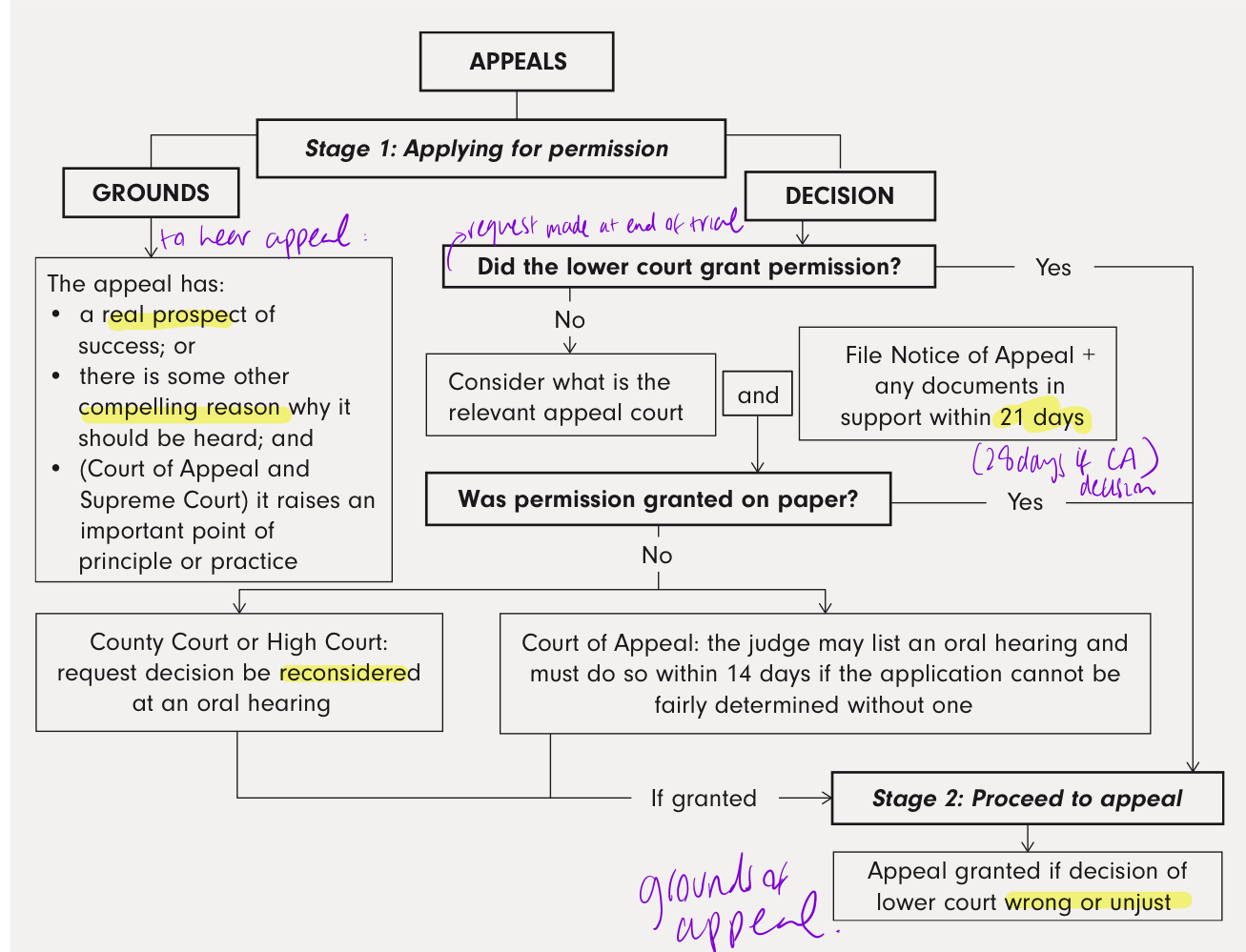
permission to appeal
test
time limits
destination of appeal
Permission to appeal (should appeal be heard)?
real prospect of success / some other compelling reason why the appeal should be heard
Grounds (should appeal be allowed/granted)?
Was the lower court decision wrong or unjust because of a serious procedural or other irregularity in proceedings?
Time limit for permission to appeal:
• County Court / High Court decision → within 21 days
• Court of Appeal decision → within 28 days
Permission to appeal
• Party can apply for permission from appeal court itself
• Usually dealt with on paper, without hearing
• but in CoA, if judge decides application cannot fairly be determined without parties present, then judge must direct oral hearing (listed no later than 14 days after this direction)
Where to appeal:
• District Judge in County Court → Circuit Judge in County Court
• Circuit Judge in County Court → High Court Judge in High Court
• Master/District Judge in High Court → High Court Judge in High Court
• High Court Judge in High Court → Court of Appeal
modes of address - judges
High Court and above = My Lord / My Lady
Circuit Judge / Recorder = Your Honour
District Judge / Master / Tribunal Judge / Employment Judge = Judge
Lay magistrates = Your Worship / Sir / Madam
enforcing money judgments - oral examination
• for enforcement, C must apply; court does not enforce judgment automatically
• Purpose = find D’s financial position + choose best enforcement method
Options:
instruct enquiry agent — may locate hidden assets, but costs money
apply for order to obtain information (aka oral examination)
court order requiring judgment debtor to attend court
debtor questioned on oath about finances / company finances
C files notice of application with:
debtor details
judgment to enforce
amount owed
any documents required
Procedure:
• order usually personally served
• debtor can request reasonable travel expenses within 7 days
• hearing usually at debtor’s local County Court
• questioning by court officer, or judge if requested
• answers recorded, read + signed by debtor
Questions may cover:
• employment + income
• property + assets
• bank accounts + balances
If debtor fails to attend:
• court may make suspended committal order
4 methods of enforcing money judgments
If the claimant decides to proceed with enforcement, options:
• taking control of goods orders;
• third-party debt orders;
• charging orders;
• attachment of earnings orders.
methods of enforcing money judgments -
taking control of goods
Writ / warrant of control — Used to recover money judgment by seizing debtor’s goods + selling at auction
• debt ≤ £600 → County Court warrant of control
• debt £600–£5,000 → County Court or High Court
• debt > £5,000 → High Court writ of control
Entry powers:
• cannot force entry into debtor’s home
• can use reasonable force to enter business premises if debtor’s goods believed inside
Goods seized:
• home/business items, cars, computers, banknotes, boats, shares
Exempt:
• necessary items exemptions (clothes furniture)
• work/study tools (£1,350 total) computers, vehicles etc up to
Controlled goods agreement - gives debtor final opportunity to pay before goods removed/sold
• goods may remain on premises;
• debtor acknowledges: bailiff has taken control of goods; must not remove/dispose of goods before debt paid
High Court Enforcement Officer / county court bailiff
methods of enforcing money judgments -
third party debt orders
• Used where third party owes money to judgment debtor, e.g. bank account in credit / trade debt
• Court orders third party to pay creditor enough to satisfy judgment debt + costs
• Debt/funds must belong to judgment debtor solely + beneficially (i.e. no joint bank account)
Procedure:
• Creditor applies without notice to debtor (apply to the court that made the order being enforced)
• Interim order freezes funds/account; hearing listed ≥ 28 days later
• Court considers objections
• If no good reason not to → final order requiring third party to pay creditor
• Main benefit = surprise; debtor only finds out after funds frozen
• Ineffective if account not in credit when order served
methods of enforcing money judgments -
charging orders
• Secures judgment debt against D’s land or securities, e.g. shares
• C placed like mortgagee; debt paid from sale proceeds
• Can charge D’s sole land or D’s beneficial interest in jointly owned land
• Register charge at Land Registry
• useful where D lacks liquid assets; secures debt
• interest may continue to accrue
• ineffective if little equity or prior charges
• order for sale may be refused, e.g. severe impact on others in home (children)
Procedure:
• C applies with evidence + draft interim charging order
• Interim charging order usually made without hearing
• C serves interim charging order + application + evidence on D within 21 days
• objection: D may object within 28 days of service by filing + serving written evidence stating grounds of objection
• Court may make final charging order, discharge interim order, or direct trial of disputed issues
• If final charging order granted → C needs fresh application for order for sale
charging order on securities
• e.g. beneficial interest in gov stock/shares/unit trusts - court order extends to any interest/dividend payable
methods of enforcing money judgments -
Attachment of earnings orders
Attachment of earnings orders
• available through County Court only
• Only available if D is employed
• Employer deducts regular sums from D’s wages and pays court → court pays C
Procedure:
• C applies to County Court Money Claims Centre
• Court tells D to pay or file statement of means
• Court officer fixes repayment rate
• Order specifies:
normal deduction rate
protected earnings rate = amount D needs to live on
• Employer deducts from wages; may deduct small admin cost
• Either party may object → can apply for reconsideration by district judge at hearing
Pros / cons:
• effective if D stays employed
• payments stop if D loses job
• if D changes job, C may need to repeat process
• instalments may be low, so debt may take long time to satisfy
methods of enforcing money judgments -
enforcement in other countries
• Basic procedure: register the judgment in the country where D holds assets, then use country’s local methods to enforce it
• For countries not covered by reciprocal systems, C may need to issue fresh proceedings + instruct local lawyers
Scotland / Northern Ireland:
• obtain certificate of High Court / County Court money judgment
• apply to Scottish / NI court to register within 6 months
• once registered → enforce under local methods
Commonwealth / reciprocal countries:
• judgment must be:
final
for specific sum
registered in time