male repro
 Call Kai
 Learn
Learn Practice Test
 Spaced Repetition
 Match
Match Flashcards
 Knowt Play
1/23

There's no tags or description
Looks like no tags are added yet.
Name | Mastery | Learn | Test | Matching | Spaced | Call with Kai |
|---|
No analytics yet
Send a link to your students to track their progress
24 Terms
what are the 2 functions of hte testis
production of spermatozoa
production of reproductive hormones
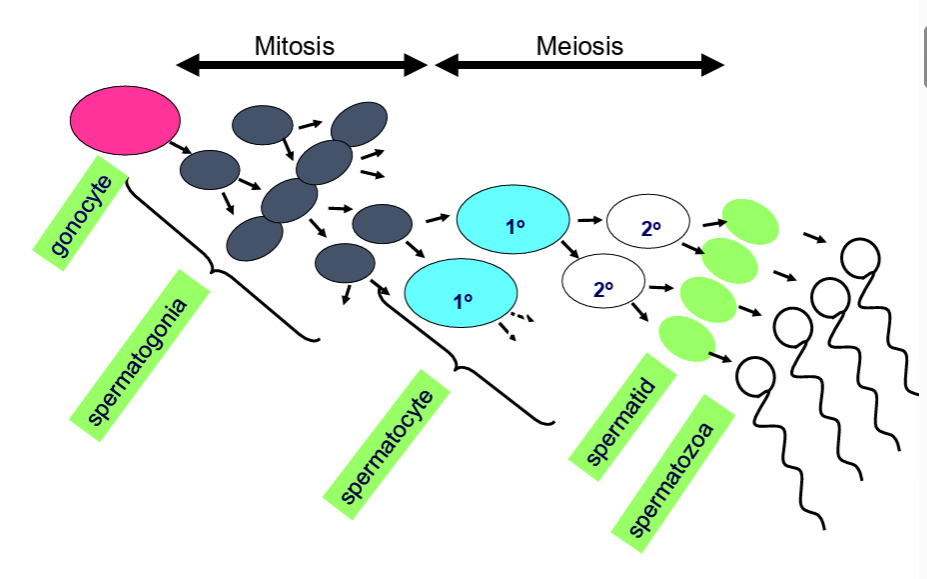
spermatogenesis
2 types of division ad what do they produce
last step and what does it form
mitotis proliferation- produces large numbers of cells (spermatogonia), diploid and genetically identical
meiotic division- generates genetic diversity as chromatids exchange genetic material, halves chomosome number (haploid), spermatocytes to spermatids
cytodifferentiation(spermiogensis)- packages genes for delivery to oocyte, elongating spermatids→spermatozoa
spermatogenesis
sertoli cells
what attaches to it
what does it control and how
what does it do to elongating spermatids
what does it mediate
what are they linked by and why
developing sperm attach to sertoli cells via gap junctions
sertoli cells control spermatogenesis-
transfer developmental proteins to spermatocytes
remove material from elongating spermatids
mediate androgen hormone (testosterone) action
all sertoli cells are linked by gap junctions = coordinated wave of spermatogenesis
transport to epididymis
where are they first released
where do they then travel to
sperm released from associated sertoli cells into semifumerous tubules.
sperm transported in fluid by sertoli cells
travel into rete testis, vasa efferntia and epididymis
epiddymal maturation
• Sperm maturation
• Loss of surplus cytoplasm (cytoplasmic droplet)
• Condensation of nuclear chromatin by disulphide bridge
• Metabolism
• Decreased metabolic activity to prolong cell viability
• Increased dependence on external fructose for energy production
• Motility
• Increase in cAMP and acquisition of motlity
Passage through epididymis takes 10 days
Journey through the urethra – seminal plasma Seminal plasma + spermatozoa = ejaculate/semen
where is seminal plasma derived from
accessory glands
prostate glands
seminal vesicle
ampulla
bulbourethral gland
what does seminal plasma do
determines ejaculate volume
accessory gland structure varies between species
carries spermatozoa
seminal plasma composition
Glycoprotein decapacitation factors
• Fructose and Sorbitol
• energy substrate
• Citric acid
• prevents cell coagulation - seminal ’stones’
• Acid phosphatase
• phospholipid metabolism
• Buffers
• neutralise acid pH of vaginal fluids
• Ascorbic acid
• anti-oxidant after ejaculation
• Prostaglandins
• muscle contractions in female reproductive tract
androgens
main testicular is testosterone
sunthesised by leydig cells
testosterne passed from leydig cells into blood (feedback on anteriori pituitayr and hyothalamus) and semifumerous tubules
sertoli cells convert testosterone to dihydrotestosterone wich passes into testicular fluuid to suport speratogenesis.
hypothalamic pituitary axis
what are pituitary hormones major regulators of
how is GnRH transported to the anterior pituitary
pituitary hormones are major regulators of spermatogenesis
GnRH is synthesised in the hypothalamus
GnRH is transported to anterior pituitary via the blood hypophyseal portalvessles - mediating the sectretion of LH and FSH
why castrate
• Removal of the testis
• Stops sperm production
• Stops testosterone production
• Enables lambs/piglets to grow larger before slaughter– Testosterone affects taste
• Reproductive and behavioural purpose
because men are dicks
spermatic cord
• Artery
• Veins
• Vas deferens
• Nerves
• Cremaster muscle (paired muscle in the inguinal canal and scrotum covering the testis and spermatic cord)
• Enters abdominal cavity through the inguinal ring
blood supply
testicular artery
r testicular vein
left testicular vein
what are vessels arranged as
• Testicular artery – aorta (below renal artery)
• Right Testicular vein – inferior vena cava
• Left Testicular Vein – left renal vein
• Vessels arranged as Pampiniform plexus
• Counter current temperature regulation
fibroelastic penis
what animal
what type of tissue
components
• Ram, bull, boar
• Erectile tissue
• Corpus cavernosum
• Corpus spongiosum
• Sigmoid flexure
• Allows penis to be retracted into the body until erection
• Sigmoid flexure held by retractor penis muscles
• Relax retractor muscles penis protrudes
musculovascular penis
what species
features
differences
what type of penis muscle
Stallion, Human
• Large corpus cavernosum fills with blood during erection. Cavernous tissue contains large blood spaces divided by a thin septa. therefore a relatively larger volume of blood is required to achieve erection.
• No sigmoid flexure
• Retractor penis muscle
lots of erectile tissue and little connective tissue so during erection there is both an increase in length and diater of the penis
glans penis
• Highly specialised!
• Tom cat androgen dependent spines. cone shaped with keratinised papillae directed caudally.
• induced ovulator
• Boar corkscrew with a left hand thread.
• Ram large extension of the urethral process
bull - slightly spiralled end
stallion- mushroom shape with slight protrusion of the urethral process
visual cues
mating in others
lordosis
olfacoty cues
• Sniffing of vulva • Female urination • Pheromones • Androgens, Boar Mate
erection
what is it
what happens to the arteries
what happens to the penis muscle and why
what happens to the muscle of the vas deferens, seminal vesicles and prostate
what is expelled
Erection– Stimulation of pelvic nerve
• Arterial dilation and increased blood flow
• Relaxation of retractor penis muscle– Straightens sigmoid flexure
• Muscles of vas deferens, seminal vesicles and prostate contract
• Spermatozoa and seminal plasma expelled
• Can be very forceful in some species (Stallion)
• Single spurt (bull 1-3sec) or extended (camel 6-20min
blood pressure
flaccid penis, low blood pressure
sexual arousal, vasodilation of helicine arteries and increasing blood flow, increase in pressure
increased blood flow to cavernous tissue and decreased venous outflow, sharp increase
sharp decrease, venouss outflow
erection in dogs
Male and female ‘tied’
• Os penis
• Bulbus glandis forms copulatory lock
• Venous outflow restricted
• Muscles in female vulva contract
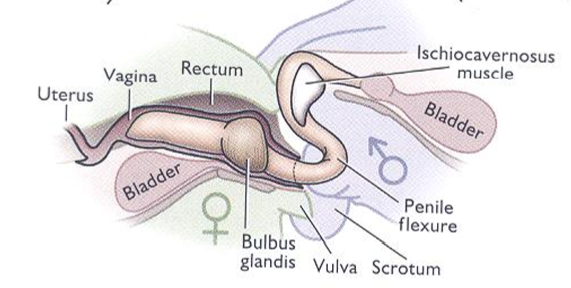
copulation in dog
• First stage coitus
• Male mounts female
• First and second fractions of semen ejaculated
• 1-2min
• The Turn
• Dog turns by lifting one leg over bitch
• Second stage coitus
• Third fraction of semen ejaculated (30ml) wow so exact
• 5-45min (45 min!?? so long)
• Inter-uterine deposition
• Maintains high vaginal pressure