All of Computer Science Paper One
 Call Kai
 Learn
Learn Practice Test
 Spaced Repetition
 Match
Match Flashcards
 Knowt Play
1/193

There's no tags or description
Looks like no tags are added yet.
Name | Mastery | Learn | Test | Matching | Spaced | Call with Kai |
|---|
No analytics yet
Send a link to your students to track their progress
194 Terms
Regular language
any language that can be described using regular expressions
Regular expression
notation (ab*,a+) that represents all elements of a set
Context-free languages
a way of describing the syntax of a language when the syntax is complex (e.g. palindrome). Used when counting and matching is infinite
Backus-Naur Form
a form of notation describing the syntax used by a programming language
method of context-free language
produces a set of acceptable strings (describing the rules of the language)
e.g. <Integer> ::= <Digit>|<Digit><Integer>
Terminal
the final element that requires no further rules
Syntax diagram
a way to represent BNF expressions or any context-free language
A set
A set is a collection of unordered, unique values (only appears once)
cartesian product
combining the elements of two or more sets to create a set of unordered pairs
e.g.
A = {1, 2}
B = {x, y}
then A × B = {(1, x), (1, y), (2, x), (2, y)}
Finite State machines
Any device that changes state based on an input
State transition diagram
a visual representation of finite state machines using circles and arrows
double circle - end state
State transition table
a table to represent an FSM by showing its inputs, current state and next state
Mealy machine
a finite state machine with outputs
Turing Machine
a type of finite state machine that reads and writes data to an unlimited tape
How does a Turing Machine operate
the tape is used as memory and is divided into many cells
the read write head can either read the cell or write into it
the machine can halt at any point if the 'halting state' is entered or if the input has been processed fully
Universal Machine
a machine simulating other turing machines by reading a description of the machine with the inputs of its own tape
(turing machines linked together with one tape)
Constant O(C)
time independent of input (e.g. determining if a number is odd or even)
Logarithmic - O(log2(n))
halves items per iteration (e.g. binary)
linear O(n)
worst case scenario, goes through every item (e.g. linear)
linear logarithmic
o(nlog(n)) - merge sort
polynomial O(n2)
bubble sort
Exponential O(2n)
Cannot be solved, intractable - recursively calculating fibonacci numbers
Factorial O(n!)
intractable - travelers problem
graphs for BigO
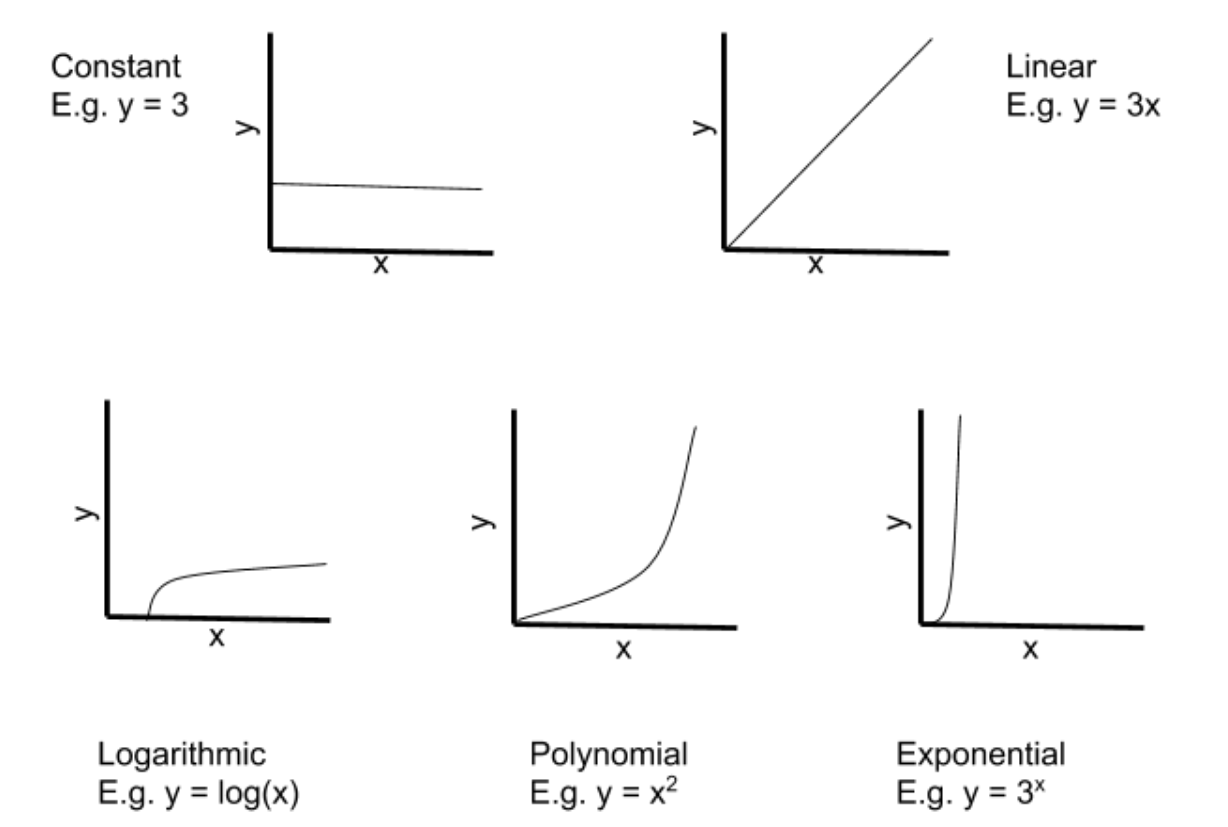
Algorithm
a sequence of steps that can be followed to complete a task that always terminates
tractable problems
problems that have a polynomial (or less) time solution
intractable problems
problems that have a longer time solution than polynomial
representational abstraction
Removes unnecessary details from the problem
abstraction by generalisation
Groups common characteristics
Information hiding
hiding unessential details of an object
Procedural abstraction
breaking down a complex model into reusable procedures
Functional abstraction
disregards the particular method of a procedure and results in just a function
Data abstraction
hiding specific details of how data is represented to create new data structures
Problem abstraction/reduction
removing details from a problem until its solvable
Decomposition
breaking down a problem into small sub-problems to be solved individually
Composition
combining procedures to form a larger system
Automation
putting abstractions of real world phenomena into actions by creating algorithms
Halting Problem
Process of writing a program to test if another program will halt from given inputs without running the given program
The halting problem demonstrates that there are some problems that cannot be solved
Depth-first
Fully explores branch before backtracking
Uses a stack
e.g. navigating a maze
Breadth-first
searches left to right in rows from the top (level by level)
uses a queue
e.g. shortest path for an unweighted graph
tree traversal orders (pre,in,post)
pre-order: VLR
in-order: LVR
post-order: LRV
Linear Search
Searches every item in a list
List can be unordered
O(N)
Binary Search
Looks at the midpoint of a list and determines if the target is higher or lower than the midpoint until it is found
Time halves each search
Requires an ordered list
O(logN)
Binary tree search
Compares child nodes on a binary tree to see if its higher/lower
O(logN)
Bubble sort
Makes passes through data and swaps adjacent items until no swaps are performed
O(n2)
Merge sort
Divides array up into sorted lists and merges them together
O(nlogn)
Dijkstra’s algorithm
works out the shortest path between a single source and every other vertex on weighted graphs, producing the shortest path tree
Tracing Dijkstra’s algorithm
starting with A, list all the connections to other nodes, marking unconnected nodes as infinity
the smallest number from this row is the next row's node
B was the smallest so next we list all the connections from B to other nodes as before.
what does pre-order traversal do on a tree
copies the tree
what does in-order traversal do on a tree
sorted output for BST
what does post-order traversal do on a tree
delete tree
What are data structures
methods for storing information on a computer
Why are there multiple data structures?
Depending on the usecase, different complexities and efficiencies are needed
Arrays
A finite indexed set of related elements (of the same data type)
What are files made up of (records/fields)
Each file is made up of records, composed of fields
Characteristics of static datatypes
amount of memory set prior by the programmer
fixed in size
fast access speeds
cannot grow/shrink in size (results in memory wastage or overflow)
Characteristics of dynamic data structures
Flexible in size
Efficient memory use
Slower access
Requires more memory
Increased complexity
Why are graphs used
to represent complex relationships between items (e.g. networks - transport, IT, the internet)
What do graphs consist of
nodes, joined by edges
Weighted vs unweighted graphs
Weighted graphs assign values to an edge (e.g. time, distance, cost)
Directed vs undirected graphs
Edges have directions, connecting nodes to each other
Adjacency list
Stores every possible connection per node
A: B,C,D
B: A,C,E
Adjacency matrix
Stores all possible connections that exist on a table (1 = edge exist, 0 = no edge)
Adjacency List advantages
Adjacency List is quicker for lookups (searched by row/column) and is suited for sparse graphs with lots of connections
Adjacency List disadvantages
More complex to implement
Adjacency Matrix advantages
Suited for dense graphs with less connections
O(1) lookup time
Disadvantages of Adjacency matrixes
wastes space if there a few edges
Tree characteristics
connected
undirected
no loops
Rooted trees
all nodes stem from root/parent node
Leaf nodes
Nodes with no children
Binary trees characteristics
has a root node
two or less child nodes
Used in file management on computers
how does a hashing algorithm work
hashing algorithm takes an input (key) and returns a hash, that aims to be unique to its input.
the result of the hash is the index of the key-value pair in the hash table.
what is a hash table
a way of storing data that allows it to be retrieved with a constant time complexity O(1) made up of a table containing the data and key
advantages of hashing
faster to lookup and search
disadvantages of hashing
hard to design
risk of collisions
two ways to how to handle hashing collisions
chaining
rehashing
what is chaining
creating a linked list for duplicated indexs
what is rehashing
recalculating the hashing algorithm to provide a new index until it finds an empty slot or using an alternative hashing algorithm
dictionaires
a data structure that stores key-value pairs
how do dictionaries work?
a dictionary maps keys to data (associative array), where the keys identifiy the location of the data. this can be done by implementing a hash table to calculate the key.
for example:
Car = {"make": " toyota"}
Car["make"]
or
Car = {}
Car["make"] = "toyota"
dot product
dot product of A = [12,3] and B = [5,8]
= (12×5) + (3×8) = 84
what does scaling a vector do (magnitude/direction)
magnitude changes, direction remains the same
Access order in Queues
FIFO (first in, first out)
Usecase of queues
Computer keyboards → letters appear in order typed
Enqueuing an item to a linear queue
Check if full - if full → error
If empty, set front to 0
Increment rear and insert value at rear
Dequeuing an item from a linear queue
Check queue isn’t empty - if empty → error
Remove item at front
Increment front pointer
Benefits of circular queues
Reuses empty spaces, wrapping the array around itself
Enqueuing to a circular queue
Check if queue is full → error
Compare rear pointer with maximum size of array
If not empty, rear pointer increments and item added to new rear position
Dequeuing from circular queue
Check if queue is empty → error
If not, dequeue front item in queue
Reduce size of queue
Check if front pointer is at the end of the array, if it is set to first position. Else, add 1 to front pointer
Priority queue advantages
Higher priority elements are removed first
Equal prioriy elements = standard FIFO order
Elements in priority queue are based on
their priority, with elements being shifted when added
Usecase for priority queues
Processor scheduling
Access order in stacks
LIFO (last in, first out)
Adding to a stack
Push
check if full
Increment top
Inset item at top
Remove item from stack
Pop
Check if empty
Remove elements from top
Decrement top
Peek operation
Returns item at top
Checking if stack is full/empty
IsFull
IsEmpty
Binary search trees
used for efficient searching
searches left, then root, then right
div symbol
//
mod symbol
%
normal division
/